

| Turisztikai és Vidékfejlesztési Tanulmányok Tourism and Rural Development Studies 8. évfolyam, 4. szám, 2023: 78–90. doi: 10.15170/TVT.2023.08.04.05 |
THE VILLAGE CARETAKER SERVICE, A RETENTION FACTOR
1Zoltán Koltai & 2Zoltán Raffay
1Associate professor, University of Pécs, Faculty of Cultural Sciences, Education and Regional Development, Institute of Regional Development; koltai.zoltan@pte.hu
2Associate professor, University of Pécs, Faculty of Business and Economics, Institute of Marketing and Tourism; raffay.zoltan@ktk.pte.hu
ABSTRACT
As urban dwellers, or simply as people living in a settlement with a larger population, we rarely find ourselves short of the goods that are essential to our daily needs. We take it for granted that there is a wide choice of grocery shops, there is a local pharmacy, a local doctor, and offices are at hand. We have a rich offer of cultural and leisure facilities, and a kindergarten and school for children. At the same time, these basic social functions are often inaccessible to people living in small villages. This is particularly problematic in ageing small communities with social problems, where the lack of a private car and poor public transport links make it almost impossible to live a full life. For them, the village caretaker may be the only way to reduce isolation.
Keywords: Hungary, place of residence, village, village caretaker service
Received: 12 September 2023
Accepted: 1 December 2023
Published: 20 December 2023
A FALUGONDNOKI SZOLGÁLAT, MINT NÉPESSÉGMEGTARTÓ TÉNYEZŐ
1Koltai Zoltán & 2Raffay Zoltán
1Egyetemi docens, PTE Kultúratudományi, Pedagógusképző és Vidékfejlesztési Kar, Vidékfejlesztési Intézet; koltai.zoltan@pte.hu
2Egyetemi docens, PTE Közgazdaságtudományi Kar, Marketing és Turizmus Intézet; raffay.zoltan@ktk.pte.hu
ABSZTRAKT
Városlakóként, vagy egyszerűen nagyobb lélekszámú településen élőként ritkán kell a mindennapi szükségleteinkhez nélkülözhetetlen javakat nélkülöznünk. Természetesnek tartjuk, hogy elérhető az élelmiszerboltok széles választéka, helyben megtalálható a gyógyszertár, az orvos, az orvosi rendelők. Kulturális és szabadidős létesítmények gazdag kínálata, a gyermekek számára óvoda és iskola áll rendelkezésre. Ugyanakkor ezek az alapvető társadalmi funkciók gyakran elérhetetlenek a kis falvakban élők számára. Ez különösen nagy problémát jelent az elöregedő, szociális problémákkal küzdő kisközösségekben, ahol a személygépkocsi hiánya és a rossz tömegközlekedési kapcsolat szinte lehetetlenné teszi a teljes életet. Számukra a falugondnok lehet az egyetlen módja az elszigeteltség csökkentésének.
Kulcsszavak: Magyrország, lakóhely, falu, falugondnoki szolgálat
Benyújtva: 2023. szeptember 12.
Elfogadva: 2023. december 1.
Publikálva: 2023. december 20.
1. Introduction
People living in small villages often lack access to basic social functions, which is particularly problematic in ageing small communities struggling with social problems. For them, the village caretaker is the only chance to reduce isolation and live a full life. If we look at the demographic characteristics of Hungarian counties, the largest number of settlements with less than 1,000 inhabitants can be found in six of them. Table 1 shows the number of settlements with less than 1,000 inhabitants in these six counties, the share of these villages from the total of settlements within the counties, and the number of inhabitants in these counties and their proportion from the total of the respective county populations. These figures clearly designate those counties where the effective operation of the village caretaker service is of particular importance (KSH, 2023).
Table 1: Number of villages with less than 1000 inhabitants and the proportion of their population in their counties
| Number | Proportion from the total settlement stock of their counties, in per cent | Total population | Proportion from the total population of their counties, in per cent | |
| Counties | of villages with less than 1000 inhabitants | |||
| Baranya | 261 | 86.7 | 82 033 | 23.1 |
| Borsod-Abaúj-Zemplén | 238 | 66.5 | 97 338 | 15.6 |
| Zala | 221 | 85.6 | 74 140 | 28.3 |
| Vas | 186 | 86.1 | 69 418 | 27.8 |
| Somogy | 185 | 75.2 | 73 812 | 25.0 |
| Veszprém | 161 | 74.2 | 66 145 | 19.5 |
Source: own editing, based on KSH, 2023.
This paper summarises the main findings regarding villages in our questionnaire research on the competitiveness of Hungarian municipalities and explores the circumstances of the establishment of the village caretaker service and the main elements of the related training programme. It can be assumed that the demographic processes in the small villages taken as the target group of the caretaker service will further appreciate the future role of the service. This assumption is also reinforced by a report by Halloran and Vera on basic social services in rural settlements in Hungary (Halloran & Vera, 2005).
2. Residents’ perception of living conditions in small settlements
In the framework of our questionnaire survey on the competitiveness of Hungarian settlements, we wanted to know, among other things, how the Hungarian population perceives the everyday living conditions provided by small settlements. The nationwide stratified survey was based on questioning 1000 respondents, and the four aspects of the survey were the distribution of the Hungarian population by region, gender, age, and educational attainment. Thanks to the personal questioning, the completed questionnaires were suitable for evaluation almost without exception.
It was assumed that those who prefer this settlement level with the smallest population would primarily attribute it to positive human relations and a clean, tranquil living environment, while the main reasons for rejection would be lack of amenities, inadequate employment conditions, and unfavourable demographic trends (Koltai, 2014).
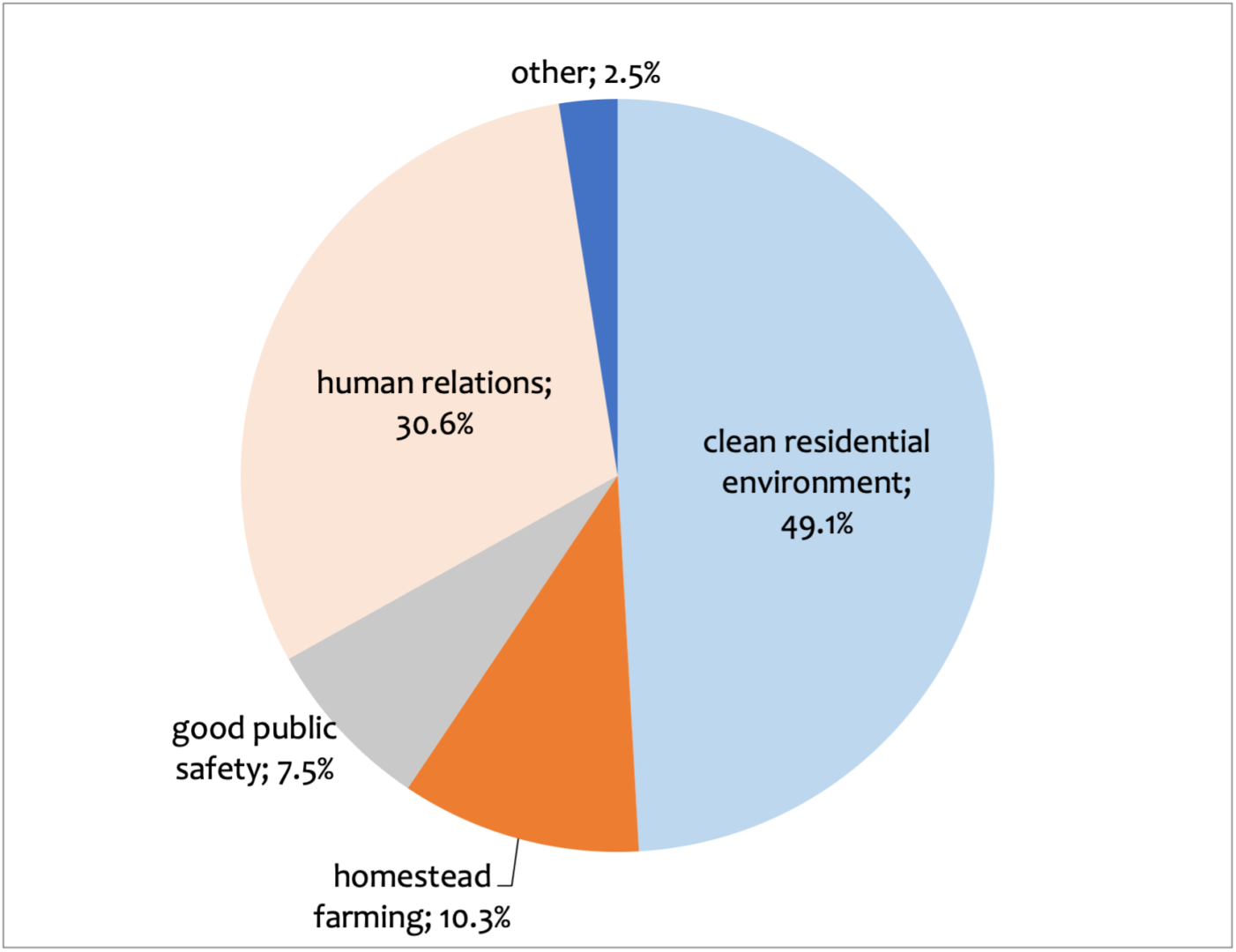
Our hypothesis about the advantages of living in a village was confirmed, as almost half of the responses (49.1%) were related to a healthy, clean, and quasi-natural residential environment. Positive human relations, social cohesion, mutual attention, and helpfulness were also mentioned by many (30.6%), while the third most frequently mentioned advantage was the possibility of homestead farming, gardening, and related self-sufficiency (10.3%). Better public safety was mentioned by 7.5% of respondents, while lower property prices and shorter distances within the municipality were options in the “other” category (2.5%) (Figure 1).
Figure 1: Distribution of the advantages of living in a village according to the survey of the Hungarian population (n=1000)
Source: Koltai, 2014:151.
Most criticism was directed at the lack of services and facilities in the villages, with two-thirds of the responses (67.7%) mentioning this as a disadvantage. Nearly one in four (23.7%) of the responses mentioned employment problems, lack of job opportunities, and low incomes. The “other” category (8.6%) included depopulation, ageing, disadvantaged ethnic composition, as well as problems of being too well known, lack of public safety, and isolation.
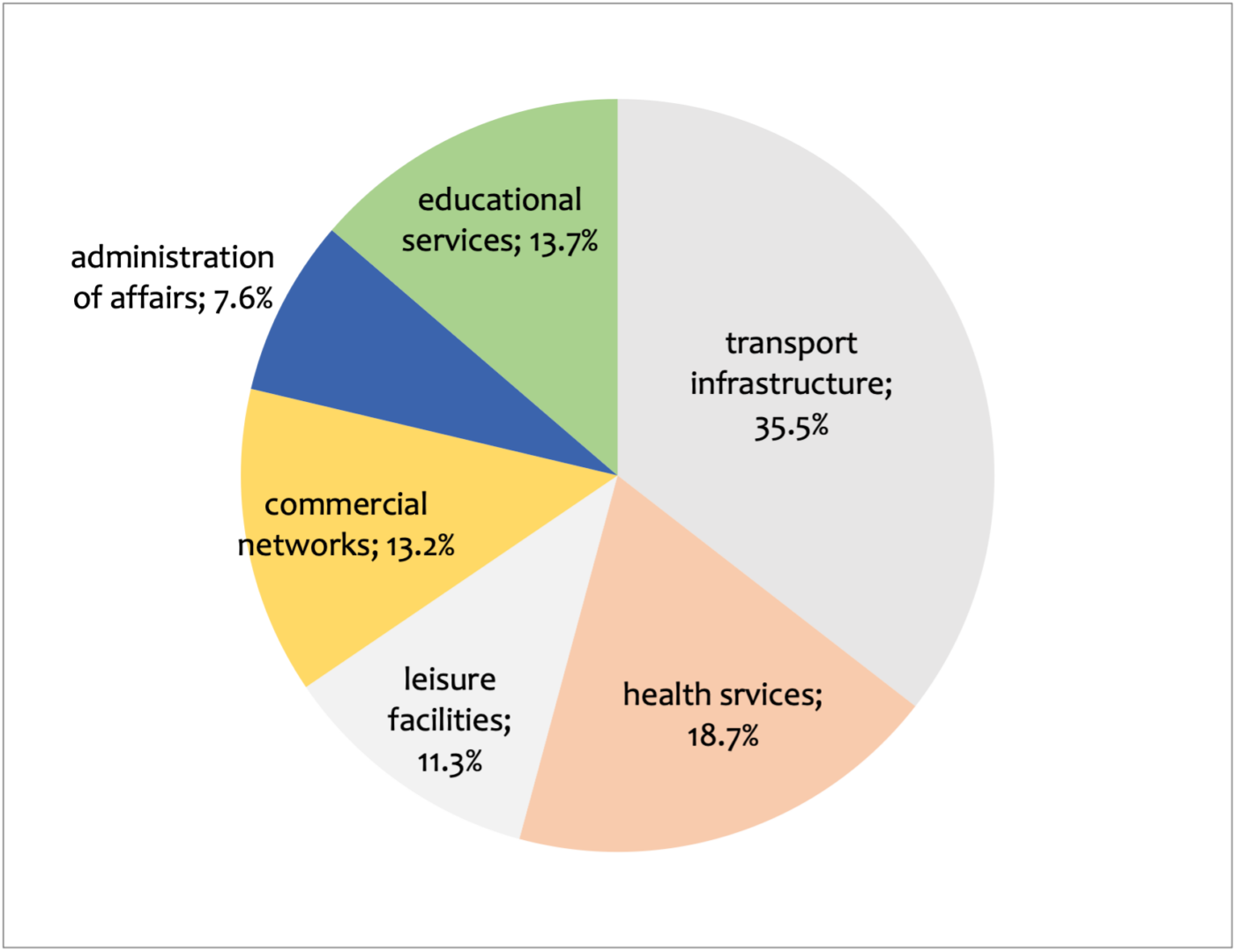
Looking in detail at the group of services, the majority of negative opinions were related to transport infrastructure (35.5%), with many mentioning limited access to local health services (18.7%) and a deficient educational system from kindergarten to secondary level (13.7%). Slightly less criticism was expressed about the development level of commerce and the supply of goods (13.2%) and the often limited and cumbersome facilities for administration of affairs (7.6%), but more people (11.3%) considered the lack of leisure and recreational facilities to be a problem (Figure 2).
Figure 2: The underlying reasons for the disadvantaged position of small settlements in terms of supply and service conditions, according to the survey of the Hungarian population (n=1000)
Source: Koltai, 2014: 152.
Businesses were also asked about what they considered to be the main advantages and disadvantages of different settlement types of different sizes. The national stratified questionnaire surveys (distribution of Hungarian businesses by region, size and sector of the enterprise) also used a sample of 1,000 respondents. The geographical distribution of the respondents was different from that in the population survey, due to the different time of the sampling.
In the case of villages, we expected to find evidence for the frequent occurrence of more favourable operational costs and a better quality of the residential environment, complemented by the activity and supportive attitude of the local government. A clear negative was expected to be scarcity of the market, deficient background conditions (public institutions and business services), and quantitative and qualitative limitations of the locally available workforce (Koltai, 2022).
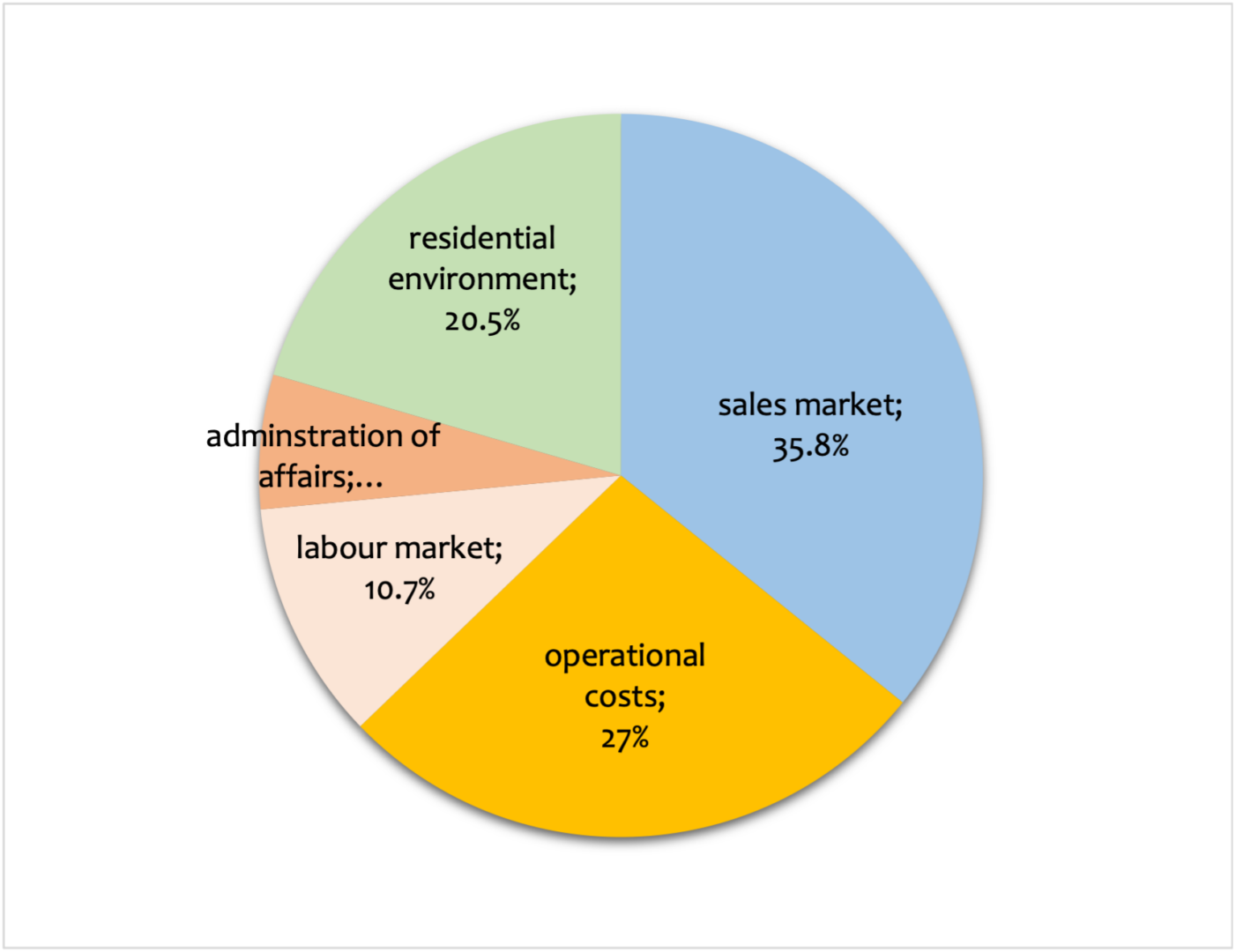
Our hypothesis was confirmed, with more than a third of respondents (35.8%) citing a predictable recruitment market based on personal relationships as a positive factor (Figure 3), but also a high proportion mentioning favourable operational costs (27%). A quality, liveable residential environment (20.5%) and a labour market with lower wages and loyal workers (10.7%) were also frequently cited as positive factors. Finally, the business-friendly municipal policy of the local government and personalised administration were cited by 6% of companies as a clear advantage.
Figure 3: Distribution of municipal advantages according to the survey of Hungarian businesses (n=1000)
Source: Koltai, 2022: 27.
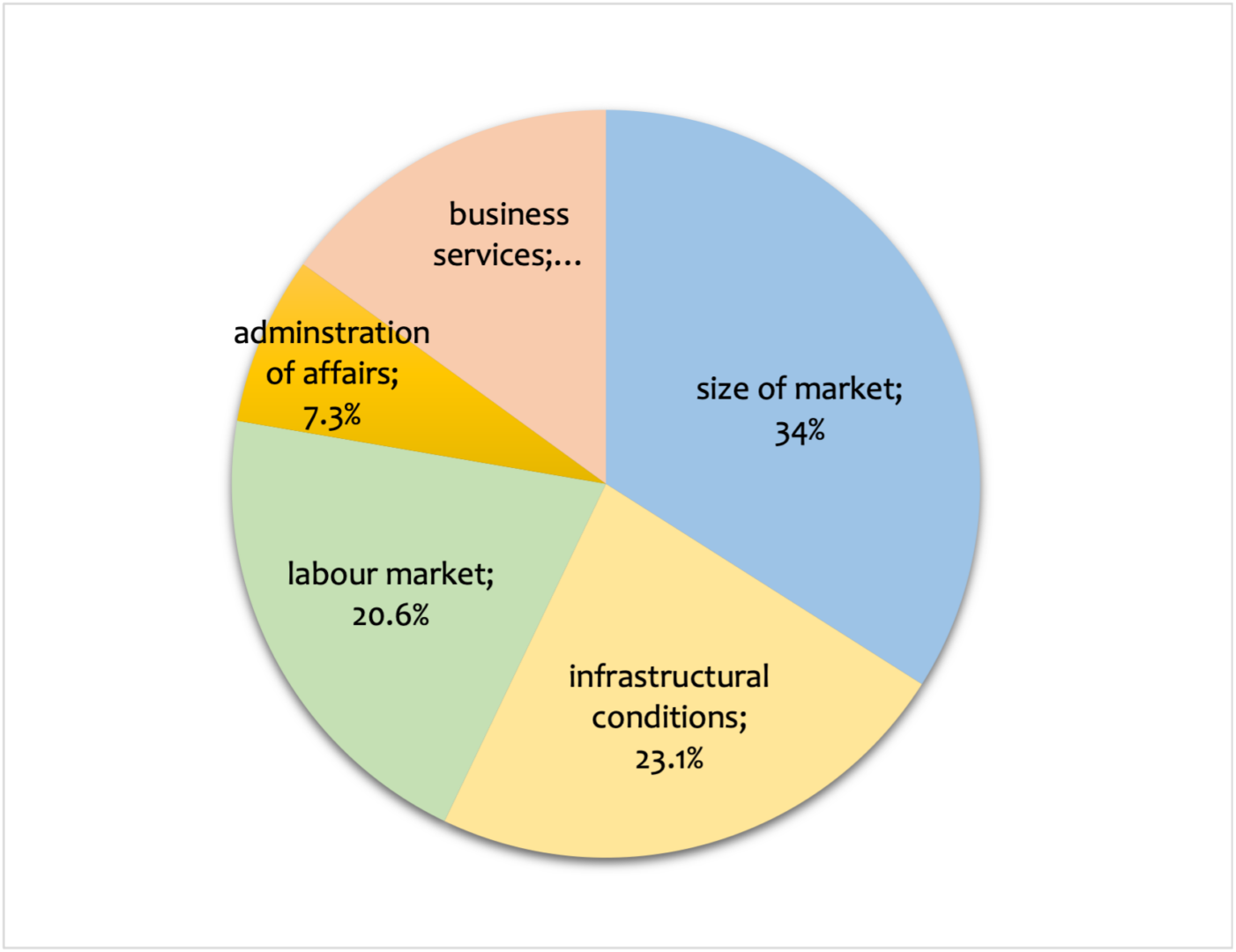
Most criticism was directed at municipalities for the narrow size of their market and their weak purchasing power, with this statement found in over a third (34%) of responses (Figure 4). The next most common shortcomings were underdeveloped and inadequate transport infrastructure (23.1%) and a lack of skilled workers and underqualification (20.6%). Low-quality and often incomplete business services were mentioned by 15% of enterprises, while cumbersome administrative facilities and limited access to public institutions were mentioned by slightly fewer (7.3%).
At the level of villages, the duality is clearly visible in the sales market, the labour market, and public institutions. Municipalities are characterised by a predictable but narrow sales market, a cheaper but mostly unskilled labour market, and personalised but still limited administrative facilities. All in all, there is a clear dominance of negative opinions.
Figure 4: Disadvantages of the villages according to the survey of Hungarian enterprises (n=1000)
Source: Koltai, 2022: 28.
3. The birth of the village caretaker service
According to Bertalan Kemény, rural development “needs not only a population-sustaining capacity, but also a population that can sustain its capacity” (Kis, 2019: 15). The basic idea of the village caretaker service, and later the spread of the services, is linked to the name of Bertalan Kemény, an agricultural engineer and regional planner, who was given the task of preparing a development proposal for the suburban settlements and small villages of Somogy County in 1982 (Faludi, 2013). In the spirit of the National Settlement Network Development Concept in force, these settlements without functions, excluded from any development opportunities, were in fact designated for humane elimination, but Kemény sought a different solution. In line with his firm belief that every settlement and human community has the right to life and to shape its own future, he aimed to reverse this unfavourable trend (Faludi, 2004). Among other things, he proposed the territorial expansion of small-scale production by providing an optimal environment for small-scale full-time farmers, and he called for the strengthening of local autonomy, thus promoting the revival of the internal relations of local society and local patriotism. Lastly, he specified a person or small group of people known as village caretakers or village caretaker service to run small villages. Focusing on the latter element of the diverse package of recommendations, a few years later, in 1990, with the active participation of the Association of Cserehát Settlements, the service was launched in small villages of Borsod-Abaúj-Zemplén County in the most disadvantaged position. In the following year, with the support of the Ministry of Public Welfare (which enabled the purchase of vehicles for 15 settlements), village caretaker services were set up in Baranya and Somogy counties, followed in the 1990s by the small villages of other counties. The service, initially operating in settlements with less than 500, later 600, and now less than 1000 inhabitants, had 1650 village and farm caretakers by September 2020 (DG for Social Affairs and Child Protection, s.a.). Their work is supported by 11 regional village caretakers’ associations operating in the country, which not only bring together village and farm caretakers, maintainers, professionals, NGOs and volunteers involved in the service, but also provide consultancy, professional advice, information, the organisation of programmes, and networking to support and develop the services (Csörszné Zelenák & Sümeginé Ország, 2022).
Although the service function was launched in August 1990, it was not legally regulated until the adoption of Act III of 1993 on Social Administration and Social Benefits: “The purpose of the village and farm caretaker services is to alleviate the disadvantages of small villages and rural or other outskirts settlements and farms resulting from the lack of institutions, to provide access to services and public services to meet basic needs and to certain basic services, and to help meet individual and community needs” (Act III, 1993: 60.1).
According to the Decree 1/2000 (7 January) of the Ministry of Social and Family Affairs, the following direct personal services are considered as basic tasks of the village caretaker service:
- Assistance in the provision of meals, home help, community, and social information.
- Provision of access to health care, such as transport to the general practitioner’s surgery, transport to other health care facilities, purchase of medicines, and access to medical aids.
- Transport of children of kindergarten and school age, such as transport to kindergarten, school and other transport of children.
Residential services that are considered as additional tasks:
- Organisation and promotion of community, cultural, sporting, and leisure activities.
- Assisting in the handling of individual official affairs, forwarding requests from the public.
- Contributing to the provision of other services to the public, other basic social services, and child welfare.
The following are defined for the village caretaker service as an indirect service to assist in the performance of municipal tasks:
- Delivery of food to a municipal institution.
- Dissemination of municipal information to the public,
- Tasks related to the operation of the village caretaker service.
The latter tasks, which qualify as indirect services, may account for up to 50% of the service provision (Decree of the Ministry of Social and Family Affairs, 2000: 39.1).
It can be seen that a finding of our questionnaire research on individuals (Koltai, 2014) is fully reflected in the basic and additional tasks of the village caretaker service: the main disadvantage of people living in villages is the lack of services, including limited transport and health care, lack of education, commerce network, cumbersome administrative facilities, and limited leisure time (Figure 2).
The role of village caretakers is multifaceted and unique in the social care system in addressing the simultaneous municipal and social disadvantages. In addition to their work with the population of the whole settlement (service area), they use their minibuses to connect with the world outside the village, either by taking people to the institutions of the central settlement or by bringing their services to the village (mobility). The journey is also a community experience, as it is not only a way of getting around with others, but also a way of managing private affairs in a safe environment, even away from home, with the support of others (personalisation). The flow of information is always bi-directional, which can be seen in the fact that through the caretaker the beneficiaries are given up-to-date news from the local community, on the one hand, and the village caretaker also plays an active role in feeding back reported problems, on the other, bringing and carrying the news at the same time (community care, with due regard for data protection). Moreover, it is a particular responsibility of the village or farm caretaker to be the first to detect everyday problems (Duró, 2013).
It can be stated that the village caretaker service is a locally initiated solution designed to meet local needs, which should bear the specific characteristics of the given settlement as a “fingerprint”, whether these are of geographical, economic, demographic, or institutional and infrastructural origin (Csörszné Zelenák & Sümeginé Ország, 2022). The needs assessment, which is the starting point, is as indispensable for the introduction of the service as it is for the further development of the existing service. Based on all this, it is not an exaggerated statement that the farm and village caretaker service can function as a local solution to the manifold problems of the Hungarian countryside by strengthening the spatial links of services (Tóth, 2018).
4. The core values of the village caretaker service and their reinforcement through training
As Szaló puts it, village caretakers’ “primary characteristic is empathy, a sense of need, an active life and the subordination of one’s own personality to that of others. A great profession!” (Szaló, 2004: 7).
The core values of the service can be summarised in the following seven points (Kemény, 2004b):
- The village caretaker service is a school of democracy, because caretakers are elected by those whom they serve. They can only do their job well where the social environment is cooperative, where there is public trust, goodwill and openness in everyday life. (We would refer back to the results of our survey, which showed that being a community is typically associated with positive human relations, cohesion, mutual attention and helpfulness, as shown in Figure 1).
- The specific professional content of the task is site-specific, always defined in consultation with the stakeholders. Local specificities, rather than central requirements, can give the service a flexible content.
- Assistance is personalised, hence its predictability and reliability.
- Local and human skills, humanity, competence, and acceptance are the main criteria in the selection of the village caretakers.
- The service must never be partial: the fairer and more important request, the affair of the village, is always given preference.
- The value of the service is that the excursions and leisure activities enrich the daily lives of people who are tied to a place and find it difficult to get out.
- All these values contribute to bringing people closer together, and listening to each other, solidarity and responsibility for community members creates functioning village communities.
Based on these principles, the most important personality traits of a village caretaker are empathy, credibility, lack of prejudices, flexibility, helpfulness, patience, good relationship building and problem-solving skills, decisiveness, and precision (Csörszné Zelenák & Sümeginé Ország, 2022).
When applying for the position of village (or farm) caretaker, candidates must have at least eight years of primary education and a valid driving licence (a minibus with 8+1 seats is typically the most suitable for the task) and must declare that they will undertake to attend the training course for village and farm caretakers required for the job.
The Village Development Society, founded in 1989 at the time of the regime change, has from the very beginning placed great emphasis on training participants. The training of village caretakers was initially provided in a one-week and then in a multi-week in-school format, and is currently made available through a 170-hour programme, comprising 52 hours of theory and 118 hours of practical training (Bódy et al., 2021). The village caretaker job is only open to persons who, at the time of starting employment, are registered by the employer for the basic training required to become a village and farm caretaker and who complete the training within one year of starting employment.
The training is provided by the county self-government or an institution commissioned by it and organised by the National Institute for Social Policy.
The main curriculum units currently follow the structure below:
- Basic skills of the village and farm caretakers (history of the village and farm caretaker service, the provision of tasks and their documentation, health, legal, ecological and vehicle operation skills).
- Social and community skills.
- Social work and the assistance profession.
- Developing communication skills and professional self-awareness.
- Practical exercise on the spot.
The course ends with writing a dissertation and with an oral examination. One of the main benefits of the training programmes is an expanding network of contacts, friendships, increased awareness and confidence required for work, a positive attitude, increased openness, a sense of systemic thinking and perhaps most importantly, a sense of being in the right place.
5. Summary
According to Bertalan Kemény, the founder of the service, “A good village caretaker notices every problem, helps with what he can, and tries to solve what he cannot (due to lack of time, petrol, knowledge). He is interested, seeks information, asks for it, mediates it, encourages action, gives ideas, forms opinions, shapes the opinion of the ‘public’. In short, he works to make the village community work again, to make it viable again” (Kemény, 2004a: 21).
It is a welcome fact that although small settlements in Hungary are currently in a rather ambivalent situation, as their residential environment and the possibility of positive human relations make them attractive, all these are negatively offset by their lack of services and unfavourable labour market conditions, the population of Hungarian settlements with less than 1,000 inhabitants has increased in relation to the total population in the last decade (2010: 7.7%, 768 060 inhabitants; 2023: 8.2%, 783 629 inhabitants). The negative effects of an unfavourable labour market cannot be mitigated by the village caretaker service, but deficient transport links, the lack of health and education facilities, and limited local commercial, administrative and leisure facilities can. The role of village caretakers is essential in tackling the simultaneous municipal and social disadvantages at the level of the smallest settlements, and that the person in charge is a guarantee of trust and security. We believe that the service can be a retention factor both by the strengthening of the external relations of the villages and by making the internal operation of the communities more effective, which will further reinforce its role and significance in the future.
References
Bódy, É., Csörszné Zelenák, K., Sándor-Lenkei, A., Szarvák, M. & Szeder-Kummer, M. (2021). A falu- és tanyagondnoki képzés oktatási programja az egyes szociális szolgáltatásokat végzők képzéséről és vizsgakövetelményeiről szóló 81/2004. (IX. 18.) SzCsM rendelet szerint (Training programme for village and farm carers according to the Decree of the Ministry of Social and Family Affairs 81/2004 (18 September) on the training and examination requirements for certain social service providers). Second revised edition. Budapest: Nemzeti Szociálpolitikai Intézet. Available online:
https://szocialisportal.hu/wp-content/uploads/2021/03/Falu_es_tanyagondnok_OP_ 2021_01_07.pdf/ Accessed on 30 November 2022.
Csörszné Zelenák, K. & Sümeginé Ország, E. (2022). Segédlet a falugondnoki és tanyagondnoki szolgálatok indításához és működéséhez (Guide for the start-up and operation of village and farm caretaker services). Kecskemét: Falugondnokok Duna-Tisza Közi Egyesülete. Available online:
https://szocialisportal.hu/wp-content/uploads/2022/04/Segedlet-a-falugondnoki-es-tanyagondnoki-szolgaltatok-inditasahoz-es-mukodesehez.pdf/ Accessed on 30 November 2022.
Duró, A. (2013). A kistelepülésen élők szolgálatában (Serving the people of small towns). In: Csörszné Zelenák, K. (ed.) Mint egy falat kenyér… Könyv a falu- és tanyagondnokságról (Like a piece of bread… Book about village and farm caretakers). Kecskemét: Falugondnokok Duna-Tisza Közi Egyesülete, pp. 16–18.
Faludi, E. (2004). A falugondnoki hálózat kiépülése (The building out of the village caretakers’ network). In: Csörszné Zelenák, K. (ed.) Falugondnokság – a vidékfejlesztés szelíd módszere (Village caretaker service – a mild method for rural development). Budapest: Magyar Tanya- és Falugondnoki Szövetség, pp. 24–29.
Faludi, E. (2013). A falugondnokság története (The history of the village caretaker service). In: Csörszné Zelenák, K. (ed.) Mint egy falat kenyér… Könyv a falu- és tanyagondnokságról (Like a piece of bread… Book about the village and farm caretakers). Kecskemét: Falugondnokok Duna-Tisza Közi Egyesülete, pp. 7–12.
Halloran, J. & Vera, K. C. (2005). Basic social services in rural settlements – Village and remote homestead community care-giving. Synthesis report. Peer Review in the Field of Social Inclusion Policies: Hungary 2005. Available online:
http://pdc.ceu.hu/archive/00003916/01/1138966400_93475.pdf/ Accessed on 1 December 2023.
Kemény, B. (2004a). Ki a falugondnok? Mi valójában a falugondnoki szolgálat? (Who is the village caretaker? What is a village caretaker service in reality?) In: Csörszné Zelenák, K. (ed.) Falugondnokság – a vidékfejlesztés szelíd módszere (Village caretaker service – a mild method for rural development). Budapest: Magyar Tanya- és Falugondnoki Szövetség, pp. 18–21.
Kemény, B. (2004b). A falugondnoki szolgálat alapértékei (The core values of the village caretaker service). In: Csörszné Zelenák, K. (ed.) Falugondnokság – a vidékfejlesztés szelíd módszere (Village caretaker service – a mild method for rural development). Budapest: Magyar Tanya- és Falugondnoki Szövetség, pp. 22–23.
Kis, K. (2019). Gondolatok a vidékfejlesztés „rendszertanáról” – a teljesség felé… (Reflections on the “taxonomy” of rural development – towards completeness…). Jelenkori Társadalmi és Gazdasági Folyamatok 14 (3): 11–27. DOI: 10.14232/jtgf.2019.3.11-27.
Koltai, Z. (2014). Sikeres és versenyképes városok, Piackutatás a magyar települések körében (Successful and competitive cities, Market research among Hungarian municipalities). Pécs: PTE FEEK, 212 p.
Koltai, Z. (2022). Felértékelődő telephelyi tényezők Magyarországon? A környezeti minőség és a nemzetközi kapcsolatrendszer vállalati megítélése (Appreciating location factors in Hungary? Corporate perceptions of environmental quality and international relations). Turisztikai és Vidékfejlesztéssi Tanulmányok 7 (3): 17–31. DOI: 10.15170/TVT.2022.07.03.02
Szaló, P. (2004). Előszó (Foreword). In: Csörszné Zelenák, K. (ed.) Falugondnokság – a vidékfejlesztés szelíd módszere (Village caretaker service – a mild method for rural development. Budapest: Magyar Tanya- és Falugondnoki Szövetség, pp. 7–8.
Online sources
Act III (1993). Act III of 1993 on Social Administration and Social Benefits (Hungarian).
Available online:
https://net.jogtar.hu/jogszabaly?docid=99300003.tv/ Accessed on 30 November 2022.
Decree of the Ministry of Social and Family Affairs (2000). Decree of the Ministry of Social and Family Affairs 1/2000 (7 January) on the professional tasks of social institutions providing personal care and the conditions of their operation (Hungarian). Available online: https://net.jogtar.hu/jogszabaly?docid=a0000001.scm/ Accessed on 30 November 2022.
DG for Social Affairs and Child Protection (s.a.). Training of village and farm caretakers. Priority project EFOP-3.8.2-16-2016-00001 AND VEKOP-7.5.1-16-2016-00001, Development of Social Human Resources. PowerPoint slideshow. (Hungarian) Available online:
https://szocialisportal.hu/wp-content/uploads/2021/09/EFOP-382_Falu-es_tanyagondnoki_alapkepzes_ppt_vegleges.pdf/ Accessed on 20 November 2022.
KSH (2023). 8.1.2.8. A települések száma és népessége népességnagyság kategóriák szerint, 2023. január 1. Available online: https://www.ksh.hu/stadat_files/fol/hu/fol0013.html/ Accessed on 31 October 2023.
Tóth, M. (2018) Hivatásuk a tanya- és falugondnokság (Their profession is farm and village caretaking). Magyar Nemzeti Vidéki Hálózat. Available online:
http://videkihalozat.eu/?p=24250/ Accessed on 20 November 2022.
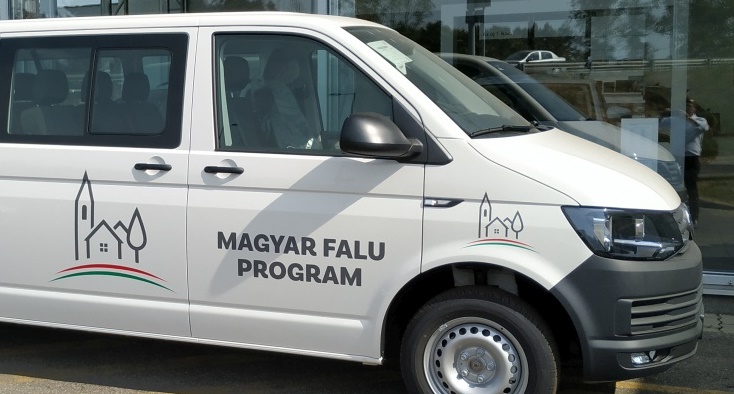
Kiemelt kép forrása: https://falugondnokibusz.hu/