

| Turisztikai és Vidékfejlesztési Tanulmányok Tourism and Rural Development Studies 8. évfolyam, 4. szám, 2023: 91–100. doi: 10.15170/TVT.2023.08.04.06 |
TRANSFORMATION OF THE RUHR REGION: INDUSTRIAL HERITAGE AND SOCIETY
1Mariann Juha
1Project coordinator, Deutsches Bergbau-Museum, Bochum, Germany; mariann.juha@bergbaumuseum.de
ABSTRACT
Since the end of the 1980s, abandoned industrial areas and objects have become more and more characteristic of the Ruhr area, the change of function of which resulted in the award of the RUHR.2010 title and thus becoming a tourist region relying on industrial heritage. The aim of the hcc.ruhr project is to map, store, and make transparent the knowledge and methods related to the preservation techniques and ethics of objects of industrial culture. As a center for transfer processes, it aims to seek and offer solutions to the complex cultural and technological issues arising in connection with the conservation of industrial monuments. Within the framework of the project, an online survey was prepared in 2021 to examine what questions arise from society in relation to industrial heritage.
Key words: industrial heritage, Ruhr area, society, tourism
Received: 20 August 2023
Accepted: 17 October 2023
Published: 20 December 2023
A RUHR-VIDÉK TRANSZFORMÁCIÓJA: IPARI ÖRÖKSÉG ÉS TÁRSADALOM
1Juha Mariann
1Projektkoordinátor, Deutsches Bergbau-Museum, Bochum, Németország; mariann.juha@bergbaumuseum.de
ABSZTRAKT
A Ruhr-vidéken az 1980-as évek végétől egyre jellemzőbbek azok a felhagyott ipari területek és objektumok, melyek funkcióváltása a RUHR.2010 cím elnyerését és ezzel együtt egy, az ipari örökségre támaszkodó turisztikai régióvá válását eredményezték. A hcc.ruhr projekt célja, hogy feltérképezze, tárolja és transzparenssé tegye az ipari kultúra tárgyainak megőrzési technikáival és etikájával kapcsolatos ismereteket és módszereket. A transzferfolyamatok központjaként kíván megoldásokat keresni és kínálni az ipari műemlékek megőrzésével kapcsolatban felmerülő összetett kulturális és technológiai kérdésekre. A projekt keretén belül 2021-ben egy online felmérés készült azt vizsgálva, hogy a társadalom részéről milyen kérdések merülnek fel az ipari örökség kapcsán.
Kulcsszavak: ipari örökség, Ruhr-vidék, társadalom, turizmus
Benyújtva: 2023. augusztus 20.
Elfogadva: 2023. október 17.
Publikálva: 2023. december 20.
1. Introduction
The study of heavy industry in the second half of the 20th century reveals that many industries were affected by the global restructuring that led to the closure of factories and production sites in what were typically industrial regions earlier. This process is still continuing today. The question is: what function do or can these once active industrial sites and buildings fulfil? When can they be considered industrial heritage?
Several professional groups are involved in the conservation and scientific research of industrial heritage, of which TICCIH (The International Committee for the Conservation of the Industrial Heritage) is one of the most important international non-governmental organisations. One of the important precursors to the establishment of TICCIH was the 2nd International Conference on the Conservation of Industrial Monuments, held in Bochum in 1975, which identified the need for a professional organisation dealing with industrial heritage conservation (the term industrial heritage conservation was first used officially at the time of its foundation) at an international level. The first conference of this kind was held in Ironbridge, England, in 1973 (Smith, 2013). By this time, the rethinking of abandoned industrial areas, which were still mostly negatively connotated by society at that time, had become an important research topic even at an international level, as well as an area waiting for the elaboration of utilization plans and the regulation of their implementation.
With regard to the protection of industrial heritage, the Nizhny Tagil Charter for the Industrial Heritage (TICCIH, 2003), drawn up by the International Council on Monuments and Sites (ICOMOS) in 1965, stated that the Industrial Revolution was the beginning of a historical phenomenon that continues to have an impact on society and, not least, on nature. The tangible evidence of these changes is of universal human value, which is important to study and preserve. In the same document, industrial heritage was defined as follows: “Industrial heritage consists of the remains of industrial culture which are of historical, technological, social, architectural or scientific value. These remains consist of buildings and machinery, workshops, mills and factories, mines and sites for processing and refining, warehouses and stores, places where energy is generated, transmitted and used, transport and all its infrastructure, as well as places used for social activities related to industry such as housing, religious worship or education.”
Industrial heritage can be a driving force for sustainable development and an important resource for reorienting regions – for example through the use of brownfield sites for tourism. Many examples of good practice have been implemented in recent years (Steinecke, 2022), such as those in the Ruhr area, which became internationally renowned in 2010.
2. Metamorphosis: from a heavy industrial region to a tourist destination based on industrial heritage
In 2010, a total of three cities or regions were European Capitals of Culture. Of these three destinations, Pécs in Hungary and Essen in Germany (Ruhr area) have a strong industrial heritage, mainly of former mining and other heavy industry activities, which is also a significant feature of the urban landscape. Although the focus of the Capital of Culture title is on a particular municipality, in the case of Essen it was extended to the Ruhr as a conglomerate (RUHR.2010). The decentralised (or polycentric) Capital of Culture concept has enabled a much larger area some 53 municipalities, to benefit from the positive tourism marketing and urban development elements of the title.
The Ruhr region in the west of Germany is a 116 km long and 67 km wide area, which is mainly known for its heavy industry, coal mining, metallurgy and the economic, social and ecological aftermath of the disappearance of most of these industries. How did this disadvantaged region become a cultural metropolis? How important is industrial heritage in this process? What challenges does the region still face today in terms of sustainability?
Since the 1960s, the decline of mining and metallurgy has led to a rethinking of the use and conservation of industrial sites and buildings (Oevermann, 2012). The strategic elements of urban development and the use of industrial heritage space at regional level – and the basis for the title of Capital of Culture – were already defined during the Internationale Bauausstelung IBA Emscher Park (1989–1999). With the international exhibition, the focus of transformation in the region was extended beyond buildings to include the renaturalisation and formal conservation of the industrial environment, which was once heavily polluted by heavy industry. These areas, once enclosed by a wall, have been revitalised and opened up to the public, with recreation and leisure activities at the heart of the development. The conversion of industrial buildings and sites and the addition of new functions have largely been carried out in an adaptive way, which is the economical (cf., tourism recycling, urban upcycling) and ecological basis of sustainable architecture as opposed to iconic architecture, such as the Landschaftspark in Duisburg, the Gasometer, Oberhausen’s new centre, the Zollverein in Essen, which is on UNESCO’s World Heritage List, the Nordsternpark in Gelsenkirchen, the Jahrhunderthalle in Bochum, and the Kokerei Hansa in Dortmund, Zeche Zollern and later the U-Building (Scheytt, 2011). Initially, the focus of research was on the survey and possible use of the area under study. In this cycle, industrial heritage conservation played only a secondary role, and the primary focus was typically on safety and conservation tasks. In the second half of the 1990s, the tourism potential of the destinations mapped was investigated. One of the results of this process was the creation in 1999 of the Industrial Heritage Route, a thematic path which is still in operation and is being extended (Hücherig, 1997).
Industrial heritage as a basis of identity plays a decisive role in the process of the Ruhr region’s transformation into a systematical planned cultural and research region and cultural space. In acquiring the title of Capital of Culture (2006), the organisers aimed to promote the unity and ongoing structural transformation of the region, long-term cooperation, and a positive image. This has proved to be a complex task for 53 the municipalities involved and a population of around 5.3 million, and has not been fully achieved, having lost momentum over time due to operational and financial challenges. The choice of the name itself was a challenge for a region of cities that were essentially in competition with each other and merging almost without borders. Instead of the name of the city of Essen, the neutral and universally accepted RUHR.2010 (originally: Essen für das Ruhrgebiet) was used, which became the first European Capital of Culture to be designated as a region (Fischer & Grizzo, 2011). The term Ruhrgebiet was deliberately omitted from the title, as it is most evocative of the region’s past, with Metropole Ruhr used instead to describe the present and, above all, the future (Scheytt, 2011). The Zeche Zollverein in Essen, which was inscribed on UNESCO’s World Heritage List in 2001, has become a symbol of the cultural capital and, at the same time, of the region, especially the mine tower. Its dominant role as an industrial heritage site and regional identifier is reflected in the choice of venues for the opening and closing events: Zeche Zollverein instead of the Aalto-Theater in Essen and Zeche Nordstern in Gelsenkirchen instead of Gartrop Castle (Pleitgen, 2011).
In the Ruhr region, previously a black spot in tourism, former industrial sites and objects have become increasingly characteristic since the late 1980s, and their change of function has led to the RUHR.2010 title and with it to a tourist region based on industrial heritage, and the basis of the region’s sense of identity.
3. Can it stay? Preserving the industrial heritage in the light of society
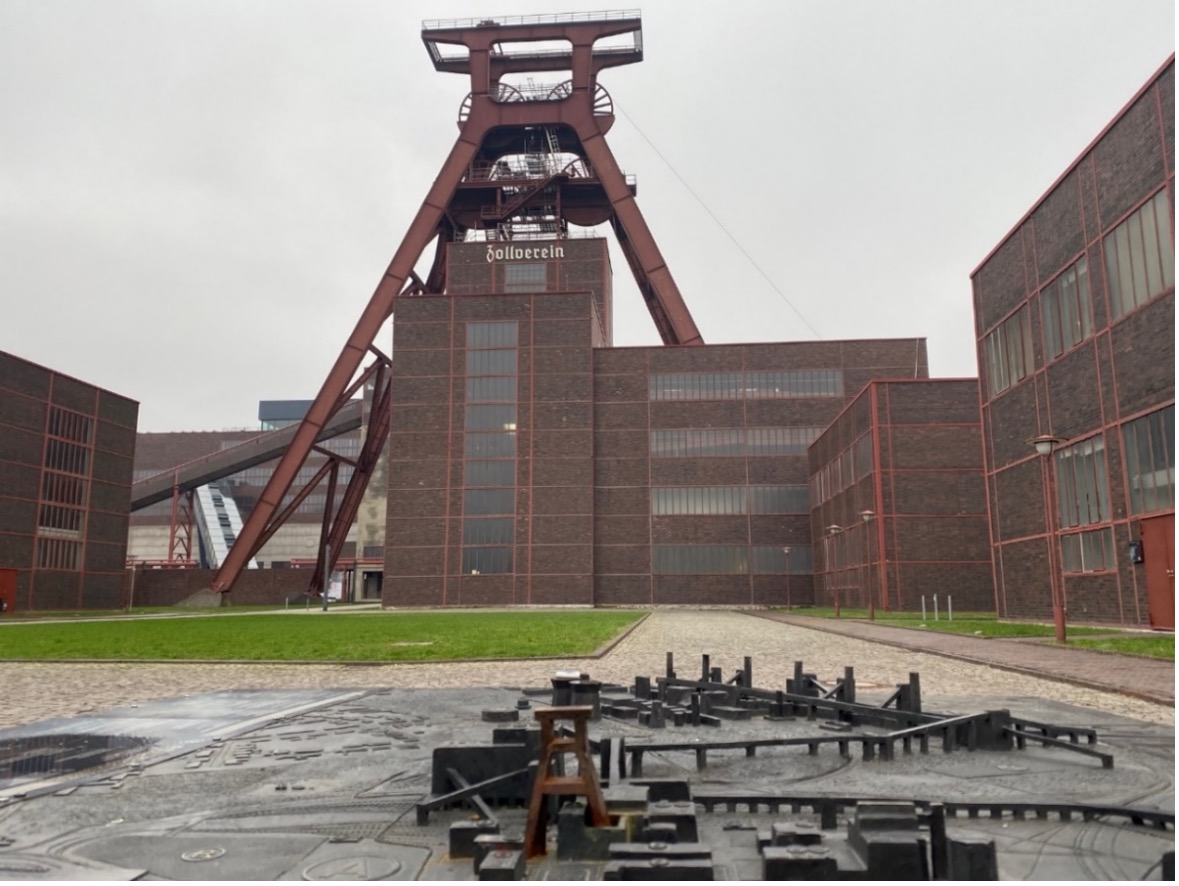
The initiative launched in 1989 – the systematic transformation of the industrial heritage – is still ongoing and is always looking for answers to the questions of the time. One of these current issues is the conservation of elements of a large-scale industrial heritage site with a complex monumental heritage, such as the Stiftung Zollverein in Essen (Figure 1).
Figure 1. Zeche Zolverein, Essen
Source: own photo, 2023.
The goals of the Heritage Conservation Center Ruhr (hcc.ruhr) project focus on the conservation of objects from the history of industrialization, coal mining, and metallurgy. The hcc.ruhr is a joint project of the Deutsches Bergbau-Museum Bochum and the Leibniz-Forschungsmuseum für Georessourcen. The aim of the transfer project is to map, store, and make transparent the knowledge and methods of conservation techniques and ethics of objects of industrial culture. In the long term, transfer is not only about facilitating the exchange of information and knowledge between experts in materials science and heritage conservation, but also about creating, sensitising, and, last but not least, supporting an interdisciplinary community. As a first step, the project will target people who, by virtue of their profession, have an interest in the sustainable conservation of industrial heritage. This group includes representatives of various disciplines and professions that are directly or indirectly linked to industrial heritage: archaeology, history (such as mining history), architecture, heritage conservation, materials science, restoration, and tourism. In addition to the transdisciplinary exchange of knowledge and methods among experts, there is a need for an ongoing dialogue with society. The transfer of knowledge envisaged by hcc.ruhr will enable the development of methods, based on existing professional knowledge, with the involvement of the lay community, and to extend them to additional relevant topics.
3.1 Purpose of the survey
Within the framework of the project, Katrin Liffert launched an online survey in 2021 to investigate the issues that society raises about the concept and preservation of industrial heritage. The questions have received little if any scholarly attention, and thus the most important part of the questionnaire concerns the interest of lay people, non-professionals. What questions does society seek answers to in relation to the concept of industrial heritage? What do we expect from the lay public as a result of our work with them? What can we build on? Why is this important?
In a knowledge society, knowledge and technologies have long held not only scientific relevance but they also increasingly serve as economic resources and solutions to societal problems (Blotevogel & Wiegand, 2015). For this endevour to be successful, it was essential to examine the needs expressed by society by means of a questionnaire, with the aim of gaining knowledge so that programmes and cooperation designed to generate interest and transfer knowledge could be successfully planned. Knowledge transfer is not a one-way process, a frontal dissemination of knowledge, but a two-way communication whereby both parties receive knowledge from the other. This requires a partnership and equal status of all participants. It is also important to facilitate personal contact in workshops or other forms of knowledge transfer. In recent years, the successful involvement and participation of society in various projects and programmes has become increasingly important. In the interests of mutual understanding, it is essential to analyse who the potential recipients are and to define reference frames in advance. Once these questions have been answered, the development of formats geared towards the target audience can begin. By creating a win-win situation, targeted communication with society offers the opportunity to raise new questions, reflect on procedures, and build mutual understanding. As a consequence of the transfer, both parties benefit: lay people find new experiential knowledge, experts new impulses and perspectives on how to preserve industrial heritage.
3.2 Structure of the survey
The questionnaire consisted of four parts in total: an introductory text, information on data protection, the questions themselves, and a concluding section. The introductory part gave a brief summary of the hcc.ruhr project, followed by the practical completion time (10–15 minutes) and specific information and contact details related to the completion of the questionnaire.
The four groups of inquiries contained around between 15 and 21 items. The types of questions in the survey were: open and closed (alternative, selective, and scale) items. In the questionnaire, there were several options, including the provision of a respondent’s own answer under the heading other. Words that may not be in common use were supplemented by explanations to make them easier to understand. At the beginning of each group of inquiries, 5–6 questions related generally to the person completing the questionnaire, followed by questions on the occupation or knowledge background (4), professional contacts and cooperation (8–9) and the website (indumap) redesigned during the project (2) for experts and lay people (4–5), and questions on knowledge, interest, and attitudes (3–4) and transfer formats (3) for lay people. With the relaunch of the indumap website in 2023, a new site with new content will be created in a more user-friendly and meaningful format. For the success of the optimisation, respondents’ opinions on the content composition were important. What would they like to read about in the future? What information are they currently unable to access? What content needs to be added to the existing website? Do they even use this channel to get new information? The final section thanked respondents for completing the questionnaire and provided the website link of the hcc.ruhr project.
4. Research findings
The questionnaire was available on the limesurvey platform for six weeks between 11 February and 25 April 2021. A total of 233 people completed it during this period. In the hope of a greater success, the questionnaire was sent to various associations, organisations, and institutions (in the fields of restoration, conservation and tourism) addressing the two target groups (experts and lay people).
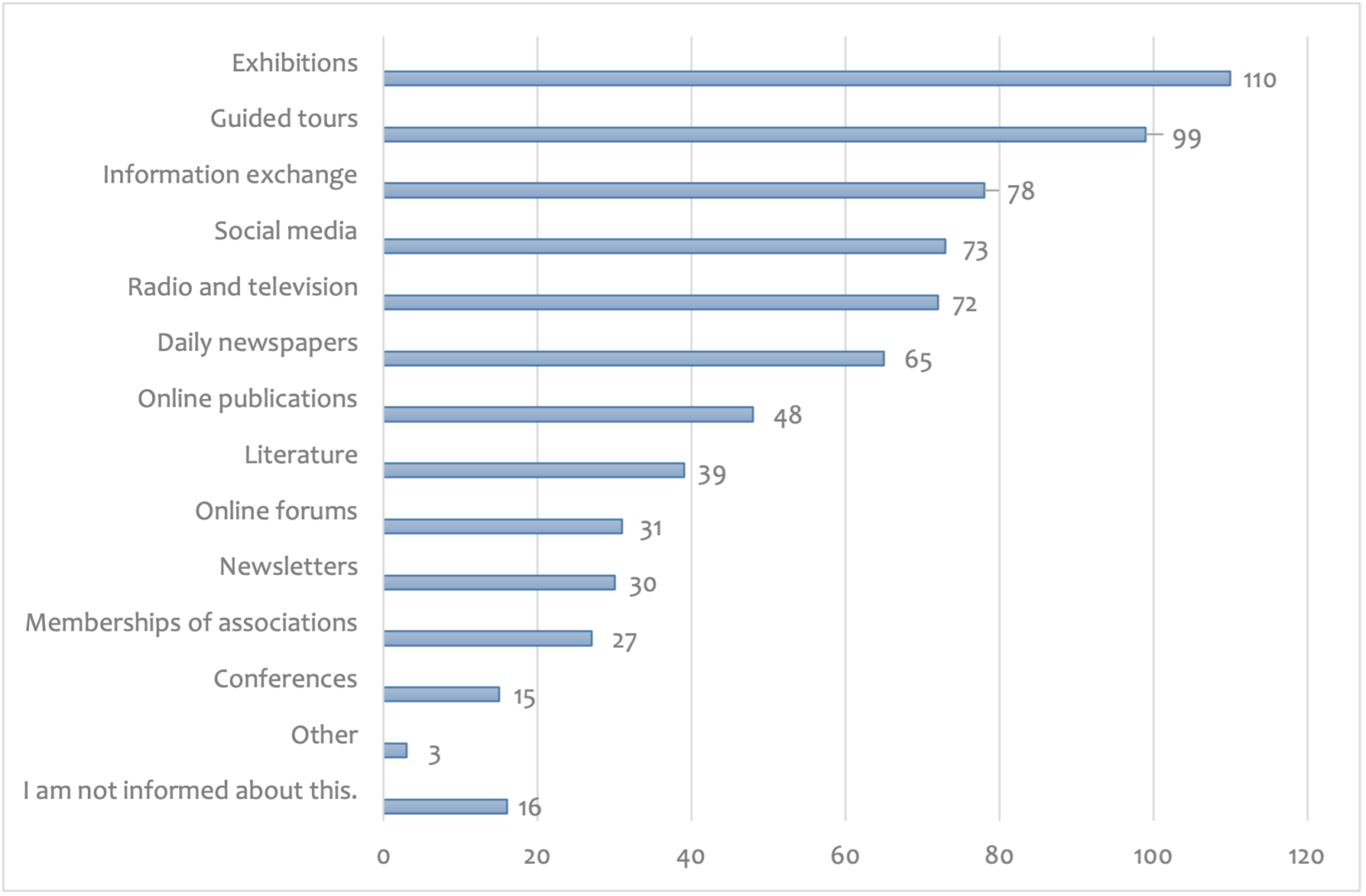
The majority of respondents were from the Ruhr area, 42.9% aged between 50 and 69, with only 0.4% under 18. Since we sent the questionnaire primarily to partners working in scientific fields, it is not surprising that 76.4% of respondents had a high school diploma and 52.4% a higher education degree. Within this group, historians and heritage conservation professionals made up the majority of respondents. 27.9% of the respondents classified themselves as experts, while 72.1% as lay people. The latter group, which is the most lacking in information, significantly identifies the conservation of industrial monuments as the most important task. They typically come into contact with industrial heritage through their family and friends and through leisure activities (the importance of photography is noteworthy here), and least through their work. A large proportion of lay people, around 72%, consider industrial heritage to be important for industrial culture, with 69.6% not considering the presence of industrial heritage in the urban landscape to be a nuisance, and 46.4% believe that it should be preserved in its original form. A total of 66.67% think that industrial monuments should be made accessible and visitable to all. 39.3% consider that their knowledge of the subject is medium. The majority of lay people find information on the subject at exhibitions, in the context of tourism programmes, on social platforms, on television and in the press. When asked about the channels through which they would like to receive information about industrial monuments and their conservation, the majority of respondents (67%) mentioned open days. Other important and requested communication channels include exhibitions, guided tours, social platforms, videos, public and organised talks, online literature, podcasts and workshops, information desks, newsletters and conferences (Figure 2).
Figure 2. Formats of information sources used by respondents (n=168)
Source: Katrin Liffert.
In the open-ended question on this topic, two formats were mentioned as important from lay respondents’ point of view: online offers (virtual tours) and (guided) tours, for example, given by former employees in an authentic environment and reporting on their personal experiences of the site. In the acquisition of information, it is important to be up-to-date and able to interpret certain terms and, where necessary, to explain concepts unfamiliar to the public. There is a similar need to present content in a practical form (e.g., in a workshop). 10% of lay people are satisfied with the input of information on the subject, 16% are not at all informed, and 25% show no interest whatsoever in industrial heritage.
In a specific example of a restoration project, the majority of lay people interviewed showed a much greater willingness to participate passively (observer only) than actively. In response to the open-ended question on what question they would ask industrial heritage professionals, a total of 22.6% responded. The first set of questions were related to the use of industrial heritage: How could industrial heritage elements be used? What would be the most appropriate functions for them?; the second to preservation: What technologies are used to conserve them, can they be preserved in the long term? Are the conservation tasks more concerned with authenticity or preservation? It includes criteria for the neutralization of harmful substances during reconstruction?; and the third to their significance: How feasible is it to neutralise harmful substances during reconstruction?
5. Summary
The main objective of our research on the conservation of former industrial sites was to answer the question, What is the role of built industrial heritage for society? These brownfield sites may represent a link between the experts, former workers and their families, and new residents in particular, who have no interest in the history of the city or of industry. Industrial heritage can be an important basis for structural rethinking of regions based on sustainable development, regeneration, and community networking. Education is essential to the success of this process. The most difficult social groups to reach are young people, young adults, and new urban dwellers, who have no connection with the industrial heritage in their neighbourhood. Sensitisation close to where they live, but not necessarily in the industrial heritage area, is an important aspect. One of the aims of the questionnaire was to formulate the primary knowledge transfer formats through which these groups, less receptive to exhibitions and guided tours, could be reached.
The next stage of the project will be to analyse the exact target area, taking into account the results of the questionnaire, to design different engagement methods and interactions, and to create programmes in the Katernberg district near the Stiftung Zollverein in Essen. Together with local social and societal institutions, we will plan knowledge transfer events integrated into the existing programmes of these institutions and will reach the population and thus the target group of the research more quickly, in a more targeted and practical way. A report with Katharina Flisikowski is expected in early 2024.
References
Smith, S. (2013). The work of TICCIH. In: Douet, J. (ed.) Industral Heritage Re-tooled. New York: Routledge, pp. 222–227.
Blutevogel, H. H. & Wiegand, T. S. (2015). Zur Evaluation von Wissensgenerierung und Wissenstransfer in der Akademie für Raumforschung und Landesplanung (ARL) – Leibniz-Forum für Raumwissenschaften. Raumforschung und Raumordnung 73 (3): 155–165. DOI: 10.1007/s13147-015-0346-7
Fischer, J. & Grizzo, N. (2011). Der Weg zum Titel: Die Bewerbung des Ruhrgebietes um den Titel Kulturhauptstadt Europas 2010. In: Pleitgen, F. (ed.) Ruhr.2010: Die unmögliche Kulturhauptstadt. Chronik einer Metropole im Werden. Essen: Klartext Verlag, pp. 7–11.
Hücherig, R. (1997). Tourismus im Ruhrgebiet: Der Beitrag der Internationalen Bauausstellung Emscher Park. Materialien zur Fremdenverkehrsgeographie, Heft 41. Trier: Geographische Gesellschaft, 149 p.
Oevermann, H. (2012). Über den Umgang mit dem industriellen Erbe: Eine diskursanalytische Untersuchung städtischer Transformationsprozesse am Beispiel der Zeche Zollverein. Essen: Klartext Verlag, 290 p.
Pleitgen, F. (2011). Schneesturm und Eiseskälte. Wie der Anfang, so das Ende. Die fünf Grossprojekte der Kulturhauptstadt und das Wetter. In: Pleitgen, F. (ed.) Ruhr.2010: Die unmögliche Kulturhauptstadt. Chronik einer Metropole im Werden. Essen: Klartext Verlag, pp. 77–89.
Scheytt, O. (2011). Kulturmetropole Ruhr. Die programmatische Entwicklung der Kulturhauptstadt Europas RUHR.2010. In: Pleitgen F. (ed.) Ruhr.2010. Die unmögliche Kulturhauptstadt. Chronik einer Metropole im Werden. Essen: Klartext Verlag, pp. 13–23.
Steinecke, A. (2022). Industrie und Tourismus: Zwischen Fabrikruinen, Markenwelten und Kreativquartieren. München: UVK Verlag, 164 p.
Online sources
TICCIH (2003). The Nizhny Tagil Charter For The Industrial Heritage. The International Committee for the Conservation of the Industrial Heritage (TICCIH), 17 July 2003. Available online: https://ticcih.org/wp-content/uploads/2013/04/NTagilCharter.pdf/ Accessed on: 30 July 2023.