

Citizens’ motivation and attitude as potential host volunteers in the preparatory years of the Veszprém-Balaton 2023 European Capital of Culture Programme
1Éva Kruppa-Jakab – 2Edit Kővári
1European Capital of Culture managing expert, Rector’s Office, University of Pannonia;
kruppa-jakab.eva@uni-pannon.hu
2Associate professor, Faculty of Business and Economics, Management Institute, University of Pannonia; European Capital of Culture representative; kovari.edit@gtk.uni-pannon.hu
DOI: 10.15170/TVT.2023.08.01.08
Abstract
This study is focusing on volunteering as a host in the local tourism industry. The Hungarian city, Veszprém and the Lake Balaton region won the title ‘Veszprém-Balaton 2023 European Capital of Culture’ (hereinafter VEB2023 ECoC) in 2018. Creating and managing an effective volunteer programme is one of the keys to the success of an ECoC project. The research aims to uncover the motivations and willingness of Veszprém citizens as potential host volunteers and their interest in the VEB2023 ECoC events during the preparatory years. In 2020, an online and offline survey was conducted to answer the following questions: Are those interested in the proposed ECoC events more likely to volunteer as a host? Are they willing to remain volunteers until and beyond 2023? Does the prestige of VEB 2023 ECoC motivate residents to be host volunteers? In May 2020, a case study was carried out on the opportunities for students of the University of Pannonia in Veszprém to participate in the VEB2023 ECoC programme. The findings and the practical recommendations help to develop a successful, sustainable and smoothly operating volunteering system in Veszprém and its surroundings, and can be beneficial for other future European Capitals of Culture or major event organisers as well.
Keywords: volunteering, tourism, host volunteers, European Capital of Culture, Veszprém, Balaton
A veszprémi lakosok önkéntes motivációja és attitűdje a helyi turizmusban a Veszprém-Balaton 2023 Európa Kulturális Fővárosa program felkészülési időszakában
Absztrakt
Ez a tanulmány az önkéntességet vizsgálja a helyi turizmusban. Veszprém és a Balaton régió 2018-ban nyerte el a „Veszprém-Balaton 2023” Európa Kulturális Fővárosa (továbbiakban VEB2023 EKF) címet. A hatékony önkéntes program felépítése és működtetése a sikeres EKF projektek egyik kulcsa. A kutatás célja, hogy feltárja a veszprémi polgárok, mint potenciális helyi turisztikai önkéntesek motivációját, önkéntességi hajlandóságát, valamint érdeklődését a VEB2023 EKF rendezvények iránt a programévet megelőző felkészülési időszakban. A 2020 őszén végzett online és offline kérdőíves felmérés a következő kérdésekre kereste a választ: Nagyobb valószínűséggel önkénteskednek-e a helyi turizmusban az EKF kiajánlott programjai iránt érdeklődők? Folytatnák-e ezt a tevékenységet 2023-ig és azt követően is? Milyen az EKF presztízse és motiválja-e a lakosokat a helyi turisztikai önkéntességre? 2022 májusában esettanulmányt készítettünk a Pannon Egyetem (Veszprém) hallgatóinak EKF programban való részvételi lehetőségeiről. A kutatás eredményei és a gyakorlati ajánlások segítik a sikeres, fenntartható és gördülékenyen működő EKF önkéntes rendszer fejlesztését Veszprémben és térségében, és hasznosak lehetnek más jövőbeli EKF városok, vagy egyéb nagyrendezvények szervezői számára is.
Kulcsszavak: önkéntesség, turizmus, helyi turisztikai önkéntesek, Európa Kulturális Fővárosa, Veszprém, Balaton
1. Introduction
The city of Veszprém and the Lake Balaton region won the title ’Veszprém-Balaton 2023 European Capital of Culture’ (hereinafter VEB2023 ECoC) in December 2018. The experiences of other former European Capitals of Culture show that volunteers of the local community are the key to the success of the project. Therefore it is essential to build a volunteer programme in Veszprém and its surroundings, which is sustainable and effective. The primary research examines the attitude, the willingness and the motivations of Veszprém citizens regarding volunteering in the programmes of the VEB2023 ECoC project. The paper does not only focus on the programmes in 2023, but also on the events of the preparation period. The aim of this research paper is to suppport the VEB2023 ECoC Volunteering Programme, especially concerning the field of tourism.
The research questions are the following:
RQ1: Are those local residents interested in the proposed VEB2023 ECoC events more likely to volunteer as hosts in VEB2023 ECoC Volunteering System?
RQ2: Are those interested in host volunteering in VEB2023 ECoC Volunteering System also willing to remain volunteers until 2023 and beyond?
RQ3: Does the prestige of the VEB2023 ECoC programme motivate residents to be host volunteers in the VEB2023 ECoC Volunteering System?
With getting closer to the local volunteers’ motivation and attitude, this research can be a good tool for creating a successful, sustainable and more smoothly operating volunteer system. As the result of this process, Veszprém and Lake Balaton appears as a destination with high level of hospitality and a well-organised European Capital of Culture in 2023 and beyond. The results can be beneficial for other future European Capitals of Culture or major event organisers as well.
Éva KRUPPA-JAKAB’s dissertation (2020) served as the base of this paper. It was complemented by a case study carried out in May 2022 with the participation opportunities of students of the University of Pannonia (located in Veszprém) in the VEB2023 ECoC programme.
2. Literature review
Researchers try to conceptualise the complex phenomenon of tourism volunteering, shed light on the motivations of volunteers, and the way of retaining them in different volunteering settings. The bottom up initiatives are of high importance in establishing a volunteering programme. There are several definitions drawn up by the researchers in connection with the nature, structure, dimensions and impacts of tourism volunteering.
The following definitions are essential to clear up in order to use and refer to them consequently in this paper. The following volunteering aspects are studied: guest and host volunteering, forms of volunteering, determinants of volunteering (demographic data), motivation.
2.1. Volunteering
The forms, purposes and settings of volunteering vary widely, thus no general definition of volunteering exists. It is undoubted that volunteering is a supporting activity. “Volunteering is any activity in which time is given freely to benefit another person, group or organization. This definition does not preclude volunteers from benefiting from their work…Volunteering is part of a cluster of helping behaviours, entailing more commitment than spontaneous assistance but narrower in scope than the care provided to family and friends.” (WILSON 2000:215-216) CNAAN, HANDY and WADSWORTH (1996) conclude volunteering as a discretionary activity, which means virtually a donation of time. There are diverse activities that fall under the umbrella of volunteering, e.g. household chores, shopping, administration, child care, elderly care, education, research, cultural activity, event organising, helping the disabled, environmental protection, maintaining public order, helping at disaster recovery, etc.
In the interpretation of the Hungarian Central Statistical Office (KÖZPONTI STATISZTIKAI HIVATAL, hereinafter KSH 2016), those individuals defined as volunteers, are those who perform some activity directly or through an organization; voluntarily, without payment; for the benefit of persons living outside their household or for the benefit of society (group, wider community, animals or the environment, etc.). A volunteer must meet all three of the previous conditions.
The most important motivations of Hungarian volunteers are based on the following values: helping others, appreciation of voluntary activities, faith or personal convincement, well-being and self-esteem, self-enhancement, serving the society and social relations (KSH, 2016).
Motivations for volunteering is classified by CLARY et al. (1998). Table 1 summarises the motivation functions. This is the base of the Volunteer Function Inventory (VFI).
Table 1: The motivations for volunteering
| Values function | The person volunteers in order to express or act on important values, such as humanitarianism and helping the less fortunate |
| Understanding function | The volunteer seeks to learn more about the world and/or exercise skills that are often unused |
| Enhancement function | The individual seeks to grow and develop psychologically through involvement in volunteering |
| Protective function | The individual uses volunteering to reduce negative feelings, such as guilt, or to address personal problems |
| Career function | The volunteer has the goal of gaining career-related experience through volunteering |
| Social function | Volunteering allows the person to strengthen one’s social relationships |
Source: Kruppa-Jakab (2020), based on Clary et al. (1998)
This categorisation is very helpful in understanding the nature of volunteering. The VFI survey is one of the most widely used quantitative methods to assess volunteers’ motivations. As the most important motivations of Hungarian volunteers are very similar to the VFI motivation functions, the VFI is a useable method to assess motivations in a Hungarian volunteering setting as well. It can help understanding the motivations of Veszprém citizens regarding volunteering in the VEB2023 ECoC Programme. Exploring the motivations of volunteers helps to recruit and retain volunteers in the programme.
WILSON (2000) represents the positive impacts of volunteering, which can also be causes for volunteering. Volunteering increases life-satisfaction, self-esteem, self-rated health, strengthens functional ability, improves educational and occupational achievement and has a positive impact on length of life. Youth volunteering reduces the likelihood of school truancy and drug abuse.
According to the KSH (2016) research in Hungary, the vast majority of volunteers, 94.1%, continued to help directly with their unpaid work (informal volunteers). 3.3% carried out such activities through or for the benefit of an organisation (formal volunteers). 2.6% supported people in need, different organisations, institutions or some kind of common cause both directly and with the help of an organisation. Today, volunteers can do something for others not only offline, but also online.
Determinants of the voluntary activities in Hungary:
- Gender: In Hungary, the results of the KSH survey (2011 and 2014) show that although there are traditionally female (e.g. childcare, nursing, elderly care) and male (e.g. advocacy, board membership, rescue work, public security, disaster relief) types of voluntary work, these have also been undergoing change recently and nowadays volunteering overall is balanced between men and women. Many areas previously dominated by men have become areas divided between the genders. In addition to volunteering linked to traditional social values, there is an emerging, new type of volunteering, which focuses on knowledge-based social values like expertise-gaining practical experience, preserving the acquired knowledge and meeting the expectations of lifelong learning (KSH 2016).
- Level of education: The level of education is an extremely important determinant of charitable behaviour. The volunteer proportion increases with education and is the highest among graduates. While 28.8% of those with a primary education, 35.4% of high school graduates and 38.5% of graduates volunteered in the 12 months prior to the interview. Professional qualification is also a major differentiating factor. Those with a secondary education (with or without a high school diploma) showed higher activity in terms of volunteering, than the average, closer to the volunteering level of those who have a higher education (KSH 2016).
- Age: The trend in recent years shows that in Hungary, the proportion of young people who volunteer is becoming more and more prominent compared to other age groups. The average age of the current volunteers is nearly 46 years. For understandable reasons, the proportion of older people among former volunteers is slightly higher, with an average age of 52. In contrast, those who have never tried volunteering are on average 48 years old (Új Nemzedék Központ Nonprofit Kft. 2018).
- Tourism volunteering
Uriely, Reichel and Ron (2003) explain that ‘volunteering in tourism’ is a distinguishable expression of postmodern culture. “The terminology of tourism volunteering captures volunteering in both host and guest settings better than volunteering in tourism. This means any or all volunteers who are involved in tourism settings” (HOLMES – SMITH 2009:6).
HOLMES AND SMITH (2009) point out that this notion includes those people volunteering at their residency, in their own community (residents referred to as host volunteers) and those volunteering at a destination (tourists referred to as guest volunteers or volunteer tourists). This is the classical approach, however, the boundaries of these two groups are often blurred. This also applies t the VEB2023 ECoC programme: those participants, who take part in the ECoC programmes and like them as a guest, may later decide to be host volunteers occasionally or regularly. Those Veszprém citizens can also be considered as guests (not literally visitors or tourists, but audience) of the ECoC programme, who enjoy the programmes in their own city, still, they can later decide to be host volunteers of the programme.
Tourism volunteering is in the centre of interest nowadays. “The range of touristic, leisure, and cultural locations and events taken for granted at a community, national and international level likely cannot be sustained into the future without the support of a growing volunteering population” (HOLMES et al. 2010:25).
Based on the literature review, there is an overlap of using the term of host or/and guest volunteers. Their roles are often parallel and it is hard to divide them either spatially or in the time dimension. In the present study we apply the host volunteer definition, because it expresses more precisely the main role of volunteers in the ECoC programmes.
The motivation of volunteers in tourism
There is a wide range of research on the motivations of volunteers in tourism. Based on URIELY at al. (2003); SIN et al. (2015); WEARING and McGEHEE (2013); SMITH and HOLMES (2011) and ADONGO et al. (2019), Table 2 summarises the motivations of guest and host volunteers. The most important difference, what distinguishes host volunteer motivations from voluntourist motivations is welcoming visitors as ambassadors of the place and showcasing their home town or region. The volunteer setting (location) is the place of residence, where host volunteers want to demonstrate pride in their town or region. Host volunteers want to acknowledge the importance of tourism to the community. If we concentrate on tourism-related motivations, the most important similarities are leisure and tourism pursuits, cultural immersion, experiencing something new, escaping from everyday life and participating in community development. These are the motivations, which connect the two tourism volunteering concepts the most.
Table 3: Factors influencing volunteering participation rates and participation willingness in the VEB2023 ECoC Volunteering System
| Demographic factor | Higher volunteering participation rates associated with | Higher participation willingness in the VEB2023 ECoC Volunteering System (Yes/No) |
| Age/lifestyle | Being of working age or recently retired | No |
| Gender | Being female | No |
| Family and household structure | Being partnered/married | No |
| Having dependent children | Yes | |
| Labor market status | Being in paid employment (full or part time) | Yes |
| Socio-economic status
| Higher level of educational attainment | In this case, the sample was not large enough to prove the connection
|
| Higher occupation status | Not examined | |
| Higher income level | Not examined | |
| Disability or long-term illness | Absence of a disability or long-term illness | Not examined |
| Ethnicity | Member of the dominant ethnic group | Not examined |
| Geographical location and length of residence
| Living in a rural area |
Not relevant, as all respondents are from Veszprém city (urban area) |
| Being a longer-term resident | No, but being a permanent resident – yes | |
| Migration | Being born in the country (rather than an immigrant born overseas) | Not examined |
| Religion | Being actively involved in formal religious activities | No |
| Civic and social participation | Being involved with voluntary associations | |
| Having a higher level of civic participation | Yes | |
| Source: Kruppa-Jakab (2020), based on: Zappala and Burrell (2001), Finlay and Murray (2005), Low et al. (2007) in Holmes and Smith, 2009:9 | ||
Locals can also undertake several volunteering activites, like hosting events, operating attractions, welcoming tourists, providing services, in order to express their commitment to local heritage and values, customs and traditions. The notion voluntary hospitality by URIELY at al. (2003) expresses the will of a local resident to be a part of the tourism business voluntarily, to welcome visitors, tourists and to serve them in order to make the system of local tourism operate more smoothly. This is the definition used in the survey to make respondents understand the question regarding willingness to participate in host volunteering in the VEB2023 ECoC Volunteering System.
Volunteers not only provide financial support indirectly to the attractions, but also contribute greatly to enhance the visitor experience with their commitment and love. In many cases the staff ‘smile for money’, and their behaviour and their thoughts are in sharp contrast, which the visitor will of course notice immediately. In case of volunteers, this phenomenon does not occur. They help in their free time and with enthusiasm, and do not expect financial rewards (remuneration) for all of this, as they participate for the experience, for their daily contact with people (PUCZKÓ – RÁTZ 2017). In case of visitor centres, “the dominant rationales for involving volunteers are need, community involvement, visitor experience, and the personal qualities and motivations of volunteers.” (SMITH – HOLMES 2011:562). Volunteers form a bridge between tourism and the local community. They are predominantly involved in the following settings:
- Visitor/tourist information centres
- Meet and greet programmes (at transport hubs, e.g. railway stations, airports)
- Accommodation hosting roles
- Rescue services, teams
In each case, volunteers can have a direct impact on tourists’ holiday experiences (SMITH – HOLMES 2011). Volunteering activities vary widely in European Capitals of Culture, from survey interviewer tasks to providing information to visitors, performing marketing tasks and hospitality activities. Volunteers can choose between offline and online activities, however, online volunteering in the field of culture and tourism is not usual, and it does not help to develop a sense of belonging to the community as much as offline volunteering. Year 2020 was different due to the COVID-19 pandemic: online volunteering proved to be a good transitional solution for keeping volunteers motivated when less offline events could be organised.
2.3. The Veszprém-Balaton 2023 European Capital of Culture Programme
The city of Veszprém applied for the ECoC title first in 2005, but finally the Hungarian city, Pécs won the title for 2010. Veszprém did not give up the ambition to be a European Capital of Culture. After a long preparation period, Veszprém and the Lake Balaton region bid for the 2023 ECoC title in 2017. As a result of a long bidding process, on 14th December 2018, Veszprém was announced to win the title. The Veszprém-Balaton 2023 Joint-Stock Company is responsible for the general coordination, the programme development, and the realisation of cultural and artistic projects of the ECoC, with the help of cultural, civic and market-based organisations (VESZPRÉM-BALATON 2023 JSC. 2020).
Based in the research findings of LŐRINCZ and RAFFAY (2019), the main goals of the VEB 2023 ECoC are to stimulate mobility, increase the volume of cultural tourism and to put the Veszprém-Balaton region on the European map of tourism and culture.
Besides community building, tradition, innovation and sustainability, volunteering is one of the main values of the VEB2023 ECoC Programme. According to the values, the main goals of the volunteering system of Veszprém-Balaton 2023 Jsc. (hereinafter VEB2023 Jsc.) are: sustainability; developing an experienced and well-prepared host organisational base; raising the programme to the international (European) level; building a strong volunteer community; increasing the prestige and image, raising awareness of volunteering and volunteers; and having a strong focus on monitoring.
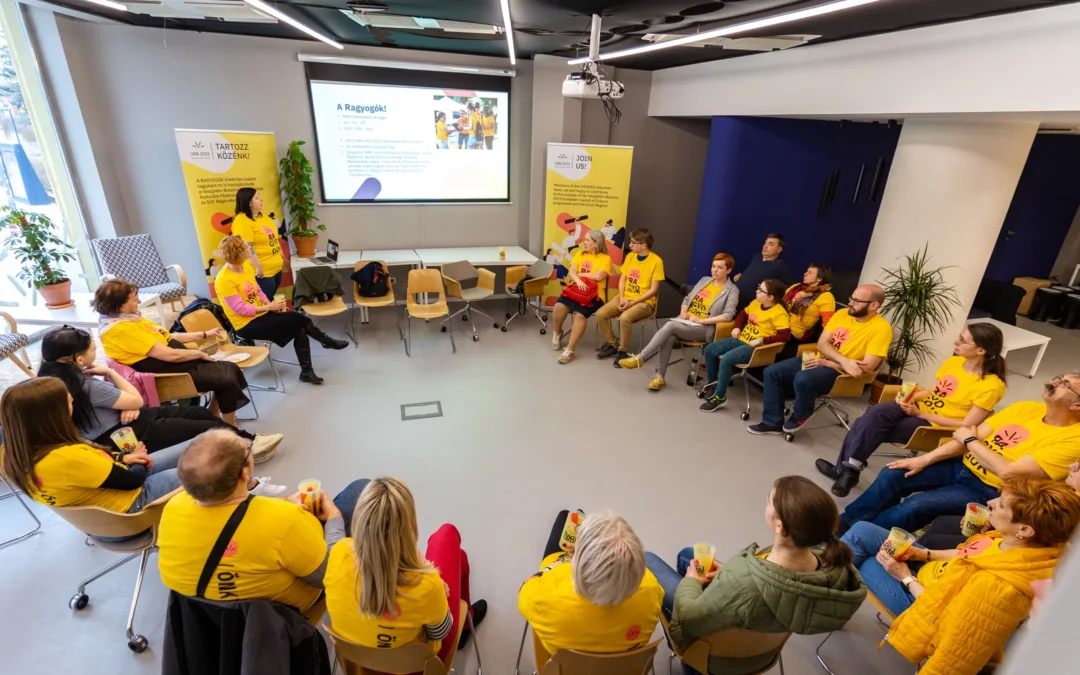
The VEB2023 Jsc’s Ragyogók (Shiners) Volunteer Programme was launched on 15th June, 2020 (earlier than planned), with the slogan: Shiners (Ragyogók) – Let’s shine together! (Ragyogjunk együtt!). The VEB2023 ECoC Volunteer Guidelines were published online on the official website of the VEB2023 Jsc. (Veszprém-Balaton Régió Kultúrájáért Közalapítvány 2020). The main values emphasised in the guidelines are: equal treatment, accessibility, support of volunteers by mentors, trainings, and the freedom of volunteers to choose tasks. The guidelines also stress the need for a voluntary contract and the acceptance of the privacy policy in Hungary.
3. Research methodology
There are two types of methodology applied in this paper. An online and offline survey was conducted in Autumn 2020 to underpin the research propositions, and a case study focusing on university students was devised in May, 2022.
The aim of the survey was to contribute to the recruitment and retaining the volunteers by uncovering Veszprém citizens’ most important motivation functions, volunteering outcomes, interest in ECoC events and willingness to participate. The research also aimed to uncover the influence of the prestige level of the ECoC programme on participation willingness. Three groups were examined: students; active workers; seniors and pensioners. Including an existing, elaborated survey, the Volunteer Function Inventory (VFI) for assessing volunteer motivation (CLARY et al. 1998) and other, ECoC-related questions. The following resarch propositions were defined based on the literature review and previous studies:
- RP1: Those local residents, who are interested in the proposed VEB2023 ECoC events, are more likely to volunteer as a host in VEB2023 ECoC Volunteering System.
- RP2: Those interested in host volunteering in VEB2023 ECoC Volunteering System, are also willing to remain volunteers until 2023 and beyond.
- RP3: The prestige of the VEB2023 ECoC programme motivates residents to be host volunteers in the VEB2023 ECoC Volunteering System.
As pointed out in the literature review, the Volunteer Function Inventory (VFI) by CLARY et al. (1998) is one of the most widely accepted quantitative methods for assessing volunteer motivation. To unfold the motivations of Veszprém citizens regarding volunteering in tourism, the complete VFI survey was included in the primary research (in the online and offline questionnaire alike), because this categorisation is very helpful in understanding the nature of volunteering. It can help understanding the motivations of Veszprém citizens regarding volunteering in the VEB2023 ECoC Programme. Uncovering volunteer motivations help recruiting and retaining volunteers in the programme.
The VFI survey consists of two parts: the Reasons for Volunteering and the Volunteering Outcomes. Other specific questions were added, concerning Veszprém and the Veszprém-Balaton 2023 ECoC programme, especially about its volunteer programme ‘Ragyogók’ (Shiners). It is important to note, that the first part (Reasons for Volunteering) was compulsory to fill in for all respondents. This part consists of 30 statements, where respondents needed to indicate (on a 7-point Likert-scale) how important they are for them. The second part (Volunteering Outcomes) was compulsory only for those who were already members of the Ragyogók (Shiners) Volunteer Programme. This part consists of 17 statements, which also needed to be indicated (on a 7-point Likert-scale), how important they were for the respondent. During the data collection, out of the ca. 40 registered Shiners, 21 volunteers took part in the survey.
The main chapters of the questionnaire were following: Volunteerism measured whether the participant has ever participated in a voluntary activity and in the 12 months prior to the survey. Motivation: the reasons for volunteering was measured based on the VFI, on a 7-point Likert scale. The scale of willingness was based on the questions related to the readiness, the will of an individual Veszprém citizen to volunteer as a host in the local tourism industry and in the VEB2023 ECoC Volunteering System. The respondents had to answer whether they would participate in the proposed events of VEB2023 ECoC programme (e.g. Filmpicnic) as a guest (audience). Respondents had to rank the prestige of the VEB2023 ECoC programme on a 1-7 Likert-scale. They also had to assess, to what extent the prestige of the VEB2023 ECoC programme influenced their willingness for host volunteering in the VEB 2023 ECoC Volunteering System (on a 1-7 Likert-scale). Furthermore, the survey included some questions considering demography.
The Lime Survey programme was used for creating the online questionnaire, which was available between 15th September and 29th October, 2020. Additionally, 25 questionnaires in paper form were also used to reach the pensioners’ age group.
This research focuses only on Veszprém citizens. 302 inhabitants of Veszprém city filled in the questionnaire. This sample is not representative, however, the questionnaire (both online and offline) was sent directly to over 20 various local communities representing different age groups. Members were asked to forward the questionnaire to others (snowball method).
SPSS software was used to examine the quantitative data.
SMITH and HOLMES (2011) agree that by quantitative studies, it is often hard to uncover the reasons why volunteers choose a certain volunteer programme or volunteer role of an organisation. Besides quantitative research methods it is also useful to apply qualitative research methods. Thus, as a complementary, qualitative method, a case study was devised in May 2022 on the participation opportunities of students of the University of Pannonia (located in Veszprém) in the VEB2023 ECoC programme.
The case study was based on presentations by tourism and catering university students, which answered the following question: How can the students of the University of Pannonia be actively involved in the Veszprém-Balaton 2023 European Capital of Culture programme? The presentations were followed by a discussion about their opinions and own ideas.
The next chapter introduces the results of the survey and the case study following the research propositions.
4. Research analyses and findings
4.1. Research proposition 1 (RP1)
- RP1: Those local residents, who are interested in the proposed VEB 2023 ECoC events, are more likely to volunteer as hosts in the VEB2023 ECoC Volunteering System.
To examine the willingness of Veszprém citizens to volunteer as hosts in the Veszprém-Balaton ECoC Volunteering System, two questions were asked from the respondents in the Willingness chapter of the questionnaire.
RP1/Question 1:
Would you take part in volunteering as a host in the local tourism industry (e.g. as a host of an event, a tour guide, an event organiser, a band sitter, a museum host/hostess, a ticket sales person, etc.) to welcome visitors, tourists and to serve them in order to make the local tourism system operate more smoothly?
302 Veszprém citizens answered the above question. Only 77 of them answered yes (25.49%), 86 citizens answered no (28.47%), and the majority, 139 respondents answered ‘I do not know / I am not sure’ (46.03%).
Many examples were put in the question so as to help the respondents understand the meaning of the notion ‘host volunteering’. As only 25.49% answered yes, it is very important to clarify the meaning of this voluntary activity in the upcoming years. Promoting this activity with good examples, role models or influencers is advisable.
RP1/Question 2:
If the answer for Question 1 was yes, another compulsory question was asked from the respondent: Are you interested in taking part in host volunteering in the Veszprém-Balaton 2023 European Capital of Culture Volunteering System?
The majority, 89 of 137 respondents answered ‘yes’ (64.96%), 6 said ‘no’ (4.38%), and 42 respondents answered ‘I do not know / I am not sure’ (30.66%). The majority finds it interesting to take part in host volunteering within the Veszprém-Balaton 2023 European Capital of Culture Volunteering System. The ratio of uncertain responses is much lower (30.66%), than in case of Question 1 (46.03%). It means that the notion ‘host volunteering’ is more interesting for respondents if mentioned together with the expression ‘Veszprém-Balaton 2023 European Capital of Culture Volunteering System’. The reason behind this can be the average prestige level of the Veszprém-Balaton 2023 European Capital of Culture programme, which is evaluated by 302 respondents as high: 5.219 (on a 7-point Likert scale, where 5 means high and 6 means very high). An important result for VEB2023 Jsc. is that 147 of 302 respondents (48.7%) did not know, that the VEB2023 ECoC Volunteer Group, the Shiners had been founded. 135 respondents were aware of this fact (44.7%), and only 20 of them were uncertain (6.6%). Based on this, promoting the Shiners Group was suggested in the city.
Table 3 shows the factors influencing volunteering participation rates and participation willingness in the VEB2023 ECoC Volunteering System.
Table 3: Factors influencing volunteering participation rates and participation willingness in the VEB2023 ECoC Volunteering System
| Demographic factor | Higher volunteering participation rates associated with | Higher participation willingness in the VEB2023 ECoC Volunteering System (Yes/No) |
| Age/lifestyle | Being of working age or recently retired | No |
| Gender | Being female | No |
| Family and household structure | Being partnered/married | No |
| Having dependent children | Yes | |
| Labor market status | Being in paid employment (full or part time) | Yes |
| Socio-economic status
| Higher level of educational attainment | In this case, the sample was not large enough to prove the connection
|
| Higher occupation status | Not examined | |
| Higher income level | Not examined | |
| Disability or long-term illness | Absence of a disability or long-term illness | Not examined |
| Ethnicity | Member of the dominant ethnic group | Not examined |
| Geographical location and length of residence
| Living in a rural area |
Not relevant, as all respondents are from Veszprém city (urban area) |
| Being a longer-term resident | No, but being a permanent resident – yes | |
| Migration | Being born in the country (rather than an immigrant born overseas) | Not examined |
| Religion | Being actively involved in formal religious activities | No |
| Civic and social participation | Being involved with voluntary associations | |
| Having a higher level of civic participation | Yes | |
| Source: Kruppa-Jakab (2020), based on: Zappala and Burrell (2001), Finlay and Murray (2005), Low et al. (2007) in Holmes and Smith, 2009:9 | ||
Based on HOLMES and SMITH (2009), Table 3 summarises the most important factors influencing participation in volunteering. In the first coloumn, those demographic factors are highlighted (with italic letters), which were examined in the online survey. The literature statements in the second coloumn were compared with the results of the survey regarding the willingness to participate in the Veszprém-Balaton 2023 Volunteering System. The results of the comparison are listed in the third coloumn (Yes/No/Not relevant/Not examined, and in one case: the sample was not enough to prove the connection).
The main findings of the analysis are the following: higher participation willingness in the VEB2023 ECoC is associated with:
- being in a paid employment status (full or part time employment or entrepreneur) – rather than having an inactive labour market status (being a student, a pensioner, or having other inactive status, e.g. maternity leave)
- having dependent children (0-18 years old)
- being a permanent resident (in Veszprém)
- being a member of a civic association, foundation or a religious community
- being a member of a civic association or organisation
- being a member of civic and religious communities both
To examine RP1, there is one more related question, in the Interest chapter of the online survey:
RP1/Question 3: Are you interested in the proposed events of VEB2023 ECoC programme (e.g. Filmpicnic) as a guest (audience)?
253 respondents answered yes (83.8%), 17 answered no (5.6%) and 32 answered I do not know / I am not sure (10.6%). There is a significant interest in the proposed events of VEB2023 ECoC programme as a guest (audience).
Table 4 summarises the results of the SPSS CrossTabs analysis concerning RP1/Question 2 and RP1/Question 3.
Table 4: Crosstabulation RP1 / Question 2 and Question 3
| Interest in proposed VEB2023 ECoC events (RP1/Question 3) | Interest in host volunteering in the Veszprém-Balaton 2023 European Capital of Culture Volunteer System? (RP1/Question 2) | SUM | ||
| Yes | No | I do not know / I am not sure | ||
| Yes | 83 (66.6%) | 5 (4.03%) | 36 (29.37%) | 124 (100%) |
| No | 2 (40%) | 1 (20%) | 2 (40%) | 5 (100%) |
| I do not know / I am not sure | 4 (50%) | 0 (0%) | 4 (50%) | 8 (100%) |
| SUM | 89 | 6 | 42 | 137 |
Source: Kruppa-Jakab (2020)
RP1/Question 2 asks about the willingness of Veszprém citizens to volunteer as a host especially in the VEB2023 ECoC Volunteering System. We have compared the answers of those respondents who are interested in the proposed VEB2023 ECoC events as a guest (RP1/Question 3) with the answers of those who are uncertain (who answered ‘I do not know / I am not sure’). We have not examined those respondents who answered ‘no’ to RP1/Question 3, because that is not relevant for RP1. We have marked the number of respondents and the ratios with grey colour in Table 4.
The findings show that those local citizens who are interested in the proposed VEB2023 ECoC events, are more likely to volunteer as hosts in the VEB2023 European Capital of Culture Volunteer System (66.6%>50%). Those respondents who have uncertain interest in the proposed VEB2023 ECoC events, are more uncertain in RP1/Question 2 (50%>29.37%).
To conclude, Table 4 underpins the research proposition, which is accepted: RP1: Those local residents, who are interested in the proposed Veszprém-Balaton 2023 ECoC events, are more likely to volunteer as hosts in Veszprém-Balaton 2023 ECoC Volunteering System.
4.2. Research Proposition 2 (RP2)
- RP2: Those interested in host volunteering in Veszprém-Balaton 2023 ECoC Volunteering System, are also willing to remain volunteers until 2023 and beyond.
The survey questions related to this topic are the followings:
RP2/Question 1: Are you willing to volunteer in the local tourism in Veszprém and its surroundings?
302 Veszprém cizitens answered this question. 77 respondents answered ‘yes’ (25.49%), 86 said ‘no’ (28.47%), and 139 respondents answered ‘I do not know / I am not sure’ (46.04%). It is important to notice the high ratio of uncertain responses, just like in case of RP1/Question 1. RP2/Question 1 is very similar to RP1/Question 1 (the responses are also very similar), the only difference is that the last one emphasises the location where the host volunteering takes place, ‘in Veszprém and its surroundings’.
Those who answered ‘yes’ to RP2/Question 1, had to respond to another question concerning long-term intention for volunteering.
RP2/Question 2: Please indicate, which year are you willing to volunteer in the local tourism of Veszprém and its surroundings?
This was a multiple choice question. Year 2021 was indicated 48 times, year 2022 was marked 53 times, 2023 was indicated 66 times, and beyond 2023 was indicated 38 times by the respondents. Of course, year 2023 was marked the most, because of the ECoC year, but it is clear to see that each answer options were marked in a quite balanced way. Even after 2023, respondents (citizens) are open to continue volunteering.
At the same time, it is important to discuss the motivation tools, which can be used for keeping volunteers motivated (to retain them in the system) until 2023 and beyond. That is why a question was asked about the respondents’ opinion regarding the non-monetary reward of volunteers.
RP2/Question 3: In your opinion, is it possible to motivate a volunteer by non-monetary reward?
277 of 302 respondents answered ‘yes’ (91.72%), and 25 answered ‘no’ (8.28%). The reason behind it may be that the respondents are aware of the nature of volunteering (that the volunteer does not receive financial remuneration for the activity).
If the answer to RP2/Question 3 was yes, the respondent got the following question:
RP2/Question 4
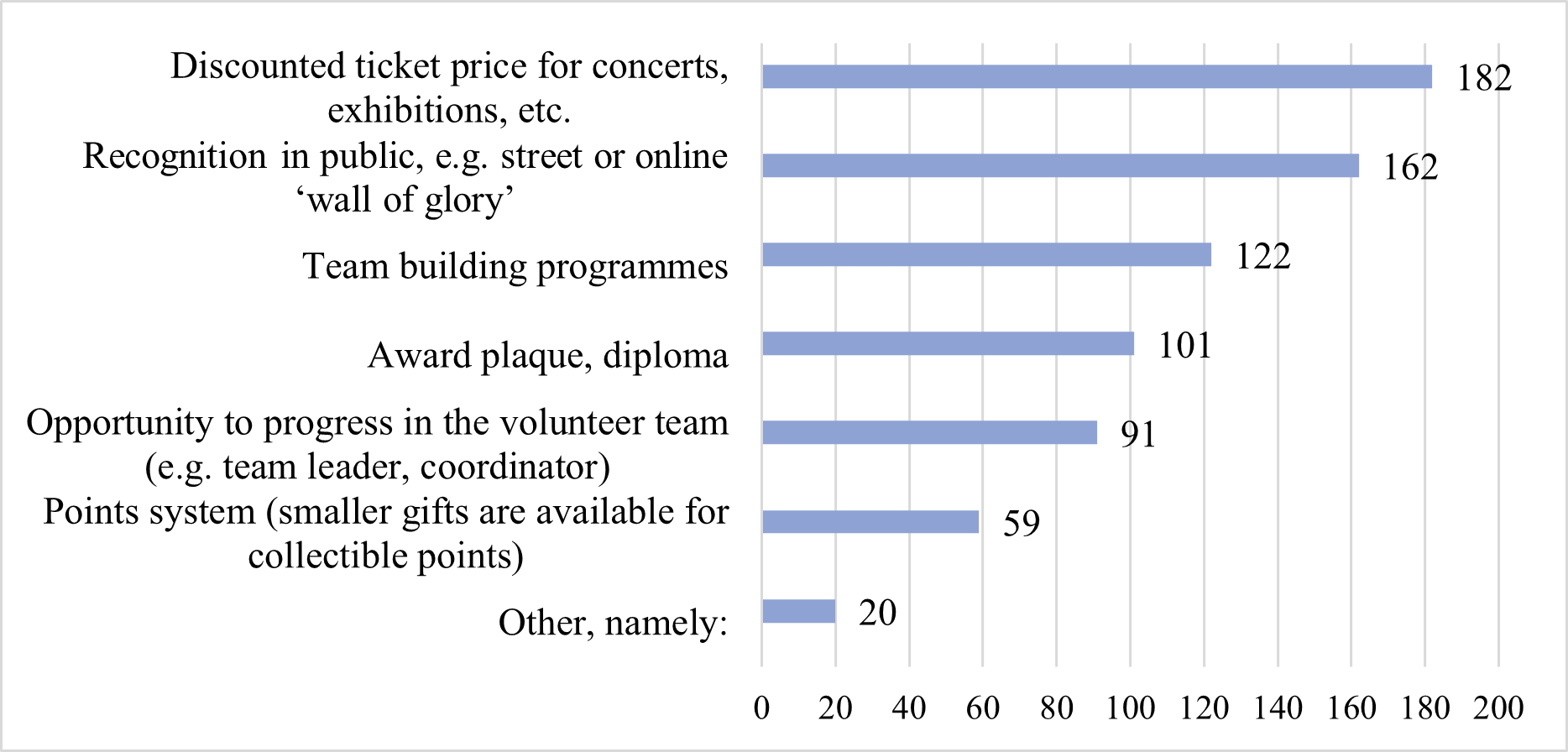
What kind of tools can be used to motivate volunteers? (You can indicate more answers.)
Figure 1 represents the results of RP2/Question 4, which was a multiple choice question, and the number of markings were altogether 737.
Figure 1: Non-monetary rewarding tools for motivating volunteers
Source: Kruppa-Jakab (2020)
The ‘Other’ category was marked by 20 respondents: We have grouped their comments in four main categories: 1. appreciation of one’s work, one’s importance, 2. career-building opportunities, 3. Training opportunities, 4. financial remuneration (free concert tickets, meal vouchers, boat trip, shopping coupons).
It is also important to note that RP1, which is accepted, underpins the result of Figure 1: the higher interest in the events of the ECoC, the higher participation willingness of volunteers.
There are two more questions related to RP2 in the Willingness chapter of the online survey:
RP2/Question 5: Are you interested in host volunteering in the Veszprém-Balaton 2023 European Capital of Culture Volunteer System? (We have already introduced the results at RP1/Question 2.)
RP2/Question 6: Please indicate in which year would you volunteer in the local tourism in Veszprém and its surroundings? (multiple choice question)
SPSS CrossTabs analysis was used to analyse the data regarding Question 5 and Question 6.
The findings (based on the number of markings) show that those local citizens who are interested in host volunteering in the VEB2023 ECoC Volunteering System, are also willing to remain volunteers in the preparation years (in 2021 and 2022) in the ECoC year 2023 and beyond 2023. For the ECoC year there were much more markings, and for ‘beyond 2023’, the willingness to participate was weaker. The same can be stated in case of Question 6.
To conclude, the research proposition is accepted: RP2: Those interested in host volunteering in VEB 2023 ECoC Volunteering System, are also willing to remain volunteers until 2023 and beyond.
4.3. Research Proposition 3 (RP3)
- RP3: The prestige of the Veszprém-Balaton 2023 ECoC programme motivates residents to be host volunteers in the Veszprém-Balaton 2023 ECoC Volunteering System.
To examine how the prestige of the VEB2023 ECoC programme influences the willingness of host volunteering, two questions in the Prestige chapter of the questionnaire were asked from the respondents:
RP3/Question 1: Please rank the prestige of the Veszprém-Balaton 2023 European Capital of Culture programme! In my opinion, the prestige level (reputation, power, cachet, dignity) of the Veszprém-Balaton 2023 European Capital of Culture programme is: (7-point Likert scale)
The average prestige level, based on the answers of 302 respondents is 5.219, which means a high prestige on the 7-point Likert-scale. The median of the dataset is 5. The modus is 5, which means that this is the most frequent value in the dataset.
It is important to note that the VEB2023 ECoC title was announced in December 2018 and this survey was carried out in autumn 2020, so it has not taken quite two years to build up the prestige of the VEB2023 programme to a high level. However, the overall perception of the ECoC programme might also be reflected in this result.
RP3/Question 2: To what extent does the prestige of the VEB 2023 European Capital of Culture programme influence your willingness of volunteering in the VEB 2023 ECoC Volunteering System?
The average value of the 302 responses is 3.424, which means that the prestige of the VEB2023 ECoC programme does not influence much the willingness of volunteering in the VEB 2023 ECoC Volunteering System (on the 7-point Likert-scale). However, the average does not express the correlation between the two variables, therefore a correlation analysis is needed. The median of the dataset is 3. The modus is 1, which means that this is the most frequent value in the dataset. We have examined the correlation between the prestige and the willingness of host volunteering. Prestige and willingness were both evaluated on a 7-point Likert-scale by 302 Veszprém citizens. The two variables are both measured on scales. We have examined whether there is a linear correlation between the two variables. The SPSS software was used to calculate the Pearson-correlation coefficient (r).
The results can be seen in Table 5. The Pearson Correlation coefficient, r=0.302, which means there is a positive, medium strength relation between the variables (the prestige and the willingness to host volunteering). It is significant, because it is below 0.05 (Sig.:0.000). There is a linear correlation justified: the increase of the prestige of Veszprém-Balaton 2023 ECoC programme increases the willingness of residents to be host volunteers in the Veszprém-Balaton 2023 ECoC Volunteering System.
Table 2 Correlation of Prestige and Willingness
| Correlations | |||
| Prestige | Willingness | ||
| Prestige | Pearson Correlation | 1 | ,302** |
| Sig. (2-tailed) | ,000 | ||
| N | 302 | 302 | |
| Willingness | Pearson Correlation | ,302** | 1 |
| Sig. (2-tailed) | ,000 | ||
| N | 302 | 302 | |
| **. Correlation is significant at the 0.01 level (2-tailed). | |||
Source: Kruppa-Jakab (2020)
According to the findings, we accept RP3: The prestige of Veszprém-Balaton 2023 ECoC programme motivates residents to be host volunteers in the Veszprém-Balaton 2023 ECoC Volunteering System.
4.4. Results of the Volunteer Function Inventory (VFI) included in the questionnaire
As mentioned in the Literature review 2.1 Volunteering chapter, the VFI survey (CLARY et al. 1998) belongs to the most widely used quantitative methods for assessing volunteer motivations. We included the VFI in the questionnaire.
The 302 respondents (Veszprém citizens) were grouped into three age groups:
- 15-24 years: age group of secondary school and university students
- 25-64 years: age group of active workers
- 65+ years: age group of seniors, pensioners (seniors are people over 65 years, but not retired yet, pensioners are over 65 and retired)
Based on the VFI, we summarised the main motivations of the above three age groups. The first part of the VFI is the Reasons for Volunteering. Thirty statements are listed in the Motivation chapter of the questionnaire. Each statement has a number. These thirty statements are thirty reasons why people volunteer. The respondents had to indicate how important/how accurate each reason was for them (on a 7-point Likert scale, where 1 means not at all important/accurate for the respondent, 7 means extremely important/accurate for the respondent.)
The VFI methodology is the following: we have to add certain item responses according to the literature to get the scores for the different motivation functions. (The limited space of this article does not allow us to explain the VFI method in detail, but it can be found in the literature by CLARY et al. 1998) As the VFI was elaborated for an individual volunteer, it was decided to count the average of the scores given by the respondents and to add up the average scores to count the sum of the certain item responses.
Table 3: VFI Reasons for Volunteering by age groups
| Age group | Values Function | Understanding Function | Enhance Function | Social Function | Career Function | Protect Function |
| A. 15-24 | 25.77 | 25.09 | 22.63 | 16.31 | 22.29 | 17.23 |
| B. 25-64 | 26.10 | 23.33 | 22.00 | 16.60 | 15.51 | 14.90 |
| C. 65+ | 26.93 | 21.53 | 22.58 | 19.27 | 10.78 | 15.13 |
Source: Kruppa-Jakab (2020)
There are similarities and differences between the three age groups:
Values function is in the 1st place, which means that respondents want to act for important values while volunteering (humanitarianism, helping the less fortunate). Understanding function and enhancement function is in the 2nd or 3rd place (with minor differences), which means that respondents find it important to get to know the world better through volunteering, to develop their skills that are often unused, and to grow psychologically while volunteering. Social function (the will to strengthen social relationships by volunteering) is in the 4th place in case of age group B and C, but in case of age group A, social function is in the last place. The reason is probably that students have strong social relationships at school and they do not consider it that important to have new social relationships through volunteering. Another difference is that age group A finds career function more important than age group B and especially age group C (seniors, pensioners). Of course, students are more willing to seek career opportunities in volunteering than the active workers’ group and pensioners. Protective function (to reduce negative feelings, such as guilt, or to address personal problems by volunteering) is considered more important by group A and C. The reason might be that young people and seniors are more vulnerable, looking for more support from the others, and solutions for their own personal problems.
The second part of the VFI is Volunteering Outcomes, which examines the outcomes of volunteering within a certain organisation. That is why it was decided to research this part only among the Ragyogók / Shiners group, who are the members of the VEB2023 ECoC Volunteering System. The aim of the Volunteering Outcomes part is to understand this organisation better. 21 Shiners answered this part of the questionnaire. Seventeen statements are listed (which have to be evaluated on a 7-point Likert scale), plus one question is asked related to long-term intention for volunteering in this part of the questionnaire. The results show that the Shiners experienced the understanding motivation function the most (11.04/14 points) while volunteering within the organisation. The enhance function was also experienced (10.24/14 points), and the career motivation function was also rated high 9.81/14 points.
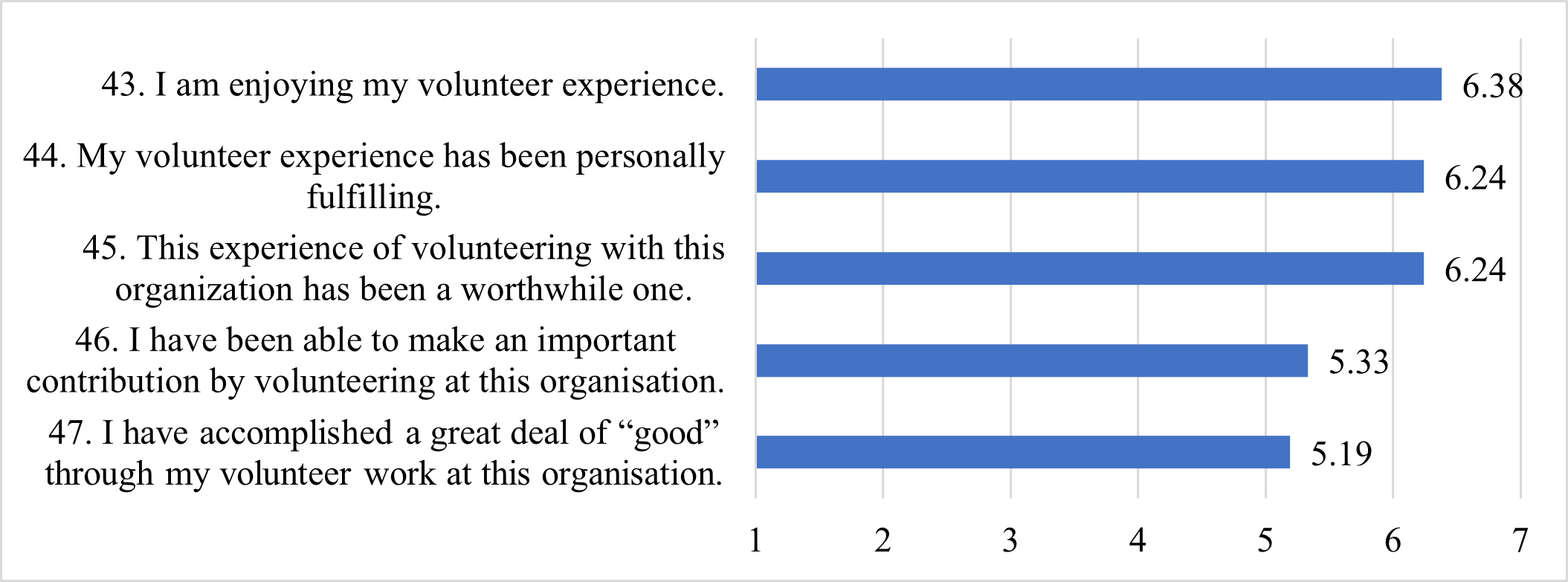
The third part of the VFI is the Satisfaction items part. The averages of the 21 Shiners’ scores of the Satisfaction items (statement 43. + 44. + 45. + 46. + 47.) were added up, and 29.38 points were given from the maximum 5×7=35 points. It means a 83.94% satisfaction ratio concerning the VEB2023 ECoC Volunteer organisation, which is a very good result. The five statements regarding satisfaction were scored as shown in Figure 2:
Figure 2: VFI – Volunteer satisfaction – VEB2023 ECoC Volunteering System (Shiners)
Source: Kruppa-Jakab (2020)
4.5. Case study
As introduced in the Research methodology chapter, a group of full time tourism and catering students at University of Pannonia were asked how the students of the university can actively be involved in the Veszprém-Balaton 2023 European Capital of Culture programme.
The students’ motivating factors, demotivating factors, critical comments and suggestions, ideas regarding the active involvement are the following:
University students’ motivating factors: Students would like to volunteer because they would like to take part in the ECoC-organised programmes, especially in concerts, festivals. (This also underpins RP1 of this research.) Music, sports and films are their favourite fields of interest (especially if famous stars, celebrities perform who make the programme more attractive for them). The good examples mentioned for ECoC-organised programmes (what students especially liked) were: Gisela Days Art Festival 2022, Off-Season Literature Festival 2022, Music Hungary and Showcase Festival 2021, Street Music Festival 2021.
Those students who volunteer on a regular basis, would like to get coupons or a discount card for ECoC-supported restaurants valid for 1 year. Verified absence (from the classes) can also be a motivating factor for student volunteers. Own community programmes organised by (and for) the students may also motivate them to take part in the ECoC and they also build a strong community.
The payment for volunteering should be the experience. The leader of the volunteer team should be understanding, flexible, not too strict, who creates a good atmosphere. Volunteering looks good in the curriculum vitae and helps to bridge generational gaps. Volunteering means an adventure, a good deed and professional experience.
University students’ demotivating factors: Students claim there is a lack of information (and lack of promotion) regarding ECoC programmes. Due to the students’ busy schedule (classes and part time work), they have a little free time for cultural programmes and volunteering. Some students claimed that “ECoC decisions were made in a bubble”, without involving the youth, which is demotivating. The poor perception of volunteering among young people (due to the compulsory Youth Community Service in secondary school) is also demotivating. Dormitories are not open in the summer, thus students can not participate in Veszprém summer festivals, programmes as volunteers (they can not be accommodated).
Critical comments: There should be more exciting programmes for the youth (e.g. creative workshops) organised by the ECoC. Students want to be involved in the decision making process. They recommend the volunteer programme to be more transparent. The ECoC image (for them) is not strong enough. In general, volunteering should be a team-builder programme, not a way of doing the dirty work.
Suggestions: Volunteer credits (ECTs) should be launched at the university. It means that students should receive credits in exchange for volunteer hours, which count into their studies. The exam period should be longer to be able to join the volunteer programme. Widening the programme opportunities for youth is advisable. In the ECoC communication, opinion leaders should be asked to spread the word about programmes and volunteering opportunities by WOM (Word of Mouth). This is the most effective method, especially in dormitories. Well-known youth ambassadors (eg. local, but nationally well-known athletes, musicians) should be asked to represent the ECoC programmes. University lecturers should be involved in the communication process to use their channels in sending out the programme information for students. Instagram is also a good tool for advertising, posting ECoC image videos to reach the students. The ECoC team should make more appearances at university events with own pop-up stand (even at the dormitories) to introduce the ECoC project and the Shiners to the students. It was also suggested that tourism and catering students and community organiser students should be involved in the ECoC meet & greet programmes, taking advantage of the fact that they are studying these subjects. These students could be brought together in a common event management course and the task would be to organise a larger event.
Volunteering is not the only way for students to be involved in the ECoC programmes. Internship opportunities at the ECoC organisation, or the Community Hubs of the ECoC, or even part time jobs should be offered for students. Youth can also join the ECoC by working on their own project. ECoC-themed courses and theses/dissertations are also interesting for them. International students should be also involved in volunteering. They need clear instructions in English and attractive programmes, trendy ECoC merchandising products as gifts, which make volunteering more attractive for them. Also, exploring the Veszprém-Balaton ECoC region together with the Hungarian students may be a good motivating tool for them.
University students also suggested that volunteering should be promoted among high school students, too. However, due to the compulsory Youth Community Service in secondary school, their perception of volunteering is deteriorating.
5. Suggestions and conclusions
According to the literature review, the most important difference that distinguishes host volunteer motivations from voluntourist (guest volunteer) motivations is welcoming visitors as ambassadors of the place and showcasing their home town or region. Hospitality of the locals is a key to the success of the ECoC programme. Hosts and guides of cultural attractions, event hosts, group and V.I.P. attendants, survey interviewers, auditorium coordinators, information providers are those front line volunteers who need a special training about the hospitality programme and the event or attraction they are volunteering at. The vast majority of 302 respondents are interested in the proposed events of VEB2023 ECoC programme as guests. The long-term intention of the respondents shows that they would like to volunteer in the local tourism (in Veszprém and its surroundings) in the preparation years and to continue volunteering beyond 2023, too. They are mostly interested in volunteering in the ECoC year, 2023.
Values (helping others) are in the first place regarding motivation functions of the potential host volunteers. Understanding and enhancement is in the top three motivation functions of potential host volunteers and volunteering outcomes of the Shiners alike. There are differences between the motivations of the three age groups examined. Youngsters are motivated more by career opportunities at the host organisation or at other organisations they contact while volunteering, while for the active workers’ age group and for seniors and pensioners, this is less important. For them, social functions (new relationships, a new community) are more motivating. Veszprém citizens assessed the prestige of the VEB2023 ECoC programme as high. Prestige is influencing the participation willingness in the VEB2023 ECoC Volunteering Programme. There is a significant interest in the VEB2023 ECoC events, and those who are interested in the events, have higher willingness to participate in host voluntary activities. The vast majority of respondents believe that volunteers can be motivated by non-monetary rewarding tools. The access to the ECoC events, concerts, exhibitions at a discounted price or for free is the most important motivating tool, which can help retaining volunteers in the VEB2023 ECoC Volunteer Programme on a long run. It also coincides with one of the accepted research propositions: those residents, who are interested in the ECoC events, are more likely to volunteer in the VEB2023 ECoC Volunteering System.
Our case study findings show that volunteering is not the only way for students to be involved in the ECoC programmes. Internship opportunities at the ECoC organisation, or the Community Hubs of the ECoC, or even part time jobs should be offered for students. Youth can also join the ECoC by working on their own project. ECoC-themed courses and theses/dissertations are also interesting for them. The University of Pannonia used the students’ suggestions and created the Vounteer Credit (90 hours of volunteering in ECoC programmes gains them 3ECTs) and also the ECoC Course has been running since 2019, which is very popular and successful among Hungarian and international students.
To outline some future research topics, it is important to create a competency map of Shiners, to be able to assign the most appropriate volunteer tasks to the right volunteer. Another research field can be examining the level of trust between the stakeholders of VEB2023 ECoC, especially between volunteers and the host organisation. A longitudinal research, repeating the same survey in Veszprém, and in the Lake Balaton region is also suggested.
Reference List
Adongo, R. – Kim, S. – Elliot, S. (2019): “Give and take”: A social exchange perspective on festival stakeholder relations. Annals of Tourism Research 75, pp42-57. Retrieved 3 May, 2020 from https://www.sciencedirect.com/science/article/pii/S016073831830135X
CNAAN, R. A. – HANDY, F. – WADSWORTH, M. (1996): Defining who is a volunteer: conceptual and empirical considerations. Nonprofit and Voluntary Sector Quarterly 25: 364-383 Retrieved 2 May, 2020 from https://www.researchgate.net/publication/249676933_Defining_Who_Is_a_Volunteer_Conceptual_and_Empirical_Considerations
CLARY, E. G. – SNYDER, M. – RIDGE, R. D. – COPELAND, J. – STUKAS, A. A. – HAUGEN, J. – MEINE, P. (1998): Understanding and assessing the motivations of volunteers: A functional approach. Journal of Personality and Social Psychology 74: 1516-1530. Retrieved 2 May 2020 from https://doi.apa.org/doiLanding?doi=10.1037%2F0022-3514.74.6.1516
Holmes, K. – Smith, K. A. – Lockstone-Binney, L. – Baum, T. (2010): Developing the Dimensions of Tourism Volunteering. Leisure Sciences: An Interdisciplinary Journal. 32:255-269. Retrieved 25 April, 2020 from https://www.researchgate.net/publication/232871650_Developing_the_Dimensions_of_Tourism_Volunteering
Holmes, K. – Smith, K. (2009): Managing Volunteers in Tourism: Attractions, Destinations and Events. Wallingford, England: Elsevier Butterworth-Heinemann: 6-12 Retrieved 26 April, 2020 from: https://books.google.hu/books?hl=hu&lr=&id=fs4sBgAAQBAJ&oi=fnd&pg=PP1&dq=managing+volunteers+in+tourism&ots=pKKQbt5x3p&sig=LNJmh7DkFBEM6sPb0uxglTiXKyU&redir_esc=y#v=onepage&q=managing%20volunteers%20in%20tourism&f=false
KRUPPA-JAKAB É. (2020): Veszprém citizens as potential host volunteers in the Veszprém-Balaton 2023 European Capital of Culture Programme. Dissertation. MSc in Tourism Management. University of Pannonia, Faculty of Business and Economics.
Lőrincz K. – Raffay Á. (2019): „Beyond, azaz túllépni saját magunkon” – A turizmus szerepe a Veszprém 2023 Európai Kulturális Főváros projektben. Turisztikai és Vidékfejlesztési Tanulmányok 4 (2):19 Retrieved 30 April, 2020 from https://www.researchgate.net/publication/341000645_Beyond_azaz_tullepni_sajat_magunkon_a_turizmus_szerepe_a_Veszprem2023_Europai_Kulturalis_Fovaros_projektben#fullTextFileContent
Puczkó L. – Rátz T. (2017): Az attrakciótól az élményig. Budapest: Akadémiai Kiadó. Retrieved 26 April, 2020 from: https://mersz.hu/hivatkozas/dj235aaae_161_p25#dj235aaae_161_p25
Sin, H. L. – Oakes, T. – Mostafanezhad, M. (2015): Traveling for a cause: Critical examinations of volunteer tourism and social justice. Tourist Studies Vol. 15(2): 119-131 Retrieved 2 May, 2020 from https://www.researchgate.net/publication/282686995_Traveling_for_a_cause_Critical_examinations_of_volunteer_tourism_and_social_justice
Smith, K. A. – Holmes, K. (2011): Visitor centre staffing: Involving volunteers. Tourism Management 33 (3): 562-568. Retrieved 2 May, 2020 from https://www.sciencedirect.com/science/article/pii/S026151771100121X
Uriely, N. – Reichel, A. – Ron, A. (2003): Volunteering in Tourism: Additional Thinking. Tourism Recreation Research Vol. 28(3): 57-62. Retrieved 26 April, 2020 from https://www.researchgate.net/publication/271725693_Volunteering_in_Tourism_Additional_Thinking
Wearing, S. – McGehee, N. G. (2013): Volunteer tourism: A review. Tourism Management 38:120-130 Retreived 2 May, 2020 from https://www.researchgate.net/profile/Stephen_Wearing/publication/271725707_Volunteer_Tourism/links/5661f2de08ae418a78693bd1/Volunteer-Tourism.pdf
WILSON, J. (2000): Volunteering. Annual Reviews Sociol. 26: 215-240. Retrieved 26 April, 2020 from https://www.annualreviews.org/doi/full/10.1146/annurev.soc.26.1.215#_i2
Other references
KÖZPONTI STATISZTIKAI HIVATAL (KSH) (2016): Az önkéntes munka jellemzői. Retrieved 2 May, 2020 from https://www.ksh.hu/docs/hun/xftp/idoszaki/pdf/onkentes.pdf
Veszprém-Balaton Régió Kultúrájáért Közalapítvány (2020): VEB 2023 ECoC Volunteer Guidelines https://veszprembalaton2023.hu/blob/volunteer-guidelines.pdf (2022.12.10.)
Veszprém-Balaton 2023 Jsc. (2020): In Progress 2020. Official brochure published by the company.
ÚJ NEMZEDÉK KÖZPONT NONPROFIT KFT. – GYORGYOVICH, M. (2018): Az Önkéntesség Magyarországon 2018 kutatás első eredményei http://unp.hu/hir_docs/147_onkentesseg_2018.pdf (2022. 12. 11.)
Kiemeltt kép forrása: https://helloragyogok.hu/oldal/a-ragyogok