

REVIEWING THE EFFECTS OF WORLD EXPOS: PULSAR EVENTS FOR THE EVENTFUL CITY?
1Greg Richards
1Full Professor, Tilburg School of Social and Behavioural Sciences, Tilburg University, Netherlands; G.W.Richards@tilburguniversity.edu
DOI: 10.15170/TVT.2023.08.03.05
Abstract
Expos, festivals and events have become increasingly important as tools of urban development in recent decades. The competitive drive to put cities on the global map has led many to adopt event-based strategies, including the creation of ‘eventful cities’, ‘festival cities’ and ‘event portfolios’. World Expos have taken on a particular significance as ‘pulsar events’ that can shape the host city through urban development, increased tourism and place branding. Each host city also uses the event in a different way, and gives it a unique flavour that tempers the eventual effects. This paper reviews the literature on World Expos and their effects, identifying themes including Place branding, Tourism flows, Resident attitudes and Architecture and urban development. It then analyses the experience of Barcelona, twofold Expo host and a ‘paradigmatic’ example of a city developed through mega events.
Keywords: Barcelona, festival cities, place branding, tourism flows, urban development, World Expos
Received: 10 July 2023
Accepted: 10 September 2023
Published: 30 September 2023
A VILÁGKIÁLLÍTÁSOK HATÁSAINAK ÁTTEKINTÉSE: PULZÁLÓ ESEMÉNYEK AZ ESEMÉNYDÚS VÁROS SZÁMÁRA?
Absztrakt
A világkiállítások, fesztiválok és rendezvények a városfejlesztés eszközeként egyre fontosabbá váltak az elmúlt évtizedekben. A városok világtérképre való felkerülésére irányuló versenyhelyzet sokakat arra késztetett, hogy eseményalapú stratégiákat alkalmazzanak, beleértve az „eseménydús városok”, „fesztiválvárosok” és „eseményportfóliók” létrehozását. A világkiállítások különös jelentőséget kaptak, mint „pulzáló események”, amelyek a városfejlesztés, a turizmus növekedése és a helymárkázás révén alakíthatják a fogadóvárost. Minden egyes fogadóváros másképp nyúl az eseményhez, és egyedi jelleget ad neki, ami mérsékli az esetleges hatásokat. Ez a tanulmány áttekinti a világkiállításokkal és azok hatásaival foglalkozó szakirodalmat, és olyan témákat taglal, mint a helymárkázás, a turistaforgalom, a lakosok hozzáállása, valamint az építészet és a városfejlesztés. Ezt követően Barcelonát állítja az elemzések középpontjába, amely kétszeres világkiállítás fogadóvárosként „paradigmatikus” példája a megaesemények által fejlesztett városnak.
Kulcsszavak: Barcelona, fesztiválvárosok, helymárkázás, turistaforgalom, városfejlesztés, világkiállítások
Benyújtás ideje: 2023. július 10.
Elfogadás ideje: 2023. szeptember 10.
Közlés ideje: 2023. szeptember 30.
1. Introduction
The shaping of cities by events, and vice versa, is a trend that has gained increasing attention in recent decades. First framed by Sabaté Bel – Frenchman – Schuster (2004), recognition of this reciprocity has given increasing power to a model of urban development based on events. The idea that major events could be used as tools for achieving a wide range of urban policy goals crystallised into the concept of ‘eventful cities’ (Richards – Palmer 2010). Cities also began to develop more varied and diverse ‘event portfolios’ (Antchak – Lück – Pernecky 2021) or to position themselves as ‘festival cities’ (Gold – Gold 2020, Richards – Leal Londoño 2022).
Such models have spread around the world, propagated by consultants and ‘policy tourists’ eager to find new approaches to urban development and economic regeneration. The previous hegemony of Europe and North America in the Expo field is gradually disappearing, with cities in Asia, Latin America and the Middle East hosting events. The World Expo held in Dubai between October 2021 and March 2022 was hailed as a success in spite of the challenges posed by Covid. The event attracted more than 24 million visits, very close to the expected total of 25 million. Reflecting the effect of Covid, more than 200 million visits were also made virtually to the Expo website. The Dubai Expo site will soon be transformed into District 2020, “a smart and sustainable city centered on the needs of its urban community”, which will “provide a curated innovation-driven business ecosystem that brings together global minds and embraces technology and digital innovation to support industry growth” (Richards 2021).
Such results do not come cheap, however. The Dubai infrastructure cost alone was $7 billion, and the event needed the combined efforts of 30,000 volunteers to keep things running. This paper aims to assess the contribution of Expos to the cities that host them. Can an Expo act as a pulsar event to transform a city? Can it help to make a city more wealthy, happier and produce a better quality of life? We review some of the evidence to come up with some pointers.
2. The World Expos: An eventful history
The regular staging of World Expos in different parts of the world over the past 170 years is a reflection of the growing role of events in urban and regional development. A review of the World Expos by Greenhalgh (2011) develops a typology of these events, which are usually hosted by countries and based in cities, and which reflect the need of places to position themselves in the face of growing global competition. In the ‘Beginnings’ phase (1851–1875) the Expos tended to reflect the imperial ambitions of countries such as the UK and France, celebrating their manufacturing prowess. During the following ‘Golden age’ of Expos between 1875 and 1915, events were held with increasing regularity and growing visitor numbers. Over 50 million visits were made to the Paris Expo in 1900, ten times the attendance at the previous Paris Expo in 1855. After the First World War, there were a series of ‘Modern expos’, of which the American ‘century of progress exhibitions’ were particularly important in the period 1925–1970. Between the World Wars, America adopted the Expo format to celebrate the progress and increasing prominence of the New World, reversing the previous colonial flow with extensive participation in Expos in Europe. From 1970–2000 a series of ‘Postmodern expos’ were held, starting with Osaka in Japan, which presented the theme “Progress and Harmony for Mankind”. Increasing awareness of environmental issue stimulated ‘Expos for the future and sustainable development’ from the year 2000 onwards. The 2020 Expo in Dubai sits comfortably in the sustainable development category, with its Sustainability District arranged around the Sustainability Pavilion.
Scholars have differing views of the role of Expos and World Fairs. As Jacobson (2011) notes: “Paul Greenhalgh has argued that exhibitions ‘catered to the educated as well as the ignorant, providing a formula and a rationale for national culture which was capable of being interpreted by a wide cross-section of the population’. Rob Kroes and Robert Rydell, experts on America’s ‘world’s fairs’ and mass culture, have described these spectacles as ‘primary weapons in the cultural arsenals of emerging nation-states’”. The view of the Expos as vehicles for nation branding ignores the fact that they are always staged in a specific city. This means that national ambitions are often tempered by local development agendas and political debates. For example, Gotham (2011) sees the Expos becoming ‘spectacles of contestation’, in which social and political conflicts emerge as a result of the gap between promised benefits and incurred costs.
Unlike in the past, where opposition to mega events was often muted or exceptional, today we witness the proliferation of a variety of mobilisations and sustained protests led by opposition coalitions dedicated to drawing global attention to the inequities and anti-democratic nature of spectacles (Gotham 2011: 209–210).
In spite of increasing local contestation, cities keep bidding for Expos. Their ability to attract attention and resources means that they play a powerful role in changing the image and the physical realities of the cities that host them. These changes can also be long term. The Great Exhibition in London left a physical mark on the city that is visible to this day in public spaces and cultural institutions. In this sense, an Expo fits into the category of a ‘pulsar event’ (Richards 2015), as a happening which changes the place in which it is staged. Pulsar events are also arguably an integral part of ‘eventful city’ strategies (Richards – Palmer 2010).
An essential quality of an eventful city is that it deliberately uses a programme of events to achieve wider urban goals. This is certainly the case of successive Expos, most of which have explicit urban development goals, or image development or tourism development aims. This paper reviews the experience of the Expos in recent decades and attempts to assess the extent to which Expos have been successful in affecting their host cities and regions.
3. Literature review
The volume of literature related to events and festivals has been growing steadily in recent years, and the analysis of the staging and effects of mega-events such as the Expo has become an important segment of event studies. Not surprisingly, the study of Expo events tends to be boosted by the staging of an Expo. A search of Scopus using the search term “World Expo” over the period 1980 to 2021, for example, reveals a clear peak of research effort linked to the 2010 Shanghai World Expo. The peak year for Expo research to date has been 2011, when over 70 studies appeared (Figure 1), the vast majority from Chinese scholars. The Milan World Expo in 2015 produced a much smaller peak, with 31 studies appearing in that year. There is no sign yet that the Dubai Expo will generate a large number of studies – to date there were only 9 World Expo publications in 2021, for example. Because of the dominant role of the Shanghai Expo in the literature, most authors are also based in China (Figure 2).
Figure 1: Number of papers on World Expos by publication year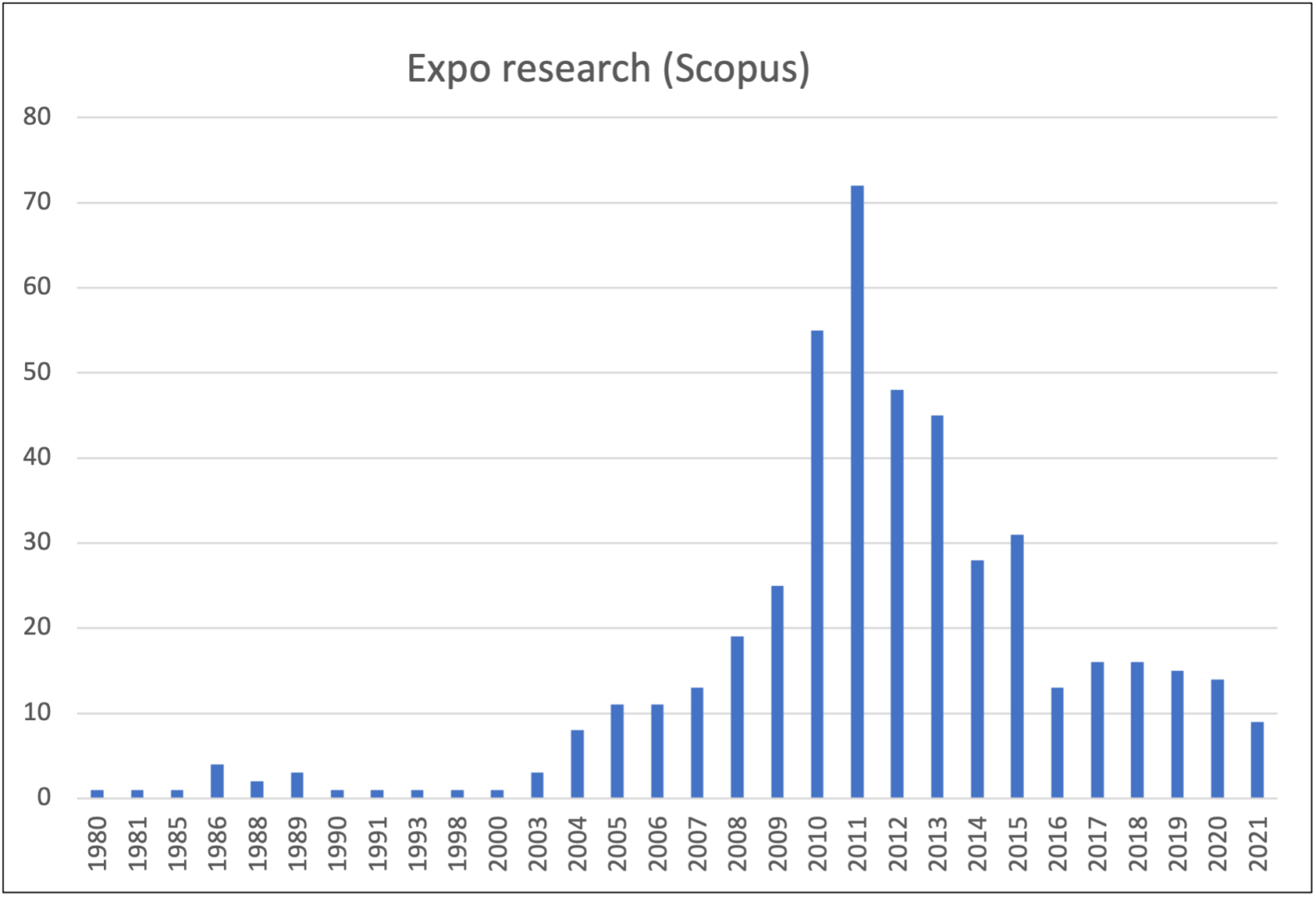 Source: own editing
Figure 2: Country of lead author for Expo publications
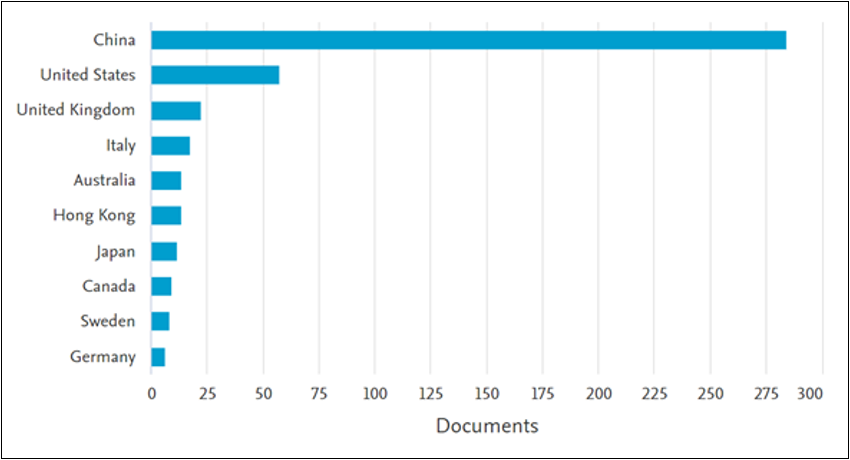
Source: own editing
The majority of publications linked to the World Expo are from engineering disciplines. Engineering aspects of the Expo that have received attention include the effects of large crowds on the environment, such as a study of human-induced vibration control at the Expo Culture Centre at the in Shanghai World Expo (Lu et al. 2012). This study found, for example, that tuned mass dampers can reduce floor vibration acceleration by approximately 15%. Other engineering-related research includes studies of pedestrian simulation modelling (Yue et al. 2009) and urban aerosol characteristics during the world expo 2010 in Shanghai (Zhang et al. 2013).
4. Expo research themes
In the social sciences and management disciplines that are more usually related to event studies, most Expo research tends to revolve around issues of event scale, projection and impact. The main themes encountered in the literature review were Place branding, Tourism flows, Resident attitudes and Architecture and urban development.
4.1. Place Branding
The branding of Expo events is an important issue, since Expos develop their own brands, and try and support the brand or image of their host city, and to increase awareness and reputation. Dynon (2011) saw the Shanghai Expo as a “public relations set piece” tied not to the city but rather to the political legitimacy of the Chinese Communist Party. He argued that the branding raised ethical questions about the reality of the city’s spectacular image. The presentation of the city as a harmonious place did not chime with negative media coverage. Instead, the branding of the city represented an aspiration for an imagined future rather than current reality. Callahan (2012) argues that the Shanghai World Expo in 2010 was ‘the Olympics for Culture, Economy and Technology’, one of the mega events designed to show ‘the Real China’. The Expo arguably posed a ‘globally networked and climate-friendly lifestyle’ as the acceptable middle-class dream. Callahan contrasts this centralised view of a unified future with the work of Shanghai’s citizen intellectuals, such as filmmaker Jia Zhangke. He argues that they are creating alternative futures that contrast with the official line of the Expo events.
Shin (2012) analysed the Shanghai World Expo as part of a ‘mega-event troika’ of spectacles organised by China, the 2008 Beijing Olympic Games and the 2010 Guangzhou Asian Games. These presented the rhetoric of a ‘Harmonious Society’ “in order to create a sense of unity through the consumption of spectacles, and pacify social and political discontents rising out of economic inequalities, religious and ethnic tensions, and urban–rural divide.” In supporting China’s role as the ‘factory of the world’, the Expo and other mega events also provide spectacles to ease social and political tensions in the country.
Similarly, Xue – Chen – Yu (2012) also questioned the branding ethics of Shanghai 2010 through a content analysis of all Shanghai-related news reports in English newspapers in ten countries. This indicated that the Expo did change newspaper attitudes towards Shanghai, and particularly its future potential. However, their post-event assessment also indicated that effects were short-lived. In common with Hildreth (2008) they conclude that actions speak louder than words – improve your reality rather than polish the brand. A netnographic study by Larsen (2014) of foreign residents’ perceptions of Shanghai indicated that they were predominantly negative, with social media emphasising pollution, congestion and rudeness of the local population. They conclude there is a dissonance between the officially communicated brand identity and the word-of-mouth communication on social media.
Yu – Wang – Seo (2012) analyzed the perceptions of Chinese tourists of the Shanghai Expo and levels of visitor satisfaction. The hosting of the World Expo had significant positive impact on Shanghai. Local residents were particularly important in supporting the positive image with their hospitality and volunteering, supporting the host city brand and increasing tourist loyalty to the city as a destination.
4.2. Tourism flows and visitor experience
Improving the image of the host city often goes hand in hand with the development of tourism flows. In the case of the Milan Expo in 2015, Sainaghi et al. (2019) found that the event was able to improve hotel performance and to combat seasonality in tourism flows. There was also evidence of increased diversification in tourist demand.
Experience was found to influence visitor satisfaction at the Expo 2012 in South Korea. Song – Ahn – Lee (2015) undertook surveys that showed that the aesthetic experience was the most important of Pine – Gilmore’s (1999) four dimensions, followed by entertainment experience. Perceived quality also had an important influence on satisfaction, and therefore on the overall effect of the Expo. Wang – Lu – Xia (2012) constructed a structural equation model for the relationship among tourists’ perceived value dimensions, behavioural intentions and revisit intentions at the Shanghai World Expo. They found that utilitarian value and enjoyment value significantly affected both inbound and domestic tourists’ behavioural intentions. The influence of utilitarian value on intentions was more significant for inbound tourists, while enjoyment value had a more significant influence for domestic tourists.
Much tourism-related research on mega events revolves around visit intentions, particularly because the scale of the event makes it important to forecast visitor numbers. Visit intentions are important in gauging the level of likely demand, but the question arises: how many of those intending to visit an Expo actually do so? In South Korea, approximately 50% of the respondents with intentions to visit actually attended the Expo 2012 in Yeosu (Lee et al. 2014). The research found that stronger visit intentions also produced a greater likelihood of visiting. However, this effect was tempered by distance – the further people had to travel, the lower the rate of realised visits. Further research by Kah – Lee – Lee (2016) compared those who travelled to the 2012 Yeosu Korea Expo with those who did not. They found that non-travellers were most likely to be in the 20–29 age group and in the lowest income group. They concluded that intention not to visit is a more effective predictor of subsequent behaviour than the intention to visit.
Mou et al. (2020) analysed Flickr photos taken over the period 2004–2018 by foreign visitors in Shanghai. They concluded that “the hosting of the World Expo undoubtedly changed the structure of the Shanghai inbound tourism network. It can, thus, be concluded that World Expo played a positive role in promoting Shanghai tourism.” The number of tourists using Flickr exhibited a distinct peak during the World Expo, and the Expo also expanded the number of sties visited by inbound tourists. But the effects of the Expo in Shanghai were not evenly distributed spatially or across economic sectors. Sun – Ye (2010) note that although the Shanghai Expo stimulated greater growth in construction and tourism, this was not accompanied by growth in foreign trade and in the finance, insurance and real estate (FIRE) industries.
4.3. Resident reactions
A longitudinal study examining resident attitudes to the Shanghai Expo was conducted by Ye et al. (2012). They found a high level of resident support for the event both before (86.2%) and during the event (91%). Image enhancement was seen as the most positive impact, while negative impacts included increased prices, traffic problems, crowding and congestion.
The role of Expos in stimulating community participation was examined in Shanghai by Lamberti et al. (2011). They conducted interviews with those involved in the organisation of the 2010 World Expo, and found that the Expo stimulated a significant enlargement of the stakeholder groups involved in decision-making, including some outside the “dominating elites”.
One important role of residents as event stakeholders is volunteering for events. Wang – Wu (2014) examined the motivational factors of the 2010 Shanghai World Expo volunteers and the inter-relationship between volunteers’ motivation, experience, and satisfaction. The result shows that the prime motivations for the World Expo volunteers are those items focusing on doing something good for the organization and society, such as “Expression of Values”, “Career Orientation”, and “Love of Expo”.
Recent Expos have emphasised sustainability, but what impact does this have on the residents of the host city? Guizzardi – Mariani – Prayag (2017) found that Milan residents thought that the 2015 Expo would have minimal negative and positive environmental impacts. Resident perceptions of environmental certification of the event were positively related to their overall attitude toward the Expo, reflecting research on resident support for other events (van der Steen – Richards 2021). A minority of residents were aware of the environmental certification of the event, indicating the need for better communication. Magno – Dossena (2020) also surveyed residents of Milan three years after the end of Expo Milano 2015, analysing their perceptions of the effects of a mega-event on their Quality of Life (QOL). They found that hosting a mega-event such as an Expo is a way to reinforce community pride, which then increases perceived QOL. Unlike some other studies, the results indicated that the effects continued after the event and into the medium term. They suggest that the cost of investments in infrastructure for such Expo events are outweighed by the benefits in QOL.
5. Architecture and urban development
As Sykta (2020) notes, one of the major legacies of the Expos is urban development. “Whenever a particular city organised a World Exhibition, it exploited the occasion to show off any urban improvement it had introduced. During the Paris Exhibition of 1867 visits were organised to the city sewers” (Cardoso de Matos 2004: 229). In more recent times the urban development role of the Expos has been strengthened by processes of ‘urban entrepreneurialism’, originally imported to Europe from the US. Public-private partnerships are now regularly used to redevelop and regenerate spaces used for Expo events.
In the case of Lisbon, for example, Carrière – Demazière (2002) analysed the development of the 1998 Expo site. They argue that Expo 98 was considered not just as an event but as a catalyst for urban restructuring. The overall aim was to give Lisbon a stronger international profile by promoting its Atlantic coastal position. Internally, the event was supposed to allow residents of Lisbon to ‘rediscover the river’, echoing Barcelona’s rediscovery of the sea through the 1992 Olympics (Richards 2016). The Lisbon Expo was envisaged as a new city centre, and the development included reorganisation of the road system and attempts to restructure the entire urban area through the redevelopment of brownfield sites. Also in common with the Barcelona Olympics, involvement of private investment was stimulated through new types of partnership. The development of the Expo site was hampered by tight time constraints on the opening of the exhibition, with only four years between the first phase of work on the site and its opening to the public. This left few opportunities for consultation with the local population or for more strategic urban planning. Questions were therefore raised about the multiplier effects of the project, its links and connections with the rest of the urban area, its social impact and its financial consequences.
Sun – Ye (2010) found that after winning the bids for the Olympics and the World Expo, Beijing and Shanghai experienced greater growth in construction and tourism, a speeding-up in economic development and restructuring, and an improvement in physical infrastructure. However, the enhancement of global exposure was not accompanied by growth in foreign trade and in the finance, insurance and real estate (FIRE) industries. This seems to indicate that Expo events have a greater impact on physical development of cities than on the broader urban ecosystem.
The problems related to the strategic effects of Expo events points to challenges of governance. Based on 17 years of longitudinal and in-depth analysis of the World Expo 2010 during its bidding, preparation, operation, and post-development stages, Li et al. (2018) studied the evolution of governance in the Shanghai event. They identified a mixed governance structure of vertical integration and an elite management system, supported by a multi-layer structure, which included government and quasi-government owned companies.
This review indicates that most research on the Expos has had a fairly narrow focus. Not only is the range of subjects fairly limited, with an emphasis on branding, tourism and resident attitudes, but the geographic and time coverage is also relatively restricted, as reflected in Figures 1 and 2. The following case study of Barcelona examines a broader range of issues arising from event-based development.
6. Using Expos for strategic urban development tool: Examples from Barcelona
Barcelona, as one of the few cities to host more than one Expo, is seen by Caramellino – de Magistris – Deambrosis (2011) as a ‘paradigmatic example’ of a Mega Event city. Perhaps the desire for Barcelona to ‘put itself on the map’ through events can be traced back to its long-standing rivalry with Madrid. As Richards (2004) describes:
“The desire of Barcelona to develop independently of Madrid also led to city to embark on an ambitious series of event-led developments. The first of these was the World Exhibition of 1888, which put the city on the international map and developed the Cuitadella area of the city, there was a second World Exhibition in 1929 which developed the area around Placa Espanya and Montjuïc, and probably the most famous example was the Olympic Games, which developed the Olympic stadium and other sports facilities on Montjuïc, as well as creating the Olympic Village and Port Olympic, and opening up Barcelona to the sea.”
If rivalry with Madrid was an important early spur for event development, there were other aspects of the city itself that facilitated the development of events. Barcelona was a major centre for industry in the 19th century, and it used the Expos as a showcase for its products as well as its progress in architecture and urban design. Garcia-Ramon – Albet (2000: 1331) argue that “The Universal Exhibitions of 1888 and 1929 may be seen as milestones because they brought about lasting changes in the urban design of the city, besides bringing international attention”.
The first Expo in Barcelona was staged in 1888 as an attempt to profile the Catalan capital as an important trading and manufacturing city. “The 1888 exhibition was held at the Ciutadella Park and included an impressive Hall of Machines alongside other technological attractions such as a huge captive balloon and the sumptuous electric lights of the Palacio de la Industria” (Valentines-Álvarez – Sastre-Juan 2019: 135). Torreblanca (2015) argues that Barcelona was in a good position to stage a universal exhibition comparable to London and Paris. It also wanted to beat Madrid to being the first Spanish city to stage such an event.
According to Nieto-Galan (2012: 39) the 1888 Expo contributed to a deep transformation of the city, which went far beyond the areas of the exhibition. “Examples include the building of the Columbus Monument, in honour of the discoverer of America, and the construction of the ephemeral International Hotel (Hotel Internacional), which became the meeting point of national and international elite visitors. In the city, those impressive constructions, near the exhibition ground, were also complemented by other spaces such as panoramas, the equestrian circus, the maritime exhibitions, which, together with other buildings and showcases became the attraction for visitors.” In spite of these urbanistic developments, the 1888 Expo did not attract much participation from the Modernist artistic movement, apart from the El castell dels 3 dragons restaurant in Barcelona from Domènech i Muntaner and a temporary pavilion by Antonio Gaudí (Torreblanca 2015).
The visitor numbers to the 1888 exhibition were relatively low compared to the previous events in Europe and North America. Whereas the London Expo in 1851 had attracted over six million visits and the 1878 Paris Expo 16 million, Barcelona only managed to generate just over 2 million visits over a longer opening period. It should be noted that Barcelona, with only 450,000 inhabitants at the time, was also a much smaller city.
In spite of the relatively low visitor numbers, Barcelona was keen to repeat the successful experience, and to go even further in terms of urban redevelopment. Torreblanca (2015) argues that the 1929 Expo stimulated significant change, even though the exhibition itself repeated the formula familiar from other Expos: large pavilions dedicated to industry and the arts, entertainment and transport facilities. Constructions for the event included the National Palau of Montjuïc, (or Palau Nacional), designed as the main building of the Expo, and now the national art museum of Catalunya. The Montjuïc Mountain also became home to Teatre Grec, the Olympic Stadium and Poble Espanyol (“Spanish Town”), an exhibition of reproductions of different urban and architectural environments from different regions of Spain. Other features developed on Montjuïc included the Magic Fountain, Montjuïc Telèferic and Port Vell Aerial Cable Car (although the latter was not completed until 1931). One thing that was missing was the invitation of foreign countries via diplomatic channels, which related to the lack of Government backing for the event.
After the 1929 Exhibition, a debate arose among the city’s elite about what to do with the pavilions and other spaces on Montjuïc. Among the proposals were an ambitious plan for a university campus and a permanent trade fair venue. Two proposals to create a permanent large-scale industrial museum were also put forward, but this failed. As with the 1888 Expo, however, many other developments happened across the city. This included the landscaping of the Plaça Tetuán, Plaça Urquinaona and Plaça Letamendi, the redesign of Plaça Catalunya, the extension of Avinguda Diagonal and the Gran Via de les Corts Catalanes. The Fira de Barcelona was developed as a permanent centre for fairs and exhibitions and Barcelona El Prat Airport was constructed. Cocola-Gant – Palou Rubio (2015: 476) quote a contemporary source thus: “the works to urbanise and embellish our city continue with notable activity, increasing the charms that Barcelona has always had and embellishing it so that its fame and prestige are consolidated in front of the numerous foreigners coming to see the International Exhibition”.
One of the architectural highlights of the 1929 Expo was the German Pavillion designed by Mies van der Rohe, which Manoliu – Gradinaru (2016) describe as a ‘cathedral of empherality’, which “brought a new model of making, understanding and living architecture”. The pavilion was dismantled in 1930 and the parts dispersed or destroyed. Even after its demise, “the Pavilion became one of the most praised and copied architectural projects of the twentieth century. The 1929 photographs, as much as the 1929 building, were copied” (Hill 2002). In 1986 a reconstruction of a second Pavilion was made on the original site, although not always following Mies’ original design.
Having staged two World Expos that had a profound effect on the city, it is not surprising that many people in Barcelona were keen to repeat the exercise once democracy was restored in the late 1970s. The first chance came with the Olympic Games in 1992, when Seville also got to host the World Expo. This echoed the situation in 1929, when Seville had also staged the Ibero-American section of the World Exhibition. Although Barcelona did not have an Expo in 1992, the Olympic Games made use of Expo-type development principles to kick-start a further transformation of the city. Apart from the facilities built for the Games itself, which included a spectacular diving pool, a velodrome and the Olympic Village, the bulk of the investment went on road improvement and remodelling of the beachfront. This transformation helped to complete a shift in Barcelona’s ambitions from being the ‘Paris of the South’ to the ‘Capital of the West Mediterranean’ (Monclús 2000). Barcelona suddenly became the ‘place to be’, with tourism growing from less than 2 million in 1990 to over 3 million in 1999. In 1999 Barcelona also became the first city to win a RIBA Royal Gold Medal for its architecture.
The city staged a programme of event-years designed to follow up on the Olympic success story, including the phenomenally successful Gaudí Year in 2002. A desire to find a mega event to repeat the success of the Olympics also led Barcelona to stage the UNESCO Universal Forum of Cultures in 2004. Walliser (2004) saw this as “a new proposal that seeks to introduce a new kind of world event beyond the world exhibitions”. Although the Forum branched out beyond the material world to present dialogues on culture and diversity, it did not meet its target of 5 million visits.
Richards (2016) argues that the relative failure of the Forum was a lack of attention to the lessons of the past. He summarises the critical success factors of the Barcleona event-led placemaking model as hinging on “permeability, mutability, tangibility”. This ‘PMT model’ included: “Permeability in making public space visible, accessible and readable; mutability in making spaces multifunctional, heterogeneous and flexible; tangibility in developing the reality behind the image of the city, which in turn impacts on the lived experience of all users of urban space.”
The Forum experience indicated that the city had forgotten these lessons. The Forum space was not easily accessible to residents of Barcelona, either economically or physically, and it failed to provide tangible benefits to locals beyond the expensive apartments and new shopping centre at the end of the Diagonal. The Forum area remained largely unloved and unused, until it was gradually integrated into the calendar of the city by the staging of events such as Primavera Sound, La Mercè and Barcelona Beach Festival. These uses remain large ephemeral, however, and as Richards (2016) notes:
“Barcelona is pock-marked with the traces of events, some of which like the Cuitadella Park or the Olympic Port have melded into and moulded the urban fabric. In all cases, however, the opening up of spaces by and for events creates a need for more events to provide animation, or the development of structures to provide more permanent forms of use.”
By using mega events as a development tool, therefore, the city has arguably become more dependent on events to ensure successful development outcomes.
The Barcelona case is certainly paradigmatic, as Caramellino – DE MAGISTRIS – DEAMBROSIS (2011) suggest, as it contains all of the elements discussed in this review: Place branding, Tourism flows, Resident attitudes and Architecture and urban development. The Barcelona brand has been built through pulsar mega events as well as the more regular and mundane ‘iterative events’ (Richards 2015). They showed an ability to stage successful mega events alongside attention to detail. But there is a sense that Barcelona may have overreached itself, and with growing social discontent, there is also increasing resistance to branding, commodification and the standard model of tourism development.
As Garcia-Ramon – Albet (2000: 1331) discuss, mega events became part of the “alleged ‘Barcelona modelʼ” that many cities tried to follow. Their doubts about the transferability of the Barcelona Model stem from their analysis of the specificities of Barcelona as a city. You can transfer ideas to other places, but you cannot transfer the context. In fact, it could be argued that the Barcelona Model is not so much a model for development, but rather part of Barcelona’s story about itself. Barcelona has always been good at creating a narrative of success, even when events have not always run smoothly (Richards – Palmer 2010). The narrative of the Barcelona Model is designed to create an imagined successful city beyond the messy reality of political, economic and social divisions.
The experience of Barcelona shows that staging Expos and similar events can produce positive outcomes, particularly where a consistent approach is taken to integrating these events into the fabric of the city. In terms of quantitative indicators, Expo events have certainly helped to make Barcelona wealthier, put the city on the map and helped to build a quality of life that attracts people from all over the world. The problem lies in separating these events and the city itself. One could argue that Barcelona and similarly successful places have become ‘eventful cities’, or even postmodern ‘city-events’. Eventful cities succeed by melding event legacies and contemporary eventfulness to lever positive outcomes for all those who live in and pass through the city.
7. Future research
This review indicates that there are a number of areas in which more research will be needed in future. The tendency of Expo research to focus on the event itself tends to obscure the complex links between the Expos, their host cities and communities and other stakeholders. Often there is a need to combine different scales of analysis to understand the dynamics of these events more fully. Gotham (2011) argues that we need a critical approach to examine the interaction of both macro and micro levels to understand how different governments and political organisations work with economic élites and private interests to produce spectacles; how different marketers and advertising agents use images and theming strategies to represent spectacles; which groups and interests oppose different spectacles; and which contending groups use spectacles to advance their own resistant agendas.
More holistic analysis could usefully take a network approach rather than sticking to more traditional stakeholder analysis, as Jarman (2021) proposes. Adopting a stakeholder approach to events tends to conceptualise different groups of stakeholders, such as local businesses or local communities, as homogeneous groups. In fact, the reality is that there are often divergent views and positions within these groups, which can be obscured by traditional approaches. As the current review has shown, there are often tensions within and between stakeholder groups that can only be exposed by critically combining different scales of analysis, as Gotham suggests.
Separating the effects of different processes or events in the development of cities hosting Expo events is also a challenging task. As more and more countries stage multiple Expos or combine different Expo-style events, it becomes difficult to trace cause and effect. Joo – Bae – Kassens-Noor (2017), for example, have analysed the effect of grouping mega events in South Korea, which staged the Summer Olympics (1988), the World Expo (1993), the FIFA World Cup (2002), and the Winter Olympics (2018). In other countries mega events have been grouped even more closely, as the ‘mega-event troikas’ in Spain in 1992 and in China from 2008–2010 demonstrate. Particularly in terms of tourism, does such temporal and spatial clustering of mega-events lead to increased tourism activity, or does it begin to undermine tourism through ‘Expo fatigue’?
The pre-Covid levels of event activity already suggested the possibility of ‘over-eventfulness’ emerging. In the Netherlands, for example, the number of festivals grew from 774 in 2013 to over 1000 in 2018, a growth of over 30%. The growth of festivals has even continued in the post-Covid era, with the number of music festivals in 2022 increasing by 10% compared with 2019. These growing levels of activity place more pressure on festival sites and the cities that host them. In many places limits have been out on the use of certain sites or on the total number of festivals that can be staged. We are also seeing growing resistance to mega-event bids by cities. Given the growing cost of staging an Expo-type event, and the difficulty of measuring the benefits, this is hardly surprising. More research is needed on the costs of such events, which often include ‘hidden’ subsidies; for example, in the form of infrastructure that is not included in the event budget. The benefits of Expos also need to be traced more effectively, and research should include more ‘intangible’ benefits such as social cohesion and quality of life.
Sustainability is also becoming a more crucial issue. When an Expo attracts tens of millions of visitors, it is difficult to see how the event can be sustainable, particularly in environmental terms. Even though the Dubai Expo had a strong sustainability content, this message may have been dulled by the fact that one third of the visitors came from abroad, many of whom came by air. Perhaps the future of Expos will lie in the promotion of virtual forms of attendance, such as those forced on Dubai 2020 by Covid-19. Without the 200 million virtual visits to Dubai in 2020 the environmental impact could have been much higher.
There is also a marked lack of longitudinal research on the Expos. Apart from more historical considerations (e.g., Gold – Gold 2005), most studies concentrate on the pre-event phase (what might happen) or the event itself (what happened in the Expo year). A handful of studies with a longitudinal approach have suggested that established wisdom about Expo legacies may not hold – but more such research is needed to gain a clearer picture. More structural longitudinal research, which follows the event development of a city over many years or even decades, is much harder to find (Richards – Rotariu 2015). Such research is challenging, because the Expo organisers themselves have little stake in measuring the long-term effects of the event, and most research funding bodies do not have the stamina for such research.
Undertaking longitudinal research would also allow us to shift our focus in terms of the value generation potential of event from historical or current value to future value. The ‘lifetime value’ of an event such as the Expo should potentially be much greater than the impact the event has in the year in which it is staged. The total value of the event will include not just the immediate impacts of tourism and image exposure, but also legacies such as social capital, public health and welfare and levels of happiness. It was interesting, for example, to compare the exuberant 2017 celebrations of the 50th anniversary of the 1967 Expo in Montreal with the previous bitter wrangling that accompanied the years spent paying off the debts (Gold – Gold 2005). Perhaps it takes decades for the Expo hangover to wear off and being replaced by a warm glow of achievement.
8. Conclusions
This review shows that Expo research has tended to stick closely to the contours of the events themselves, rather than broadening our debate in time and space and across disciplinary boundaries. The wave of research from China that accompanied the Shanghai Expo in 2010 quickly peaked and ebbed away. The suggestion emerges that Expos are seen and analysed as exceptional, embedded events, which rather goes against the universalism that characterised Expo growth in the past. Comparative studies of Expos and Expo-like events could be extremely instructive in isolating general and specific principles of these manifestations.
The sheer scale of the Expo makes this challenging, however. Not only the event itself is gargantuan, but it often acts as a ‘pulsar event’ that changes the city itself. These changes also begin well before the Expo is staged, and presumably echo long after it is gone. The scale of the event also means it is even more difficult to use as a strategic tool. As an infrequently occurring event rotating between different contexts, it is difficult to learn from and develop transferable knowledge and models for. Even so, the literature review presented here does point to some basic areas of research that have some potential to provide a body of knowledge to draw on in future. Whether this can lead to some understanding of the dynamics of ‘Expo cities’, along the same lines as ‘eventful cities’ or ‘festival cities’, remains to be seen.
Acknowledgement
A version of this paper was originally presented to the Association of Tourism and Leisure Education and Research (ATLAS) Middle East WEBINAR, in March 2022. I am grateful to the organisers of the event and ATLAS for the opportunity, and for the participants in the seminar for the insightful discussions. The webinar can be found on the ATLAS YouTube channel: https://www.youtube.com/watch?v=GJdecAJthLs
References
Antchak, V. – Lück, M. – Pernecky, T. (2021): Understanding the core elements of event portfolio strategy: Lessons from Auckland and Dunedin. International Journal of Contemporary Hospitality Management, 33(7): pp. 2447–2464. DOI: 10.1108/IJCHM-09-2020-1022
Callahan, W. A. (2012): Shanghai’s alternative futures: The World Expo, citizen intellectuals, and China’s new civil society. China Information, 26(2): pp. 251–273. DOI: 10.1177/0920203X12442
Caramellino, G. – De Magistris, A. – Deambrosis, F. (2011). Reconceptualizing Mega Events and urban transformations in the twentieth century. Planning Perspectives, 26(4): pp. 617–620. DOI: 10.1080/02665433.2011.599930
Cardoso de Matos, A. (2004): World exhibitions of the second half of the 19th century: A means of updating engineering and highlighting its importance. Quaderns d’història de l’enginyeria, 2004, Vol. 6: pp. 225–235.
Carrière, J. P. – Demazière, C. (2002): Urban planning and flagship development projects: Lessons from EXPO 98, Lisbon. Planning Practice and Research, 17(1): pp. 69–79. DOI: 10.1080/02697450220125096
Cocola-Gant, A. – Palou Rubio, S. (2015): Tourism promotion and urban space in Barcelona: historic perspective and critical review, 1900–1936. Documents d’anàlisi geogràfica, 61(3): pp. 461–482. DOI: 10.5565/rev/dag.266
Dynon, N. (2011): Better city, better life? The ethics of branding the model city at the 2010 Shanghai World Expo. Place Branding and Public Diplomacy, 7(3): pp. 185–196. DOI: 10.1057/pb.2011.21
Garcia-Ramon, M. – Albet, A. (2000): Pre-Olympic and post-Olympic Barcelona, a ‘model’for urban regeneration today? Environment and planning A, 32(8): pp. 1331–1334. DOI: 10.1068/a3331
Gold, J. R. – Gold, M. M. (2005): Cities of Culture: Staging international festivals and the urban agenda, 1851-2000. Ashgate, Aldershot.
Gold, J. R. – Gold, M. M. (2020): Festival Cities: Culture, Planning and Urban Life. Routledge, London.
Gotham, K. F. (2011). Resisting urban spectacle: The 1984 Louisiana World Exposition and the contradictions of mega events. Urban Studies, 48(1): pp. 197–214. DOI: 10.1177/0042098009360230
Greenhalgh, P. (2011): Fair World: A History of World’s Fairs and Expositions, 1851–2010. Papadakis, London.
Guizzardi, A. – Mariani, M. – Prayag, G. (2017): Environmental impacts and certification: evidence from the Milan World Expo 2015. International Journal of Contemporary Hospitality Management, 29(3): pp. 1052–1071. DOI: 10.1108/IJCHM-09-2015-0491
Hildreth, J. (2008): The Saffron European City Brand Barometer: Revealing which Cities Get the Brands They Deserve. Saffron Brand Consultants, London.
Hill, J. (2002): Weathering the Barcelona Pavilion. The Journal of Architecture, 7(4): pp. 319–327. DOI: 10.1080/1360236032000040820
Jacobson, S. (2011): Interpreting Municipal Celebrations of Nation and Empire: The Barcelona Universal Exhibition of 1888. In: Whyte, W. – Zimmer, O. (eds.) Nationalism and the Reshaping of Urban Communities in Europe, 1848–1914. Palgrave Macmillan, London, pp. 74–109.
Jarman, D. (2021): Festival to festival: Networked relationships between fringe festivals. Event Management, 25(1): pp. 99–113. DOI: 10.3727/152599520X15894679115510
Joo, Y. M. – Bae, Y. – Kassens-Noor, E. (2017): Mega-events and mega-ambitions: South Korea’s rise and the strategic use of the big four events. In: Mega-Events and Mega-Ambitions: South Korea’s Rise and the Strategic Use of the Big Four Events. Palgrave Pivot, London, pp. 1–22. DOI: 10.1057/978-1-137-53113-1_1
Kah, J. A. – Lee, C. K. – Lee, S. H. (2016): Spatial–temporal distances in travel intention–behavior. Annals of Tourism Research, 57: pp. 160–175. DOI: 10.1016/j.annals.2015.12.017
Lamberti, L. – Noci, G. – Guo, J. – Zhu, S. (2011): Mega-events as drivers of community participation in developing countries: The case of Shanghai World Expo. Tourism Management, 32(6): pp. 1474–1483. DOI: 10.1016/j.tourman.2010.12.008
Larsen, H. G. (2014): The emerging Shanghai city brand: A netnographic study of image perception among foreigners. Journal of Destination Marketing & Management, 3(1): pp. 18–28. DOI: 10.1016/j.jdmm.2013.12.003
Lee, C. K. – Mjelde, J. W. – Kim, T. K. – Lee, H. M. (2014): Estimating the intention–behavior gap associated with a mega event: The case of the Expo 2012 Yeosu Korea. Tourism Management, 41: pp. 168–177. DOI: 10.1016/j.tourman.2013.09.012
Li, Y. – Lu, Y. – Ma, L. – Kwak, Y. H. (2018): Evolutionary governance for mega-event projects (MEPs): A case study of the World Expo 2010 in China. Project Management Journal, 49(1): pp. 57–78. DOI: 10.1177/875697281804900105
Lu, X. – Ding, K. – Shi, W. – Weng, D. (2012): Tuned mass dampers for human-induced vibration control of the Expo Culture Centre at the World Expo 2010 in Shanghai, China. Structural engineering and mechanics: An international journal, 43(5): pp. 607–621. DOI: 10.12989/sem.2012.43.5.607
Magno, F. – Dossena, G. (2020): Pride of being part of a host community? Medium-term effects of mega-events on citizen quality of life: The case of the World Expo 2015 in Milan. Journal of Destination Marketing & Management, 15(2): 100410. DOI: 10.1016/j.jdmm.2020.100410
Manoliu, R. – Gradinaru, T. (2016): Cathedrals of Ephemerality: Impermanence as Symbol. In: 3rd International Multidisciplinary Scientific Conference on Social Sciences and Arts Sgem 2016. STEF92 Technology, Sofia, pp. 259–266.
Monclús, F. (2000): Barcelona’s planning strategies: From ‘Paris of the South’ to ‘Capital of the West Mediterranean.’ Geojournal, 51(1): pp. 57–63. DOI: 10.1023/A:1010890320915
Mou, N. – Yuan, R. – Yang, T. – Zhang, H. – Tang, J. J. – Makkonen, T. (2020): Exploring spatio-temporal changes of city inbound tourism flow: The case of Shanghai, China. Tourism management, 76: 103955. DOI: 10.1016/j.tourman.2019.103955
Nieto-Galan, A. (2012): Scientific ‘marvels’ in the public sphere: Barcelona and Its 1888 International Exhibition. Journal of History of Science and Technology, 6: pp. 33–63.
Pine, B. J. – Gilmore, J. H. (1999): The experience economy. Harvard Business Press, Cambridge, Mass.
Richards, G. (2004): European Cultural Tourism: A view from Barcelona. A paper presented at the workshop on national cultural tourism policy in Vienna, May 2004. Retrieved from: https://www.researchgate.net/publication/360727075_European_Cultural_Tourism_A_view_from_Barcelona
Richards, G. (2015): Events in the network society: The role of pulsar and iterative events. Event Management, 19(4): pp. 553–566. DOI: 10.3727/152599515X14465748512849
Richards, G. (2016): Placemaking in Barcelona: From ‘Paris of the South’ to ‘Capital of the Mediterranean’. MMNieuws, 12 sep 2016, 8–9. Retrieved from: http://www.mmnieuws.nl/article/placemaking-in-barcelona-from-paris-of-the-south-to-capital-of-the-mediterranean/
Richards, G. (2021): How sustainable is a World Expo in the desert? TRAM Tourism Research and Marketing, Oct 12, 2021. Retrieved from: https://www.richardstourism.com/post/how-sustainable-is-a-world-expo-in-the-desert
Richards, G. – Leal Londoño, M. (2022): Festival Cities and Tourism: Challenges and prospects. Journal of Policy Research in Leisure, Tourism and Events, 14(3): pp. 219–228. DOI: 10.1080/19407963.2022.2087664
Richards, G. – Palmer, R. (2010): Eventful Cities: Cultural Management and Urban Revitalisation. Routledge, London.
Richards, G. – Rotariu, I. (2015): Developing the Eventful City in Sibiu, Romania. International Journal of Tourism Cities, 1(2): pp. 89–102. DOI: 10.1108/IJTC-08-2014-0007
Sabaté Bel, J. – Frenchman, D. – Schuster, J. M. (2004): Llocs amb esdeveniments = Event Places. Universidad Politécnica de Catalunya, Barcelona – International Laboratory on Cultural Landscapes, Massachusetts Institute of Technology, Cambridge, Mass.
Sainaghi, R. – Mauri, A. G. – Ivanov, S. – d’Angella, F. (2019): Mega events and seasonality: The case of the Milan World Expo 2015. International Journal of Contemporary Hospitality Management, 31(1): pp. 61–86. DOI: 10.1108/IJCHM-10-2017-0644
Shin, H. B. (2012): Unequal cities of spectacle and mega-events in China. City, 16(6): pp. 728–744. DOI: 10.1080/13604813.2012.734076
Song, H. J. – Ahn, Y. J. – Lee, C. K. (2015): Examining relationships among Expo experiences, service quality, satisfaction, and the effect of the Expo: The case of the Expo 2012 Yeosu Korea. Asia Pacific Journal of Tourism Research, 20(11): pp. 1266–1285. DOI: 10.1080/10941665.2014.965719
Sun, J. – Ye, L. (2010): Mega-events, local economies, and global status: What happened before the 2008 Olympics in Beijing and the 2010 World Expo in Shanghai. Journal of Current Chinese Affairs, 39(2): pp. 133–165. DOI: 10.1177/186810261003900205
Sykta, I. (2020). Urban and architectural heritage, as well as the impact of American world expos on city planning and development on example of Philadelphia, Buffalo, Saint Louis and Cleveland. Part I. Initial studies—supplement. Teka Komisji Urbanistyki i Architektury Oddziału Polskiej Akademii Nauk w Krakowie, 48: pp. 315–348. DOI: 10.24425/tkuia.2020.135421
Torreblanca, M. M. (2015): Barcelona’s Universal Exhibition of 1888: an atypical Case of a great exhibition. In: Filipová, M. (ed.) Cultures of International Exhibitions 1840–1940: Great Exhibitions in the Margins. Ashgate, Farnham, Surrey, pp 45–68.
Valentines-Álvarez, J. – Sastre-Juan, J. (2019): The Failed Technology Museum of Catalonia: Engineers and the Politics of the Musealization of Technology in Barcelona (1929–1939). Nuncius, 34(1): pp. 128–154. DOI: 10.1163/18253911-03401005
van der Steen, T. – Richards, G. (2021): Factors affecting resident support for a hallmark cultural event. Journal of Policy Research in Tourism, Leisure and Events, 13(1): pp. 107–123. DOI: 10.1080/19407963.2019.1696352
Walliser, A. (2004): A place in the world: Barcelona’s quest to become a global knowledge city. Built environment, 30(3): pp. 213–224. DOI: 10.2148/benv.30.3.213.54300
Wang, C. – Wu, X. (2014): Volunteers’ motivation, satisfaction, and management in large-scale events: An empirical test from the 2010 Shanghai World Expo. VOLUNTAS: International Journal of Voluntary and Nonprofit Organizations, 25(3): pp. 754–771. DOI: 10.1007/s11266-013-9350-0
Wang, C. – Lu, L. – Xia, Q. (2012): Impact of tourists’ perceived value on behavioral intention for mega events: Analysis of inbound and domestic tourists at Shanghai World Expo. Chinese geographical science, 22(6): pp. 742–754. DOI: 10.1007/s11769-012-0575-4
Xue, K. – Chen, X. – Yu, M. (2012): Can the World Expo change a city’s image through foreign media reports? Public Relations Review, 38(5): pp. 746–754. DOI: 10.1016/j.pubrev.2012.06.013
Ye, X. – Scott, N. – Ding, P. – Huang, Y. (2012): Residents’ attitudes toward the 2010 World Expo in Shanghai prior to and during the event. Journal of Sustainable Tourism, 20(8): pp. 1087–1105. DOI: 10.1080/09669582.2012.673620
Yu, L. – Wang, C. – Seo, J. (2012): “Mega event and destination brand: 2010 Shanghai Expo”. International Journal of Event and Festival Management, 3(1): pp. 46–65. DOI: 10.1108/17582951211210933
Yue, Z. – Jiangyan, W. – Huang, D. – Shengyang, S. (2009): Pedestrian simulation modeling for world expo 2010 Shanghai. Journal of Transportation Systems Engineering and Information Technology, 9(2): pp. 141–146. DOI: 10.1016/S1570-6672(08)60060-4
Zhang, M. – Chen, J. – Chen, X. – Cheng, T. – Zhang, Y. – Zhang, H. – DING, A. – WANG, M. – Mellouki, A. (2013): Urban aerosol characteristics during the World Expo 2010 in Shanghai. Aerosol and Air Quality Research, 13(1): pp. 36–48. DOI: 10.4209/aaqr.2012.02.0024
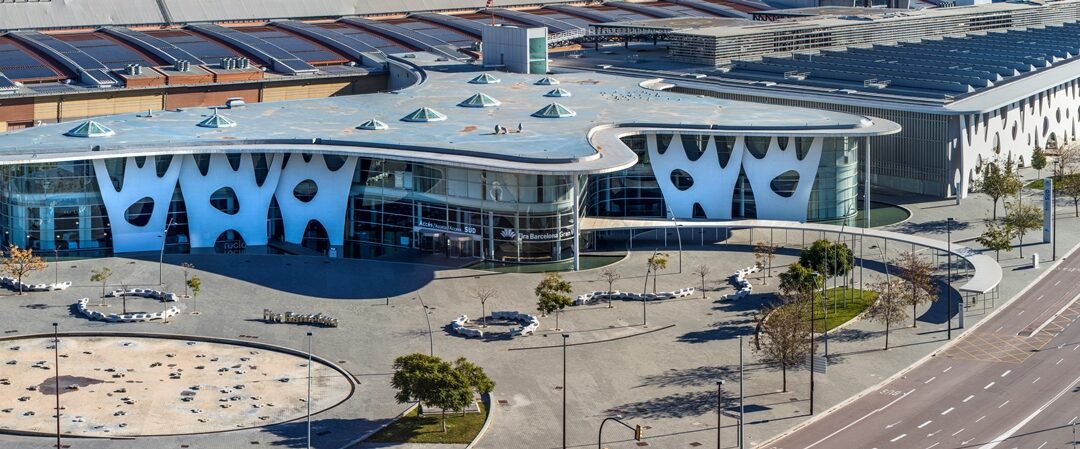
Source of featured image: https://galeria.firabarcelona.com/es/premsa/seleccio