


VISITING FRIENDS AND RELATIVES TRAVEL: A SPATIAL PERSPECTIVE ON SOUTH AFRICA
Christian M. Rogerson
Research Professor, University of Johannesburg, School of Tourism & Hospitality, South Africa; chrismr@uj.ac.za, ORCID: 0000-0003-1306-8867
Download >
ABSTRACT
Despite being a major component in contemporary global tourism, VFR travel has attracted – at least until recently – only limited scholarly attention from tourism researchers. This paper represents a contribution to the small international scholarship on VFR travel in the context of the Global South. The novel contributions of this article are twofold. First, it offers a longitudinal analysis of VFR travel over a period of two decades (2002-2024) and reveals the changing status of VFR in South African tourism as a whole. Second, the paper unpacks the geography of VFR travel and in this regard represents one of the few studies which have addressed the spatial dimensions of VFR travel. Overall, the findings confirm the dominance of VFR trips in South Africa’s tourism economy. As indexed by the volume of flows, the results pinpoint the country’s large metropolitan areas as the leading destinations for VFR travel. In addition, the study provides insight into the critical importance of VFR travel in terms of its significance for large parts of the economically marginalised spaces of the country.
Keywords: South Africa, spatial analysis, uneven geography, visiting friends and relatives
Received: 19 January 2026
Accepted: 2 March 2026
Published: 15 April 2026
BARÁT- ÉS ROKONLÁTOGATÓ UTAZÁSOK: TERÜLETI KITEKINTÉS DÉL-AFRIKÁRA
Christian M. Rogerson
Kutatóprofesszor, Johannesburgi Egyetem, Turizmus és Vendéglátás Intézet, Dél-afrikai Köztársaság; chrismr@uj.ac.za, ORCID: 0000-0003-1306-8867
ABSZTRAKT
Annak ellenére, hogy a barát- és rokonlátogató (VFR) utazás a jelenkori globális turizmus egyik fő alkotóeleme, a közelmúltig csak korlátozott tudományos figyelmet kapott a turizmuskutatók részéről. Ez a tanulmány a VFR utazásokkal foglalkozó kisszámú nemzetközi kutatáshoz járul hozzá a globális Dél kontextusában. A cikk nóvuma kettős. Először is, a VFR-utazások longitudinális elemzését kínálja két évtized (2002-2024) távlatában, és feltárja a VFR változó helyzetét a dél-afrikai turizmus egészében. Másodszor, a tanulmány feltárja a VFR-utazások földrajzát, és e tekintetben azon kevés publikációk egyike, amelyek a VFR-utazások térbeli dimenzióit is vizsgálják. Összességében az eredmények megerősítik a VFR-utazások domináns szerepét Dél-Afrika turisztikai gazdaságában. Az áramlások volumene alapján indexálva az eredmények azt mutatják, hogy a VFR-utazások elsődleges célpontjai a nagyvárosok. A tanulmány továbbá rávilágít a VFR-utazások kiemelt jelentőségére az ország gazdaságilag marginalizált területeinek vonatkozásában.
Kulcsszavak: Dél-Afrika, területi elemzés, egyenetlen földrajzi eloszlás, barát- és rokonlátogatás
Benyújtva: 2025. január 19.
Befogadva: 2026. március 2.
Publikálva: 2026. április 15.
1. Introduction
Visits to friends and relatives (VFR) is viewed as one of the oldest forms of travel and tourism (Backer & King, 2015). Travel to visit friends and relatives is described as a “simple, often taken-for granted pleasure” with a rhythm of visits usually organised around birthdays, anniversaries, and public holiday periods (Kelly, 2022: 634). In the contemporary global landscape of tourism, VFR travel is one of its most significant forms across the world (Kwon, 2024; Zentveld, 2024a). According to Guo (2022: 428) “VFR tourism is a large form of tourism worldwide and one of the oldest, largest and most important forms of tourism”. In many countries VFR travel is the main element of domestic tourism (Rogerson, 2015a; Zátori et al., 2019) and further is a significant contributor also to international tourism (Backer & King, 2015; Nurmatova, 2026). Recent data for the 27-member European Union suggest it is the second most common purpose of travel, accounting for an average of 39.5 percent of all tourism trips (Çali & Malaj, 2025). The prominence of VFR can be readily understood “since relationships between family, relatives and friends, and visits to or by them, are mainstays of human life for all except the chronically unfortunate, isolated or disaffected” (Seaton, 2017: 455).
Unquestionably, at a global scale, VFR mobilities continue to grow because of migration flows (Kwon, 2024). Indeed, households are increasingly geographically split and dispersed as a result either of migration or sometimes due to lifestyle considerations and yet wish to retain traditional emotional and friendship connections (Backer & King, 2015; Griffin & Dimanche, 2017; Godínez, 2025). For Yeoman et al. (2022: 159) the “family is the most important feature in consumers’ lives” and observe that “emotional attachment is at its highest in times of personal bereavement or economic recession”. Nevertheless, as a major component in contemporary global tourism VFR travel has attracted – at least until recently – only limited scholarly attention from tourism researchers (Backer 2012a; Aslan & Dinçer, 2018; Zentveld et al., 2022a). Zentveld (2026) points to the striking fact that as one of the most underexamined forms of tourism, VFR, is positioned in both tourism and medical journals. The latter reflects concerns about international VFR travel movements with exposure to diseases with limited presence in the home country and further with outbreaks of infectious diseases (Carroll et al., 2025). Illustratively, Barkati et al. (2025) report international VFR travellers are the specific group most at risk for malaria and malaria-related hospitalisation as they are less likely to seek pre-travel medical advice and often travel without taking malaria precautions.
In correspondence with the patterns of production of tourism scholarship as a whole, the vast majority of existing literature on VFR travel is focused on countries in the Global North with a particularly vibrant set of writings on Australia, Canada and the United Kingdom (Backer, 2012b; Bischoff & Koenig-Lewis, 2017; Griffin & Dimanche, 2017; Griffin & Francis, 2025). The closing years of the 2010s have witnessed some upturn of interest in VFR research (Barnes & Rogerson, 2021; Rogerson & Rogerson, 2023). For some observers it can be argued now that tourism scholars are beginning “to give VFR travel the respect it deserves” (Backer & Morrison 2017: 398). The vast majority of this recent wave of research is anchored on the basis of studies concerning ‘Western’ VFR travellers with research mainly concentrated in the Global North (Griffin, 2013; Yousuf & Backer, 2015). In international writings only limited attention has been accorded to issues of VFR travel occurring across the region of sub-Saharan Africa (Rogerson, 2015a; Dzikiti & van der Merwe, 2017; Rogerson, 2017a). Although domestic VFR travel predominates in Africa, Dzikiti and van der Merwe (2017) show that VFR travel within Africa includes a notable segment of international travellers.
It is against this backdrop that the aim in this paper is to examine the state of VFR travel within the Global South. The case of South Africa is under scrutiny. A review of trends and debates in the existing international scholarship shows that among several neglected issues around VFR travels is that of geography. The novel contribution of this paper is therefore to bring a spatial perspective into our understanding of VFR travel mobilities. The experience of South Africa is unpacked using data that covers a period of over two decades. Undertaking a longitudinal analysis the specific research objectives are to determine the changing significance of VFR travel and the shifting spatial patterns of VFR travel destinations. It will be argued that the recent and current geographical trajectories of VFR travel in South Africa are, to a large extent, influenced by historical migration patterns. The remainder of the paper is organized into three sections of material. As context, the next section offers a broad-brush review of the central issues and current trends in international literature surrounding VFR travel. Following a brief discussion on methods and sources, the results of the South African study are presented.
2. Literature review
Among others Backer and King (2017: 191) highlight that in terms of volume and impacts the international phenomenon of VFR travel is “substantial”. In addition, with the accelerating impacts of climate change and accompanying questions surrounding rising costs as well as the social acceptability of excessive air travel it is conjectured that in future “VFR demand will become a much higher proportion of air travel” (Griffin & Dimanche, 2017: 108). The demand for both international and domestic VFR travel is influenced by “elements such as friendship, blood ties, longing, social connections, family events, obligatory hosting and events” (Zentveld et al., 2022b: 2). Kelly (2022: 634) asserts that the action of VFR travel represents “an unspoken network of connection, identity and belonging”. Correspondingly, Seaton (2017: 455) opines that “relationships between family, relatives and friends, and visits to or by them, are mainstays of human life for all except the chronically unfortunate, isolated or disaffected”.
Across the international experience it is suggested the historical underdevelopment of VFR research is accounted for in part because the segment is not viewed as ‘sexy’ for marketing purposes as compared to that of leisure tourism (Backer, 2012b, 2019). This said, Seaton (2017: 455) notes the remarkable paradox that VFR travel as a marginalised category by tourism marketers “has always been, as a domain of behaviour, more central to human experience than leisure tourism”. The paucity of literature was confirmed by two surveys of the ‘state of the art’ in the 2010 decade as produced by the University of Surrey thinktank (Palovic et al., 2014) and by Yousuf and Backer (2015). Even as late as 2022 the claim could be made that whilst VFR was a significant form of travel in most countries, it remained that “relatively little VFR research has been undertaken” (Zentveld et al., 2022a: 385). Lin et al. (2022: 18) offered a similar sentiment stating that despite “the prominence of visiting friends and relatives (VFR) travel to show strong resilience in the face of global crises, it has been one of the most underexplored tourism contexts in the literature”.
Arguably, however, beyond its unsexy character for policy-makers, another significant factor is certain difficulties associated with actually defining what is VFR travel (Munoz, 2018). Palovic et al. (2014) describe the VFR concept as unstructured and chaotic. VFR can be considered variously as a trip purpose, a trip activity, and an accommodation use (Griffin, 2016). It was argued by Backer (2007) that use of trip purpose alone is insufficient to capture the extent of VFR, and therefore it is appropriate to incorporate accommodation use in discussions of visits for pleasure. The definition was proposed that VFR constitutes “a form of travel involving a visit whereby either (or both) the purpose of the trip or the type of accommodation involves visiting friends and/or relatives” (Backer, 2007: 369). In a further advance Backer (2012a) put forward a definitional typology that used the two dimensions of ‘purpose of travel’ and ‘form of accommodation’ to capture more precisely who are VFR travellers. As shown on Table 1 four visitor categories are discerned. These are as follows: 1) Pure VFRs (PVFRs) which are VFR purpose and stay with friends and relatives; 2) Commercial VFRs (CVFRs) which are VFR purpose and staying in commercial accommodation; 3) Exploiting VFRs (EVFRs) which are pleasure purpose but staying with friends or relatives; and, 4) a final group of non-VFR travellers who are pleasure purpose and patronize commercial accommodation (Backer, 2012a).
Table 1. Backer’s definitional typology
| Accommodation: Friends and Family | Accommodation: Commercial | |
| Purpose of Visit: VFR | PVFRs | CVFRs |
| Purpose of Visit: Non-VFR | EVFRs | Non- VFRs |
Source: Adapted after Backer (2012a)
For Munoz (2018) this typology represents a conceptual advance for VFR research. An extension of the Backer categorisation was made by Munoz et al. (2017) with the insertion of additional components to the matrix and subsequently re-casting it as a form of mobility. Importantly, this extended definition builds upon the recognition that VFR is not simply about leisure. Instead, it is contended that “there are instead multiple practices within visits that have little to do with tourism such as attending a funeral, childcare or visiting an ailing relative” (Munoz et al. 2017: 480). The extended definition and conceptualisation is anchored within the mobilities paradigm. It situates VFR “as a form of mobility influenced by a host that includes face-to-face interaction between a host and visitor who have a pre-existing relationship” (Munoz et al., 2017: 477). Undoubtedly, “the element that appears to distinguish VFR travel from non-VFR travel is the existence of a prior personal relationship between visitor and resident” (Munoz et al., 2017: 481). Zentveld (2025: 5) concurs that “VFR travel is a unique aspect of tourism in that it centrally involves local residents”. It is considered that local residents as hosts are instrumental in attracting VFR travelers who during any year may visit on multiple occasions. Accordingly, it can be viewed that local residents “are the key aspect regarding VFR travel that sets it apart from any other form of visitation to a destination” (Zentveld, 2025: 6).
VFR travel thus is increasingly understood as relating to the behavior and implications of residents and visitors who have a pre-existing relationship and spend time together in a destination (Munoz et al., 2017; Rokni & Choi, 2024; Godínez, 2025). Empirical research reported from Australia by Backer et al. (2017: 61) concluded that “the VFR segment is not homogeneous, but rather contains – at least – two sub-segments: people who travel to visit relatives and people who travel to visit friends”. It is evidenced that research about VFR “highlights the heterogeneity of visiting friends from relatives, revealing differences among the two groups, such as the volume of visits, rate of expenditure, length of stay, activities engaged in, and more recently how pretravel information is collected” (Bakri et al., 2024: 4).
As compared to other forms of tourism several positive advantages are identified in VFR travel. VFRs offer multiple benefits to destinations. VFR travel can be a moderator to combat seasonality and can peak in periods of downturn and as well be less susceptible to economic or external shocks (Griffin & Francis, 2025). In research conducted in the USA during the COVID-19 pandemic VFR trips were associated with higher travel intentions and lower cancellation rates than for leisure travel. This points to the fact that VFR represents a relatively stable form of visitor demand during disruptions and, correspondingly, reinforces its relevance for resiliency planning (Griffin et al., 2025). VFR can also lead to a greater spread of spending in local economies where they visit (Zentveld, 2025). Further, as VFR hosts incur costs from hosting VFRs when taken together there is even a possibility that total expenditures from VFR travel can exceed that of leisure travellers (Backer, 2007). Accordingly, Bakri (2021: 29) can assert as follows: “VFR tourism as a key tourism segment, has been shown to be resilient during economic downturns, able to weather issues of seasonality, and spread the economic benefits of tourism deeper into the local economy”.
Beyond its economic value, VFR offers multiple social benefits for tourism destinations. It “creates meaningful shared experiences between hosts and guest that become lasting stories embedded in a destination” and aligns with cultural values, including that it “generates authentic and powerful word-of-mouth marketing leveraging personal relationships” (Griffin & Francis, 2025: 4–5). For Munoz (2018: 19) “it is hard to think of a more social segment” than VFR. The social interactions between travellers visiting friends or relatives and their host constitutes “an important component of understanding VFR travel” (Yousuf & Backer 2017: 435). The role of hosts is a vital feature of VFR scholarship (Backer, 2007; Griffin, 2013; Yousuf & Backer, 2015; Munoz et al., 2017; Capistrano & Weaver, 2018). Licata and Törngren (2025: 57) point out that VFR hosts can “take on roles as ambassadors and gatekeepers, introducing local tourism activities and destinations”.
Several other social benefits around VFR travel are highlighted in recent literature. VFR mobilities can result in positive quality of life benefits both for the VFR traveller as well as the host (Capistrano & Weaver, 2018; Backer, 2019). Further, it has been shown in demographic studies of VFR travellers conducted in Australia that “many people who would be classed as socio-economically disadvantaged engage in VFR travel” (Backer & King, 2017: 191). In South Africa VFR travel is massively the purview of less affluent Black travellers, many of whom are part of split or multi-locational households with both an urban and rural ‘home’ (Rogerson, 2017b; Rogerson & Rogerson, 2021a; Nengovhela et al., 2024, 2025). Residents of South Africa’s disadvantaged urban townships are major participants in VFR travel movements (Rogerson 2017b). As these low-income communities are excluded from other forms of tourism, VFR travel assumes a vital social function in South Africa. Indeed, it is essentially “a naturally occurring form of social tourism that has important policy implications” (Backer & Morrison, 2017: 396).
Despite progress made in recent years in advancing VFR research, several knowledge gaps persist. Three can be profiled here. First, Zentveld (2025) flags a suite of critical issues around sustainability and poses the question as to whether VFR is a sustainable visitor segment. Second, another major lacuna in VFR scholarship relates to the lack of historical research investigations. Arguably, ‘presentism’ is a defining feature of recent VFR research and there is an urgent need to complement contemporary studies with more research that explores and provides insight on VFR travels past. Finally, our understanding of the geography of VFR travel and its changing distribution both between countries in terms of international VFR movements and domestic VFR travel demands further investigation. Arguably, large urban centres automatically attract VFR travellers (Rogerson, 2015b; Rogerson & Rogerson, 2021b). Zentveld (2024b) points out that with increases in VFR travel it is axiomatic that growing urban centres will be strong foci for expanded VFR travel mobilities. Nevertheless, Kwon (2024: 251) points to a different aspect of VFR geographies, namely that “spatially, VFR travelers are distributed rather than concentrated in metropolitan cities or popular tourist destinations”. With this as context, the analysis shifts to explore the significance and spatial distribution of VFR travel in South Africa.
3. Methods and sources
The analysis is based upon the tourism component of the private sector S&P Global South Africa Regional eXplorer database. This tourism data set is a subset of a consolidated platform of integrated databases that, in the absence of official establishment and enterprise surveys, provides the most useful data available for planning purposes at a sub-national level in South Africa, with information provided down to the local municipal scale. The information base is built upon the regular collection and triangulation of primary information which is extracted by S & P Global from a wide span of both official and non-government sources. Sources include the regular surveys undertaken by South African Tourism and Statistics South Africa on international tourism arrivals and their movements as well as flows of domestic travellers within South Africa. In these South African baseline surveys VFR is identified as the purpose of trip as opposed to travel for reasons of leisure, business, health or religion.
The collated data is reworked in order to ensure consistency across variables as well as via the application of national and subnational verification tests in order to ensure that the economic model is consistent for the measurement of business activity in South Africa. As demonstrated in previous research, the local tourism base of the Regional eXplorer data set is especially useful for spatial analysis and understanding the changing structure of the tourism space economy (Rogerson, 2017; Rogerson & Rogerson, 2019, 2021b). The data set includes information on the tourism performance of all South African municipalities indexed by the following variables, inter alia, the volume of tourism trips differentiated by primary purpose of trip (leisure, business, visiting friends and relatives and ‘other’); tourism trips by origin of trip (domestic or international), bednights by origin of tourist; calculation of tourism spend; and the contribution of tourism to GDP.
The database exists from 2001 and formerly was known as the IHS Global Insight data. The data set is constantly updated with adjustments made to reflect official changes made in municipal administrative boundaries as well as the availability of new data (Rogerson & Rogerson, 2021b). This research draws upon the 2025 iteration, which provides the historical data as amended going back to 2001. The database covers all South Africa’s nine provinces and includes 213 spatial units which are comprised of 205 local municipalities and the country’s eight large metropolitan areas, namely Buffalo City (East London), Cape Town, Ekurhuleni, eThekwini (Durban), Johannesburg, Mangaung (Bloemfontein), Nelson Mandela Bay, and Tshwane (Pretoria). One limitation of the database is the absence of specific information on estimates of the VFR spend at a municipal level.
4. Findings
Notwithstanding its low status in African tourism scholarship, the mainstream of which is dominated by research on leisure tourism, it must be appreciated that VFR travel is important in the continent for both its economic and social ramifications (Rogerson, 2017a). In the case of South Africa, previous studies have pinpointed VFR to be the leading segment of tourism travel as a whole and most especially in the landscape of domestic tourism (Rogerson, 2015a, 2015b; Rogerson & Rogerson, 2021b). For family travel and the maintenance of social connections VFR tourism is vital (Naudé-Potgieter, 2026). Domestic VFR travel in South Africa is overwhelmingly the domain of less affluent Black travellers many of whom are in multi-locational households with both an urban and rural ‘home’ (Rogerson, 2015b, 2017b). Ordinary or working-class South Africans therefore dominate VFR tourism flows and forge a low-density form of VFR tourism around ‘second-home’ visits (Henama et al., 2022). The national tourism White Paper, issued in 2024, indicated the policy neglect of VFR but acknowledged the imperative to “identify opportunities for product offerings meeting its needs” (Republic of South Africa, 2024: 36). Two sub-sections of discussion are presented, which deal respectively with the overall growth and significance of VFR travel and followed by an analysis of the geography of VFR travel in South Africa.
4.1. The growth and significance of VFR travel
Although a comprehensive history of the development of VFR tourism in South Africa remains to be scripted a major part of it is inseparable from the 20th century march of urbanisation and the creation of a cheap workforce for the country’s mines and factories. Circulatory migration flows were established in the legislative context of racial segregation and a political economy of capitalist development (Wolpe, 1972). As the rural base of Black households was undermined and split urban-rural households became widespread, VFR travel has become critical for retaining the stability and survival of households (Rogerson, 2017b; Rogerson & Rogerson, 2025).
Another thread in the historical development of VFR travel by Black urban households was that VFR was a vital aspect in the emergence of a modernizing urban elite (Rogerson, 2024). In his seminal work which discusses the ‘New Africans’, Dlamini (2020: 98) points out that for the urban-based black elite – mainly resident in Johannesburg and its surrounds – “leisure was a broad term that included ‘visiting friends and relatives’ and going to places of interest”. Such seemingly disparate activities were united by the fact that they displayed a use of time by black elites not governed by South African colonial authorities (Dlamini, 2020). Against this brief historical backcloth, the distinctive features of VFR travel in South Africa and its uneven geography can now be interrogated.
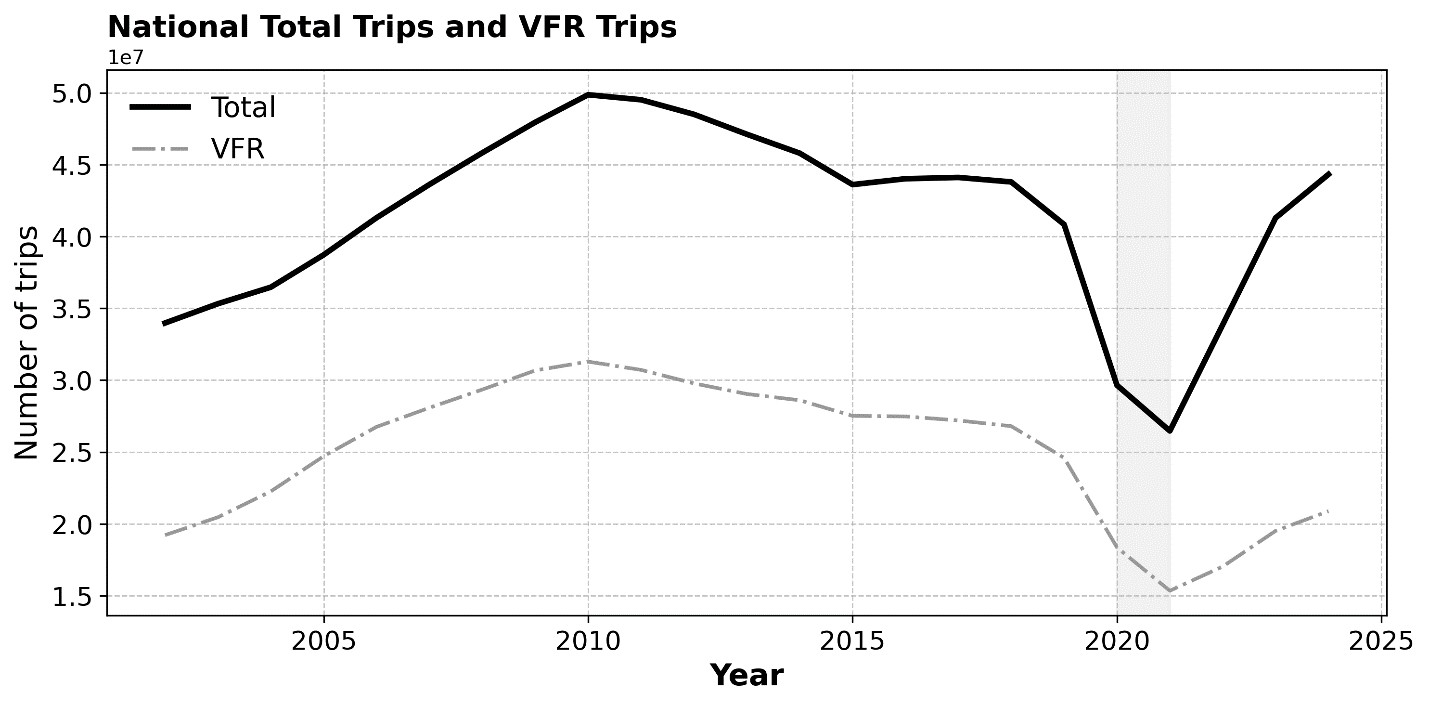
Figure 1. Comparison of VFR trips with National Total Trips 2002-2024
Note: The mathematical notation 1e7 refers to 10 million which means, for example, that the total number of trips in South Africa in the peak year of 2010 was 49.9 million.
Source: Edited by the author
Table 2. South Africa: Selected years -–Volume and share of VFR trips
| VFR Trips (Millions) | Share of VFR in Total Trips | |
| 2002 | 19.2 | 56.5% |
| 2010 | 31.3 | 62.7% |
| 2019 | 24.6 | 60.2% |
| 2021 | 15.3 | 57.7% |
| 2023 | 19.5 | 47.2% |
Source: Edited by the author
Figure 1 and Table 2 together provide a profile and detail for selected years of the size of VFR travel mobilities and significance in the tourism economy of South Africa over the period covered by the study. Figure 1 reveals the trajectory in VFR travel trips in relation to the total national trips. Table 2 provides further detail with specific data provided for five selected years. The base year of 2002 is when Johannesburg, South Africa’s largest city, hosted the World Summit on Sustainable Development. During 2010 the tourism economy of South Africa was galvanised by the organisation of the FIFA Soccer World Cup. The year 2019 is the final ‘normal’ travel year before the march of the COVID-19 pandemic devastated the national tourism economy for two years (Rogerson & Rogerson, 2021). Finally, 2023 is a year in the post-COVID recovery of the national tourism economy with signals occurring of a ‘new normal’ in tourism flows for South Africa as a whole.
Several points can be observed. Fluctuations are evident in the volume of VFR travel flows across the period of over two decades spanned by this investigation. Between 2002 and 2010 there occurred a substantial rise of nearly two-thirds in the numbers of VFR trips which peaked at over 31 million in 2010 (Figure 2). The weakened state of VFR travel in the period 2010 to 2019 to a large extent reflected South Africa’s poor macro-economic circumstances. This related to a combination of factors including economic mismanagement, government corruption (state capture), extended drought conditions, electricity shortages, and reduced international demand for the country’s minerals. Economic recession in South Africa was accompanied by a reduction of nearly 7 million trips during the period 2010 to 2019. This was followed by a further and dramatic hollowing out of VFR travel in the 2020-2021 COVID years, with harsh lockdown measures and travel restrictions imposed (Rogerson & Rogerson, 2020, 2023). Although some recovery in VFR travel is evident for the post-2021 period, Table 2 discloses that the volume of VFR trips in 2023 was only marginally above that which had been recorded two decades earlier.
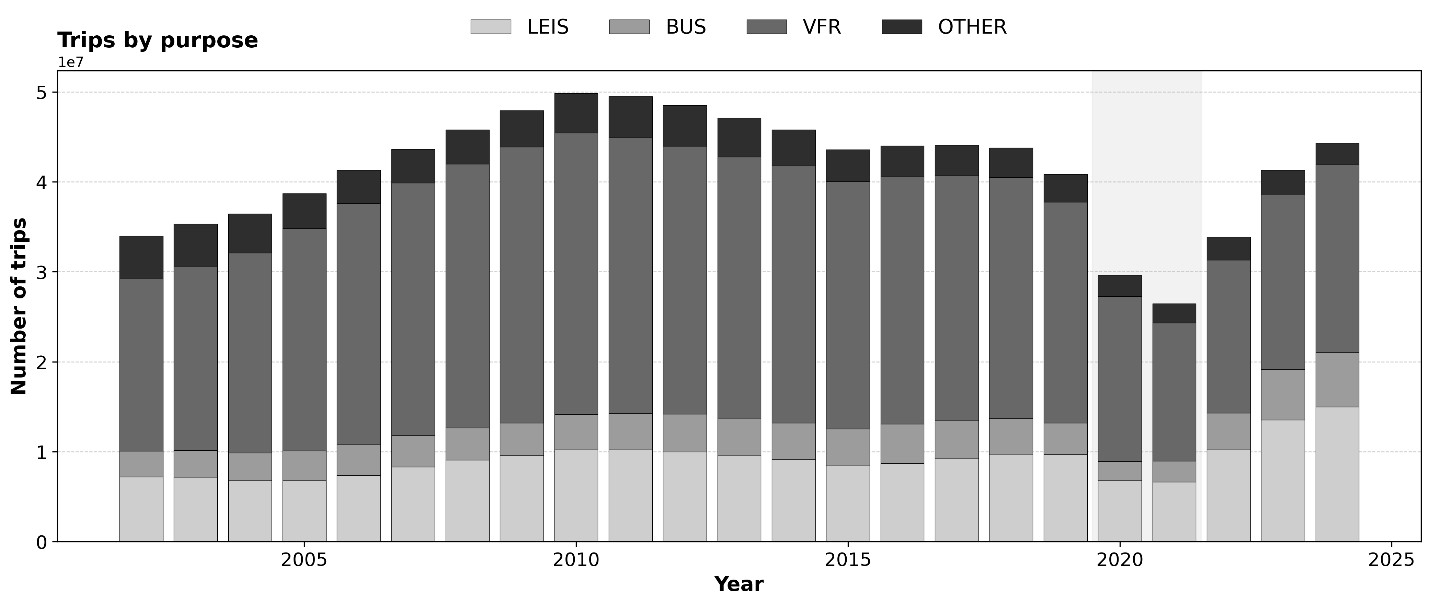
Figure 2. South Africa: Trips by purpose 2002-2024
Note: The mathematical notation 1e7 refers to 10 million.
Source: Edited by the author
Turning our attention to the share of VFR in total tourism trips in South Africa, it is evident that throughout the 2002-2024 period VFR remained the most important single purpose of travel. As is indicated on Table 2 VFR trips consistently constitute over half of all tourism trips from 2002-2021. During the peak 2010 year of travel VFR mobilities made up nearly 63 percent of all tourism trips for South Africa; this represented a marked increase of share from the 56.5 percent recorded of VFR trips in 2002. The data for post-COVID period points to VFR remaining the most significant reason for travel, albeit suggesting a slower pace of recovery than for other types of travel. These points are reinforced by the overall analysis of trips by purpose as given on Figure 2. A comparative analysis of VFR with leisure, business, and other purposes of travel once again stresses that in terms of purpose of trip, VFR is consistently the most significant across the period under investigation, including for the COVID years of 2020 and 2021.
In summary, therefore, in respect of the absolute volume of trips it is evident that VFR is much more significant in South Africa than travel for purposes of leisure, business or for the category of ‘other’ such as health or religion reasons (Figure 3). Nevertheless, in relative terms a decline is observable in the share of VFR in total national trips, namely from 63 percent in 2010, eroding to 47.5 percent of total trips by the close of the study period.
4.2. A spatial view of VFR
In terms of the geographical distribution of VFR travel within South Africa this can be unpacked by examining two issues. First, is the absolute flows of VFR travellers at local municipality destination level. This can be investigated both in terms of those most visited VFR destinations and the little examined least visited VFR spaces. Second, the relative share or importance of VFR in respect of total tourism trips within each municipality is scrutinized.
Table 3. Top 20 municipalities as percentage of national total VFR for selected years
| Rank | National Total (%) | |||||||
| 2010 | 2019 | 2021 | 2024 | |||||
| 1 | City of Johannesburg | 9.93 | City of Johannesburg | 9.43 | City of Johannesburg | 7.97 | City of Johannesburg | 9.81 |
| 2 | City of Tshwane | 6.99 | City of Tshwane | 6.11 | City of Tshwane | 5.68 | City of Tshwane | 5.86 |
| 3 | eThekwini | 6.06 | Ekurhuleni | 4.76 | eThekwini | 4.01 | Ekurhuleni | 4.84 |
| 4 | Ekurhuleni | 5.08 | eThekwini | 4.27 | Ekurhuleni | 3.71 | eThekwini | 3.91 |
| 5 | City of Cape Town | 4.65 | City of Cape Town | 3.75 | Buffalo City | 3.46 | Buffalo City | 3.67 |
| 6 | Buffalo City | 2.65 | Buffalo City | 2.66 | City of Cape Town | 3.10 | City of Cape Town | 3.46 |
| 7 | Polokwane | 2.32 | Polokwane | 2.62 | Polokwane | 2.52 | Polokwane | 2.61 |
| 8 | City of Mbombela | 2.29 | City of Mbombela | 2.31 | City of Mbombela | 2.42 | Mangaung | 2.26 |
| 9 | Mangaung | 2.05 | Mangaung | 1.97 | Mangaung | 1.95 | City of Mbombela | 1.99 |
| 10 | Nelson Mandela Bay | 1.64 | Rustenburg | 1.60 | Nelson Mandela Bay | 1.89 | Nelson Mandela Bay | 1.69 |
| 11 | Rustenburg | 1.61 | Nelson Mandela Bay | 1.54 | Ray Nkonyeni | 1.57 | Greater Tubatse/ Fetakgomo | 1.61 |
| 12 | Msunduzi | 1.31 | Greater Tubatse/ Fetakgomo | 1.35 | Rustenburg | 1.51 | Rustenburg | 1.53 |
| 13 | Ray Nkonyeni | 1.22 | Greater Giyani | 1.32 | Greater Tubatse/ Fetakgomo | 1.34 | Msunduzi | 1.13 |
| 14 | Steve Tshwete | 1.11 | Ray Nkonyeni | 1.28 | Greater Giyani | 1.25 | Greater Giyani | 1.12 |
| 15 | Elias Motsoaledi | 0.99 | Nkomazi | 1.16 | Bushbuckridge | 1.20 | Nkomazi | 1.09 |
| 16 | Nkomazi | 0.98 | Bushbuckridge | 1.14 | Msunduzi | 1.18 | Ray Nkonyeni | 1.09 |
| 17 | Govan Mbeki | 0.97 | Thulamela | 1.09 | Nkomazi | 1.13 | Thulamela | 1.02 |
| 18 | Madibeng | 0.85 | Steve Tshwete | 1.04 | Steve Tshwete | 1.04 | Elias Motsoaledi | 0.99 |
| 19 | Greater Tubatse/ Fetakgomo | 0.85 | Madibeng | 1.02 | Madibeng | 0.96 | Bushbuckridge | 0.98 |
| 20 | Emalahleni | 0.81 | Msunduzi | 0.97 | Emalahleni | 0.88 | Madibeng | 0.97 |
Source: Edited by the author
Table 3 shows the most important destinations for VFR travel based on absolute VFR trips in the selected years of 2010, 2019, 2021 and 2024. (Note: The base year of 2002 is not included.) Several points must be highlighted. First, the results confirm the international experience that the largest urban centres are automatic attractions for VFR travellers (Zentveld, 2024b). With the single exception of 2019 (the case of Nelson Mandela Bay), all South Africa’s designated eight metropolitan areas (Buffalo City, Cape Town, Ekurhuleni, eThekwini, Johannesburg, Mangaung, Tshwane and Nelson Mandela Bay) consistently feature in the list of leading ten destinations for VFR travel. Indeed, throughout the study period, South Africa’s major urban centre, Johannesburg, is the leading individual destination for VFR travel. The city accounts for 9 percent of total VFR trips; it is noted, however, that the city’s share of VFR travel was reduced in the COVID period when travellers tended to avoid ‘crowded’ urban destinations (Rogerson & Rogerson, 2023). Second, with minor exceptions, the findings point to the relative stability in the overall distribution of VFR travellers. Evidence exists, however, of a greater dispersion of VFR travellers across the period 2010-2024; in 2010 the leading five destinations accounted for 32.71% of all VFR travel, by 2021 this was reduced to 24.83% share with recovery to 28.09% by 2024.
Third, outside of the metropolitan areas, Table 3 highlights the strong attraction for VFR travel of the secondary cities of Polokwane (Limpopo), Mbombela (Mpumalanga) and Rustenburg (North West). Further, the list of ranked municipalities includes several examples of peripheral small- town municipalities which incorporates rural spaces of the former apartheid Bantustans or Homelands. Examples of such spaces that record high volumes of VFR travel are the municipalities of Greater Giyani and Greater Tubatse in the province of Limpopo as well as Bushbuckridge and Nkomazi in Mpumalanga province (Table 3). As Henama et al. (2022) point out, much VFR travel is driven by the mobilities of working-class Black South Africans who work in the country’s major urban centres and retain second homes in the former apartheid-created Bantustans where family and extended family reside on ancestral or ‘traditional’ land. The destinations of the urban-based VFR travellers are in what are the economically marginalised regions of South Africa (Rogerson & Rogerson, 2025).
Table 4. Bottom 20 local municipalities as percentage of national total VFR for selected years
| Rank | National Total (%) | |||||||
| 2010 | 2019 | 2021 | 2024 | |||||
| 1 | !Kheis (NC) | 0.015 | !Kheis (NC) | 0.013 | !Kheis (NC) | 0.015 | !Kheis (NC) | 0.012 |
| 2 | Laingsburg (WC) | 0.016 | Laingsburg (WC) | 0.020 | Kannaland (WC) | 0.022 | Laingsburg (WC) | 0.015 |
| 3 | Prince Albert (WC) | 0.018 | Kannaland (WC) | 0.022 | Laingsburg (WC) | 0.022 | Kannaland (WC) | 0.018 |
| 4 | Renosterberg (NC) | 0.018 | Magareng (NC) | 0.024 | Magareng (NC) | 0.026 | Prince Albert (WC) | 0.021 |
| 5 | Kamiesberg (NC) | 0.023 | Prince Albert (WC) | 0.026 | Prince Albert (WC) | 0.028 | Magareng (NC) | 0.024 |
| 6 | Kannaland (WC) | 0.024 | Thembelihle (NC) | 0.028 | Tokologo (FS) | 0.034 | Kgatelopele (NC) | 0.032 |
| 7 | Khai-Ma (NC) | 0.026 | Renosterberg (NC) | 0.033 | eMadlangeni (KZN) | 0.036 | eMadlangeni (KZN) | 0.038 |
| 8 | Thembelihle (NC) | 0.028 | Tokologo (FS) | 0.034 | Thembelihle (NC) | 0.039 | Nkandla (KZN) | 0.039 |
| 9 | Magareng (NC) | 0.028 | Impendle (KZN) | 0.034 | Impendle (KZN) | 0.041 | Matzikama (WC) | 0.039 |
| 10 | Richtersveld (NC) | 0.031 | Kgatelopele (NC) | 0.035 | Kgatelopele (NC) | 0.041 | Thembelihle (NC) | 0.039 |
| 11 | Kgatelopele (NC) | 0.032 | Emadlangeni (KZN) | 0.036 | Renosterberg (NC) | 0.046 | Impendle (KZN) | 0.039 |
| 12 | Tokologo (FS) | 0.034 | Kamiesberg (NC) | 0.042 | Nkandla (KZN) | 0.047 | Swellendam (WC) | 0.040 |
| 13 | Karoo Hoogland (NC) | 0.042 | Mkhambathini (KZN) | 0.043 | Swellendam (WC) | 0.048 | Maphumulo (KZN) | 0.040 |
| 14 | Siyathemba (NC) | 0.046 | Nkandla (KZN) | 0.044 | Edumbe (KZN) | 0.053 | Tokologo (FS) | 0.041 |
| 15 | Swellendam (WC) | 0.047 | Swellendam (WC) | 0.047 | Mkhamba-thini (KZN) | 0.053 | Kamiesberg (NC) | 0.044 |
| 16 | Hantam (NC) | 0.048 | Maphumulo (KZN) | 0.047 | Maphumulo (KZN) | 0.054 | Ubuhlebezwe (KZN) | 0.044 |
| 17 | Kareeberg (NC) | 0.049 | Edumbe (KZN) | 0.052 | Matzikama (WC) | 0.056 | uMzimkhulu (KZN) | 0.046 |
| 18 | Tsantsabane (NC) | 0.051 | Matzikama (WC) | 0.055 | Kamiesberg (NC) | 0.059 | Renosterberg (NC) | 0.047 |
| 19 | Dannhauser (KZN) | 0.051 | Khai-Ma (NC) | 0.055 | Mantsopa (FS) | 0.062 | Mkhambathini (KZN) | 0.050 |
| 20 | eMadlangeni (KZN) | 0.053 | Richtersveld (NC) | 0.056 | Dikgatlong (NC) | 0.063 | Ndwedwe (KZN) | 0.052 |
Note: FS Free State; KZN KwaZulu-Natal; NC Northern Cape; WC Western Cape
Source: Edited by the author
A brief examination is merited of the least visited (as indexed by volume of trips) local municipalities by VFR travellers. These are shown in ranked order on Table 4. As a whole, the least visited areas are headed by remote and sparsely populated areas of South Africa, spaces which in many respects are ‘left-behind’ in terms of national economic development. The limited VFR travel to these rural and small-town destinations is therefore ‘the other side of the coin’ to the flows of VFR travellers into South Africa’s largest cities and densely populated former Bantustan areas. Geographically, these least visited VFR destinations are concentrated in local municipalities situated in the arid, sparsely populated parts of the provinces of Northern Cape (e.g., !Kheis, Renosterberg and Thembelihle) and Western Cape (e.g., Laingsburg, Prince Albert and Kannaland). Remote and economically marginal local authorities in parts of KwaZulu-Natal and Free State provinces also are represented (Table 4). By contrast, South Africa’s economic heartland of Gauteng as well as the densely populated spaces of Limpopo and Mpumalanga provinces are unrepresented in the listing of least visited spaces throughout the study period.
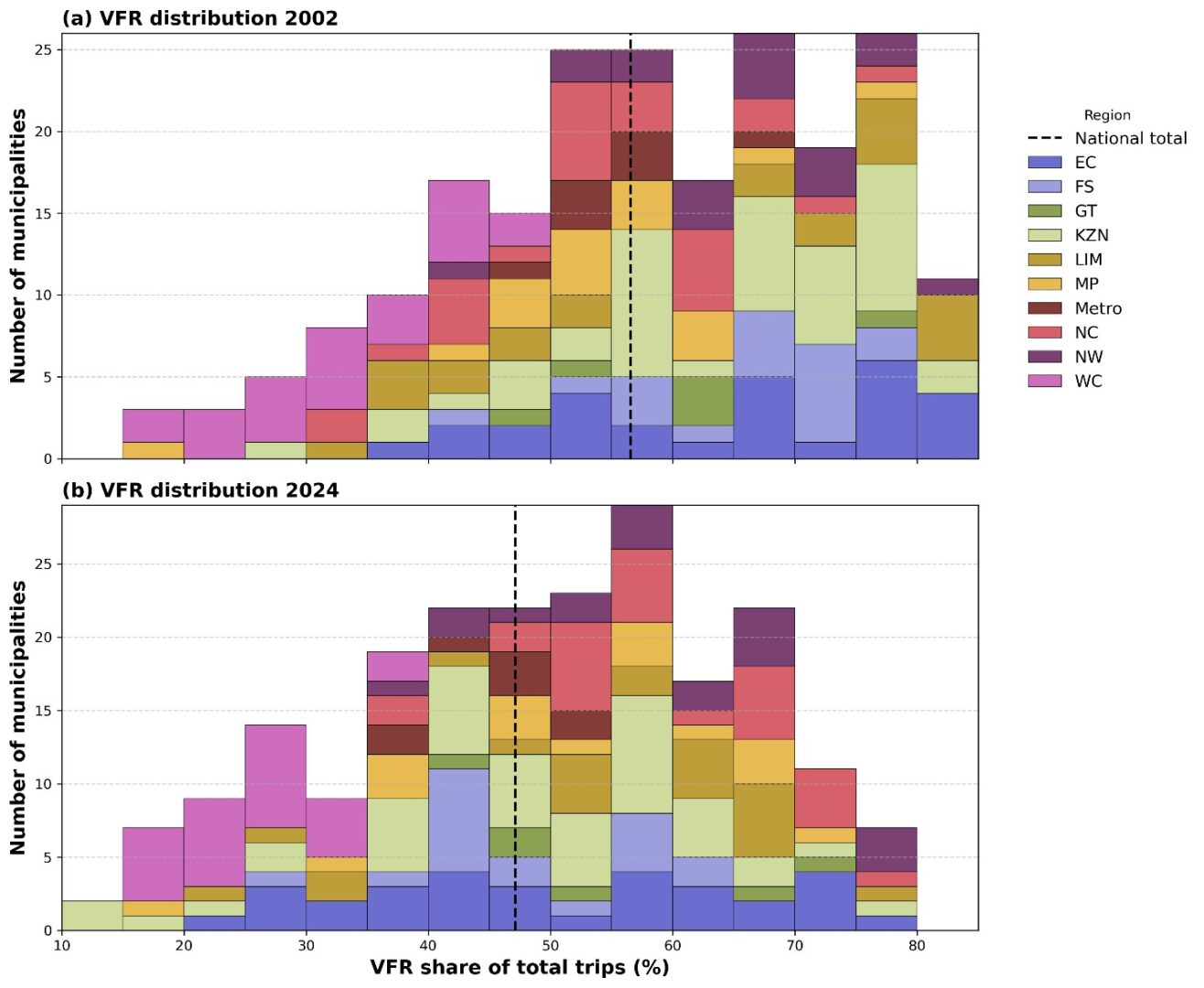
It is instructive to analyse the share of VFR trips which occur within each local municipality in order to identify what might be styled ‘VFR-dependent’ local municipalities in respect of their local tourism economies. This analysis was undertaken for the base years of 2002 and 2024. In these two years the share of VFR in total trips for South Africa as a whole was respectively 56.5 and 47.1 percent. For South Africa’s 213 local municipalities (including the metropolitan areas) Figure 3 shows the distribution of local authorities as indexed by the VFR share of total trips. It is apparent that in both 2002 and 2024, the majority of South Africa’s local municipalities (56.8% in 2002 and 57.2% in 2024) record a share of VFR which exceeds that of the national share of VFR trips. The strongest representation is in the provinces of Limpopo, Eastern Cape and KwaZulu-Natal, all of which incorporate small town and rural spaces of former Bantustans and thus high flows of VFR travellers. By contrast, it is evident from Figure 3 that most local municipalities in the Western Cape have only small relative share of VFR trips.
Figure 3. Local municipalities by province: Share of VFR in total local tourism trips
Note: The eight metropolitan areas are given as a separate category.
Source: Edited by the author
Finally, Table 5 isolates South Africa’s most VFR-dependent local municipalities in both 2002 and 2024. For each year, Table 5 lists those local municipalities in each of South Africa’s nine provinces where VFR travel constitutes at least 75 percent of all tourism trips recorded. In terms of geographical distribution the pattern is of dominance by areas of Limpopo, Eastern Cape and KwaZulu-Natal. In 2002 across South Africa 12 local municipalities recorded over 80 percent of local tourism trips accounted for by VFR travel (Table 5). By 2024, however, only six local municipalities have VFR travel constituting over 75 percent of all local tourism trips; the highest was at Nongoma in KwaZulu-Natal province where VFR trips represented 79.5 percent of all local trips. Overall, the reduction in the share of VFR in local tourism between 2002 and 2024 must be viewed as a mirror of the national downturn occurring in the volume of VFR trips as was shown on Figure 1.
Table 5. South Africa’s Most VFR-Dependent Local Municipalities 2002 and 2024
| Province | 2002 | 2024 |
| Eastern Cape | Umzimvubu; Dr AB Xuma; Ntabankulu; Mhlontlo; Matatiele; Elundini; Emalahleni; Sakhisizwe; Nyandeni; Inquza Hills; Intsika Yethu; Winnie Madikizela Mandela; Ngqushwa | Dr AB Xuma |
| Free State | Phumelela; Nala | NIL |
| Gauteng | Merafong City | NIL |
| KwaZulu-Natal | Nongoma; Nqutu; Umvoti; uMlalazi; Ubuhlebezwe; uMzimkhulu; Nkandla; Msinga; eMadlangeni; uMshwathi; Msunduzi | Nongoma |
| Limpopo | Makhuduthamaga; Thulamela; Greater Tubatse; Collins Chabane; Ephraim Mogale; Makhado, Elias Motsoaledi; Musina | NIL |
| Mpumalanga | Dipaleseng | NIL |
| Northern Cape | Joe Morolong | Joe Morolong |
| North West | Kagisano-Molopo; Ratlou; Tswaing | Greater Taung; Ratlou; Kagisano-Molopo |
| Western Cape | NIL | NIL |
Note: Italics indicates over 80 percent share of VFR travel in a local municipality.
Source: Edited by the author
5. Conclusion
Arguably, it remains that the “neglected status of VFR research compared to its large size and numerous benefits to the tourism industry and local communities is one of the main characteristics of the VFR literature” (Munoz, 2018: 18). This article represents a contribution to the limited international scholarship on VFR travel in the context of the Global South. The novel contributions of this article are twofold. First, it offers a longitudinal analysis of VFR travel over a period of two decades which reveals the changing status of VFR in South African tourism as a whole. Second, the paper unpacks the geography of VFR travel and in this regard represents one of the few studies which have addressed the spatial dimensions of VFR travel. Overall, the findings point to the metropolitan areas of South Africa as the leading destinations for VFR travel as indexed by volume of flows. In addition, the study provides insight into the critical importance of VFR travel in terms of its significance for large parts of the economically marginalised or ‘left-behind’ spaces of the country. The uneven geography of VFR travel and its implications for local tourism development in South Africa merit further investigation. It is recommended that local case studies be undertaken to explore both the economic and social significance of VFR travel mobilities.
Acknowledgements
Jonathan Rogerson was instrumental in the data analysis. Comments from two journal reviewers were appreciated. Thanks are due to Robbie Norfolk and Betty White for valued inputs. In addition, special thanks go to Lulu White, a friend who passed but forever will be remembered.
References
Aslan, S. & Dinçer, M. Z. (2018). A conceptual framework of visiting friends and relatives. Journal of Tourismology, 4 (1): 21–34. DOI: 10.26650/jot.2018.4.1.0003
Backer, E. (2007). VFR travel – An examination of the expenditures of VFR travellers and their hosts. Current Issues in Tourism, 10: 366–377. DOI: 10.2167/cit277.0
Backer, E. (2012a). VFR travellers: It is underestimated. Tourism Management, 33 (1) : 74–79. DOI: 10.1016/j.tourman.2011.01.027
Backer, E. (2012b). Why marketing to Aunt Betty matters. In: H. Schänzel, I. Yeoman & E. Backer (Eds.), Family tourism: Multidisciplinary perspectives. Bristol: Channel View, pp. 81–92.
Backer, E. (2019). VFR travel: Do visits improve or reduce our quality of life? Journal of Hospitality and Tourism Management, 38: 161–167. DOI: 10.1016/j.jhtm.2018.04.04
Backer, E. & King, B. (eds.) (2015). VFR travel research: International perspectives. Bristol: Channel View.
Backer, E. & King, B. (2017). VFR traveller demographics: The social tourism dimension. Journal of Vacation Marketing, 23 (3): 191–204. DOI: 10.1177/1356766716665439
Backer, E. & Morrison, A. M. (2017). VFR travel: Is it still underestimated? International Journal of Tourism Research, 19 (4): 395–399. DOI: 10.1002/jtr.2145
Backer, E., Leisch, F., & Dolnicar, S. (2017). Visiting friends or relatives? Tourism Management, 60: 56–64. DOI: 10.1016/j.tourman.2016.11.007
Bakri, M. (2021). More than words: Decoding the influence of user-generated images on visiting friends and relatives tourism. PhD thesis (Marketing), Victoria University of Wellington, New Zealand.
Bakri, M., Richard, J. E., & Krisjanous, J. (2024). Image-generated word-of-mouth: A catalyst for visiting friends and relatives (VFR) tourism? International Journal of Tourism Research, 26: e2735. DOI: 10.1002/jtr.2735
Barkati, S., Libman, M., & Schwartz, E. (2025). Severe malaria in travellers – Time to create a specific definition. Journal of Travel Medicine, 32 (6): taaf066. DOI: 10.1093/jtm/taaf0066
Barnes, J. & Rogerson, C. M. (2021). Student-centred VFR travel: Evidence from Johannesburg. In: C. M. Rogerson & J. M. Rogerson (Eds.), Urban Tourism in the Global South: South African Perspectives. Cham, Switzerland: Springer, pp. 173–191.
Bischoff, E. E. & Koenig-Lewis, N. (2017). VFR tourism: The importance of university students as hosts. International Journal of Tourism Research, 9: 465–484. DOI: 10.1002/jtr.618
Çali, E. & Malaj, V. (2025). Migration and tourism nexus: A viewpoint based on the VFR trend in Albania. The Albanian Journal of Economy and Business, 39 (1): 177–184.
Capistrano, R. C. G. & Weaver, A. (2018). That’s what friends are for: Emotional solidarity, friendship and social interactions between first-generation immigrants and their visiting friends. Journal of Hospitality and Tourism Management, 36: 57–66. DOI: 10.1016/j.jhtm.2018.07.003
Carroll, S. C., Castellanos, M. E., & Neumeyr, A. (2025). What’s the worst that could happen? The risk of illness, injury and death related to international travel – the Australian experience. Travel Medicine and Infectious Disease, 68: 102933. DOI: 10.1016/j.tmaid.2025.102933
Dlamini, J. S. T. (2020). Safari nation: A social history of the Kruger National Park. Athens OH: Ohio University Press.
Dzikiti, L. G. & van der Merwe, C. D. (2017). The expenditure patterns of Zimbabweans travelling to and from South Africa for visiting friends and relatives purposes. African Journal of Hospitality, Tourism and Leisure, 6 (3): 1–22.
Godínez, G. (2025). Visiting friends and relatives. In: J. Jafari & H. Xiao (Eds.), Encyclopedia of tourism. Cham, Switzerland: Springer, pp. 1114–1115.
Griffin, T. (2013). A content analysis of articles on visiting friends and relatives tourism, 1990-2010. Journal of Hospitality Marketing and Management, 22: 781–-802. DOI: 10.1080/19368623.2012.708960
Griffin, T. & Dimanche, F. (2017). Urban tourism: The growing role of VFR and immigration. Journal of Tourism Futures, 3 (2): 103–113. DOI: 10.1108/JTF-10-2016-0036
Griffin, T. & Francis, N. (2025). VFR travel and visitor attractions. Toronto: Toronto Metropolitan University, Ted Rogers School of Hospitality and Tourism Management.
Griffin, T., Guttentag, D., Smith, W. M., & Litvin, S. W. (2025). Exploring VFR travel intentions during COVID-19: Insights for resiliency planning. Tourism and Recreation Research, 1–8. DOI: 10.1080/02508281.2025.2525167
Guo, H. (2022). A review of research on family and friends visiting tourism. World Scientific Research Journal, 8 (6): 428–437. DOI: 10.6911/WSRJ.202206_8(6).0056
Henama, U. S., Apleni, L., & Phale, J. K. (2022). Low density tourism in the Global South: Second home tourism in South Africa as a form of visiting friends and relatives. In: R. A. Castanho (Ed.), Analyzing sustainability in peripheral, ultra-peripheral, and low-density regions. Hershey, PA: IGI Global, pp. 261–275.
Kelly, C. (2022). ‘I just want to go home’: Emotional wellbeing impacts of COVID-19 restrictions on VFR travel. Tourism and Hospitality, 3: 634–640. DOI: 10.3390/tourhosp3030039
Kwon, J. (2024). Beyond borders: Analyzing the dynamics of visiting friends and relatives (VFR) travel in the context of global migration. International Area Studies Review, 27 (3): 250–265. DOI: 10.69473/iasr.2024.27.3.250
Licata, S. & Törngren, S. O. (2025). Being and becoming local: Migrants’ personal social networks and their influence on inclusive visiting friends and relatives tourism experiences. Scandinavian Journal of Hospitality and Tourism, 25 (1): 54–75. DOI: 10.1080/15022250.2024.2437175
Lin, P. M. C., Peng, K-L., & Au, W-C. (2022). To return or not to return? Identifying VFR travel constraints during the pandemic. Journal of Travel & Tourism Marketing, 39 (1): 18–30. DOI: 10.1080/10548408.2022.2045246
Munoz, J. R. (2018). The role of students as hosts to VFR travellers: Towards a conceptual framework. PhD thesis, University of Surrey, Guildford, UK.
Munoz, J. R., Griffin, T., & Humbracht, M. (2017). Towards a new definition for ‘visiting friends and relatives’. International Journal of Tourism Research, 19 (5): 477–485. DOI: 10.1002/jtr.2110
Naudé-Potgieter, R. (2026). More than a getaway: Unpacking the motivations and quality of life of South African mothers on family vacations. In: H. Schänzel, C. Khoo, & M. J- J. Yang (Eds.), Handbook of children and family tourism, Cheltenham: Edward Elgar, pp.155–172.
Nengovhela, M., Nethengwe, T., & Dafuleya, G. (2024). Funeral tourism in Northern parts of South Africa. Tourism and Rural Development Studies, 9 (4): 140–153. DOI: 10.15170/TVT.2025.09.04.07
Nengovhela, M., Nethengwe, T., & Dafuleya, G. (2025). Predicting behavioural intentions of funeral travellers to consume tourism-related products and services. Tourism and Rural Development Studies, 10 (4): 108–119. DOI: 10.15170/TVT.2024.10.04.06
Nurmatova, S. S. (2026). The influence of national culture and sociocultural factors on foreign tourist behavior in Uzbekistan: Challenges and implications. Central Asian Journal of Innovations on Tourism Management and Finance, 7 (1): 429–435. https://cajitmf.casjournal.org/index.php/CAJITMF/
Palovic, Z., Kam, S., Janta, H., Cohen, S., & Williams, A. (2014). Surrey think tank – Reconceptualising visiting friends and relatives (VFR) travel. Journal of Destination Marketing & Management, 2 (4): 266–268. DOI: 10.1016/.jdmm.2013.11.004
Republic of South Africa (2024). White paper on the development and promotion of tourism in South Africa, 2024. Pretoria: Government Gazette No. 51354.
Rogerson, C. M. (2015a). VFR travel in sub-Saharan Africa: The case of South Africa. In: E. Backer & B. King (Eds.), VFR travel research: International perspectives. Bristol: Channel View, pp. 134–148.
Rogerson, C. M. (2015b). Revisiting VFR tourism in South Africa. South African Geographical Journal, 97 (2): 139–157. DOI: 10.1080/03736245.20151028981
Rogerson, C. M. (2017a). Visiting friends and relatives matters in sub-Saharan Africa. African Journal of Hospitality, Tourism and Leisure, 6 (3): 1–10.
https://www.ajhtl.com/uploads/7/1/6/3/7163688/article_38_vol_6__3__2017.pdf/
Rogerson, C. M. (2017b). Unpacking directions and spatial patterns of VFR travel mobilities in the Global South: Insights from South Africa. International Journal of Tourism Research, 19: 466–475. DOI: 10.1002/jtr.2101
Rogerson, C. M. (2024). Traces of the past: The Bantu World and Black South African travel mobilities in the 1930s. African Journal of Hospitality, Tourism and Leisure, 13 (2): 359–366. DOI: 10.46222/ajhtl.19770720.517
Rogerson, C. M. & Rogerson, J. M. (2019). Tourism and accommodation services in South Africa: A spatial perspective. In: J. Knight & C. M. Rogerson (Eds.), The geography of South Africa: Contemporary changes and new directions. Cham: Springer, pp. 213–-220.
Rogerson, C. M. & Rogerson J. M. (2020). COVID-19 tourism impacts in South Africa: Government and industry responses. GeoJournal of Tourism and Geosites, 31 (3): 1083–1091. DOI: 10.30892/gtg.31321-344
Rogerson, C. M. & Rogerson, J. M. (2021a). Looking to the past: The geography of tourism in South Africa during the pre-COVID-19 era. In: C. M. Rogerson & J. M. Rogerson (Eds.), Urban tourism in the Global South: South African perspectives. Cham: Springer, pp. 39–75.
Rogerson, C. M. & Rogerson, J. M. (2021b). The other half of urban tourism: Research directions in the Global South. In: C. M. Rogerson & J. M. Rogerson (Eds.), Urban tourism in the Global South: South African perspectives. Cham: Springer, pp. 1–37.
Rogerson, C. M. & Rogerson, J. M. (2023). VFR travel and COVID-19 impacts: The South African experience. GeoJournal of Tourism and Geosites, 48 (2 Supp.): 717–724. DOI: 10.30892/gtg.482spl05-071
Rogerson, C. M. & Rogerson, J. M. (2025). South Africa’s ‘left behind’ spaces: The historical evolution of the former Bantustans. In: M. Mdlalose, I. Khambule, & N. E. Khalema (Eds.), Contemporary South Africa and the political economy of regional development. Abingdon: Routledge, pp. 75–92.
Rokni, L. & Choi, S-H. (2024). Place attachment expressed by hosts and guests visiting friends and relatives and implications for sustainability. Sustainability, 17 (12): 5558. DOI: 10.3390/su16177325
Seaton, T. (2017). Qualitative approaches to the phenomenology of VFR travel: The use of literary and cultural texts as resources. International Journal of Tourism Research, 19: 455–465. DOI: 10.1002/jtr.2100
Wolpe, H. (1972). Capitalism and cheap labour power in South Africa: From segregation to apartheid. Economy and Society, 1: 253–285.
Yeoman, I. S, Schänzel, H., & Zentveld, E. (2022). Tourist behaviour in a COVID-19 world: A New Zealand perspective. Journal of Tourism Futures, 8 (2): 155–176. DOI: 10.11108/JTF-03-2021-0082
Yousuf, M. & Backer, E. (2015). A content analysis of visiting friends and relatives (VFR) travel research. Journal of Hospitality and Tourism Management, 25: 1–10. DOI: 10.1016/j.jhtm.2015.07.003
Zátori, A., Michalkó, G., Nagy, J. T., Kulcsár, N., & Balizs, D. (2019). The tourist experience of domestic VFR travellers: The case of Hungary. Current Issues in Tourism, 12: 1437–1459. DOI: 10.1080/1368500.2017.13711117
Zentveld, E. (2024a). VFR travel: Opportunities, trends and issues. In: A. M. Morrison & D. Buhalis (Eds.), Routledge handbook of trends and issues in global tourism supply and demand. Abingdon: Routledge, pp. 433–442.
Zentveld, E. (2024b). Review – Handbook on sustainable urban tourism. International Journal of Tourism Cities, 10 (4): 1588–1590.
Zentveld, E. (2025). VFR travel: A sustainable visitor segment? Sustainability, 17 (12): 5558. DOI: 10.3390/su17125558
Zentveld, E. (2026). Tourism and other disciplines: Shall we dance? In: J. Wen, M. Kozak, J. Aston, & W. Wang (Eds.), Interdisciplinary research and tourism. Abingdon: Routledge, pp. 8–17.
Zentveld, E., Labas, A., Edwards, S., & Morrison, A. M. (2022a). Now is the time: VFR travel desperately needing respect. International Journal of Tourism Research, 24 (3): 385–399. DOI: 10.1002/jtr.2509
Zentveld, E., Erol, G., & Dūşmezkalender, E. (2022b). VFR travel in Turkey during and post-COVID-19. Tourism and Hospitality, 3: 651–655. DOI: 10.3390/tourhosp3030040