

RURAL AND AGRITOURISM DEVELOPMENT IN RUSSIA: RESULTS AND TASKS
1Nataliia Andreeva✉, 2Vladimir Savenko
1Expert, Russian Engineering Academy of Management and Agribusiness, Chelyuskinskaya settlement, Moscow region, Russian Federation;
natalia.stocen@gmail.com, ORCID: 0009-0007-1998-7393
2Professor, Moscow Witte University, Moscow, Russian Federation;
savenko-vg@mail.ru, ORCID: 0009-0007-3057-4653
Abstract
Rural and agritourism is a new phenomenon in the Russian countryside. The first rural tourism initiatives took place more than two decades ago. Rural tourism contributes to the preservation of the rural way of life in Russia, to the revival of traditions and customs, to the increase of the cultural and social attractiveness of life in rural areas, as well as to the level of income of the rural population through the creation of additional jobs and the development of rural infrastructure. The period of the coronavirus pandemic has shown that this type of tourism is viable because of its small scale, its location outside cities, healthy food, and other specific features. Involving the local population in the reception of tourists develops the rural community and arouses interest in the protection and conservation of nature. Our paper describes the first two decades of rural and agritourism development and reflects on the policy support and governmental and regional policies that have been enacted in the last 5-6 years to accelerate this form of rural entrepreneurship and community involvement. We also look at the institutional background that underpins the development of rural and agritourism.
Keywords: diversification, income increase, organic products, rural and agro-tourism, rural community, synergy and multiplication
Received: 13 September 2024
Accepted: 28 November 2024
Published: 17 December 2024
VIDÉK- ÉS AGROTURISZTIKAI FEJLESZTÉS OroszországBAN: EREDMÉNYEK ÉS FELADATOK
1Nataliia Andreeva✉, 2Vladimir Savenko
1Szakértő, Oroszországi Menedzsment és Agrárgazdasági Mérnöki Akadémia, Cseljuszkinszkaja, Moszkvai régió, Oroszországi Föderáció; natalia.stocen@gmail.com,
ORCID: 0009-0007-1998-7393
2Egyetemi tanár, Moszkvai Witte Egyetem, Moszkva, Oroszországi Föderáció;
savenko-vg@mail.ru, ORCID: 0009-0007-3057-4653
Absztrakt
A falusi és agroturizmus viszonylag új jelenség Oroszországban. Az első, ilyen irányú kezdeményezésekre mintegy két évtizede került sor. A falusi turizmus hozzájárul az oroszországi vidéki életforma megőrzéséhez, a hagyományok és szokások újjáéledéséhez, a vidéki élet kulturális és társadalmi vonzerejének növeléséhez, valamint a vidéki lakosság jövedelmi szintjének emelkedéséhez további munkahelyek teremtésének és a vidéki infrastruktúra fejlesztésének köszönhetően. A koronavírus-járvány időszaka megmutatta, hogy emberléptékűsége, városon kívüli elhelyezkedése, az egészséges élelmiszerek hozzáférhetősége és egyéb sajátosságai miatt ez a fajta turizmus életképes. A helyi lakosság bevonása a vendégfogadásba erősíti a vidéki közösségeket és felkelti az érdeklődést a természet védelme és megóvása iránt. Írásunk a falusi és agroturizmus fejlesztésének első két évtizedével ismertet meg és reflektál azokra a szakpolitikai támogatásokra, valamint az elmúlt 5-6 évben megvalósult kormányzati és regionális politikákra, amelyek a vidéki vállalkozói tevékenység és a közösségi szerepvállalás ezen formájának felgyorsítását célozták. Megvizsgáljuk a falusi és agroturizmus fejlődését megalapozó intézményi hátteret is.
Kulcsszavak: biotermékek, diverzifikáció, falusi és agroturizmus, falusi közösség, jövedelemnövekedés, szinergia és multiplikáció
Benyújtva: 2024. Szeptember 13.
Elfogadva: 2024. November 28.
Publikálva: 2024 December 17.
1. Introduction: The starting position and background for rural tourism development
By 2024, a quarter of Russia’s population will live in rural areas. Russia’s rural areas have great natural, demographic, economic, historical and cultural potential, which, if used more fully, rationally and efficiently, can ensure sustainable multisectoral development, full employment, a high standard of living and quality of life for the rural population.
The technical and technological modernisation of agricultural production and the introduction of innovative management elements in agriculture over the last twenty years have significantly reduced the need for jobs and increased the already high level of unemployment in rural areas. International (mainly European) practice shows that the development of rural and agritourism in the form of small family enterprises is an important socio-economic programme for the transfer of part of the rural population from the production to the service sector. Along with the development of traditional areas of agricultural entrepreneurship (farms and private subsidiary farms, various types of handicrafts and folk art), some Russian villagers began to engage in a new business – the provision of rural tourism services.
The Strategy for the Development of Tourism in the Russian Federation for the period up to 2035 provides the following interpretation of the term: “Rural tourism is a type of tourism that involves temporary accommodation of tourists in rural areas for recreation and (or) participation in agricultural work without material gain of the tourist”.
Rural tourism began to develop actively in rural settlements at the beginning of the 2000s. It was an initiative of farmers and active rural residents. The first stage of this process was the provision of overnight accommodation on farms for city dwellers at weekends. This was followed by the provision of food-related services, leisure activities (such as fishing and mushroom picking), the production and sale of handicrafts, and the attraction and employment of other villagers, especially those involved in folk crafts and the preparation of quality food. To meet the needs of tourists, a wide range of services has been developed, including basic services (transport, accommodation, food), special services to meet the needs of the purpose of the trip (visits to farms and cheese dairies) and complementary services (crafts, events, harvesting of crops and wild fruit).
The possibility of joining forces to develop rural tourism led to informal cooperation and subsequently to the creation of tourism clusters offering not only accommodation and meals, but also a range of services for organising leisure activities and a variety of natural and tasty farm products (which in turn contributes to the development of organic production), and participation in events and folk festivals (restoration of traditional rituals, preservation of the development of folk art and crafts). Participation in master classes in a cheese dairy or apiary increases the impact of agritourism in promoting respect for agricultural work among young people.
Rural tourism fulfils important socio-economic functions, such as the creation of attractive jobs, including for young people and women in rural areas; the development of rural areas; the integrated use of the natural and cultural potential of rural areas. The development of rural tourism contributes directly to increasing the attractiveness of life in rural areas. A multiplier effect is created when, as a result of the involvement of many villagers in the process, the income received by the settlement exceeds many times over the amount of money spent by a tourist in a guesthouse, if we take into account the payment for all the services and products received by the tourist in the rural settlement, and the funds invested in tourism activities not only provide direct income, but also have an indirect effect on the sectoral and territorial structure of rural areas.
Rural tourism is most actively developed in the republics of Altai, Buryatia, Karelia, Altai, Krasnodar Krai, Arkhangelsk, Astrakhan, Vologda, Voronezh, Kaluga, Moscow and other regions and includes recreation in the countryside and participation in agricultural work on the farm. The process of effective development of rural tourism began with a local initiative to host tourists, to make their homes available for folk festivals or to entertain children in the rural settlement. Over time, the local community supported the initiative and, based on an analysis of its resources, planned and implemented its activities to organise and develop rural tourism. Conducting educational activities (professional courses, training seminars, workshops, master classes, trainings) for owners of rural guesthouses, representatives of peasant (farm) households, individual entrepreneurs. The organisation and provision of tourism services in rural areas gave rise to a new type of entrepreneurship, reducing risks and increasing income from tourism. This was particularly important for the subsequent stages of rural tourism development, such as resource mobilisation, promotion, and effective use of local resources.
2. Literature review
Domestic tourism in Russia is a rapidly developing part of the national economy. The reduction of employment in agriculture promotes the development of alternative employment in services, rural tourism, folk crafts, and the preservation of traditional rural settlements (Egorov et al., 2022). Under the influence of a number of stimulating factors (crises, pandemics, booking problems), the tourism industry has expanded from organising foreign tourist flows to domestic ones and has given impetus to the development of rural tourism (Lebedeva et al., 2021a). The study of consumers of rural tourism services in Russia showed that rural tourism is becoming increasingly popular among city dwellers (Lebedeva et al., 2021b).
European experience shows that there are no identical recipes for solving the problems of rural employment (Regoli & Strugut, 2013). The solution depends on the peculiarities of the socio-economic and political structure and cultural traditions, modified by changes in the economy and the labour market. At the same time, almost all countries apply an active employment policy: they influence the level of employment by stimulating entrepreneurial initiative and creating the necessary conditions for the growth of non-agricultural employment (Kovács, 2020).
The joint efforts of the settlement community, the national association and the educational and advisory centres in the development of rural tourism make it possible to accelerate the process of socio-economic development of the village and improve the standard of living of its inhabitants (Andreeva, 2015).
Rural tourism in Russia has all the necessary potential for long-term development (Nikonova & Vorontsova, 2021), but some researchers (Morozova & Valigursky, 2024) believe that rural tourism in Russia is affected by a number of problems that significantly limit the possibilities of its growth. The following problems can be oibserved: failure to use a significant part of the country’s tourism potential, poor infrastructure development in a number of rural communities, inaccessibility and limited investment capital, low quality of services, among others. At present, many of the problems listed by the authors of the articles have been solved by regional and federal authorities. The state has drawn up and approved the Strategy for the Development of Tourism in the Russian Federation for the period up to 2035, which focuses on the development of domestic tourism in Russia. In 2024, the law on the development of rural tourism was adopted, and various forms of financial and non-financial support appeared.
3. Methodology
This paper is based on desk research, personal observation, and a literature review. Economic and statistical methods were employed with a systems approach to analyse data from federal organisations and regions of the Russian Federation, in addition to the study of successful regional practices of rural tourism development, as well as federal and regional regulations and subsidies.
4. Results
4.1. The potential of rural and agritourism
In the majority of regions, tourism potential is being developed and has become a real engine of entrepreneurial and social activity for the rural population. The share of rural tourism in the total volume of tourism services in the Russian Federation was estimated at 2% and remains the same, as the development of other forms of tourism has also increased during this period (Figure 1).
Figure 1. Share of rural and agritourism among other forms of tourism in Russia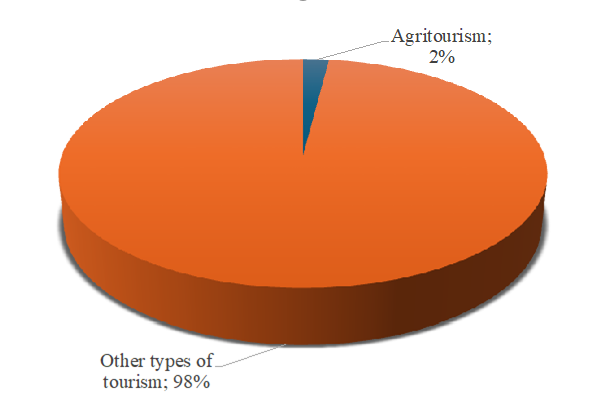
Source: own editing.
Rural tourism in Russia has potential for development:
- Ethnic and natural diversity of the country;
- Attractive historical and cultural potential of regions;
- Large rural areas with unique natural and climatic conditions;
- Favourable ecological condition of most rural settlements;
- Preservation of traditional ethnic cultures in a number of regions;
- The expressed need of Russians to return to their national roots.
Rural tourism includes all types of leisure activities in rural areas. A prerequisite for this type of tourism is the accommodation of tourists in rural houses and farms. The network of guesthouses is developed in the Altai and Krasnodar Territories, Baikal, Karelia, Yakutia, Kaliningrad, the Moscow and Leningrad Oblasts, and other regions. Gradually, several directions of rural tourism have been defined, such as ecological, gastronomic, cultural and ethnographic, educational, and health-promoting. The main objectives of rural tourism are to provide work and additional income for rural residents, whereas for city dwellers these are recreation, health improvement, an opportunity to get acquainted with the natural potential, national and cultural traditions of rural areas.
The object of rural tourism is usually a farmstead – a house in the countryside. Agritourism is a type of rural tourism that includes recreation in the countryside and participation in the agricultural work of the farmstead. As a kind of agritourism farm, the agro-homestead is a mini-hotel. To illustrate, the North Karelia region is characterised by a large number of forest lakes and a prevalence of village tourism in small, family-run holiday homes that can accommodate two to eight people. The accommodation is equipped with a range of amenities and facilities. Cottages usually consist of a living room and several bedrooms. They have hot and cold running water, a small kitchen with an electric cooker, a fridge, a microwave and a coffee maker. Most of the cabins have fireplaces and saunas. Tourists can rent boats, fishing gear, or ski equipment. All this makes it possible to have a rest in comfortable conditions, to be completely secluded and active at the same time. The lack of special comfortable houses for tourists in rural settlements has been compensated for by the development of various forms of glamping and the adoption by the State Duma in 2024 of a law allowing farmers to build guesthouses on agricultural land.
4.2. Characteristics of the market: Results of a customer survey
The Agency for the Development of Rural Initiatives conducted a survey of consumers of rural tourism services in Russia in 2021, which showed that:
- Rural tourism is still not widespread enough in the country: only one third of Russians said they would like to go on a tourist trip in the Russian countryside.
- Many potential tourists to rural areas of Russia like to travel, prefer active recreation, hiking, car trips for recreation.
- In favour of the development of rural tourism is the general trend of increasing the share of independent travel among Russians (without the mediation of tour operators).
- Focus groups have shown that a number of potential rural tourists in Russia are characterised by a spontaneous choice of travel direction.
- The most popular reason for choosing rural tourism is the opportunity to be in peace and solitude, away from the hustle and bustle of the city.
- For some potential tourists choosing rural tourism, the opportunity to change climatic zones and to go to another region is important, especially for residents of megacities wanting to get away from the cities.
- The combination of different leisure motives in rural tourism attracts potential tourists to rural areas.
- The majority of those wishing to visit rural areas prefer long trips: a week or more.
- Potential users of rural tourism have a preference for relatively low-cost accommodation on rural tours.
- The most common source of future travel information for potential rural tourism audiences is word of mouth and internet sources.
- The most important factors for respondents when choosing a particular rural trip are accommodation conditions, cost, and safety during the trip. Tourists also pay attention to the accessibility of the destination. Other factors are much less important.
The research carried out allows us to confirm the growing importance of rural tourism.
4.3. Legal regulations, subsidies, communities
The requirements for accommodation facilities used to provide rural tourism services in rural areas are established by the Ministry of Economic Development of the Russian Federation. They include information on how a rural accommodation facility should be equipped, what sanitary facilities for common use it should have, what the area should be of the premises intended for tourist accommodation, and what the signage should be. The requirements have been in force from 1 March 2023, their implementation being under the control of the regional tourism department. Rural tourism has recently received a certain legal registration and state recognition as an object of promotion in the country’s sector structure.
Tourism activities revitalise rural communities, promote national cultural traditions, diversify rural economies, and create demand for recreational services. New sources of income for farmers and owners of private enterprises, as well as increased tax revenues for the local budget and increased employment and income for the rural population raise the sustainability of the rural economy and support the development of other sectors of the economy, such as transport, construction, and trade. The study of the formation and development of rural and agritourism in Russia has shown that there is a synergy between the development of the rural community, agricultural production, and rural tourism (Figure 2).
Figure 2. Synergy of rural community development, production and tourism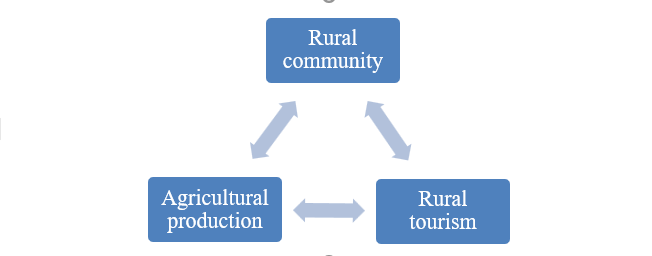 Source: own editing.
The rural community is becoming more active and motivated in the development of rural settlements, interested in supporting the diversification of products of farmers and private subsidiaries, participation in tourism initiatives (production of souvenirs, development of folk crafts, and event activities). Rural production is adapting to the needs of tourists and expanding its range of products, taking a creative approach to packaging, working with local artisans to offer cheese in birch bark and straw, honey in earthenware, sachets in embroidered cloth bags. Guesthouses in the village or on farms attract the rural population by organising events and gastronomic festivals, folk craftsmen by holding master classes with the subsequent sale of finished products and are a platform for the direct sale of rural products of the locals. Since 2020, Russia has been developing the making of organic products. It is expected that in 2030 the production of organic products for the domestic market will exceed 100 billion rubles, the volume of consumption of organic products and their export will increase. Rural and agritourism are the driving forces behind the popularisation of the consumption of organic products in the country.
Currently, the development of rural and agritourism is supported by government programs, various funds, and consulting organizations (Table 1). The regions of the country have their own measures to support rural and agritourism projects, including grants to support projects for the development of tourist infrastructure and products, to compensate for costs related to the creation of tourist infrastructure, to reimburse interest on loans, and to compensate for the costs of participation in tourist exhibitions. There are also non-financial support measures, such as the selection of land for projects or the expansion of facilities; training and accelerating programs to develop projects and prepare them for attracting public support; services for the development of business plans and financial models (this is also done by the “My Business” centres); services for the promotion of services and products; support for rural tourism projects; services of regional centres of competence in the field of agriculture. Many regions pull in financial resources from local entrepreneurs and NGOs, because attracting financial resources to a rural tourism project is one of the factors of its success as a business project. In order to start a rural tourism project economically, it is necessary to attract financial resources (grants, micro-loans, investments, credit resources), as well as to obtain information and advice on structuring project financing, since sometimes a project can combine several sources of financing.
The Ministry of Agriculture has launched “Agrotourism Grant” as a system of financial support for agricultural enterprises engaged in tourism in 2022. Only agro-producers can receive the subsidy. They must be registered and operate in a rural area or rural agglomeration of a constituent entity of the country. This grant has a number of specific features. In particular, the project must already have a business plan and its own resources at the time of application. Amount of the grant: 3 million rubles (10% own funds, 90% grant funds); 5 million rubles (15% own funds, 85% grant funds); 8 million rubles (20% own funds, 80% grant funds); 10 million rubles (25% own funds, 75% grant funds).
Table 1. Sources of support for rural tourism development at the federal level
| Programmes, projects | Support areas | Timeframe (years) | Organisations implementing support |
| National Project “Tourism and Hospitality Industry” Ministry of Economic Development
| – Development of tourist-attractive villages and rural settlements – Organisation of annual events stimulating tourist flows on a federal and regional scale – Creation and development of national branded tourist routes | 01.01.2021 – 31.12.2024 | Regional Tourism Agencies |
| Federal project “Development of Rural Tourism” of the Ministry of Agriculture | – Development of tourism in small forms of farming in the agro-industrial complex (agritourism) | 2022–2025 | Regional agro- management bodies |
| National Project “Culture” of the Ministry of Culture | – Creation of rural museums – Creation (reconstruction) of club-type cultural and leisure organisations on the territories of rural settlements – Creation of conditions for strengthening civic identity on the basis of spiritual, moral and cultural values of the peoples of the country | 2019–2024 | Regional and municipal cultural bodies |
| Presidential Grants Fund | – Realization of socially signi-ficant projects of NGO | 2017–2024 | Presidential Grants Fund |
| Rosselkhozbank Platform “Own. Out of Town” | – Travel platform to rural settlements and farms – Consulting support for the design of tourist products | 2022–2024 | Internet-based platform |
| National project “Small and medium-sized entrepre-neurship and support for individual entrepreneurial initiative” | – Creation of a system of support for farmers and development of rural cooperation – Formation of a positive image of an entrepreneur. – Identification of entrepreneurial abilities and involvement in entrepreneurial activity of persons with entrepreneurial potential and (or) motivation to create their own business; – Information and consulting support | 2018–2024 | Regional and municipal business centers |
Source: own editing.
Many farmers do not produce enough to organise their processing, packaging and sale to supermarkets, so selling products directly from the farm is a good solution for their sustainable development. Tourists’ demand for natural products is encouraging farmers to diversify. For example, beekeepers are beginning to produce not only honey, but also pollen, propolis, candles and wax souvenirs, soaps, and sachets of bee products. Farmers with strawberry farms are expanding their product range to include blackcurrants, redcurrants, blueberries, and raspberries. Dairy farms are producing cheese and new products such as ugurt. Product diversification creates new jobs and increases farmers’ incomes. The aim of the Agrotourism Grant is to increase farmers’ income by selling their agricultural products to tourists. In order to receive a high expert rating in the competition, the following is required:
- The project should be interesting and the rural object spectacular.
- The tourist wants to return to the farm after the first visit.
- The farm should be included in tourist routes; i.e., the rural tourism development project includes comprehensive programs and activities. The tourist route offers maximum impressions to the tourist and meets the requirements of integrated rural development.
- Package holiday products are always preferable.
- The organisation of food and accommodation of the guests during the implementation of the tour product should be provided.
- The tourism product should be available to different categories of citizens according to age, mobility, and budget preferences.
- The project should have a historical, cultural component or legend.
- If there is no historical or cultural background to the tourist product, it is necessary to offer a legend or parable about the project, which will be a point of attraction for potential tourists.
- The participant of the national project “Tastes of Russia” and other competitions receives additional points when evaluating a rural tourism project.
- The project should be linked to the national culture and have an ethnic orientation.
- The project should be of gastronomic value.
- The project should promote a positive attitude towards parents with children, the disabled, and sedentary citizens. The project should include safety measures.
The Ministry of Agriculture supervises the project and monitors how the grant is spent over five years. Another resource is the support tools provided by the National Project to Support Small and Medium Enterprises. This project is implemented by the Ministry of Economic Development. The regional “My Business” centers provide grants to young entrepreneurs. Under this program, it is possible to receive a grant of 100-500 thousand rubles for the creation and development of a rural tourism facility. At the same time it is necessary to provide 25% co-financing (which can be in the form of a micro-loan from “My Business”).
Such a relatively new direction of rural entrepreneurship needs systematic scientific, methodological, advisory, and educational support. In solving the problems of providing and supporting the development of rural tourism, the structures of the agricultural counseling system play a significant role. Advisory centers provide information, methodological, consulting, and, partly, educational services in the following areas:
- Promoting and organizing rural tourism;
- Working with rural women and village youth to involve them in the development of rural tourism;
- Diversifying the activities of the rural population (folk crafts and handicrafts, collecting and harvesting wild and medicinal plants, making furniture and homemade clay and wooden dishes, souvenirs, private kindergartens, etc.);
- Improving rural settlements (gardening, landscaping);
- Organising cultural leisure activities, restoration of the history of villages and their inhabitants, creation of museums of rural life;
- Organising consumer cooperatives in the housing and utilities sector and marketing of non-agricultural products;
- Promoting rural ecology and production of organic and ecologically clean (improved) products.
When developing a regional brand, there is an opportunity for cooperation of several rural administrations, municipalities or their parts or the region as a whole, especially if the territory has a unique natural-climatic, cultural-historical potential or is known as a place of origin of quality goods and services. The regional aspect should be used by consultants of advisory centers in the phases of planning and implementing rural tourism development projects in the labeling and form of tourist products, improving the quality and range of tourist packages, and promoting rural tourism (agritourism) on domestic and foreign markets.
Training in the organisation of rural tourism is paramount. Rural tourism training programmes are available at all agricultural universities, the Russian Academy of Management and Agribusiness, and the Russian State University of Tourism and Service. The National Association of Rural and Ecotourism Development Organizations organises study tours, seminars and webinars for farmers to share experiences and promote best practices. The National Association of Rural and Ecotourism Development Organizations cooperates with the European Federation of Rural Tourism.
Financial and non-financial support for the development of rural and agritourism in the Russian Federation by government and public organizations shows its importance for the development of rural settlements in the country.
5. Conclusion
Rural and agritourism, along with traditional forms of agricultural entrepreneurship, is becoming an important direction of diversification of the agrarian economy, contributing to the development of rural areas, improving the welfare of rural residents, developing various types of crafts and folk art, and preserving the identity of the people. In 2024, the trend towards growth in domestic tourism continue to strengthen, as Russians travel around the country and explore the vastness of their homeland, with demand for recreation in rural areas growing by up to 20% in the summer months.
Rural and agritourism is developing dynamically, with positive results already observed. Small settlements are being preserved and restored, the living conditions of the rural population are improving, traditions, folk customs, and rituals are being preserved, traditional values and ways of life are being revived. Rural tourism sites of various ethnic groups of the country with their authentic gastronomy, traditions, interesting national holidays and events are particularly popular with tourists.
For a more active promotion of rural tourism, it is proposed to extend the measures of state support for rural tourism organisers, to provide tax and other preferential conditions for small promising organisations in this area.
It is important to create a website with information on all rural tourism facilities in Russia (currently there are only separate websites for each region), where tourists can give feedback on their trips, and to promote rural and agritourism through longevity programmes. The development of the production of souvenirs of local crafts with thematic symbols, the production of local organic products in original packaging need support. The potential of rural areas and the synergy of rural community development, agricultural production and tourism are a good basis for diversifying activities in rural settlements, preserving and improving the quality of life of Russia’s rural population and attracting Russian and foreign tourists.
References
Andreeva, N. (2015). Rural tourism. Promising direction in the development of settlements [Russian]. Rosinformagroteh, pp. 3–80.
Egorov, Y., Savenko, V., Moszaev, E. & Shmakov, P. (2022). Improvement of mechanisms of scientific support to rural economic entities [Russian]. Rosinformagroteh, pp. 16–28 p.
Kovács, D. (2020). Decades of rural tourism development in Hungary. Turisztikai és Vidékfejlesztési Tanulmányok 5 (4): 91–108. DOI: 10.15170/TVT.2020.05.04.06
Lebedeva, I., Kopylova, S., Pantyuhina, S., Korneva, V., Testov, M., Kovalevskaya, V., Merlushkin, V. & Ivanova, A. (2021). Rural tourism: Basics, principles, partnerships. Methodological manual for beginners [Russian]. Moscow: ANO “ARSI”, 104 p. Available online: https://xn--e1aecaeegnkjlghcsq1m.xn--p1ai/assets/files/Методичка%20ЕС%20от%20А%20до%20Я.pdf
Lebedeva, I., Kopylova, S. & Lebedeva, T. (2021). Analytical report: Research of consumers of rural tourism services in Russia [Russian]. Moscow: ANO “ARSI”, 39 p. Available online: https://xn--e1aecaeegnkjlghcsq1m.xn--p1ai/assets/files/books/otchet-issledovaniya-potrebitelej-selskogo-turizma_arsi_2021.pdf
Morozova, N. & Valigursky D. (2024). Agrotourism as a condition for the revival of rural areas and consumer cooperation [Russian]. Fundamental and applied research of the cooperative sector of the economy 1: 103–112.
Nikonova, T. & Vorontsova, L. (2021). The role of rural tourism and directions of its development in the modern economy of Russia [Russian]. Vestnik Altai Academy of Economics and Law 9 (2): 23–45. DOI: 10.17513/vaael.1855
Regoli, F. & Strugut, A. (2013). Le tourisme rural en Europe de l’Est: un levier du développement local? Pour 217: 125–133. Available online: https://shs.cairn.info/revue-pour-2013-1-page-125?lang=fr