

FUNERAL TOURISM IN NORTHERN PARTS OF SOUTH AFRICA
1Munei Nengovhela✉, 2Tondani Nethengwe, 3Gift Dafuleya
1Lecturer, University of Venda, Department of Tourism and Hospitality Management, South Africa; munei.nengovhela@univen.ac.za, ORCID: 0000-0001-7664-3043
2Senior lecturer, University of Venda, Department of Tourism and Hospitality Management, South Africa; tondani.nethengwe@univen.ac.za ORCID: 0000-0003-2610-7327
3Professor, University of Venda, Department of Economics, South Africa; gift.dafuleya@univen.ac.za, ORCID: 0000-0002-4343-7945
Abstract
Visiting friends and relatives (VFR) accounts for a substantial part of tourism in South Africa, including in the former homeland areas that are not considered as significant tourism destination in the northern part of the country. One reason why people visit their friends and relatives is to participate in funeral rites and services, which is rarely explored in tourism literature. This study focuses on funerals in the northern part of South Africa and their connection to tourism. The patterns of funeral rites demonstrate that several local tourism amenities benefit from the spike in demand for their services by the visitors. In official statistical reports, travelling because of a funeral is reported separately from VFR, and on that basis, it is necessary but not sufficient to classify it as funeral tourism. We make an argument that a sufficient definition of funeral tourism must allow for other people who may not be relatives and friends – that is, tourists – to experience the funerals of these tribes.
Keywords: dark tourism, funeral tourism, funeral traveler, South Africa, visiting friends and relatives
Received: 21 September 2024
Accepted: 10 December 2024
Published: 17 December 2024
TEMETKEZÉSI TURIZMUS A DÉL-AFRIKAI KÖZTÁRSASÁG ÉSZAKI RÉSZÉN
1Munei Nengovhela✉, 2Tondani Nethengwe, 3Gift Dafuleya
1Tanársegéd, Vendai Egyetem, Turizmus és Vendéglátás Menedzsment Tanszék, Dél-afrikai Köztársaság; munei.nengovhela@univen.ac.za, ORCID: 0000-0001-7664-3043
2Adjunktus, Vendai Egyetem, Turizmus és Vendéglátás Menedzsment Tanszék, Dél-afrikai Köztársaság; tondani.nethengwe@univen.ac.za ORCID: 0000-0003-2610-7327
3Egyetemi tanár, Vendai Egyetem, Gazdaságtudományi Tanszék;
gift.dafuleya@univen.ac.za, ORCID: 0000-0002-4343-7945
Abstract
A barátok és rokonok szülőföldre történő hazalátogatása (VFR) a dél-afrikai turizmus egyik jelentős ágazatát képviseli, beleértve az ország északi részét is, amely egyébként nem számít számottevő turisztikai célpontnak. A baráti és rokonlátogatások egyik célja a temetési szertartásokon való részvétel. A turisztikai szakirodalomban ezen utazási motiváció vizsgálatára ezidáig csak szűk körben került sor. Jelen tanulmány a Dél-afrikai Köztársaság északi részén zajló temetések turisztikai vonatkozásaira összpontosít. A temetési szertartások területi mintázatai azt mutatják, hogy számos helyi turisztikai szolgáltatás profitál abból, hogy a temetéseken részt vevő látogatóknak köszönhetően a szolgáltatásaik iránt kereslet megnövekedett. A statisztikai jelentésekben a temetésekre történő utazás a VFR kategóriától elkülönítve szerepel, ebből következően szükséges lenne azt a temetkezési turizmus kategóriájába sorolni. Ezen túl azzal érvelünk, hogy a temetkezési turizmus résztvevőinek körébe a rokonokon és barátokon kívül az egyéb látogatókat, azaz az érintett szűkebb közösségen kívül álló turistákat is be kellene vonni, akik számára a törzsi temetések rituáléja önálló turisztikai élményt jelenthet.
Kulcsszavak: barátok és rokonok meglátogatása, dark turizmus, Dél-afrikai Köztársaság, temetkezési turizmus, temetkezési utazó
Benyújtva: 2024. szeptember 21.
Elfogadva: 2024. december 10.
Publikálva: 2024. december 17.
1. Introduction
The travel and tourism industry is a critical global economic activity, accounting for 2.1% of the global GDP (Stats SA, 2022). Before the advent of COVID-19, travel and tourism accounted for 6.9% of South Africa’s GDP, which declined to 3.7% due to COVID-19 (Tourism South Africa, 2022). As tourism recovers from the negative impacts of COVID-19, it is paramount that tourism continues to be adopted as an effective economic strategy to create wealth and jobs for the African people. The industry’s managers and practitioners should strive to create further products and services aimed at meeting specific market needs (South African Tourism, 2021).
The current study proposes the consideration of funeral tourism as a distinct niche sector, meeting the specific needs of funeral travelers. The domestic tourism survey published by Stats SA records and reports on purposes of travelling, identifying travelling for funerals as one of the main reasons that South Africans travel (Stats SA, 2022). However, the current tourism concepts and promotional activities do not consider funeral tourism as a distinct independent tourism niche area.
African funeral traditions often require celebrations and rites requiring that mourners travel to funeral destination areas. As the mourners travel, they have high interactions with tourism service providers such as transport, accommodation, and restaurant and catering services, and in some cases travel agents and tour operators (Baloyi, 2014). The travelling needs of mourners clearly indicate that there is a unique tourism niche or market segment which could exhibit unique behaviors (Yeboah et al., 2017). This study will therefore explore the connection between funeral travelers and the tourism industry.
A plethora of studies demonstrates that visits to shrines and mass grave sites has been one of the tourist attraction destinations (Proos & Hattingh, 2020; Kennell & Powell, 2022). Some researchers have referred to this as dark tourism (Kunwar & Karki, 2019; Yousaf & Kim, 2023), which sometimes is confused with traveling for funeral purposes. This article offers a related but slightly different concept of tourism in that it also has to do with the dead but only at their time of burial. In Africa, a burial carries significant rites that require people to travel from different places, sleep over, and provide a dignified burial (Dafuleya, 2018). Consequently, the need to bury and participate in the burial rituals makes this form of tourism distinct from that which requires visitation to shrines, even for ritual purposes.
Based on the above, this article explores funeral tourism in Northern South Africa by:
- understanding the funeral practices of the Pedis, Tsongas, and Vendas;
- assessing how funerals are connected to tourism.
Section 2 presents the literature review, focusing first on a well-known phenomenon of visiting friends and relatives and dark tourism, since this is a related component of funeral tourism. The section also discusses the need for travel given the context of internal migration in South Africa. Section 3 describes the study area and methodology. Section 4 presents the findings, describing similarities and distinctive patterns of funerals among the Pedis, Tsongas, and Venda, while section 5 concludes by providing recommendations.
2. Literature review
2.1. Visiting friends and relatives
VFR is one of the most prevalent forms of tourism within South Africa, with the Domestic Tourism Survey indicating that it accounts for over 40% of the total travel (Bini et al., 2022). VFR is argued to trigger other forms of tourism. In South Africa, VRF has been identified as a possible catalyst for strategic growth and development of the tourism industry (Rogerson & Rogerson, 2023). It has been argued that VFR triggers the consumption of ancillary tourism products and services, which means that marketing and promoting VFR as a tourism activity could result in major economic benefits for the tourism destination.
Bini et al. (2022) categorized VFR as a form of tourism whose main motivation is to visit friends and relatives. An earlier categorization was made by Backer and King (2016) who argued that VFR tourists can be categorized into three distinct groups: those 1) whose main objective is to visit friends and relatives, frequently staying with people they are visiting; 2) who are more commercial and make use of paid accommodation whilst visiting friends and relatives; 3) who stay with friends and relatives but explore more of the local destination.
These three classifications imply that whilst the primary purpose of such travels is to visit friends and relatives, the travelers usually participate in other touristic activities and consume tourism products and services (Tran et al., 2020). When participating in various forms of tourist activities, VFR travelers can be further categorized, such as adventure tourists and eco-tourists. Ultimately, VFR can be viewed as a primary form of tourism, capable of triggering other forms of tourism (Kashiwagi et al., 2023).
2.2. Dark tourism
Travel motivated by death and tragic events dates back for centuries. In the modern day, tourists continue to be fascinated by the notion of death and regularly travel to destinations of death and tragedy (Lewis et al., 2022). When Lennon and Foley (2000) coined the term “dark tourism”, they argued that the driving travel motivations for dark tourists include dark experiences, engaging entertainment, unique learning experience, and casual interest. A contrasting remark was proposed by Raine (2013), who argued that burial sites and funerals do not fall under the umbrella of dark tourism since visits by friends, relatives, and mourners can be considered under other categories, such as pilgrimage and other forms of tourism. By definition, dark tourism centers around visiting destinations that represent historical tragedy or death (Raine, 2013). Funeral tourism is an obligated form of travel, motivated by the need to support friends and relatives during funeral periods. Tourists traveling for funeral purposes cannot be classified as dark tourists since their motivation to travel does not fall under the spectrum of dark tourist motivation, and thus funeral travellers should be recognized as distinct from dark tourists, with their unique characteristics and motivations examined separately.
2.3. Importance of funerals in Africa and why attendance is key
African people embody a set of beliefs, which includes their values and characteristics that distinguish them from other cultural groupings (Dlamini-Myeni, 2022). Such a distinguishing factor is referred to as culture. According to Uzoma (2009) African culture refers to: “The sum total of shared attitudinal inclinations and capabilities, art, beliefs, moral codes and practices that characterize Africans. It can be conceived as a continuous, cumulative reservoir containing both material and non-material elements that are socially transmitted from one generation to another. African culture, therefore, refers to the whole lot of African heritage.”
Culture influences an individual’s worldview; therefore, an African world view encompasses traditions, principles, knowledge, arts, skills and way of life of the African people. A society’s world view has a strong effect on how people view social aspects such as death. In African traditions, death is handled in a manner distinct from that of western world view. In African traditions, it is believed that if one does not attend a funeral and engage in its rites, one would be plagued by the ancestor’s wrath (Bhuda et al., 2023). Funerals and death rituals within the African context play an important role in bringing people together.
Common to all African cultures are post-funeral rites, conducted to ensure that mourners are cleansed through them (Baloyi, 2014). The existence of these cultural beliefs surrounding funerals enforces funeral travellers’ need to travel from afar to participate in funeral practices.
2.4. Internal migration and need to travel
Internal migration and urbanization are common in rural dominated areas, Limpopo being the Northern province under investigation is rural dominated (Van Koppen et al., 2020). It is envisaged that about 68% of the global community will be residing in urban areas (United Nations Human Settlements Programme, 2020). The relocation of people from rural to urban areas is mostly attributed to seeking employment or accessing urban markets for trading goods and services (Statistics South Africa, 2024). The Stats SA (2022) Mid-Year Population Estimates indicated that Limpopo had 468,149 migrants, moving out of the province, 75% of the migrants went to Gauteng, 10.4% to Mpumalanga, and 7.1% to the Northwest (Limpopo Provincial Government, 2023). The growth of urbanization and internal migration creates a need for internal migrants to visit their rural homes for various reasons (Mthiyane et al., 2022), which in the current study is to attend funerals and funeral rites – in the African world view, mandatory.
A strong correlative relationship has been found between migration and different forms of tourism. Various studies have provided empirical evidence of a strong link between migration and VFR as a tourism activity. Dwyer et al. (2014) and Kashiwagi et al. (2020) found that the relationship between migration and other forms of tourism was significant, indicating that moving from one’s birthplace increases the probability of triggering demand for travel and tourism products and services. In the context of the current study, funerals become a motivation to travel.
The study is therefore based on the primary argument that internal migration displaces individuals from their birthplace, creating a potential need to travel. An analysis of African cultural practice posits the importance of African people’s attendance at funerals (Baloyi, 2014). With over 468,000 people migrating from Northern parts of South Africa between 2016–2022 and having an innate responsibility to travel for funeral purposes (Limpopo Provincial Government, 2023), this creates a level of demand for travel. In cognizance of the tourism value chain, funeral travelers have the potential to interact with tourism service providers such as transport, accommodation, restaurants, and travel agents (Stats SA, 2022).
2.5. Statistics on traveling for funerals in South Africa
The Domestic Tourism Survey is an annual statistical release by StatsSA. It was reported in 2019 that traveling for funeral purposes accounted for 4.7% of total day trips taken and 11.3% of overnight travelers (Stats SA, 2021). The Northern part of South Africa (Limpopo) had a total of 505,000 day travelers and 1 382,000 overnight travelers specifically to attend funerals (Stats SA, 2021). By 2022, StatsSA indicated that funeral travelling accounted for 4.2% of total over-night travelling activity (Stats SA, 2022). The statistics shows the significance of funeral travel activity and the potential existence of funeral tourism as a concept.
Moreover, Stats SA indicated that in 2022, funeral travelers spent a total of 73 million Rands ($4.1 Million) in overnight and day trips, with the average length of 3.5 days, the critical reduction in expenditure being due to COVID-19 (Stats SA, 2022). Funeral travelers therefore represent a significant portion of the market share; thus, it needs to be studied further in its own merit.
2.6. Tourism amenities used by funeral travelers
The Domestic Tourism Survey reports by StatsSA revealed a trend of funeral travelers relying on lodges, bed and breakfast hotels, transport, restaurants, tour operators and travel agents (Stats SA, 2022). The Stats SA (2021) Domestic Tourism Survey report showed an overall expenditure of R6.5 billion on funeral travels, with at least R4 billion spent on transport. The reports further showed that funeral tourists rely heavily on accommodation, transport, recreation and leisure, foods and beverages, and shopping (Stats SA, 2022).
A study into the development of funeral tourism in the rural areas of Ghana reported that funeral celebration was an important demand determinant for transport operators, hoteliers (including other lodging facilities such as motels and logdes), restaurant operators, caterers and delivery service operators (Yeboah et al., 2017). It is important to note that Stats SA, in its reporting of Domestic Tourism activities in South Africa, indicated that funeral travelers participate in recreational and leisure activities, albeit at a minimal level (Tran et al., 2020).
It is therefore clear that funeral travelers have an interaction with several tourism services providers within the value chain, and conceptualizing funeral tourism as a distinct form of tourism could assist in ensuring that niche areas receive sufficient research, marketing, and planning attention. Tourism development could materialize with planning for the needs of funeral tourists.
- Study area
The study was conducted in Limpopo, the Northernmost province of South Africa. Limpopo borders Botswana, Zimbabwe and Mozambique, its main economic activity being farming, tourism, mining and manufacturing (Limpopo Provincial Government, 2023). This northern part of the country partly hosts the Kruger National Park, one of Africa’s largest game reserves and offers tourists an opportunity to experience the Big Five: lions, leopards, rhinoceros, elephants, and buffalo. Apart from the Kruger National Park, the Mapungubwe National Park and World Heritage Site is another significant natural and historical tourist attraction in Vhembe. See Figure 1, a map showing Limpopo (Northern South Africa), the study area:
Figure 1. Map of Northern South Africa

Source: AfriGIS PTY LTD.
Northen South Africa is dominated by three cultural groupings: the Northern Sotho (Pedi), Tsonga, and Venda. It has a population of 5.4 million and a GDP of $31.3 billion, most of them classified as poor. Given the lack of job opportunities in the region, young people typically migrate to other parts of the country for employment immediately after graduating. This results in a situation whereby they leave their parents and would typically visit them often, including in times when the family experiences bereavement.
4. Research methodology
The study adopted a qualitative research approach to explore the cultural dimensions and practices of funeral tourism. Snowball sampling was employed, leveraging networks within the participant pool to identify eligible individuals. This approach was particularly suitable for reaching participants with specific knowledge and experience related to funerals. The sampling framework was designed around key tribal associations focusing on Venda, Pedi, and Tsonga, allowing for a culturally comparative perspective on funeral practices. Participants were further categorized according to their roles in the funeral process, such as family members, community leaders, and service providers, to ensure a comprehensive understanding of the event’s dynamics. A recent attendance at a funeral within the past six months was used as a qualifying criterion to ensure that participants could provide detailed and relevant insights. Data collection involved telephone interviews, which offered convenience and accessibility, particularly given the sensitive nature of the topic. The interviews were recorded with participants’ consent and subsequently transcribed verbatim to facilitate detailed analysis and preserve the authenticity of their narratives. The selection conveniently sought a balance on the representation of each culture and how it conducted its funerals, resulting in the respondent data provided in Table 1.
Table 1. Participants’ profile
| Participants | Gender | Category | Cultural group |
| 1 | Female | Funeral attendee | Pedi |
| 2 | Male | Catering service | Venda (commoner) |
| 3 | Male | Religious leader | Venda (royalty) |
| 4 | Female | Religious leader | Tsonga |
| 5 | Female | Funeral organizer | Tsonga |
| 6 | Male | Bereaved family | Tsonga |
| 7 | Male | Catering service | Tsonga |
| 8 | Female | Bereaved family | Tsonga |
| 9 | Male | Catering service | Tsonga |
| 10 | Female | Catering service | Tsonga |
| 11 | Female | Bereaved family | Tsonga |
| 12 | Female | Community leader | Venda (commoner) |
Source: own editing.
The discussion guide was based on current literature and composed of three sections. Section A addressed demographic details, Section B visitation details, and Section C attendance of funerals by friends and relatives. Data was analyzed using structured thematic analysis. Each telephone IDI transcript was analyzed, with emerging themes extracted and recorded.
5. Findings
A total of 12 IDIs were completed. As seen in Table 1, the gender representation of respondents was 58.3% females and 41.7% males. Eight participants were associated with the Tsonga tribe, whereas the Vhavenda tribe had three associations, and the Pedi tribe had one. Almost all respondents had their friends and relatives living in South Africa, but in different parts of the country, and only a few had relatives living abroad. All respondents had travelled for a funeral more than 100 kms away, requiring them to stay overnight. Some also had attended a funeral that required them to travel a short distance, which did not need them to hire a venue to stay overnight or at the house of the bereaved. All respondents indicated that they had experienced a funeral requiring their friends and relatives to travel to their place.
The data showed that only two respondents had travelled less than 100 kms to attend a funeral in the past year. Participants’ tribal distribution was as follows: three attended Vhavenda funerals, four attended Tsonga tribe funerals, three attended Pedi tribe funerals, one attended a Zulu tribe funeral, and one attended a funeral in Mozambique.
Respondents attended funerals for various reasons, the main reason being the support of friends and relatives. Less than 40% attended funerals to participate in cultural and religious obligations and less than 20% travelled to participate in traditional practices. When travelling to funerals, respondents indicated that they mostly use private transportation, with only four indicating that they use public transportation. However, an interesting finding was that families would travel in groups and use a family car. All respondents used road transport.
The respondents showed a unique expenditure behavior. It was found that four respondents mainly spent on transport fare and food, whilst eight on petrol and vehicle-related services. Four respondents indicated that expenditure patterns depended on catering at the funeral and availability of accommodation space at the home having a funeral. Respondents further indicated that in some cases they would have to book lodges, guest houses or hotel rooms if they do not have accommodation made available by the bereaved family. One caterer described an interesting cost driver: “The best thing is for you to book a room. Because when you sleep at the funeral’s home, you will have challenges, there will be a group of people, maybe 20 to 30 people, but there’s one bathroom. That’s one of the challenges we can face there. But if you book yourself a room with everything, shower and everything in shower, and go to attend funeral, you will not experience those challenges”.
Experience accounts provide insights into expenditure patterns which can be driven by factors inherent to the bereaved family. According to respondents, an important part of expenditure is donations and contributions to the bereaved family. None of them said that they arrive on the day of the funeral, with the majority reporting that attending a memorial service is important and it is always done a day or days before the burial, with all respondents indicating that they always arrive the day before the event.
Arriving a day before the funeral, respondents indicated a varying sleeping pattern. A unique outcome was that Rrespondents indicated that theytended to would be accommodated in the house of the bereaved, in the neighbor’s house, and with some would booking their own accommodation. Respondents further indicated that at some instances they would not sleep but spend the night before the funeral sitting outside in around the fire and the tents. The expenditure behavior and patterns of the funeral goers showed some form of interaction with tourism service providers such as caterings, accommodation, and transport. Figure 2 below demonstrates the interaction.
Figure 2. Interactions between funeral traveler and tourism products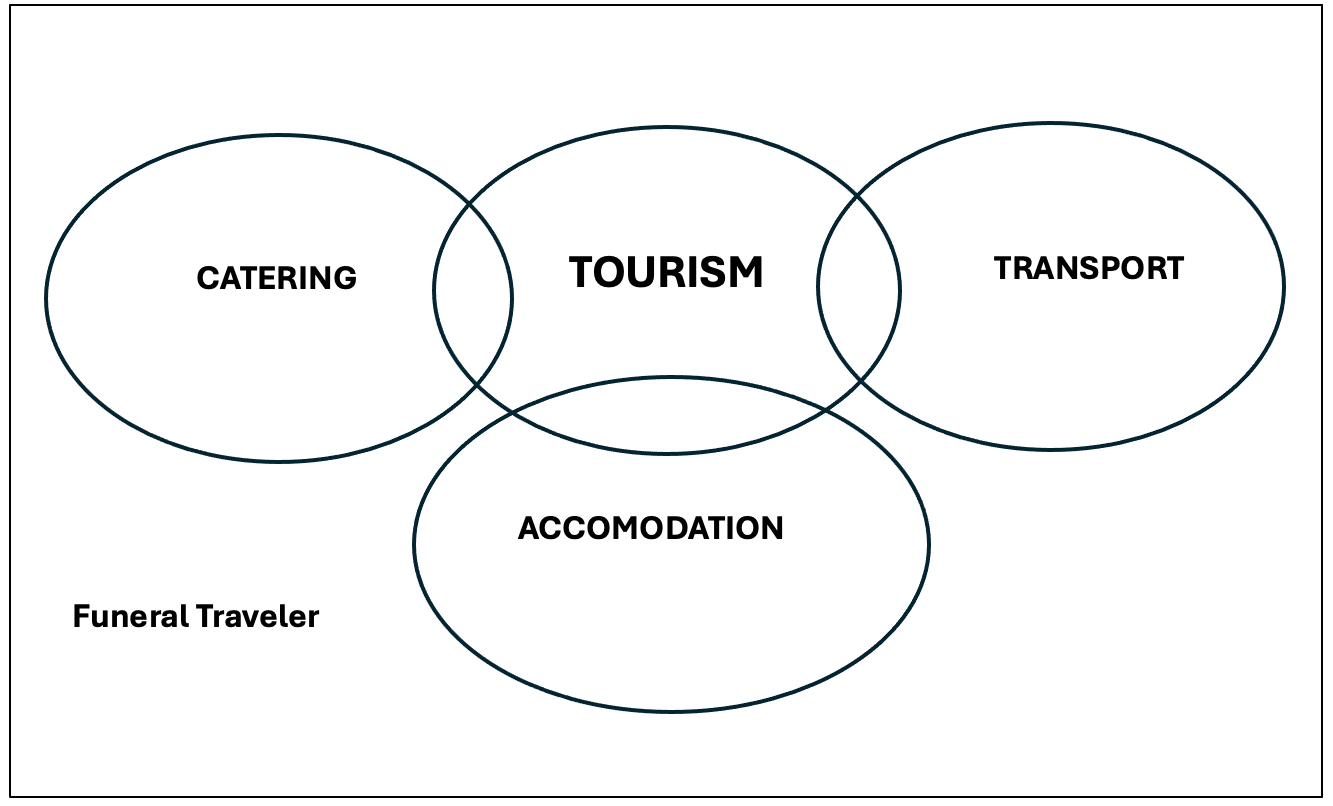
Source: own editing.
Respondents mentioned that they spend on contributions and donations to the bereaved families, whereas the bereaved families spend on coffins, food, flowers, transportation, and tombstones.
Commonalities regarding funeral experiences across the Venda, Pedi and Tsonga tribes were established. Funerals in these tribes are conducted in a similar manner in terms of memorial service, date of funeral, traditional practices such as dress code and time management; however, over 80% of the respondents who attended funerals from Tsonga tribe mentioned that their people do not necessarily adhere to time as their funerals can last until mid-day, whilst Pedi and Venda funerals take place in the morning and end before 10 am.
Obligatory expectations such as dress code, covering the head, and traditional practices were common, with all respondents saying that women are required to wear dresses that are knee high, men are required to wear jackets, black being common across the tribes.
Attendance of friends and relatives was reported to be very important by all respondents: friends and relatives provide an essential element of emotional support to the bereaved family, with one respondent indicating that: “The importance of them coming first is for emotional support because you need the support system. Losing someone is not so easy. You need people showing up, it shows that they really care, it shows support, and it gives you hope that you won’t cry forever.”
The presence of friends and relatives was also supported in the role they play in financial assistance, as such support is critical in covering costs. One respondent stated that the challenge with funerals is that they are unplanned, and so financial assistance becomes critical. However, respondents shared the sentiment that financial assistance is not a primary expectation, such that even if friends and relatives do not assist financially, their presence is essential. These findings are in line with the fact that over 80% of respondents indicated that they primarily attend funerals to assist friends and relatives.
The study established that friends and relatives are present at the house of the bereaved day or days before the funeral, and that funeral goers would be accommodated at the home of the bereaved, at the neighbors, at the local relatives, and some would book accommodation in local lodges, guest houses and hotels.
Although funeral visitor numbers cannot be estimated as attendance is driven by varying factors, respondents indicated that they welcome any number of guests at the funeral and catering is planned for with observation of attendance during the week-day prayers, one respondent mentioning that she comes from a big family and their funeral guests can reach a thousand, with another respondent mentioning that an average of 250 guests attend funerals.
Differences were noted between royals’ and commoners’ funeral practices: burials of the former occur in the early morning and is only attended by the royal family, who invite traditional healers to their burial. It was also found that high-ranking officials and politicians attend royal funerals.
6. Conclusions and recommendations
The study’s primary objective was to explore funeral tourism in the northern parts of South Africa, focusing on the funeral practices of the Venda, Pedi and Tsonga tribes and explore how their practices connect to tourism. The study revealed that the funeral practices of the three tribes are quite similar. An important finding was the importance of friends’ and relatives’ attendance to funerals, which creates a sense of obligatory travel, warranting the consumption of tourism-related products and services. The study established that funeral goers consume tourism products such as transportation, accommodation, and foods and beverages. Such a findings speak to the objective of the study which was to explore a connection between funerals and tourism. As indicated in Figure 2, a connection exists between tourism and funerals. It is therefore recommended that tourism planners, marketers, and destination managers should include funeral tourism in the promotions and planning of their destination, and that tourism service providers should craft products and services tailored to meet the needs of funeral tourists. It is further recommended that an empirical exploration of the intentions of funeral tourists to use tourism products be researched.
References
Backer, E. & King, B. (2017). VFR Traveller Demographics: The Social Tourism Dimension. Journal of Vacation Marketing 23 (3): 191–204. DOI: 10.1177/1356766716665
Baloyi, M. E. (2014). Distance no impediment for funerals: Death as a uniting ritual for African people – A pastoral study. Verbum et Ecclesia 35 (1), 7 p. DOI: 10.4102/ve.v40i1.1918
Bhuda, M. T., Motswaledi, T. & Marumo, P. (2023). A place for traditional and customary practices in funerals during and post COVID-19: Insights from South Africa . Pharos Journal of Theology 104 (3), 12 p. DOI: 10.46222/pharosjot.104.316
Bini, H. L., Tichaawa, T. M. & Harilal, V. (2022). International students as generators of VFR travel and tourism in South Africa. African Journal of Hospitality, Tourism and Leisure, 11 (6): 1937–1952. DOI: 10.46222/ajhtl.19770720.334
Dafuleya, G. (2018). (Non) state and (in) formal social protection in Africa: Focusing on burial societies. International Social Work 61 (1): 156–168. DOI: 10.1177/0020872815611196
Dlamini-Myeni, B. (2022). Navigating the new normal: An exploration of funeral and burial rituals among traditional Zulu people in the context of the Covid-19 pandemic. Indilinga: African Journal of Indegenous Knowledge Systems 21 (1): 64–74. DOI: 10.4314/indilinga.v3i2.26364
Dwyer, L., Seetaram, N., Forsyth, P. & King, B. (2014). Is the migration-tourism relationship only about VFR? Annals of Tourism Research 46 (3): 130–143. DOI: 10.1016/j.annals.2014.03.009
Fernandes, M. & Jamadagni, R. (2018). The dark tourist: An insight into the appeal of dark tourism. Atithya: A journal of Hospitality 4 (2): 41–45. Available online: https://www.academia.edu/42864165/The_Dark_Tourist_An_Insight_into_the_Appeal_of_Dark_Tourism/
Kashiwagi, S., Nagai, H. & Furutani, T. (2020). Expanding the concept of the VFR market: Excavating ‘hidden VFR travellers’. Tourism Management Perspectives 33: 100610, 8 p. DOI: 10.1016/j.tmp.2019.100610
Kashiwagi, S., Nagai, H. & Furutani, T. (2023). Understanding challenges faced by VFR hosts: A study of Japanese migrant hosts in Australia. Journal of Hospitality and Tourism Management 54: 306–315. DOI: 10.1016/j.jhtm.2023.01.004
Kennell, J. & Powell, R. (2022). Dark tourism and world heritage sites: A Delphi study of stakeholder perceptions of the development of dark tourism products. In: Isaac, R. K. (ed.) Dark Tourism Studies. London: Routledge, pp. 9–23.
Kunwar, R. R. & Karki, N. (2019). Dark tourism: Understanding the concept and recognising the values. Journal of APF Command and Staff College 2 (1): 42–59. DOI: 10.3126/japfcsc.v2i1.26731
Lennon, J. J. & Foley, M. (2000). Dark Tourism: The Attraction of Death and Disaster. London: Continuum, 184 p.
Lewis, H., Schrier, T. & Xu, S. (2022). Dark tourism: Motivations and visit intentions. International Hospitality review 36 (1): 107–123. Available online: https://www.emerald.com/insight/content/doi/10.1108/ihr-01-2021-0004/full/html/
Limpopo Provincial Government (2023). Limpopo Spatial Development Framework. Polokwane: Limpopo Provincial Government.
Mthiyane, D., Wissink, H. & Chiwawa, N. (2022). The impact of rural–urban migration in South Africa: A case of KwaDukuza municipality. Journal of Local Government Research and Innovation 3, 9 p. DOI: 10.4102/jolgri.v3i0.56
Proos, E. & Hattingh, J. (2020). Dark tourism: Growth potential of niche tourism in the Free State Province, South Africa. Development Southern Africa 39 (3): 303–320. DOI: 10.1080/0376835X.2020.1847636
Raine, R. (2013). A dark tourist spectrum. International Journal of Culture, Tourism and Hospitality 7 (3): 242–256. DOI: 10.1108/IJCTHR-05-2012-0037
Rogerson, C. & Rogerson, J. (2023). VFR travel and Covid-19 impacts: The South African experience. GeoJournal of Tourism and Geosites 48 (2. spl): 717–724. DOI: 10.30892/gtg.482spl05-1071
South African Tourism (2021). Tourism Sector Recovery Plan. Pretoria: South African Tourism.
Statistics South Africa (2024). Migration Profile Report for South Africa: A Country Profile 2023. Pretoria: Statistics South Africa.
Stats SA (2021). Domestic Tourism Survey, 2019 . Pretoria: Statistics South Africa.
Stats SA (2022). Domestic Tourism Survey. Pretoria: Statistics South Africa.
Tourism South Africa (2022). South African Tourism Annual Report 2021/2022. Pretoria: South African Tourism.
Tran, M., Moore, K. & Steel Gary. (2020). VFR tourism and intersecting global mobilities: Experiences of international PhD students in New Zealand. Tourism Management Perspectives 35 (4): 100681, 18 p. DOI: 10.1016/j.tmp.2020.100681
United Nations Human Settlements Programme (2020). World Cities Report 2020 . Nairobi: United Nations Human Settlements Programme (UN-Habitat).
Uzoma, E. E. (2009). African culture and the African personality: From footmarks to landmarks on African philosophy. Lagos: Obaroh and Ogbinaka Publishers.
Van Koppen, B., Hofstetter, M., Nesamvuni, E. & Chiluwe, Q. (2020). Integrated management of multiple water sources for multiple uses: rural communities in Limpopo Province, South Africa. Water SA, 46 (1): 1–11. DOI: 10.17159/wsa/2020.v46.i1.7870
Yeboah, T., Kulega, A., Saaka, C. A. & Baidoo, A. (2017). Examining funeral tourism development in the Ashanti region, Ghana. African Journal of Hospitality, Tourism and Leisure 6 (2), 13 p. Available online: https://www.ajhtl.com/uploads/7/1/6/3/7163688/article_35_vol_6__2_.pdf/
Yousaf, S. & Kim, J. M. (2023). Dark personality traits and dark tourism sites: Analysis of review generation and consumption behaviors. Tourism Management Perspectives 49: 101190, 12 p. DOI: 10.1016/j.tmp.2023.101190