

| Turisztikai és Vidékfejlesztési Tanulmányok Tourism and Rural Development Studies 8. évfolyam, 4. szám, 2023: 101–120. doi: 10.15170/TVT.2023.08.04.07 |
NOT JUST A PLACE… LOCAL CENTRE OF CULTURE, THE VIGADÓ – A CASE STUDY FROM KISÚJSZÁLLÁS
1Tibor Kovács
1Associate professor, Eszterházy Károly Catholic University, Faculty of Economics and Social Sciences, Institute of Economics. Vice mayor, Municipality of Kisújszállás;
kovacs.tibor@uni-eszterhazy.hu
ABSTRACT
Hungary – despite its relatively small size – has for decades faced significant regional development disparities. The external and internal peripheries are in a difficult situation, and it can be noted that the involvement and local use of external financial resources, which have been steadily decreasing, has not generated any substantial development in recent years. It should be recognised that development should be based on the application/use of local, endogenous resources, in which culture (in the broad sense) must play a key role. The present study examined Kisújszállás, the “cultural capital” of the traditional Nagykunság (Greater Cumania), an inner peripheral region, and in particular the emblematic building of the municipality, the renewed, multifunctional Vigadó, and its role in local culture. It was found that in the eight years since its reopening, despite external and unexpected difficulties, the Vigadó has played a prominent role in organising and communicating culture in the town. Moreover, it can be said that the building and the Vigadó, which has since become a brand, not only plays a prominent role in culture, but also, according to urban development literature, could become a point of resilience for the city, which sees culture as a major development direction.
Keywords: “cultural capital” of Greater Cumania, local resilience point, multifunctional cultural centre, Vigadó
Received: 23 October 2023
Accepted: 4 December 2023
Published: 20 December 2023
NEM CSAK EGY HELY… A KULTÚRA HELYI KÖZPONTJA, A VIGADÓ – KISÚJSZÁLLÁSI ESETTANULMÁNY
1Kovács Tibor
1Egyetemi docens, Eszterházy Károly Katolikus Egyetem, GTK Gazdaságtudományi Intézet. Alpolgármester, Kisújszállás; kovacs.tibor@uni-eszterhazy.hu
ABSZTRAKT
Magyarország – viszonylag kis területe ellenére – évtizedek óta igen jelentős térségi fejlettségi különbségekkel küzd. Nehéz helyzetben vannak a külső és belső perifériák, s megállapítható, hogy a – folyamatosan csökkenő – külső anyagi erőforrások bevonása, helyi felhasználása sem generált érdemi fejlődést az elmúlt években. Egyre inkább be kellene látni, hogy a fejlődést a helyi, endogén erőforrások kiaknázására érdemes alapozni, amiben meghatározó szerepet kell, hogy játsszon a (tág értelemben is vett) kultúra. Tanulmányunkban egy belső periférikus térség, a tradicionális Nagykunság „kulturális fővárosát”, Kisújszállást vizsgáltuk, azon belül is a település emblematikus épületét, a megújított, multifunkcionális Vigadót, annak a lokális kultúrában játszott szerepét. Megállapíthattuk, hogy a 2015-ös újranyitás óta eltelt nyolc évben – a külső és váratlan nehézségek ellenére – a Vigadó a városban kimagasló szerepet tölt be a kultúra szervezésében és közvetítésében. Mindezeken túl kijelenthető, hogy az épület, illetve az azóta márkává nemesedett Vigadó nemcsak a kultúrában tölt be kiemelkedő szerepet, hanem a városfejlesztési szakirodalom alapján a jövőben ez lehet a város (amely kiemelkedő fejlődési irányt lát a kultúrában) egyik rezilienciapontja is.
Kulcsszavak: a Nagykunság „kulturális fővárosa”, helyi rezilienciapont, multifunkcionális kulturális központ, Vigadó
Benyújtva: 2023. október 23.
Elfogadva: 2023. december 4.
Publikálva: 2023. december 20.
1. Introduction and literature review
Greater Cumania (Figure 1), one of the oldest traditional Hungarian cultural regions, located in Jász-Nagykun-Szolnok County, has long been struggling with serious social and demographic problems, is also plagued by significant natural and environmental problems, and seems to be missing out on the mainstream of economic development (not only in Europe, but also in Hungary) – being an internal periphery region for many decades.
Figure 1: The traditional Greater Cumania (settlements marked in dark grey)

Source: Kovács & Vasvári, 2023.
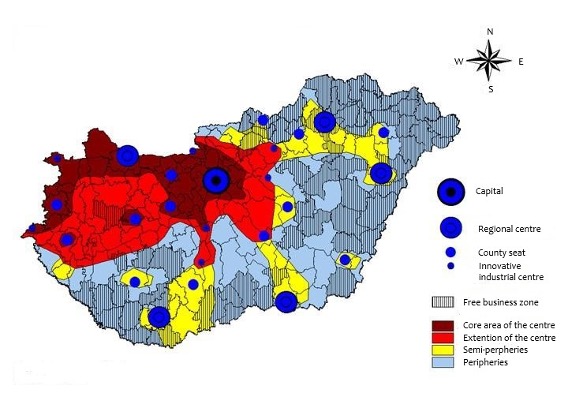
Such inner peripheries are found in large numbers in different areas of the country, but their most frequent and widespread occurrence is generally in the Great Plain and Northern Hungary. Inner peripheries are those areas of larger size located in the interior of the country, especially in the regions of county boundaries, which bear the consequences of the disadvantaged situation in a more concentrated way than the average: prolonged economic recession, acute employment crisis, unemployment above the national average, emigration, poverty, concentration of the Roma population (Baranyi, 2004) (Figure 2).
Figure 2: Spatial structure of Hungary
Source: Own editing based on Süli-Zakar, 2016.
At the same time, some of its inhabitants hold on to their centuries-old traditions (mainly through intellectual projects and initiatives by NGOs) and their sense of identity in Greater Cumania, which they hope to preserve and perpetuate through culture, and to make known to the wider travelling public, beyond the local community.
This raises the fundamental question: how can such an inner peripheral area, the viability of its constituent settlements be preserved, their survival ensured, and possibly set them on a path of moderate development in the medium term? The answer may be obvious: local resources, especially the specific culture of the region and its municipalities, must be developed, promoted, and marketed. Local cultures are linked to a specific space, they are unique, if you like, and can be understood as a well-integrated system, defined by their very link to their specific space (Hannerz, 2004). It is an old axiom that settlements should be “sold” to three main target groups: local residents, businesses, and tourists (Ashworth & Voogd, 1990; Kozma, 2006).
Tourism and its development play an important role in increasing the competitiveness of localities, as well as influencing their image, image, and positive perception (Máté & Nagy, 2015). In the life of a community, tourism can support the local people’s intentions to preserve local culture and heritage, to preserve traditions and to promote local values to visitors (MacCannell, 2003). It is important to note that the continuous physical and symbolic renewal of a municipality, and the development and sale of local specialities to tourists, is a real possibility, since “tourism is a process that involves the continuous re-creation of practice and space in a shared context” (Edensor, 2012), that is, the development of a municipality can generate the revitalisation of tourism and thus the further development of the city. It is now also a fact that “the development of cultural tourism is no longer just a tourism issue but a community issue” (Richards, 2021), that is, local tourism development has a significant potential for municipal (including significant local business) development.
In the context of 21st century tourism trends, it can be seen that “the combination of more actors entering the tourism system and the wider range of contexts used for cultural tourism experiences means that many new cultural tourism practices are emerging” (Richards, 2021), opening new avenues for localities and local businesses that previously had few traditional attractions due to their limited attractiveness at the time.
For some time now, the tourist has been looking for the special, the unique, the authentic experience, which is at the heart of their travel, and, perhaps partly as a result, there is a trend towards “going where you would never have gone before”. This also means that, beyond the physical attractions, “the search for distinction by tourists means that the contemporary city must be ’eventful or die’. Increasingly, cities are using events as a political tool to underpin culture-led development, create a distinctive image or promote social cohesion” (Richards, 2021).
In this study, our settlement – in connection with the above reasoning – is the “cultural capital” of Greater Cumania, Kisújszállás, a typical East-Hungarian, lowland rural town, and its iconic building, the multifunctional Vigadó, with its focus on its (main) role in local cultural life, its preservation, development, mediation, and the organization of local events, which has been played for almost a decade.
2. Main objectives
This paper aims to examine how the Vigadó building has become a symbol (a hub of culture and an organizing force in Kisújszállás), what local cultural attraction it has had since its reopening in 2015, how it contributes to the organization, maintenance, strengthening and development of the cultural life of the city, what role it plays in ensuring the liveability of the city, and what significance it has as a local point of resilience.
3. Research methods
The following methods were used: analysis of relevant municipal development strategies; analysis of the institution’s annual brochures; analysis of the institution’s visitor statistics; prominence research, interviews with city and institution leaders; analysis of the digital space (Facebook, Instagram, institutional website, YouTube) of the Vigadó’s activities; methodology of lived geography.
4. Results
4.1 Kisújszállás and culture – past and present
The town of Kisújszállás (together with the other five settlements of the Greater Cumania historical cultural region) is located on the eastern inner periphery of Hungary, on the basis of statistical analyses, scientific research and our subjective perception of reality, and is facing serious socio-economic-environmental challenges.
Even if the settlement is not rich in unique material assets, it is rich in exploitable symbols: Zsigmond Móricz (who studied at the gymnasium for two and a half years and then graduated from high school here), István Csukás (who was born and spent his childhood in Kisújszállás), and Nobel Prize winner Katalin Karikó (who lived and studied here from birth to graduation) are all connected to Kisújszállás; hailing from Kisújszállás, their work is preserved and cherished by active local intellectuals. At the same time, it must be said that the settlement is not in an easy situation as far as culture is concerned (nor is the whole of Greater Cumania), and these problems, clearly detectable in the present, are rooted in the past.
An analysis of the work of one of the nation’s greatest writers, Zsigmond Móricz, reveals that he spent the most emotional period of his life, his youth, in the small town of Greater Cumania; as he himself said, his art documents the interesting experiences he had in the town. It was here that he first glimpsed the desperate world of semi-feudal Hungary at its most vivid, repeating the ills of society (Kiss, 1959). His works evoke the characteristics of this landscape, the remnants of a world of salt lakes, former reeds, the wilderness with a wild pear tree here and there. Below the town we see the mills waiting for wind, inside the long, dusty main street, the wide square where a hot-water well has just been drilled; behind the high fences we see cold houses, bare courtyards, and around the town hall, a few storeys of newly erected buildings. There is the court, where the young lawyer-boys go with their chickens, across the street is the Big Inn (“Big Dish”), where the small-talking, thick-mouthed farmers and small lords drink spritzer in the scorching heat, and book-keepers and strangers are given third-day pensions (Kiss, 1959). This world, which he calls either Kunterebes or Dust City, is what he sees here: this half-nomadic, half-civilised, half-civilising, half-retarded life is what first shocked him. Móricz drew vivid pictures of the lowland peasant town of Kisújszállás in his works, largely as the embodiment of backwardness (Kiss, 1959).
The backwardness of the local society, its perceptible lagging behind the European (and even national) average is confirmed from another point of view by recent research focusing on the situation of local culture (Kovács & Vasvári, 2023). The researcher used a questionnaire to assess the cultural situation of the city among local stakeholders and prominent people (21 people in total). In this survey, respondents (81% of all respondents) assessed the cultural assets of Kisújszállás. They were most concerned about the low level of cultural demand of the local (average) population, although many of the civic associations (about 50 in number, in a settlement with a population of a little more than 10 000 and a demographically shrinking population) are able to find their audience, so the supply side is assured. The problem is lack of motivation. Activating local people is an issue that needs to be solved in many areas – although this may be a general (East) Hungarian social paralysis: the city, the municipality, and its institutions, the NGOs and everyone else who is acting cannot yet achieve better results in this area (as it is a general observation that only those who are willing to do so can be helped).
In the field of culture, the shortcomings of advertising and public relations were also highlighted, not only as a problem of cultural endowments, but also in municipal management, where the lack of communication and public relations was stressed. In addition, it is felt that little money is coming into the city from central sources: there is a general and persistent underfunding which is getting worse. This is also indicative of the general domestic process, which has been going on for almost a decade and a half in Hungary, of re-centralisation and emptying out of local governance, and the rebuilding of a vertical rather than horizontal ‘partnership’ between the various territorial levels (Kovács & Vasvári, 2023).
There are many ways to solve these problems, but in our research view, in the current situation, this could be the exploration, mobilisation and sustainable, flexible and profitable use of local, endogenous resources. Closely linked to this view is the observation that, in addition to the theoretical approach, practice is also critical. Accordingly, it has been established that in the 21st century, a single citizen’s special ‘ability’ (the Nobel Prize winner Katalin Karikó), a single ‘ability’ based on a single historic building (in this case, the Vigadó), or a single special natural resource specific to a particular municipality (e.g., Indian rice) can be the starting point or driving force for the development of a city (including its culture), for strengthening local resilience and for creating new strengths and opportunities (Fejérdy & Z. Karvalics, 2015).
This thesis is strengthened by the fact that in the 21st century, in the postmodern experience economy, it is crucial to create, produce, market, sell, and consume the culture of the lowlands in a broad sense, in this case the special culture of the Great Cumanian small town, since “culture is big business. It is one of the leading sectors of the post-Fordist economic revolution and the basis of countless urban renewal programmes” (Scott, cited by Süli-Zakar et al., 2006).
4.2 Cultural capital of Greater Cumania (?) – the institutional system of local culture
In the apparent reality of the present, sensing the problems of the local society and looking for solutions, the well-meaning people of Kisújszállás do not surrender. The town, recognizing the changing times, has for years been clearly building on culture as a local outlet and development opportunity: as a physical framework for this, it built and renovated the Vigadó building eight years ago, which has been a central force for popular and high culture events for locals and those from the countryside.
The Municipality of Kisújszállás pays special attention to the cultivation, preservation, and development of the culture of the settlement, to the transfer of local cultural values to the population (and to tourists visiting the town) – both popular and high culture (if such a distinction still exists). In a decree of 2012 Decree [46/2012 (XII. 19.)], the local representative body defined the cultural services to be “produced” and provided locally, and made the Cultural Centre and Library, a local, multifunctional public cultural institution, the main custodian and responsible institution. The Vigadó is the jewel in the crown of this institution and, although it is the most important, but not the only part (in addition to the Vigadó, this includes the Arany János Municipal Library, the House of Culture, the Ethnographic Exhibition Hall, the Lajos Papi Art House, the Bocskai House, the Country House and the Greater Cumanian Club – these are also places where the local cultural leaders, organisers and shapers are constantly working to create and preserve value and to give visitors an experience) (vigadokisuj.hu). As part of the local Cultural Centre and Library, the Vigadó, in addition to serving the cultural needs of the locals, is committed to helping visitors to have a good time and make the days of tourists visiting Kisújszállás as colourful as possible (the Vigadó staff can help visitors to go fishing, horse riding, pony trekking, or to visit the sights of the town, etc.) (Facebook.com). But how did we get here?
4.3 Brief history of the Vigadó
In the old days, family gatherings (e.g., name days, weddings, pig feasts) were the scene of social gatherings in the town. “After the Conciliation with Austria (1867), clubs, circles and reading circles provided an opportunity for social life, socialising, entertainment, recreation, and culture. The Crown Hotel and Restaurant was the first to be built specifically to meet these needs on a city-wide scale, opening on 10 January 1873 with a grand ball. The building housed a café, hotel, restaurant, ballroom, theatre and cinema. During the millennium, the young – still a student – Zsigmond Móricz stayed here, and his experiences and the atmosphere of the inn were later recorded in his writings (e.g. Ferkó Kerek)” (Ducza, 2016: 181).
As demand grew and opportunities increased, the city fathers realised the need to build a prestigious theatre-village at the turn of the century. A suitable site was the theatre in the centre of town, between the Big Inn and the Municipal Savings Bank, which was the inn’s driveway. After a decade of deliberation, the council finally decided to build the Vigadó on 10 April 1911. The initial cost was estimated at 160 000 Koronas, which would mean around 390 million Forints today or over 1 million Euros (Ártörténet.hu).
The great hall was built not only for theatrical performances. From the very beginning, it was also intended to operate a cinema (in later times it was indeed the main source of income). The opening performance took place on 7 October 1912, when the drama Bánk bán was staged. The performance and the theatre building dazzled the audience. In the then muddy, dark city, only the street corners had petrol lamps flickering on the pillars, but the theatre’s portal was aglow with purple arc lamps. As the city did not yet have electric lighting, a generator provided the lighting for the building and the halls. Needless to say, there were sold-out performances night after night. Everybody was proud of the development of the town and of the work of the Theatre-Vigadó (Ducza, 2016).
Between the two world wars, the Uránia Municipal Cinema hosted various social events in addition to film screenings, while theatre performances slowly faded away. Women’s associations organised tea parties with local performers and children, and the students of the high school organised gymnastics shows. The most important were the balls held two or three times a year, attracting a hard-to-please audience, often from neighbouring towns (the Cumania balls) (Ducza, 2016), which may indicate the regional importance of the building and some of the events held.
In 1950, Urania was nationalised and renamed Ady Cinema. In the 50s and 60s, local theatre companies with a passion for art performed in the building. School ceremonies and assemblies were also organised in the large hall. From 1993 to 2000, the space was rented by a local entrepreneur in a family business. They showed films twice a week, organised cultural programmes, music concerts, a bridal shower, a baby shower, and operated a video rental. The Leisure Centre closed down in September 2000, mainly due to a decline in interest in film screenings (Ducza 2016). The new millennium has brought a long agony to the building, which was once a landmark not only in the city but also in the wider region. The agony led to it becoming a blight on the city centre, until it was finally closed down for a decade and a half, and in the end it was only a matter of time before the building was physically destroyed and demolished.
4.4. The great renewal in the second decade of the 21st century
In the 2010s, the city centre of Kisújszállás was largely renovated with the help of EU funding of around HUF 1.2 billion, mostly in the category of spectacular, what many call “aestheticizing urban development”. This is indeed true, but they were not only real estate developments: parks and green spaces in the city centre were renewed, and cost-cutting energy improvements were also made. The most significant – as well as costliest and longest-lasting – investment was the renovation of an emblematic building in the city centre, the former Theatre and Vigadó.
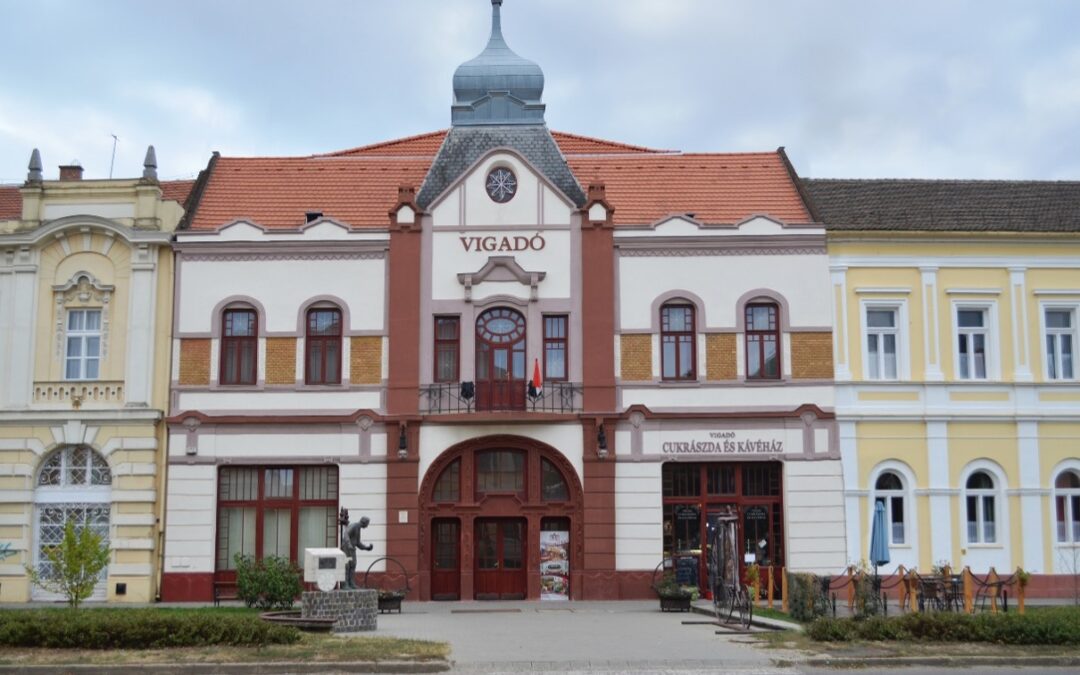
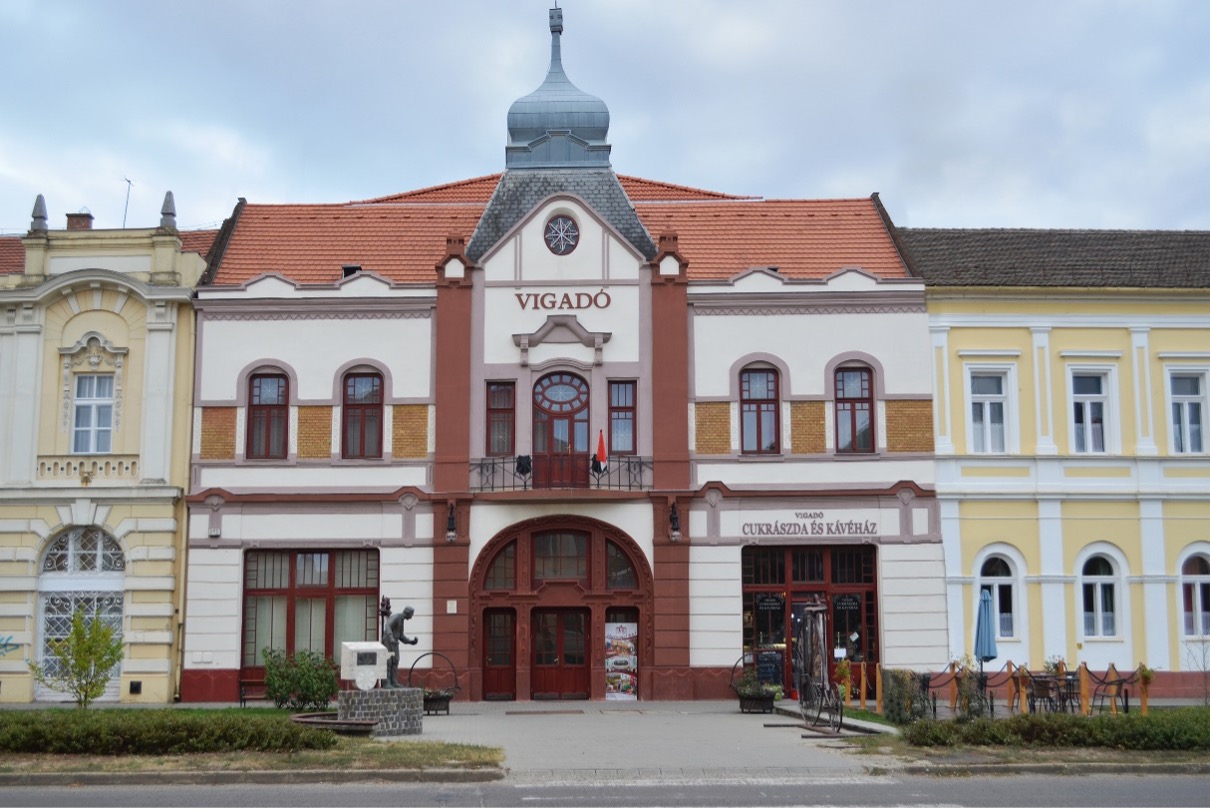
The town, based on the Great Cumanian consciousness, the specific and rich traditions of Kisújszállás, the retaining power embodied in the culture as a whole (and the long-term vision of Kisújszállás, becoming, as the sixth largest town in Jász-Nagykun-Szolnok county in terms of population, and the second largest town in Greater Cumania, the “cultural capital” of the area), did not let this unique value be lost. Utilising tender opportunities, it restored the building to and beyond its former glory, with a significant physical and functional expansion and modernization (Figure 3).
Figure 3: The renovated Vigadó building
Source: Beáta Balogh’ photograph.
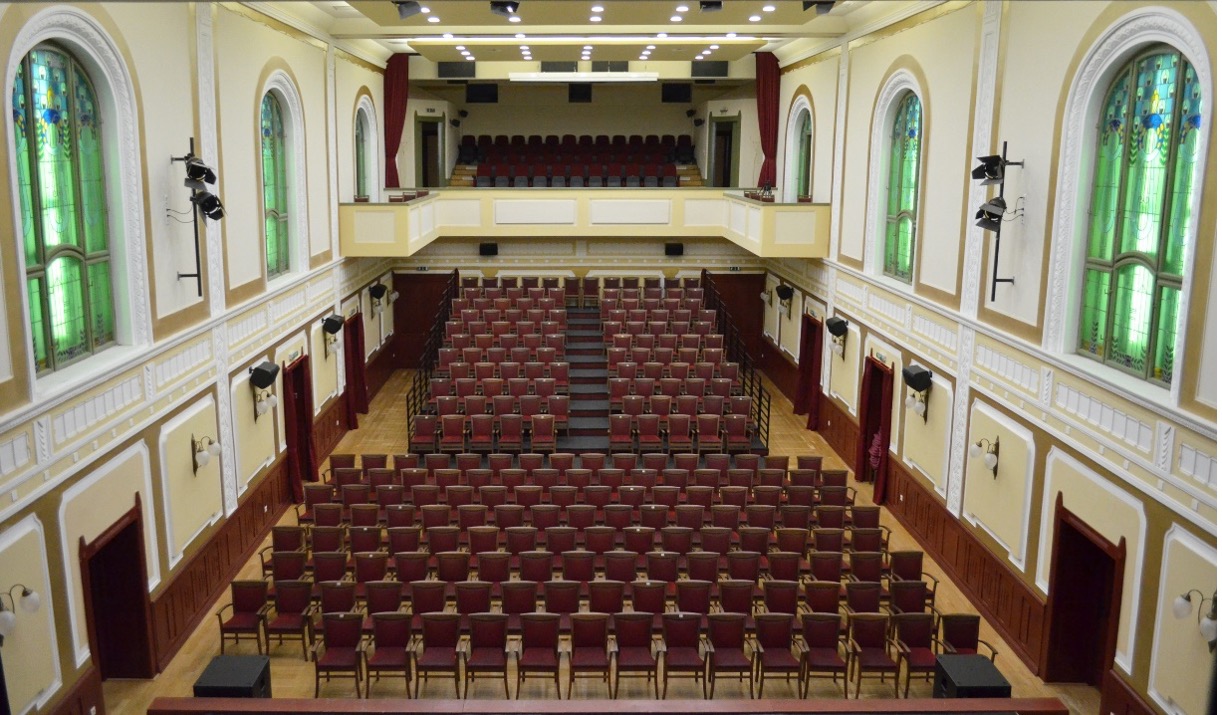
Besides the physical renewal of the building, a fundamental aspect and commitment was to make the Vigadó a multifunctional cultural centre of Kisújszállás and, in the longer term, of the wider region. Thus, the building also houses a theatre and concert hall (Figure 4), a 3D cinema, a TV studio, a children’s activity centre, a dance hall, a bowling alley, a buffet, and a café (vigadokisuj.hu; Kovács, 2022).
Figure 4: The main hall of the Vigadó
Source: Beáta Balogh’s photograph.
4.5 The Vigadó as an urban centre of culture – initial experiences
The new history of the building began with the opening ceremony on 25 September 2015. As its staff proclaimed, “The patinaed and multifunctional cultural centre is reopening its doors to the people of Kisújszállás and hopefully the surrounding villages. After a 15-year hiatus, the Vigadó’s story will continue, hopefully with exciting, exciting, funny, uplifting and even touching moments. To sum it up, the Vigadó is a unique and well-timed blend of tradition and progress” (vigadokisuj.hu). In addition to this, the local guardians and creators of culture have set as their banner that, in addition to serving the cultural needs of the local population, “the population should feel that they have been given an opportunity that is unique in our region…”, and then in the first report, there is this (subjective?) comment: “the Vigadó… has also become a tourist attraction” (Janó, 2016).
4.6 The impact of the Covid-19 pandemic on the functioning of the institution
After a promising start and a few years of consistently high-quality operations, the Vigadó and its partners faced an unprecedented challenge with the pandemic closures in the country, starting in March 2020. The local Cultural Centre and Library was forced to partially shut down for several months, their income almost completely eliminated during this time, and financial assistance from the owner municipality was required (szoljon.hu/helyi-kozelet, 2021).
At the same time, the weekdays did not pass idly, because besides the professional work, the buildings – the Vigadó, the Culture House, the Nagykun (Greater Cumanian) Club, the Papi Lajos Art House, the Municipal Library, the Gallery, the Village Hall, the Bocskai House, and the Ethnographic Exhibition Hall – were also constantly taken care of. There were operational requirements also to be met, but the head of the institution said that the most important thing was the professional work, which was communicated to the public online. As part of this process, a new website for children was launched, called Arthur the Dumpling and his friends, with stories, nature films, and a quiz, and they were constantly preparing for the relaunch. The staff of the city library found ways to make documents accessible to readers, for example by setting up an open-air library in the arcade of the Vigadó and a book delivery service. In the ethnographic exhibition room, preparations were made for the 50th anniversary, and in the country house, work began on a new room interior. In addition, summer programmes and festivals were organised (szoljon.hu/helyi-kultura, 2021).
During the period of closure, the institution lost 3 to 3.5 million Forints a month of its own income, but, as the local government has considered the support of culture important, even in the extremely difficult circumstances of the time, the budget provided for the institution’s operating expenses and staff allowances as far as possible (szoljon.hu/helyi-kultura, 2021).
4.7 The Vigadó as a symbol, a force for community
Since the re-opening of the building, there has been an interesting shift in the local public discourse, as any event organised by “The Community, The City” in the municipality is now perceived as being organised by “The Vigadó” – even though the Vigadó itself is only one of eight venues that are part of the institution officially called the Cultural Centre and Library. In the vernacular, in the local discourse, the institutions of the Cultural Centre and Library are now identified as the Vigadó, since the events outside its building are also organised by Vigadó staff with the help of the Vigadó’s resources. (From now on, I will use the term the Vigadó with this additional meaning.)
The Vigadó is a major community organiser through its events, especially for the communities of Kisújszállás, but, in addition to the cultural events that take place every year, it also organises permanent events of declared regional importance, which function as tourist attractions, such as the Süsü Family Festival and Bagaméri Ice Cream Festival (June), City Days (August), the Festival of the Bright and Sunny, Meeting of the Descendants (September), Christmas Eve (December). These events provide tens of thousands of people with a regular and stimulating experience every year.
The complexity of the Vigadó’s services speaks for itself: besides the events, other community-organizing programs should be mentioned here, as the Vigadó offers the possibility to organize exhibitions, other art meetings, presentations of communities, reorganization of their communities, regular activities of clubs, associations, choirs, dance and movement coordination, and scientific conferences. It regularly hosts national and regional educational conferences, film festivals, national meetings of people with disabilities, also providing a place for small communities wishing to go bowling. It is also a venue for family events, and the Süsü play castle is a favourite place for families with children. In addition, visitors can visit the pastry shop on the ground floor, and the courtyard is the setting for a summer programme of activities. All of this suggests that people feel a sense of ownership of the place, of the programmes (in the hundreds every year, Table 1), and that this has made the Vigadó a cultural centre concept for the residents.
Table 1: Events since the September 2015 reopening of the Vigadó in Kisújszállás
| Year | 2015 | 2016 | 2017 | 2018 | 2019 | 2020 | 2021 | 2022 | 2023 |
| All events in the city | 179 | 207 | 200 | 188 | 183 | 96 | 37 | 200 | 142 |
| Organised by the Vigadó with a fee | 6 | 26 | 23 | 19 | 23 | 6 | 4 | 11 | 26 |
| Organised by the Vigadó without a fee | 2 | 15 | 21 | 30 | 13 | 3 | 23 | 41 | 12 |
Source: Janó, 2016, 2017, 2018, 2019, 2020, 2021, 2022, 2023.
4.8 The Vigadó in the digital space
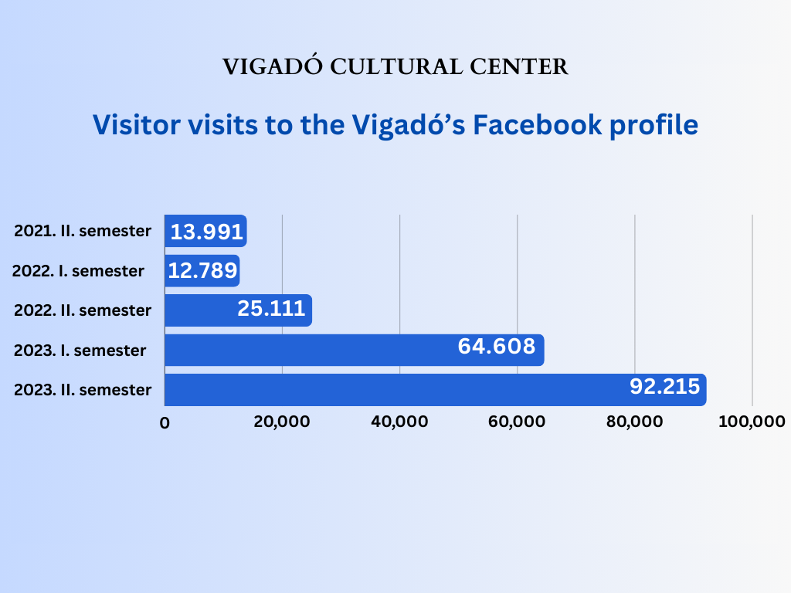
In addition to the tangible reality of the 21st century (and, indeed, long before and increasingly beyond it), it is essential for a cultural institution to be present in the digital space in the most fashionable and popular forms and content of the time – not forgetting the fact that both platforms and content are highly culture-, time- and generation-specific. The Vigadó has its own website, YouTube channel, Facebook and Instagram profile. The website is constantly updated, although this format has become rather old-fashioned, so currently the Facebook page has the most intensive traffic: at the time of writing, in August, with about 6700 followers, which exceeded 7000 by December, and tens of thousands of page views every six months (Figure 5). IThe official Facebook page of the municipality has approximately 3000 followers at the same time (Facebook.com).
Figure 5: Visitor visits to the Vigadó’s Facebook profile, between semesters II. 2021 and II. 2023
Source: Based on Facebook.com.
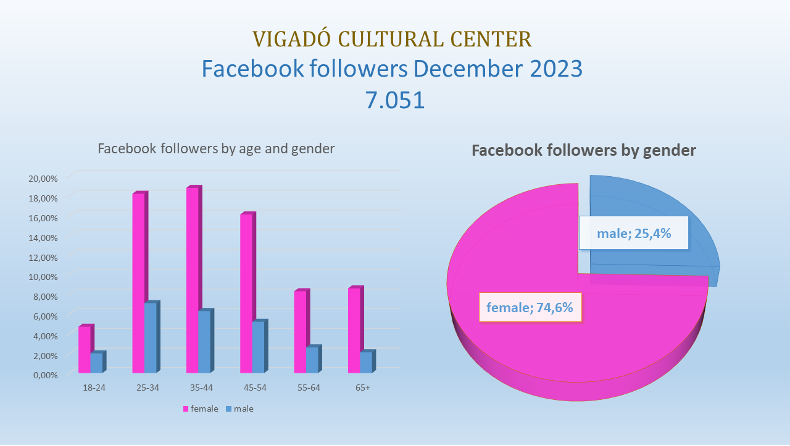
The age and gender distribution of the Facebook profile is as follows (Figure 6): the most active users are women aged 35–44, compared to men aged 25–34; 74.6% of followers are women.
Figure 6: Vigadó followers by age and gender, December 2023
Source: Based on Facebook.com.
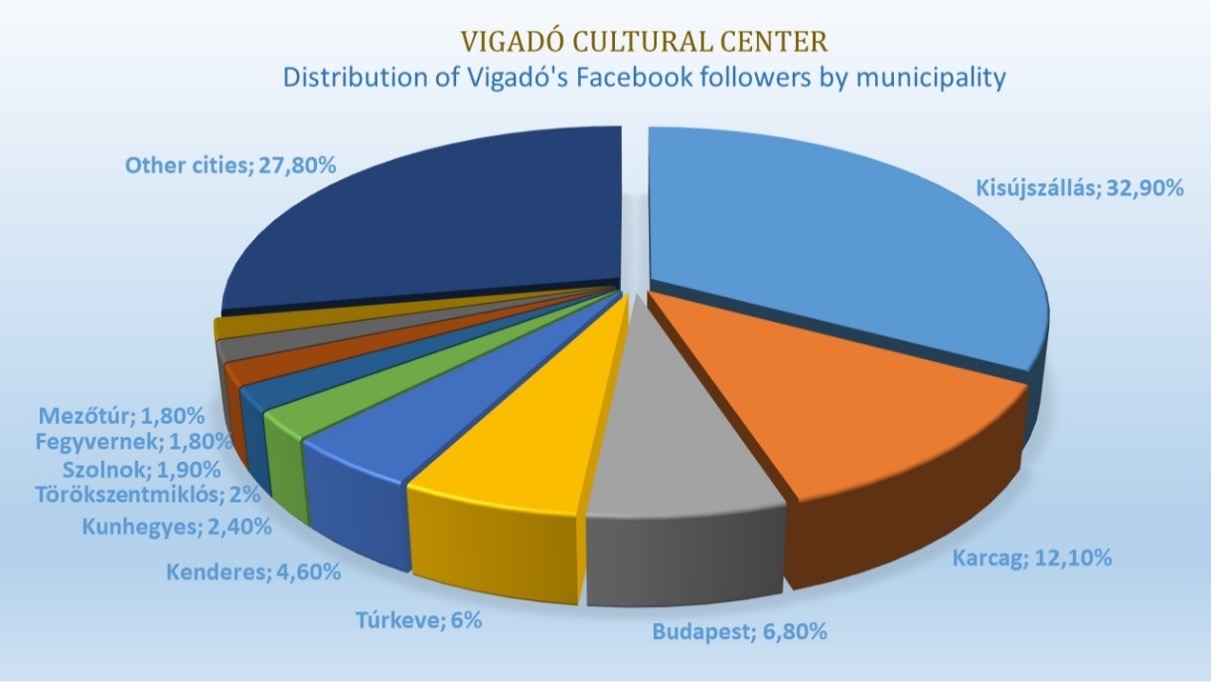
In terms of the geographical distribution of the institution’s followers (in terms of settlements), the majority of them are from Kisújszállás, followed by Karcag (the neighbouring settlement, the district centre), Budapest (mostly because of the people who came from Kisújszállás and their families), and the neighbouring settlements and the wider region, but still within the county. Other settlements account for over a quarter of the total (Figure 7).
Figure 7: Distribution of Vigadó’s Facebook followers by municipality
Source: Based on Facebook.com.
4.9 The Vigadó beyond the city limits
After the pandemic, the Vigadó resumed its operations in real space, returning to normal operations. In the almost four years since then, interviews with the director and staff of the institution have shown that although the Vigadó is mainly used by local residents, staff members have reported that the overall attendance at events is around 60% of the local population, while the number of people from the countryside is 40%.
Based on these data and the practical experience of the institution’s employees, it can be stated that the Vigadó’s programmes and events primarily attract the people of Kisújszállás, but the cultural events also have a noticeable impact on the region, especially on the residents of the surrounding settlements (Karcag, Túrkeve, Kenderes). These are the events when nationally renowned performers, artists, scientists, theatre companies can be seen and heard in the Vigadó (without claiming completeness: András Kern, Lia Pokorni, Csokonai Theatre, Zsuzsa Koncz, Zorán, Kati Kovács, Tibor Bödőcs, László Hadházi, Zoltán Kőhalmi, Tankcsapda, Katalin Karikó).
4.10 Culture and its local funding
Mention must also be made of the financial situation of the institution. In 2022, the amount spent on the operation of the institutions of the Cultural Centre and Library was 109.5 million Forints per year, of which state normative was 24 million, municipal subsidy 46.8 million, the rest being own income. The significant difference is mainly due to the drastic increase in utility costs, the increase in the minimum wage and inflation (Janó, 2022). The possibilities for maintenance, operation and development are further limited by the fact that in our case, unfortunately, there is the aforementioned low level of cultural demand in local society, which is considered low on average, and a strong, perhaps never-ending post-socialist mentality that programmes should be free – in other words, the economic revenue-generating power of culture is not yet evident in our country, which means that culture is not a big business.
In addition to the financial difficulties, it is also necessary to pay special attention to the fact that the district centre is working on the construction/renovation of a cultural infrastructure network that could put it ahead of Kisújszállás in this respect. This could pose a very big challenge and threat to Kisújszállás and the Vigadó as a cultural centre in the near future (for the C-SWOT analysis of the Vigadó, see Table 2).
Table 2: C-SWOT analysis of the Vigadó
| C – Constraints | |
| – Delays/ partial/ total non-receipt of EU funds – (World) pandemics, political crises and their consequences – National funding anomalies for culture, declining central sources – Permanent weakening of the municipal sector – Decline in the value and consumption of quality culture, in parallel with increasing social anomie | |
| S – Strengths | W – Weaknesses |
| – City centre location – Quality physical and symbolic regeneration – Multifunctionality of the building – Dedicated professional team – Varied, diverse programmes and other services | – Difficult, always stretched funding – Culture is not yet a real business locally (because of the general public demand for free) – Low level of cultural demand from some residents – Counter-intelligence of some locals |
| O – Opportunities | T – Threats |
| – Improving digitalisation (e.g., in rural ticketing) – More powerful and modern marketing in the digital space (in partnership with city marketing) – Increasing own revenues, increasing marketing and “monetising” culture – Working with local businesses to market local products – Increased outreach, involvement, and action to local and neighbourhood youth – A new approach to city’s new governance from 2024 | – Renewal of similar institutions in the district centre (inequality of opportunity continues to grow) – Reduction in local resources for culture – Lack of physical renewal/maintenance of the building (due to the municipality’s shrinking financial resources) – Declining solvent demand due to national economic problems |
Source: own editing.
5. Conclusion
In the course of the investigations, it was found that the following items were confirmed after the opening of the Vigadó in Kisújszállás at the end of September 2015 and in the period since then (FEJÉRDY & Z. KARVALICS, 2015):
- The building represents the continuity of the Greek sense of identity of Kisújszállás, a symbol of what the cultural aspirations of the local peasantry were able to create over a century ago – thus the Vigadó as a physical asset, but most of all as a symbol of the accumulated local knowledge, experience and creativity, reinforces the local culture and probably the tourist attraction of the town.
- It has become embedded in the consciousness and mental cultural heritage of successive generations through a significant historic building; this was not ultimately abandoned by the locals, but revitalised at the first favourable opportunity as a long-dormant resilience potential.
- The Vigadó was not a simple aestheticizing renovation project for its own sake, it was not treated as a museum object: it was partly reinterpreted in the context of the renovation, and its multifunctionality makes it a space for meeting the diverse needs of popular and high culture at the same time.
- The building is not only a physical space for the many cultural events in the town: it can also serve as a symbolic surplus to reinforce the slogan that Kisújszállás is the “cultural capital of Greater Cumania” in the region (which requires further research).
- By using the knowledge and experience of the building, respecting and preserving its values, Kisújszállás has at least in part provided a resilience-enhancing response to the challenges of present and future socio-economic processes; knowing that this is far from being a solution to the complex problem of urban shrinkage, for example, but it is certainly a milestone on the road to creating a liveable and sustainable city.
In all this extension of functions, the city has created a complex development that meets virtually all the theoretical scientific needs, which has been properly renovated and has since been used as a cultural centre, serving the needs of the local, and in some cases regional, population that requires culture.
It is important to underline that the Vigadó is an institution of high quality (even the Covid-19 epidemic could only temporarily weaken it), successful in the city and, based on empirical evidence, in the region. Not only does it play a prominent role in culture, but, according to urban development literature, it could be a future point of resilience for the city, which sees culture as a prominent development direction.
Acknowledgements
I would like to thank all the local and provincial actors who helped with interviews, data, written materials and other information: mayor István Kecze, deputy mayor Zoltán Tatár, director Lajos Janó, Zita Szűcsné Nagy and Tamás Füzesséry (Vigadó staff), Dr. Lajos Ducza (local historian), Ágnes Tatár-Balla, the Municipality of Kisújszállás and its Council, and all the dear residents of Kisújszállás and the countryside who contributed to the writing of this article with their subjective but valuable opinions.
References
Ashworth, G. J. & Voogd, H. (1990). Selling the City: marketing approaches in public sector urban planning. London: Belhaven Press, 178 p.
Baranyi, B. (2004). Gondolatok a perifériaképződés történeti előzményeiről és következményeiről. Tér és Társadalom 18 (2): 1–21. Available online: https://tet.rkk.hu/index.php/TeT/article/view/942/1881/ Accessed on 10 November 2023.
Ducza, L. (2016). A Vigadó története. Kisújszállási Nagykun Kalendárium 2016: 181–185.
Edensor, T. (2012). Performatív turizmus, színre vitt turizmus. A turisztikai tér és gyakorlat (újra)alkotása. In: Bódi J. & Pusztai B. (eds.) Túl a turistatekinteten. A turizmus kritikai és kultúratudományi perspektívái. Budapest, Pécs, Szeged: Gondolat KIadó, PTE BTK Kommunikáció- és Médiatudományi Tanszék, SZTE BTK Kommunikáció- és Médiatudományi Tanszék, pp. 241–269.
Fejérdy, T. & Z. Karvalics, L. (2015). Kis- és közepes városok kulturális reziliencia-súlypontjai. Replika 94 (5): 113–127. Available online: http://real.mtak.hu/110583/1/94_06_Fejerdy_ZKL.pdf/ Accessed on 15 November 2023.
Hannerz, U. (2004). A kozmopoliták és helyiek a világkultúrában. In: Biczó, G. (ed.) Az Idegen. Variációk Simmeltől Derridáig. Debrecen: Csokonai Kiadó, pp. 178–191.
Janó, L. (2023). Tájékoztató a Vigadó Kulturális Központ tevékenységéről és az egyes szolgáltatások eredményességéről. Kisújszállás, 8 p. Available online: https://kisujszallas.smartonkormanyzat.hu/data-files/userfiles/files/testulet1026%281%29.pdf/ Accessed on 19 December 2023.
Janó, L. (2022). Tájékoztató a Vigadó Kulturális Központ tevékenységéről és az egyes szolgáltatások eredményességéről. Kisújszállás, 9 p. Available online: https://kisujszallas.smartonkormanyzat.hu/data-files/userfiles/files/testulet1027.pdf/ Accessed on 19 December 2023.
Janó, L. (2021). Tájékoztató a Vigadó Kulturális Központ tevékenységéről és az egyes szolgáltatások eredményességéről. Kisújszállás, 8 p. Available online: https://kisujszallas.smartonkormanyzat.hu/data-files/userfiles/files/testulet_1028.pdf/ Accessed on 19 December 2023.
Janó, L. (2020). Tájékoztató a Vigadó Kulturális Központ tevékenységéről és az egyes szolgáltatások eredményességéről. Kisújszállás, 9 p. Available online: https://kisujszallas.smartonkormanyzat.hu/data-files/userfiles/files/testulet_1029.pdf/ Accessed on 19 December 2023.
Janó, L. (2019). Tájékoztató a Vigadó Kulturális Központ tevékenységéről és az egyes szolgáltatások eredményességéről. Kisújszállás, 8 p. Available online: https://kisujszallas.smartonkormanyzat.hu/data-files/userfiles/files/testulet_1031.pdf/ Accessed on 19 December 2023.
Janó, L. (2018). Tájékoztató a Vigadó Kulturális Központ tevékenységéről és az egyes szolgáltatások eredményességéről. Kisújszállás, 9 p. Available online: https://kisujszallas.smartonkormanyzat.hu/data-files/userfiles/files/testulet_20181030.pdf/ Accessed on 19 December 2023.
Janó, L. (2017). Tájékoztató a Vigadó Kulturális Központ tevékenységéről és az egyes szolgáltatások eredményességéről. Kisújszállás, 7 p. Available online: https://kisujszallas.smartonkormanyzat.hu/data-files/userfiles/files/testulet_20171031_ny.pdf/ Accessed on 19 December 2023.
Janó, L. (2016). Tájékoztató a Vigadó Kulturális Központ egy éves tevékenységéről és az egyes szolgáltatások eredményességéről. Kisújszállás, 8 p. Available online: https://kisujszallas.smartonkormanyzat.hu/data-files/userfiles/files/testulet_20161027.pdf/ Accessed on 19 December 2023.
Kiss, T. (1959). A Nagykunság világa Móricz Zsigmond művészetében. Jászkunság: a Tudományos Ismeretterjesztő Társulat Szolnok megyei szervezetének folyóirata 5 (1): 7–10. Available online: http://real-j.mtak.hu/19522/1/Jaszkunsag_1959_5_1_.pdf/ Accessed on 30 November 2023.
Kovács, T. (2022). Kisújszállás Város reziliencia-stratégiája. Egyeztetési anyag. Kisújszállás: Kisújszállás Város Önkormányzata, 49 p. Available online: https://kisujszallas.smartonkormanyzat.hu/data-files/userfiles/files/Kis%C3%BAjsz%C3%A1ll%C3%A1s%20V%C3%A1ros%20reziliencia-strat%C3%A9gi%C3%A1ja.pdf/ Accessed on 19 December 2023.
Kovács, T. & Vasvári, M. (2023). Az „alföldiség” karakterisztikája a Nagykunságban– kisújszállási esettanulmány. Manuscript, 23 p. Accepted for publication in city.hu Várostudományi Szemle.
Kozma, G. (2006). Terület- és településmarketing. Debrecen: Debreceni Egyetem, 178 p.
MacCannell, D. (2003). Az átalakított etnikai megjelenés. In: Szőllős P. (ed.) Turizmus és szociológia. Budapest: Budapesti Gazdasági Főiskola, pp. 114–116.
Máté, A. & Nagy, E. (2015). A turizmusfejlesztés szerepe és hatása a versenyképességre, a településimázsra és az arculatra. Településföldrajzi Tanulmányok 4 (2): 94–107. Available online: https://ojs.elte.hu/index.php/tft/article/view/3269/2965/ Accessed on 22 November 2023.
Richards, G. (2021). Emerging Cultural Tourism Practices: New Opportunities For Small Cities? Turisztikai és Vidékfejlesztési Tanulmányok 6 (4): 4–15. DOI: 10.15170/TVT.2021.06.04.01
Süli-Zakar, I. (2016). The Formation of Social and Economic Peripheries in Hungary after the Change of Regime. Acta Geographica Debrecina Landscape & Environment 10 (3–4): 179–187. DOI: 10.21120/LE/10/3-4/11
Süli-Zakar, I., Ekéné Zamárdi, I., Kozma, G. & Teperics, K. (2006). Debrecen kulturális gazdagsága és gazdasága. In: Kókai, S. (ed.) Földrajz és turizmus. Nyíregyháza: Nyíregyházi Főiskola Természettudományi Főiskolai Kar Földrajz Tanszéke, pp. 313–334.
Online sources
Facebook.com. Vigadó Kulturális Központ. Available online: https://www.facebook.com/vigadokisuj/?locale=hu_HU/ Accessed on 14 August 2023.
Kisújszállás Város Önkormányzata Képviselő-testületének 46/2012. (XII. 19.) rendelete a helyi közművelődési tevékenység támogatásáról (46/2012. (XII. 19.) Decree on the support of local public cultural activities of the Representative Body of the Municipality of Kisújszállás). Available online: https://kisujszallas.smartonkormanyzat.hu/data-files/userfiles/files/46_rendelet.pdf/ Accessed on 30 November 2023.
Szoljon.hu/helyi közélet (2021). Több mint egymilliárd forintos fejlesztési program indul. Available online: https://www.szoljon.hu/helyi-kozelet/2021/01/tobb-mint-egymilliard-forintos-fejlesztesi-program-indul/ Accessed on 14 August 2023.
Szoljon.hu/helyi kultura (2021). Áttervezett programokkal készülnek az újranyitásra Kisújszálláson. Available online: https://www.szoljon.hu/helyi-kultura/2021/02/attervezett-programokkal-keszulnek-az-ujranyitasra-kisujszallason/ Accessed on 14 August 2023.
Vigadó, Kisújszállás. Available online: https://vigadokisuj.hu/rolunk/ Accessed on 05 August 2023.