

EUROPEAN PEER COUNSELOR TRAINING IN ACCESSIBLE TOURISM – PEER ACT” INNOVATION FOR INCLUSION IN ADULT TRAINING AND INCLUSIVE TOURISM
1 Roger Schmidtchen – 2 Veronika Pataki – 3 Stefanie Trzecinski – 4 Montse Ros Serra – 5 Marieke Piepenburg – 6 Matthias Piel – 7 Nuria Mignone – 8Ana Lamza Bašić – 9 Sonja Vukovic
1 VSBI, Germany
2 Zöld-Aktiv, Hungary
3 KHuF, Germany
4 PROBENS, Spain
5 PROBENS, Spain
6 VSBI, Germany
7 Unione Montana, Italy
8 SLAP, Croatia
9 SLAP, Croatia
DOI: 10.15170/TVT.2021.06.02.09
A tanulmány letöltése pdf-ben
Abstract
This article introduces the Erasmus+ “European Peer Counselor Training in Accessible Tourism – PeerAcT” project which is a project for the implementation of tourism for all. The project runs for 30 months until August 2021 and six project partners from five European countries are taking part. The project aims to connect the areas of adult education and tourism in regard to the inclusion of people with disabilities not only as potential customers but also as adult trainers. Core aspects of the aims and expected effects of the PeerAcT project are the inclusion of people with disabilities as peer experts, the development of a needs and interests group-based training of people involved in the tourism sector, inclusion and accessibility in tourism in general and the development of new approaches for adult education. With regard to the concrete implementation of these aspects five intellectual outcomes are developed. Because of the lack of awareness of inclusion in the touristic sector the PeerAcT project offers a wide range of educational and economic opportunities for both, people with disabilities and experts in tourism.
Key words: people with disabilities, tourism, adult education, equal opportunities
Absztrakt
Jelen tanulmány bemutatja az Erasmus+ „European Peer Counselor Training in Accessible Tourism – PeerAcT” programot, amely egy a mindenki számára elérhető turizmust megvalósító projekt. A program 2021 augusztusával bezárólag 30 hónapon keresztül tart, öt európai országból hat közreműködő partner bevonásával. A project célja, hogy összekösse a felnőttképzést és a turizmust, tekintettel a fogyatékossággal élők nem csak potenciális fogyasztókként, hanem felnőttképzőkként történő bevonására. A PeerAcT projekt legfontosabb célkitűzése és várt hatása a fogyatékkal élők szakértőként történő bevonása, a turizmus ágazatban dolgozóknak az igényekre és érdekcsoportokra épülő képzése, bevonás és elérhetőség általánosságban a turizmuson belül, valamint új megközelítések elterjesztése a felnőttképzésen belül. E célok konkrét véghajtása tekintetében öt szellemi termék került kidolgozásra. A turisztikai szektoron belül a fogyatékkal élők bevonásával kapcsolatos ismeretek hiánya miatt, a PeerAcT project az oktatási és gazdasági lehetőségek széles terét nyújtja mind a fogyatékossággal élők, mind a turisztikai szakértők számára.
Kulcsszavak: fogyatékossággal élők, turizmus, felnőttképzés, egyenlő lehetőségek
Introduction
The transnational project “European Peer Counselor Training in Accessible Tourism – PeerAcT” is an adult education project of six organisations from five European countries (further description: chapter 3) with its focus on the implementation of tourism for all in Europe. The project started on November 1st 2018 and runs until August 31 2021 and is financed by the EU program Erasmus+ under the key action “Cooperation for Innovation and the exchange of Good Practices, Strategic Partnerships for Adult Education Innovation”. The idea for this project was developed during a three days lasting preparation workshop in Bad Muskau (Germany) in 2017 by all project partners.
By the project two main areas of interest for people with disabilities are adressed: adult education and tourism. The legal basis for this international project is on the one hand the “UN-Convention on the Protection and Promotion of the Rights and Dignity of Persons with Disabilities” (art. 24) and on the other hand the “European Disability Strategy 2010-2020: A Renewed Commitment to a Barrier-Free Europe” and the “Accessible Tourism Strategy of the European Commission”. The “UN-Convention on the Protection and Promotion of the Rights and Dignity of Persons with Disabilities” as well as the European Lifelong Learning programs aim, among other things, the better and equal participation of people with disabilities in adult training activities and as adult trainers themselves. The “European Disability Strategy 2010-2020: A Renewed Commitment to a Barrier-Free Europe” and the “Accessible Tourism Strategy of the European Commission” strengthen the importance of ensuring the access to tourism at all levels for people with disabilities. Unfortunately, only a few facilities of touristic destinations are accessible for alle people regardless of any disability and only a few facilities have entire service chains. Additionally, only a small number of staff has the awareness of accessibility and the adequate skills. Finally, in already existing training programs not many people with disabilities are involved. That is why efforts in the field of tourism for all have to focus on two key aspects for the implementation of strategies: Better and sufficient training of decision-makers and staff in private as well as in public institutions, organisations and enterprises is needed. Furthermore, as the main principles in inclusive processes people with disabilities must be involved in all relevant processes and activities about all relevant topics. Therefore, two core target groups are integrated by the PeerAcT project: Firstly, People with disabilities as experts in their own interests and experts in tourism work together in mixed mentor groups as equal partners. Secondly, key decision-makers and staff in private and public institutions and enterprises in tourism get access as trainees.
The main goal of the project is the development and implementation of an innovative methodology to train people with disabilities as adult trainers in accessible tourism on a regional and European level. 5 core aspects and results are expected (further explanation: chapter 4):
– Development and implementation of a methodology for organising peer-counselling and mentoring in accessible tourism
– Development and implementation of a peer-counselling/training methodology and curriculum for new (peer-) experts in accessibility
– Development and implementation of five regional training and peer-counselling centres and an online training platform
– Development and implementation of five peer/mentoring-training-curricula and trainings for accessible tourism
– Development of a lifebook with marketing/exploitation strategy for the local implementation of training centres
The expected main long-term impacts are, first of all, the empowerment and equal participation of people with disabilities as experts and adult trainers in their own interests. Secondly, better awareness and a higher level of knowledge and skills among the group of decision-makers and staff in tourism not only on a regional but also on a European level should be reached. Lastly, European cooperation and exchange/mobility of peer-experts should be achieved. As indirect impacts the better accessibility of involved touristic destinations, the change of mind and awareness among the group of professional staff and the start of the creation of so-called service chains are anticipated.
A first version of this article was published in the compendium “Opportunities and Challenges of Barrier-Free Tourism in Hungary – Results and Recommendations of a scientific workshop during the conference “European Peer-Counselor Trianing in Accessible Tourism – PeerAcT” on September 4th, 2020 in Orfü (Hungary)”. This Compendium provides an overview over the current state of the discussion about accessible tourism and inclusion of people with disabilities in tourism at all levels. It is the result of a scientific workshop in cooperation with the university of Pécs, Faculty of Economics, Marketing and Tourism Institute as part of the interim conference of the PeerAcT project on September 4th, 2020 in Orfű.
In the following an introduction of the PeerAcT project as a half-time overview with first results is given. The background and challenges, objectives, core outcomes and the expected impact are described.
1. The Challenges
As mentioned above, the objectives of the European Lifelong Learning programs (Erasmus+ Programme Guide Version 2, 2020), the “UN-Convention on the Protection and Promotion of the Rights and Dignity of Persons with Disabilities”(art. 24) (United Nations – CRPD) and the “European Disability Strategy 2010-2020: A Renewed Commitment to a Barrier-Free Europe” (European Disability Strategy 2010-2020) are the better and equal participation of people with special needs in adult training activities but also as adult trainers themselves. These International and European documents are also the legal basis and politics of the Accessible Tourism Strategy of the European Commission (United Nations – Accessible Tourim) which is claiming the accessibility of touristic offers and destinations, accessible travelling as well as the accessibility of e.g. public spaces.
Key aspects for the implementation of the strategies of accessible tourism are better training courses centred to the needs of different stakeholder groups of decision-makers and staff in relevant private and public institutions, organisations and enterprises. Main principle in the inclusion process of people with special needs is their involvement in all relevant topics, activities and processes as experts in their owns interests and as peer counsellors.
This strategy needs a joint and renewed commitment. One in six people in the European Union (EU) has a disability that ranges from mild to severe. That makes about 80 million people who are often prevented from fully taking part in society and the economy because of environment- and attitude-related barriers. More than one third of people over 75 have disabilities that restrict them to some extent, and over 20% are considerably restricted. Furthermore, these numbers are set to increase in view of the EU’s population ages perspectives (European Disability Strategy 2010-2020, p.3).The European Disability Strategy 2010 -2020 stresses that clear information should subsequently be provided about the measures taken to make sure that accessibility for all is guaranteed with regard to all products and services related to tourism (European Disability Strategy 2010-2020).Unfortunately, only a few facilities in most of the touristic destinations are accessible, have appropriate services or entire service chains.
During the preparation workshop of the project partners in January 2017 six main reasons for this unsatisfying situation were identified:
- Psychological and mental barriers on the part of tourism providers and public authorities in touristic destinations
- Information deficits regarding the market potential
- Lack of information about travel behaviour
- Lack of information about the requirements of this market
- Information deficits regarding the costs of accessibility
- Statutory barriers and conflicts of goals
Information and better training are one of the key strategies to overcome this situation and presented in the final report published in 2014 by the European Commission concerning “Mapping skills and training needs to improve accessibility in tourism services” (European Commission, Mapping skills and training needs to improve accessibility in tourism services.). Following this report and own research the PeerAcT project first objectives are better training for the stakeholder groups by using the experiences and competences of people with disabilities as peer counsellors and mentors. Further objectives are empowerment and inclusion of people with disabilities as adult trainers and, finally, the improvement of the accessibility of tourism destinations and tourism service chains.
That is why the project has two core target groups for its training activities:
Firstly, the experts in their own interests: people with special needs as well as other experts in tourism, accessibility offer trainings as mixed experts and trainer teams (trainees first and trainer at second). Secondly, the key decision makers and staff in private and public institutions and enterprises involved in tourism and leisure activities are trainees. The project provides innovative methodologies, curriculas, trainings and ideas not only for the project partners but also for other stakeholders along potential service chains in barrier- free tourism, awareness-building as well as for regional marketing. Furthermore, a training and mentoring program for people with disabilities as and mentors as well as accessibility guides and private and public staff in tourism is offered.
2. Who are the partners
Six partners from Croatia, Germany, Hungary, Italy and Spain work together to develop and practice this methodology.
They represent public and private institutions, try to develop and implement better and sufficient training for people with disabilities as peer-experts, decision-makers and employees in relevant private and public institutions, organisations and enterprises dealing with tourism.
2.2 Verein zur sozialen und beruflichen Integration e.V. (VSBI, Merseburg, Germany)
VSBI is lead applicant and coordinator of PeerAcT. The VSBI was founded in 2005 to develop and implement innovative ideas to support people with disabilities to live independently and fully include them into society and employment. VSBI offers them services to support their access to personal budget and personal assistance. The VSBI operates larger offices in Merseburg (Saxony-Anhalt, seat of the VSBI) and in Erfurt (Thuringia).
With the PeerAcT project the VSBI wants to empower and train people with disabilities as peer-experts in their owns interests. This shall give them more opportunities to become an equal part in the adult learning sector as stake- and shareholders as well as make accessible tourism better and more appropriate to the needs of people with disabilities.
2.3 Zöld-Aktív Social Cooperative (Zöld-Aktiv, Orfű, Hungary)
Zöld-Aktív Social Cooperative is based in Orfű in the county of Baranya in southern Hungary. This settlement is one of the county’s main tourist attractions. The fundamental goal was to offer full year employment, support for local tourism enterprises and new approaches to sustainable development. The cooperative itself is also active in tourism and founding organization of the “Barrier-free Tourism Day”. This annual unique inclusive event offers opportunities to try out free-time activities that are not possible for handicapped people (e.g. riding a motorcycle, driving a car, dragon shipping). Most of the staff has experiences in tourism, marketing and social policy. Project partners are: University of Pécs Faculty of Economy Marketing and Tourism Institute (https://ktk.pte.hu/en), People First Association Pécs, which supports the independent living of disabled people in every level (http://peoplefirst.hu/en/).
They would like to make the PeerAcT project widely known in Hungary and offer society a new perspective – including tourism ( GONDA – RAFFAY 2020; RAFFAY-DANYI – ERNSZT 2021)
2.4 KOPF, HAND und FUSS gGmbH (KHuF, Berlin, Germany)
KHuF actively campaigns for everyone who is different to be accepted in and valued by society, as well as to enable them to actively contribute – inclusion. In other words, for people both with or without a disability or handicap to understand, respect and support one another. Education is a key success-factor for the concept of inclusion. This is why KHuF focusses their efforts on the development and implementation of integration and further education projects in their pursuit of inclusion, specifically targeting disabled and handicapped people.
These goals will be achieved through:
- The development of special education and learning concepts as well as specific learning and teaching materials for disabled and handicapped people,
- The promotion and support of intellectual and professional exchanges as well as the collaboration between all persons and organisations that are involved and interested in education of disabled people (those directly affected, associations, sponsors and social welfare institutions, i.a.),
- The development, realisation and evaluation of further education and qualification measures to ensure the better integration of people with disabilities into the world of work,
- The informative work on possibilities to integrate disabled people into the world of work.
KHuF sees great potential to enable equal participation for all through the use of new media. Various apps, learning platforms and software have been developed as a result of their projects.
2.5 Udruga za kreativni razvoj „Slap” (Slap, Osijek, Croatia)
Slap is a development-oriented organization, dedicated to promoting the values and practices of the eco-social economy, creating sustainable models of eco-social economy and acting as a resource centre for social enterprises. With eight permanent employees and a pool of more than 20 external experts in various areas of socio economic development and social marketing, Slap has developed and done many capacity-building programs over years offering more than 600 workshops and seminars for more than 4000 participants and has implemented more than 100 projects. PeerAcT is an integral part of Turistica program, through which Slap connects tourism service providers, creates Panona tours, a DMC specializing in active and cultural tourism and at the same time promotes the principles of inclusive tourism.
2.6 Unione Montana Alta Langa (Unione, Bossolasco, Italy)
The “Unione” is a public body made of 38 Municipalities located in the southern part of Piedmont Region, Italy. The “Unione” aims the promotion and economic development, protection and improvement of mountain territories. In particular, it pursues the goal of promoting socio-economic development as well as the protection of its territory and environment. The final purpose of the cooperation between the municipalities is to improve the living conditions of citizens and to provide them with an adequate level of services. L’Unione Montana Alta Langa delegates to the Consorzio Socio-Assistenziale Alba-Langhe-Roero (a syndicate of municipalities in charge for the welfare services) the management of all activities in support of people with fragility caused by economic and social poverty, the elderly and disability. Tourism is a fundamental industry of the territory and in the last years it permitted the employability of young people and the birth of many small enterprises.
2.7 Asociación para el Estudio y Promoción del Bienestar Social (PROBENS, Barcelona, Spain)
PROBENS was founded in 1983. They have the experience of more than 30 years in youth and adult education as well as in vocational training with national, regional and local networks and about 20 years in international projects. PROBENS is specialised in working with social segregated people: women, young people, children, and unemployed people older than 45 years. PROBENS actually employs 16 professionals, 12 volunteers and 5 students in practicum /Barcelona/Catalonia /Mallorca. The first objective is to support people to find work and integrate the various skills and methods for autonomous integration into their processes.
3. Expected and realised outcomes of peeract (status 31.03.2021)
The project develops and implements six core results so called “intellectual outcomes”.
3.1 Methodology how to organise peer-counseling and mentoring in accessible tourism
This methodology contains the complete theoretical background and basis for the work of the PeerAcT project to support the inclusion and equal involvement of people with disabilities as experts in their owns interests in accessible or better inclusive tourism in the five project partner countries.
Under the leadership of the Hungarian partner, Zöld Aktiv, the partners have identified the training needs, the opportunities and requirements for developing and delivering successful training courses as well as the training needs and training requirements for the adult trainers, such as peer-experts and other tourism experts.The implications of the methodology are better training methods, suitable training for the needs of the relevant stakeholder in tourism and the process of social inclusion through the involvement of peer-experts as adult trainers and mentors. The methodology is transferable to different types of accessible tourism training courses but also gives recommendations for other learning situations related to accessibility or services needed by people with special needs where peer experts and peer counselling methods are useful. In seven chapters and many documents in the annexes, this methodology guides the project partners and their network stakeholders through the project.
In the first chapter the understanding and the state of the art of accessible tourism is presented, the presentation of best practices identified in the partners countries and the results of a survey carried out with the support of the University of Pécs concerning customers´ and disabled people stakeholders´ needs (“Accessible Tourism in some European Countries – Results of an Empirical Survey” (RAFFAY – GONDA 2020; GONDA- RAFFAY 2021)
Chapter two explains the common understanding of adult education and inclusive learning. The project shows the learning approach, the adult learning concept of PeerAcT, how accessible e-learning will work and finally, how the PeerAcT training centres should be designed in each partner country.
Chapter three deals with the marketing concept and sustainability of PeerAct. It shows which target groups the partners have, which marketing instruments are suitable and how the project achieves sustainable success for PeerAcT. How the project guarantees equal participation and prevents discrimination in terms of gender and accessibility topics is described in chapter four.
Chapter five gives an overview of international, European and national rules and regulations for barrier-free tourism and inclusion as well as relevant European standards and their implementation in the participating member states. In comparison, strategies and policies for barrier-free tourism in Europe and at national level are presented. Finally, we will show how the PeerAct training will involve key decision-maker and stakeholder in tourism, how we will develop and pilot the training for them.
Chapter six introduces and summarizes the common understanding of inclusion and disability according to the UN CRPD in PeerAcT. The necessary sensitization process for all stakeholder in tourism as well as the peer expert concept on which the PeerAcT training for the peer-experts and the training of tourism stakeholder are based, is demonstrated.
Finally, best practices are presented and summarized in innovative training courses in peer-counselling and involvement of people with disabilities in adult learning activities.
3.2 The peer-counselling/training methodology with a curriculum and training course for new accessibility (peer-) experts and trainers as blended and E-Learning tool
The training and learning approach follows three principles: Constructivism learning, cooperative learning and peer -learning.
3.2.1 Constructivism Learning
In constructivism, learning is seen as an active process in which every individual constructs their own reality based on previous experiences and knowledge that are often shaped by their social and cultural environment. What the learners think and how they interact becomes the crucial point in these theories (e.g. Piaget,1954; Vygotsky, 1980; Dewey, 1938; Bruner, 1957). Two theories are of greater interest to our approach because their references to specific interactions are presented here.
Vygotskian perspective
Vygotsky (1980) stresses that mental functions and human development originate in social relationships. For him, the cognitive abilities of the individual largely depend on the group in which the person is immersed (shared perspectives, cooperation between apprentices …). In this sense, learning and intellectual development will always take place through interaction with others. Consistent with this approach, it is clear that in social interaction the child learns to regulate its cognitive processes by following the indications or guidelines of the adults and / or people with whom he its interacting.
Piagetian perspective
Piaget (1954) places the emphasis on conflict resolution. For him, the collaboration between different people favours the ability to separate the subjective from the objective. In this way, adaptations between people are encouraged. According to Piaget’s theory, knowledge is built up from the interaction between humans and the environment. This interaction creates a conflict between the previous schemas that the individual has already reached and the new information that comes from the environment, thereby enriching the persons´ mental representations (socio-cognitive conflict). The objective of this interaction will always be to reach an agreement or a common response, starting from moderately different points of view.
3.2.2 Cooperative Learning and Peer Counseling
The PeerAcT project is based on the peer-learning approach, a learning method between people belonging to a homogenous group. These groups of equals enter in a cooperative learning environment, they gain knowledge from one another and at the same time live a process of empowerment through experience. While the definition of “peer to peer” may alter, “(a)s a practice, it is characterized by equitable relationships among people with shared experience, voluntariness, the belief that giving help is also self-healing, empowerment, positive risk-taking, self-awareness, and building a sense of community” (Darby, 2018).
The origins of the peer movement were influenced by the human and civil rights movements of the 1960s to1970s and also shaped by the independent living movement of people with physical, sensory, and cognitive disabilities. It is used nowadays in different contexts, sometimes more connected to the root of the movement, like in peer groups supporting each other, sometimes in relation to the learning/teaching context or counseling work.
The term peer counseling is nowadays often used in e.g. an university context for tutoring tasks in a more general way. However, the approach presented here, which has its origins in the same grassroots movement and shares the values of the approach, focuses on, on people with disabilities and independent living (FARKAS- PETYKÓ 2020).
As a part of the PeerAcT project, the participants in the first phases are trained on a peer-to-peer base, where they share a common horizon of experience. At a later stage, they will be part of the peer counseling movement. Empowering people in similar situations in a professional context as a peer counselor. The focus on tourism chosen in this project enables participants to apply their new discovered skills in a counseling context that is relevant to the regular/first-time job market.
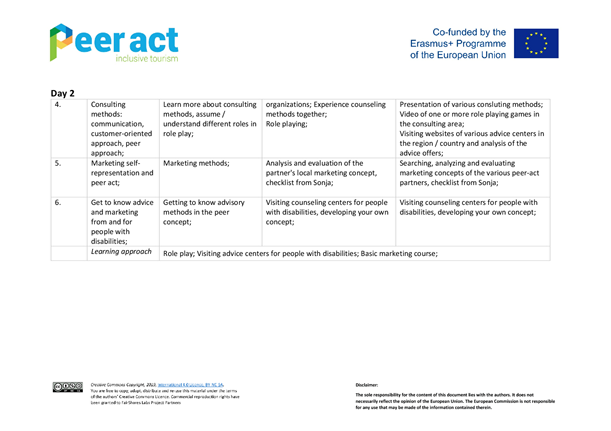
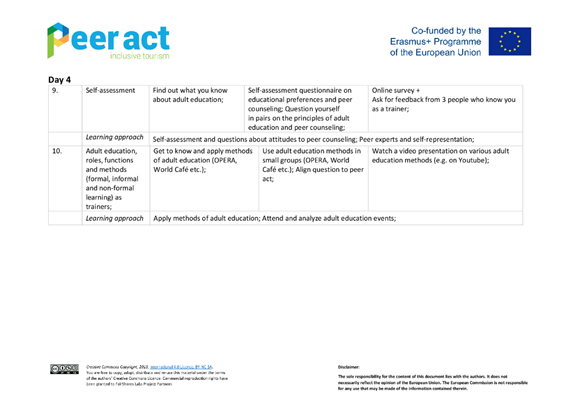
3.2.3 The Curriculum and the Training Course
By following the principles described under 2.1. and 2.2. people with and without disabilities first developed the curriculum for the training course for new accessibility (peer-) experts.
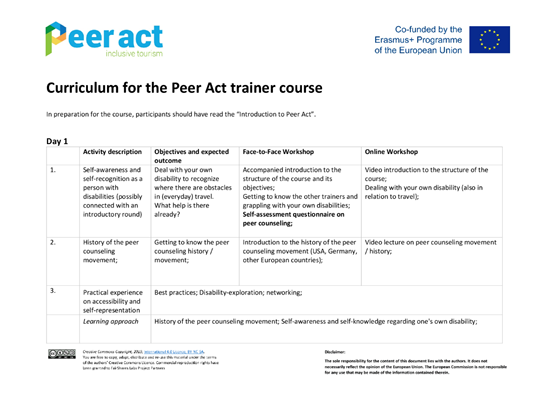
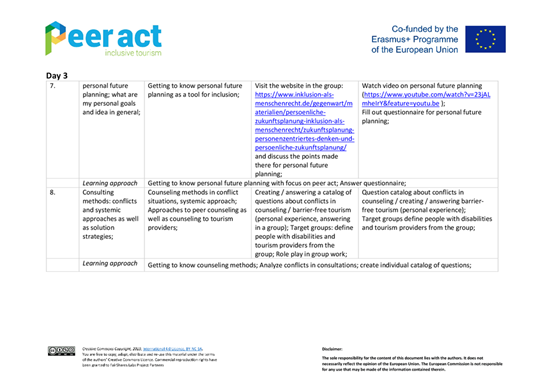
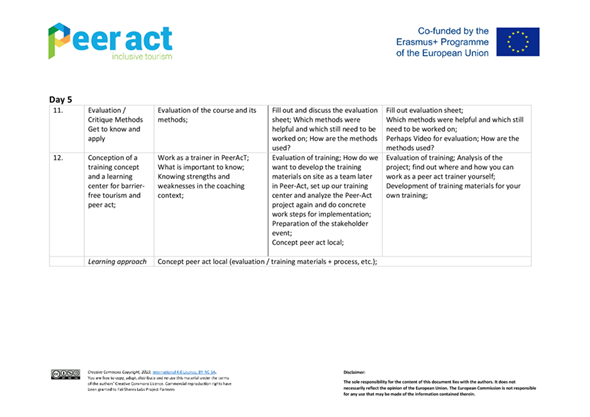
The Course was developed for a blended learning in a peer group with a peer trainer, but also as an online course for self-learning activities. It is calculated for a five-day training session. Due to the modular structure in 12 modules, the training can also be carried out over several days. All courses will be available in the five partners languages: German, Croatian, Hungarian, Italian and Spanish as well as in English for download and for e-learning on the Moodle Platform of the project- leading organisation, the VSBI.
3.3. PeerAcT Local Training and Peer Counselling Centres
Local PeerAcT training and peer-counseling centres has been implemented in each partner region. The partner developed a description and functionality of the training centre using the PeerAcT methodology. The training and counselling centre offer expertise and counselling in peer-counselling and accessible tourism affairs, the needs and independent living of people with disabilities.
The training centres offer peer-counseling training, mixed training from peer advisors and other tourism experts and online advice. They are accessible and, if possible, placed in existing training courses or offices of the partners or the local network partners.
A training module has been developed with the goal of gaining a common understanding of the needs of people with disabilities and the inclusion process, bringing together the expertise of peer experts and experts in business and a common way of working together on development, implementation and development to running training.The training centres offer mixed training of peer counsellors and other tourism professionals in a formal and informal way. The training is calculated within three days. The impact of these training courses should be a better understanding and a team building process among the experts as new mentors and trainers.
The training modules for barrier-free and inclusive tourism have been developed with these mixed skills and specialist knowledge. The results will help the trainers to identify the needed peer counsellors and other tourism experts and to prepare suitable training courses in which all three groups will train the others in their areas of competences. The impact of the outcome will be mainly the equal involvement of people with disabilities as adult trainers.
The innovation is the creation and the coordination of different competences and skills as well as the respective different teaching approach. The competences provided in these training centres are initially a methodology and practical courses in which peer-experts/counsellor are generally trained to take the role as peer-expert and adult trainers.
The second core competence is to bring these peer-experts in an informal learning process with other experts (e.g. tourism, business, culture etc.) in an inclusive way and thirdly, to develop and implement accessible and inclusive adult training courses in different branches together. Stakeholders in other European regions can use the methodology to set up their own learning and training centres.
3.4 Peer/Mentoring-training-curricula and trainings for accessible tourism
The peer/mentoring-training-curricula and training for accessible tourism consists of five curricula and training courses. These five trainings were selected by the partners during the preparatory workshop for the project application in Bad Muskau (Germany) in January 2017.
- General information / awareness -raising in accessible tourism
- How to communicate with disabled customers / how to reduce/break down barriers
- Information and marketing in accessible tourism, how clients with disabilities can be reach
- Self-evaluation/quality management of accessible tourist destinations/services
- Establishment and operation of accessible tourism service chain
Mixed mentor groups made up of peer-counselor and tourism experts in personal will develop and provide the training courses.
The training courses are also offered as webinars (two half day-sessions each) and as recorded online seminars with tutorials, learning material and background material.
The effects are better trained human resources in tourism and finally more accessible tourism service chains.
The method is innovative because all relevant stakeholder groups are involved in the training as experts and learners.
The output can be transferred to other tourist destinations/regions via the webinars and the recorded seminars.
3.5 Online Courses and Tutorials – Package – Inclusive E-Learning Approach
The peer-counseling training and the accessible tourism training are accompanied and supported by e-learning modules that include webinars, recorded training and online training with tutorials.
These tools are used for the blended learning and non-formal/informal learning approach of PeerAcT.
The webinars and the online training courses with tutorials are used for the preparation and work in homes of the trainees, but are also particularly important for those who have not been able to attend in-person training courses or webinars.
The online training contains at least 12 tutorials that are easy to understand. In addition, they are translated into audio description (important for blind and visually impaired people) and sign language (important for hearing impaired and deaf people).
The E-Learning courses are implemented on an inclusive e-learning platform, as a „normal” e-learning tool cannot provide inclusive content. However, since the project aims at people with and without disabilities, the participation of all people – including online learning – is a prerequisite for a successful project.
3.5.1. Why do we need inclusive learning systems?
With the ratification of the UN Convention on the Rights of Persons with Disabilities, every person, regardless of their starting position, should now be able to participate in society through inclusion. This paradigm shift must also be transferred to the world of digital learning. The areas of continuing training and personnel development are now often supported by digital learning systems. As a result, these digital learning systems must be inclusive. So far, however, there is hardly any research on inclusive e-learning platforms that enable people from a wide variety of backgrounds to learn digitally.
3.5.2. Socio-political context
The aim of inclusion must be to facilitate training measures for people who are excluded so far often from digital learning. Their professional and social situation should be improved to reflect the realities of a heterogeneous society.
First, however, there is a distinction between the terms „disability” and „impairment”
Article 1 of the UNCRPD states that “Persons with disabilities include those who have long-term physical, mental, intellectual or sensory impairments which in interaction with various barriers may hinder their full and effective participation in society on an equal basis with others” (United Nations – CRPD).
By the term „impairment” we mean the group of people who, due to their individual starting position, have difficulties with professional or social participation. In the medical sense, however, these people are not disabled. This group of people includes, for example, people who are functionally illiterate and have no or only mediocre writing and reading skills (Grotlüschen – Riekmann, 2012)
3.5.3. Scientific context
The concept of eLearning is defined not clearly yet. There are definitions with varying degrees of comprehensiveness and various descriptions for and around e-learning. A very general definition characterises learning as the „support of learning processes through the use of information and communication technologies” (Gabler Wirtschaftslexikon, 2016). Arnold et al. explain this in more detail and define e-learning as: „[…] [the] arrangement of electronic means, spaces and links […] [, which] are used individually or jointly for learning or for competence development and education of learners in a self-determined time […]” (2015: 22). Here it becomes clear that eLearning is not only about the use of digital media. Aspects such as didactics, space and time and self-determination also play a role also.
There are general technical standards for e-learning systems (e.g. SCORM, LTI) that enable the description and exchange of content between platforms. However, people with special circumstances have special needs. The content should be available in sign language for the deaf, a soundtrack with audio description is necessary for the blind and visually impaired. People with learning disabilities may need simple language services and often need further explanation. There are specifications for the barrier-free design of general computer systems such as the Web Content Accessibility Guidelines (WCAG) (W3C, 2008) for the barrier-free design of websites. Inclusion goes beyond the mere accessibility of content – accessibility – and in the context of e-learning includes the use of all available functions such as collaboration and communication with other users. However, the special requirements for inclusive e-learning systems (e.g. for interactive elements and feedback to learners) have hardly been researched and there is no e-learning platform that satisfactorily takes into account the requirements of people with different starting situations.
If further training is to be anchored institutionally with the help of e-learning, as is increasingly the case in companies, inclusive usability must be ensured in order to allow staff with disabilities or impairments to participate to the same extent as their non-disabled or disabled colleagues. The existing guidelines such as the WCAG are not sufficient for this. Research gaps existing with regard to requirements and concept development (for determining reusable design concepts and specific software systems for barrier-free eLearning) both as well as with regard to the practical evaluation of barrier-free eLearning systems. Based on first positive evaluation results, the LAYA system described below should take a step towards inclusive eLearning.
3.5.4. Inclusive e-learning with LAYA
When developing an inclusive system, future users should be involved from the beginning, as participation is an integral of inclusion. The requirements for e-learning systems for people without disabilities and impairments have already been well researched (e.g. Kerres, 2013, Schulmeister, 2007). So far, however, people with disabilities or impairments have rarely been considered. This was a central concern in the development of the LAYA system (Patzer, 2016).
An inclusive e-learning system should be designed in such a way that it meets the requirements of a heterogeneous user community with different needs. This includes, among other aspects, the offering of content in various forms, as described in the WCAG. For example, visual content such as images or videos is problematic for the blind and visually impaired.
An alternative representation in text form enables this target group to use screen readers that can read or display the content in Braille.
LAYA has a modular structure. This means that various support mechanisms are available in the system. They can be selected according to personal needs. In this way the system adapts to the respective user. One of these support mechanisms is the ability to play two videos in parallel, e.g. to be able to offer sign language at the same time. In addition, the language level can be varied so that texts can also be offered in simple language.
The advantage of the LAYA system is that the content can be offered for heterogeneous target groups with different needs. This can be seen very clearly in the example of further training in companies. On the one hand, the system facilitates the provision of materials, since the entire workforce can be reached via only one same portal. Each employee can decide for himself or herself whether he or she would like to receive support or not.
3.6 Summarizing report of implementation activities – Handbook and Marketing/Exploitation Strategy
The summary report of the national implementation activities is a book of life with two objectives. It helps to make the implemented training centres sustainable and helps by creating and implementing new training courses and training centres.
The summary report demonstrates the process of developing, implementing and piloting the overall PeerAcT methodology. It summarizes all activities and evaluations of the process and shows challenges and solutions, lessons learned and finally recommendations for the implementation of new laboratories and the sustainability of existing labs.
The aspects of sustainability and exploitation are dealt with in two main chapters.
The partners will present an exploitation and marketing strategy on how the training centres that have already been developed and implemented can be made sustainable and useful for other business areas besides tourism.
A manual contains instructions for the implementation of new training centres as well as adequate provision of developed training courses.
For this purpose, one chapter consists of a marketing strategy with templates for a business plan.
4. Innovation
In recent years, the European Commission has started to support accessible tourism in various programs and finally many projects have been carried out. The final report “Mapping skills and training needs to improve accessibility in tourism services”, published in 2014 by the European Commission, identified many best practices and made recommendations for the development of new and innovative training methods and course. Some of the recommendations are better group-focused customized training, open-access training and the involvement of people with special needs and disabilities as experts in their own affairs and trainers/mentors.
The European Network of Accessible Tourism e.g. offers a lot of information, conferences and best practices for accessible tourism and service chains. The National Coordination Committee for accessible Tourism and the German National Tourism Centre, together with peer groups in many parts of Germany, are providing a new data collection and testing process to certify accessible tourism destinations and services and make them public (European Commission, Mapping skills and training needs to improve accessibility in tourism services). These best practices are useful for this project, but are not enough to work as a community or small stakeholder group in training and development of accessible tourism. Some of the methods are only available to a limited extent and are not free or no longer available and usable. Much of the training are provided by non-disabled professionals rather than peer-experts, which does not reduce/remove the barriers that many tourism professionals face in dealing with and communicating with people with disabilities. These were the results of the own VSBI research with questionnaires among different service providers and tourism destinations in Merseburg and Schmalkalden in the years 2017 and 2018.
The first innovation of the project is that we involve the peer groups of people with disabilities at all levels of this process as experts, train them to be trainers in inclusive tourism and support the inclusion process and the fulfilment of the equality approach of all citizens. It was extremely important that the project partners define this area as inclusive tourism rather than accessible tourism.
The second innovation is the creation of mixed groups of peer experts and tourism experts who have all the necessary knowledge to develop and implement customized training courses on the main topics, through local research and questionnaires of the project partners in the five pilot regions (Osijek, Pécs-Baranya, Thuringia and Saxony-Anhalt, Cataluna, Piedmont-Alba) and during a preparation workshop in January 2017 in Bad Muskau:
- general information about accessible and inclusive tourism/ awareness raising
- how to communicate with customers with special needs/disabilities and how reduce communication barriers
- information and marketing in accessible and inclusive tourism, how customers with disability can be reached
- how to create and operate a service chain
- self-evaluation and quality-management of accessible and inclusive tourism destination
The project will develop and provide a free available methodology of peer counseling and mentoring in accessible tourism. It will offer innovative video tutorials on how to use the tools, the webinars and videos with recorded online seminars on an online platform for accessible tourism training. Finally, PeerAcT will provide a user strategy and report on the implementation and piloting as a manual „How to create local training centres and training courses for accessible tourism”.
This type of cooperation and planning to build up regional networks and cooperation for inclusion and accessible tourism with an European added value of cooperation across Europe is also an innovative approach.
5. Impact
The main impact of the project is intended to be the empowerment and social inclusion of people with disabilities as peer counsellor and mentors on an equal footing with other experts and adult trainers. This is a step forward in the inclusion process for people with disabilities and special needs.
The next impact is a staff better trained in tourism in five partner regions, who can influence the third impact. This means a better accessibility of the involved touristic destinations, a change in the opinion and awareness of the group of professional staff involved in tourism related jobs, and the beginning of the creation of so-called service chains to guarantee the accessibility in the pilot areas.
The involved tourism experts will also learn more about the inclusion process and how people with disabilities are able to work as adult trainers and experts in their own interests.
The participating organisations will gain knowledge and experience of how people with disabilities can be involved as peer-experts and adult trainers in daily activities and routines as well as supporting the inclusion process more generally. People with disabilities will have the opportunity to be accepted as regular training staff, employees or honorary staff in the partner organisations.
This will confirm their position in society and offer new opportunities for the participation process.
It supports key strategies for providers and goals:
– Mobilisation and training of providers in the tourism industry and public authorities in rural tourism destinations
– Strategic, coordinated procedures
– Clear communication of the accessible infrastructure in rural areas of a given destination in its marketing material.
The participating institutions will learn to cooperate in a better way towards the implementation of the common objectives of accessible and inclusive tourism and equal participation of people with disabilities by offering an entire service chain. They need to be able to cooperate to improve the service chains on local and regional level.
The direct impact will be up to 50 people with disabilities trained as experts/trainers/guides, up to 50 tourism experts trained together with the peer-counselors and finally 500 private and public tourism workers trained in all partner areas.
And at least, the long term effects should also be the development of accessible and inclusive tourism, social innovation and entrepreneurship as well as new jobs in tourism in the participating partner areas. This can be achieved through successful dissemination and exploitation of results by a transfer to other regions, to stakeholder organisations for people with disabilities, adult training companies as well as other touristic destinations. Finally the development of accessible/inclusive tourism will also have a significant economic effects.
References
ARNOLD, P. – KILIAN, L. – THILLOSEN, A. – ZIMMER, G. (2015): Handbuch E-Learning. Teaching and learning with digital media. 4th erw. Aufl. Bielefeld: W. Bertelsmann Verlag.
BRUNER, JS (1957): Beyond the information given. New York: Norton.
DEWEY, J (1938): Experience and Education. Kappa Delta Pi.
DARBY, P. (2018): Advocates for Human Potential, Inc.Defining “Peer Support”: Implications for Policy, Practice, and Research. Darby Penney, MLS Senior Research Associate, 2018.
EUROPEAN COMMISSION (2014): Mapping skills and training needs to improve accessibility in tourism services – Final Report. 02.07.2014
ERASMUS+ PROGRAMME GUIDE VERSION 2 (2020): European Commission Directorate General Education & Culture (DG EAC), e.g. pages 5 and 10. 26 02 2020.
FARKAS, J. – PETYKÓ, CS. (2020): A fogyatékosság, az akadálymentesség és a mobilitás, mint egzisztenciális alaptulajdonság. TURISZTIKAI ÉS VIDÉKFEJLESZTÉSI TANULMÁNYOK 5 : 4 pp. 43-55. , 13 p. (2020) DOI: 10.15170/TVT.2020.05.04.03
GONDA, T. – RAFFAY, Z. (2020): Egyedül nem megy – fogyatékkal élők utazási szokásainak vizsgálata egy nemzetközi felmérés eredményeinek tükrében. In: Csapó, János; Csóka, László (szerk.) Kreativitás, változás, reziliencia. III. Nemzetközi Turizmusmarketing Konferencia: Tanulmánykötet. Pécs, Magyarország: Pécsi Tudományegyetem Közgazdaságtudományi Kar (2020) 350 p. pp. 154-165. , 12 p.
GONDA, T. – RAFFAY, Z. (2021):A fogyatékossággal élők utazási szokásai
TURISZTIKAI ÉS VIDÉKFEJLESZTÉSI TANULMÁNYOK 6 : 1 pp. 20-38. , 19 p. (2021) DOI: 10.15170/TVT.2021.06.01.02
GROTLÜSCHEN, A. –RIEKMANN, W. (2012): Functional Illiteracy in Germany. Results of the first leo. Level-One study. Münster, Westf: Waxmann (literacy and basic education, 10).
KERRES, M. (2013): Media didactics. Oldenbourg publishing house.
PATZER, Y. (2016): Requirements and concept development for an inclusive e-learning software. Master’s thesis. Humboldt-Universität zu Berlin, Institute for Computer Science.
PIAGET, J. (1954): The construction of reality in the child. (M. Cook, Trans.).
RAFFAY, Z. – GONDA, T. (2020): Az akadálymentes turizmus innovatív jó gyakorlata. MODERN GEOGRÁFIA 2020 : 4 pp. 1-14. , 14 p. (2020). DOI: 10.15170/MG.2020.15.04.01
RAFFAY-DANYI, Á. – ERNSZT, I. (2021): Esélyegyenlőség a Veszprém-Balaton 2023 Európa Kulturális Fővárosa projekt rendezvényein. TURISZTIKAI ÉS VIDÉKFEJLESZTÉSI TANULMÁNYOK 6 : 1 pp. 5.-19.. (2021) DOI: 10.15170/TVT.2021.06.01.01
SCHULMEISTER, R. (2007): Basics of hypermedial learning systems. Oldenbourg publishing house.
VYGOTSKY, L. S. (1980). Mind in society: The development of higher psychological processes. Harvard university press.
Online references
ACCESSIBLE TOURISM: https://ec.europa.eu/growth/sectors/tourism/offer/accessible_en
CONVENTION ON THE RIGHTS OF PERSONS WITH DISABILITIES (CRPD): https://www.un.org/development/desa/disabilities/convention-on-the-rights-of-persons-with-disabilities.html
GABLER WIRTSCHAFTSLEXIKON (2016): Keyword: E-Learning. Springer Gabler Publishers (Ed.). http://wirtschaftslexikon.gabler.de/Archiv/82225/ e-learning-v7.html (as of 02.11.2016).
W3C (2008): Web Content Accessibility Guidelines (WCAG) 2.0. http://www.w3.org/TR/WCAG20/ (02.11.2016).
EUROPEAN NETWORK FOR ACCESSIBLE TOURISM: https://www.accessibletourism.org/
REISEN FÜR ALLE: https://www.reisen-fuer-alle.de/