

Tourism entrepreneurship’s role in the economic and sustainable growth of emerging economies: Econometric approach (case study of Algeria, 1998–2024)
1Chetbani Saida, 2Tebache Djamal*
1PhD student, University of Bejaia, Algeria; chetbanisaida@yahoo.fr, ORCID: 0000-0003-4335-758X
2Senior lecturer, Ferhat Abbas University Setif-1, Algeria; djamalzoom@yahoo.fr, djamal.tebache@univ-setif.dz ORCID: 0000-0002-3036-5831
Abstract
This study investigates the contribution of tourism entrepreneurship to sustainable development in developing economies, with a specific focus on Algeria. From a statistical point of view, constructing an index to measure sustainable development is challenging. Although the human development index (HDI) and global sustainable development index (SDG) remain the most relevant benchmarking tools, this study—given the Algerian context—focuses on the impacts on investment, unemployment, and value-added creation. Using a vector error correction model (VECM), we examined the causal relationships between tourism entrepreneurship and sustainable development through key variables: investment in the tourism sector, tourism incomes, and unemployment. Obtained results indicate a positive and significant impact in long-term relationship, with weak contribution, both investment, and tourism receipts improving SDG. However, elasticities are minimal. In short-term relationship, there are mixed and sometimes counterintuitive signs. Unemployment hurts, but past unemployment appears to help SDG (possibly a statistical artifact). Overall, the study supports a modest positive role for tourism entrepreneurship, but model limitations reduce confidence. Despite its positive contribution to Algeria’s economic growth, tourism entrepreneurship still accounts for only a small share of the economy—averaging less than 2%—particularly following the COVID-19 crisis. This underscores the need for a long-term strategic overhaul to address the structural issues hindering investment in this sector.
Keywords: Algeria, developing countries, sustainable development, tourism entrepreneurship
Received: 28 February 2026
Accepted: 26 May 2026
Published 6 July 2026
This open access article may be used under the international license terms of CC BY-NC-ND 4.0.
https://creativecommons.org/licenses/by-nc-nd/4.0/
A TURIsztikai VÁLLALKOZÁSok SZEREPE A FEjlődő országok GAZDASÁGI ÉS FENNTARTHATÓ NÖVEKEDÉSÉBEN: ÖKONOMETRIKUS MEGKÖZELÍTÉS (ALGÉRIAi ESETTANULMÁNY, 1998–2024)
1Chetbani Saida, 2Tebache Djamal*
1PhD-hallgató, Bejaiai Egyetem, Algéria; chetbanisaida@yahoo.fr, ORCID: 0000-0003-4335-758X
2Egyetemi adjunktus, Ferhat Abbas Egyetem Setif-1, Algéria; djamalzoom@yahoo.fr,
djamal.tebache@univ-setif.dz ORCID: 0000-0002-3036-5831
Absztrakt
A tanulmány a turisztikai vállalkozói tevékenység fenntartható fejlődéshez való hozzájárulását vizsgálja a fejlődő gazdaságokban, különös tekintettel Algériára. Statisztikai szempontból a fenntartható fejlődés mérésére szolgáló index kidolgozása kihívást jelent. Noha az emberi fejlettségi index (HDI) és a globális fenntartható fejlődési index (SDG) továbbra is a legrelevánsabb összehasonlító eszköz, a tanulmány – az algériai kontextust figyelembe véve – a beruházásokra, a munkanélküliségre és a hozzáadott érték teremtésére gyakorolt hatásokra összpontosít. Vektorhibakorrekciós modell (VECM) alkalmazásával vizsgáltuk az idegenforgalmi vállalkozói tevékenység és a fenntartható fejlődés közötti ok-okozati összefüggéseket a következő kulcsváltozók segítségével: az idegenforgalmi szektorba történő beruházások, az idegenforgalmi bevételek és a munkanélküliség. A kapott eredmények hosszú távon pozitív és szignifikáns hatást jeleznek, de a hozzájárulás gyenge: mind a beruházások, az idegenforgalmi bevételek javítják ugyan az SDG-t, az elaszticitások mégis csekély mértékűek. Rövid távon vegyes, és néha a várttal ellentétes jelek figyelhetők meg. A munkanélküliség negatív hatással bír, de a múltbeli munkanélküliség úgy tűnik, elősegíti az SDG-t (lehetséges, hogy ez statisztikai torzítás). Összességében a tanulmány alátámasztja az idegenforgalmi vállalkozói tevékenység mérsékelt pozitív szerepét, de a modell korlátai csökkentik a konfidenciát. Annak ellenére, hogy az idegenforgalmi vállalkozások pozitívan járulnak hozzá Algéria gazdasági növekedéséhez, a gazdaságban még mindig csak alacsony arányt képviselnek – átlagosan kevesebb mint 2%-ot –, különösen a COVID-19-válságot követően. Ez rávilágít arra, hogy hosszú távú stratégiai átalakításra van szükség az ágazatba történő beruházásokat gátló strukturális problémák megoldása érdekében.
Kulcsszavak: Algéria, fejlődő országok, fenntartható fejlődés, turisztikai vállalkozás
Benyújtva: 2026. február 28.
Befogadva: 2026. május 26.
Publikálva: 2026. július 6.
Ez a mű a Creative Commons CC BY-NC-ND 4.0 nemzetközi licence feltételeinek megfelelően használható fel.
https://creativecommons.org/licenses/by-nc-nd/4.0/
1. Introduction
Between January and June 2025, some 690 million tourists traveled internationally, as stated by UN Tourism. This represents an estimated increase of 33 million travelers compared to the same period in 2024, generating a profit of around $1.9 trillion. UN Tourism’s forecasts, which predict 3-5% growth in international arrivals for 2026, remain unchanged, as data from various countries on international tourism receipts revealed significant tourism spending in early 2025 (WTO, 2025). As a result, the tourism sector remains one of the fastest-growing industries worldwide. Its energy and strength help to stimulate and secure opportunities for profit generation and job creation, while ensuring the preservation of cultural heritage and the environment in tourist destinations around the world (Tang & Tan, 2015). According to Booking.com’s recent report, ‘Travel and Sustainable Development 2025’ (Heiny, 2025), tourists are increasingly concerned about contributing to the economies of the places they visit. A large proportion of these individuals (73%) want to support entrepreneurs and companies whose tourism-related profits are reinvested in the local community, while 77% of those surveyed aspire to have authentic experiences that are representative of the local culture during their travels. With this in mind, sustainable development is another concern that must be taken seriously in the various strategies for developing tourism entrepreneurship. The recognition of tourism as a potential tool for sustainable development was formalized on the international stage in the United Nations Millennium Development Goals declaration in 2000, and after the World Summit on Sustainable Development (UN, 2002) this role became an integral part of the implementation program (Tepelus, 2008).
For the past twenty years, and in light of its proven benefits, entrepreneurship has captured Algeria’s focus – a shift mirrored across the globe. The State’s commitment to developing this sector is evident in the implementation of a strategy (Master Plan for Tourism Development – SADT – Horizon 2030) adopted by the Government Council in 2008. This strategy outlines the goals to be met, with investment serving as a major source of wealth, jobs, and growth. Entrepreneurship is one of the most important factors for a growing economy, as its significance in economic research and policy is largely due to the benefits it brings to the economy and society. Entrepreneurship may not have a direct impact on economic expansion, but it can accelerate it through a large population of enterprising individuals. This conclusion was demonstrated in research conducted by GEM (Global Entrepreneurship Monitor), which suggested a model for comparing several countries on different social and cultural aspects (GEM, 2025). This program has shown that in places where entrepreneurship is strong, the share of GDP generated by entrepreneurial initiatives increases every year (Vellas, 2011). Algeria, with its historical, natural and cultural riches, has invaluable tourism potential. Consequently, tourism entrepreneurship can play a crucial role in the country’s economic development.
Tourism in Algeria is a rapidly growing industry, despite security and infrastructure challenges. The main tourist attractions include:
- Archaeological sites such as Djemila, Timgad and Tipaza, which promote historical and urban tourism;
- The Algerian Sahara with its dunes and oases, which promote safaris and Saharan tourism;
- The Mediterranean coast with its beaches and breathtaking landscapes, promoting seaside, rural, and cultural tourism.
Although tourism currently accounts for an average of 10% of economic activity worldwide (International Tourism Highlights, 2024), in Algeria its contribution does not exceed 3 to 4% of GDP. This predicament is a result of the security situation in the 1990s, which gave Algeria a bad reputation overseas. Furthermore, the Dutch disease appears to be another factor contributing to this sector’s lag. Nonetheless, Algeria has recently taken a number of steps to capitalize on its tourism resources, which are just as significant as its oil resources. A true revolution in tourism entrepreneurship resulted from the 1980 shift in tourism policy, which opened the door for private projects (Benslimanr & Semaoune, 2020).
Tourism has grown significantly over the last decade, with a rate of 25%. However, for many developing countries, the contribution of this sector is limited to bringing in foreign currency and improving foreign exchange reserves (Kouri, 2015). For this reason, its impact on the environment and sustainable development raises several issues. The World Tourism Organization (UNWTO) is currently working with the United Nations as part of a United Nations Environment Program to mitigate the negative effects and encourage initiatives that promote sustainable development in nations. However, tourism, due to its crosscutting nature and its role in shaping territories, is one of the sectors best suited to implementing sustainable development in line with other policies on land use planning, infrastructure, and social responsibility, while ensuring its long-term development (Livandovschi & Manolica, 2017). In order to further the struggle against poverty and hunger, equality, respect for human rights, health, and education, the tourist sector in Algeria and all other developing nations is anticipated to improve North–South ties. This thinking is based on the fact that the vast majority of tourists come from developed countries, with 40% of international trips taking place in a developing country. Tourism revenues reflect this dynamic, with developing countries experiencing a much greater increase in revenues than high-income ones (those with a GDP–PPP of over US$12,475) over the last two decades (UNWTO Tourism Highlights, 2015).
This overview leads us to consider the impact that the development of tourism entrepreneurship can have on sustainable development in Algeria. In this study, we will attempt to measure this impact using time series econometrics. To do so, we start from the hypothesis that tourism entrepreneurship contributes to the improvement of the national economy in various ways, including the creation of added value and its impact on employment and investment.
2. Literature review
According to Komppula (2014), tourism entrepreneurship can be defined as the process by which individuals identify and exploit local opportunities to create distinctive tourism experiences, often within small or medium-sized enterprises (SMEs). In the same way, it is defined as all activities created by individuals or companies that provide products or services related to travel and leisure. This type of entrepreneurship is characterized by its capacity for innovation and its adaptability to market fluctuations. Tourism entrepreneurs are often local actors who create businesses ranging from hotels and restaurants to leisure activities and transport services, as explained by Schneider & Treisch (2019).
Tourism entrepreneurship is particularly relevant in the context of sustainable development. Tourism businesses can generate jobs, revitalize local economies and promote environmental conservation. The idea of sustainable development has been a major concern for the global economy for around a century and has been part of the global development agenda since the 1980s. According to a UNWTO study, the tourism sector contributes nearly 10% of global GDP and provides millions of jobs. However, for this contribution to be sustainable, it is essential that entrepreneurs adopt practices that respect the environment and local communities. The World Tourism Organization considers sustainable tourism to be tourism that takes into account current and future economic, social and environmental impacts (World Tourism Organization, 2018).
Economically, Reinhold et al. (2017) argue that tourism entrepreneurship promotes job creation and diversification of income sources. By offering unique products and services, tourism businesses can attract visitor flows, which stimulates local economies. Research has shown that entrepreneurial initiatives focused on sustainable tourism can strengthen the economic resilience of destinations (Bramwell & Lane, 2011).
Socially, several authors confirm the key role that tourism entrepreneurship can play in empowering local communities (Adamopoulos & Thalassinos, 2020). By involving local actors in the decision-making process and allowing them to benefit from the economic spin-offs, these initiatives help to strengthen the social fabric and preserve local cultures (González-Rodríguez et al., 2020). In addition, the development of micro-enterprises promotes social ties and better intercultural understanding between visitors and residents (Aslan, 2014).
The environmental aspect of tourism entrepreneurship is also fundamental (Brida & Risso, 2010). Businesses that adopt sustainable practices, such as the use of renewable resources and waste management, can contribute to the preservation of natural resources (Fletcher, 2019). For example, businesses dedicated to ecotourism play a dual role in promoting tourism while actively participating in environmental conservation (Weaver, 2006).
A review of the empirical literature seems to corroborate the hypothesis that there is a strong connection between tourism entrepreneurship and sustainable development. A study conducted by P. Pablo-Romero & Molina (2013), which reviewed more than 80 empirical studies, showed that, all other things being equal. Two-thirds of the econometric studies examined highlight a univocal relationship between tourism (revenue generated) and GDP growth, regardless of the method used, and an additional one-fifth even suggest a biunivocal relationship between the two aggregates. Mario Holzner, for his part, studied the case of 134 countries in an effort to raise a question regarding the relationship between growth (GDP per capita) and reliance on the tourism sector. He showed that the most effective model is that of a country with an intermediate level of reliance on tourism, whose investments are primarily directed toward network infrastructure that benefits the tourism sector as well as other manufacturing sectors (Moleiro, 2020).
Despite the acknowledged potential of tourism entrepreneurship to help sustainable development globally, few empirical studies have examined the relationship between tourism entrepreneurship and sustainable development in the Algerian context. Although the economic, social, and environmental aspects of tourist entrepreneurship in developing economies have been thoroughly studied in the literature (Komppula, 2014; Reinhold et al., 2017; González-Rodríguez et al., 2020), Algeria has received less attention. The majority of the research on Algerian tourism is descriptive, concentrating on possible effects rather than quantifiable ones. Furthermore, despite Algeria’s recent attempts to grow the tourism industry and its adoption of the SADT 2030 master plan, no study has yet used time series econometrics to evaluate the causal relationship between tourism entrepreneurship and sustainable development indicators.
3. Research methods
3.1. Overview of tourism entrepreneurship in Algeria
From the foregoing, we can conclude that one of the cornerstones of the tourism industry, tourism entrepreneurship, ought to be recognized as an independent economic actor. It stimulates the creation and sale of tourism products and services, while promoting innovation, employment and, to a lesser extent, the attractiveness of regions (Roudi et al., 2019). Although studies on entrepreneurship are rather rare, the employment rate linked to entrepreneurship is low. Researchers note that the image of budding entrepreneurs is not solely guided by the desire to maximize profit. This conceptual thinking motivates an approach to entrepreneurship that includes values and cultural aspects as factors for success in addition to development, business, and growth.
Algeria has a wealth of cultural riches, with its dialects and ruins. It is the second most important site in the world, after Italy, in terms of Roman remains. It also has seven UNESCO World Heritage sites, including the ruins of Tipaza, Tigzirt, Guelma, Timgad, and Djemila. Its diverse natural environment offers opportunities for seaside tourism (1,200 km of coastline), Saharan and hiking tourism, city tourism, business tourism, and health and wellness tourism – more than 200 thermal springs (Bouacha & Lalaoui, 2018). However, these significant assets and resources remain unexploited or poorly exploited.
The process of creating tourism businesses by private actors has continued unabated since 1980. In 2024, there were approximately 1,557 hotels with a capacity of 143,811 beds, 26 thermal establishments and 4,489 travel and tourism agencies, according to the Algerian Agency for Investment Development and Promotion (AAPI). This trend is continuing at a slow pace due to bureaucratic, financial and land-related obstacles to entrepreneurship (red tape, mainly concerning building permits and travel agency licenses, access to land, which is subject to speculation, and difficulties in accessing bank financing). Thus, we are witnessing a dynamic of business creation of all kinds following the encouragement of private investment through legislation and various business creation schemes (e.g., ANDI, NESDA, ANSEJ, CALPI, CNAC). The economic fabric has thus become an agglomeration of heterogeneous businesses belonging to several sectors, including tourism, which remains relatively secondary (Chouam & Mohamed Belkacem, 2016), as Table 1 illustrates.
Table 1. Investment projects declared by sector of activity
| Number of projects | Rate | Amount Millions of DA | Rate | Number of jobs | Rate | |
| Agriculture | 1 437 | 2.36% | 341 134 | 2.23% | 56 905 | 4.65% |
| BTPH | 11 473 | 18.83% | 1 409 676 | 9.20% | 238 368 | 19.48% |
| Industry | 13 587 | 22.30% | 9 065 273 | 59.17% | 560 065 | 45.78% |
| Health | 1 217 | 2.00% | 268 814 | 1.75% | 28 785 | 2.35% |
| Transport | 26 019 | 42.71% | 1 063 087 | 6.94% | 141 514 | 11.57% |
| Tourism | 1 238 | 2.03% | 1 327 593 | 8.67% | 74 190 | 6.06% |
| Services | 5 945 | 9.76% | 1 845 681 | 12.05% | 123 638 | 10.11% |
| Total | 60 916 | 100% | 15 321 258 | 100% | 1 223 465 | 100% |
Source: AAPI (2024)
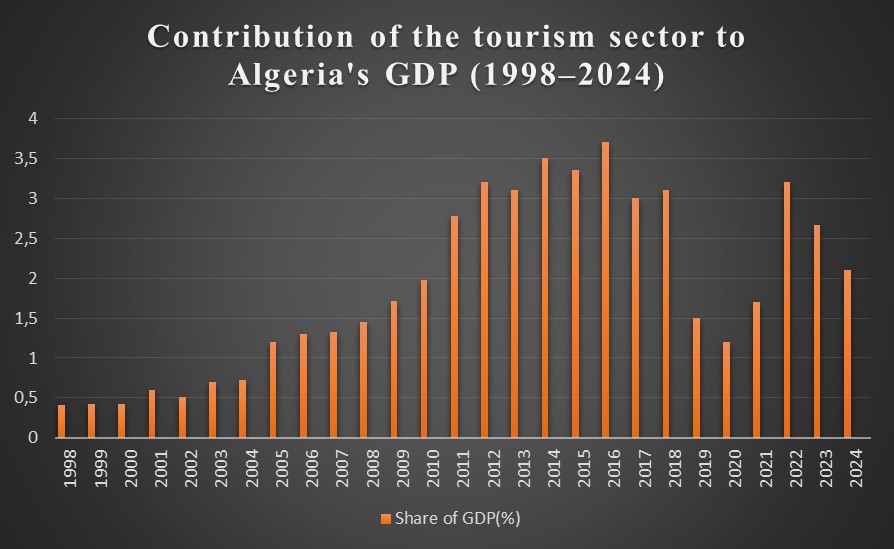
This situation has prevented the sector from developing at a steady pace, despite the efforts made by the government, as illustrated in Figure 1.
The graph indicates that, prior to 2010, tourism’s contribution to the Algerian economy was very low, generally less than 1% in the early years, with slow growth until the 2010s, when tourism accounted for around 2% to 3.5% of GDP according to broad international data (including direct and indirect contributions) for the period 2010-2014. This significant share can be explained by the inclusion of all economic impacts (jobs, taxes, domestic spending). After 2014, the trend started to decline or stabilize at around 3.5%–3.7%, showing rather slow growth in tourism compared to the economy as a whole. The available data show a sharp decline in 2020 and 2021, with tourism’s share falling to around 1.7% as a result of the global shock to international travel. Official Algerian statistics highlighted by the ministry indicate a direct contribution of around ~2% of GDP in 2023-2024, significantly lower than in pre-pandemic years. The figures of ~2-3% often come from a broader measure (WTTC) that includes indirect and induced effects. The figures of ~2% mostly cited for 2023-24 correspond to the strict direct contribution of tourism (direct added value).
Figure 1. Share of tourism sector in GDP (%) (1998–2024)
Source: Authors’ elaboration based on Open Data for Africa and Statista
Algeria remains an economy largely dominated by hydrocarbons and domestic consumption, which reduces the relative share of tourism in GDP even when the sector is growing. The obstacles remain structural: infrastructure, visas, international marketing, and regional competition (Morocco, Tunisia). In 2022, the contribution of the crafts and tourism sector to GDP was estimated at over 350 billion DA, a significant amount in terms of wealth creation at the national level. This also translates into more than 1.18 million jobs created in crafts and tourism-related trades, demonstrating the impact of local economic actors. The craft/trade sector is often an important form of tourism entrepreneurship in areas with a strong cultural identity (markets, local craft production, and heritage-related services). SMEs in the tourism sector (hotels, agencies, guides, cultural, and craft services) play a structuring role in the development of Algerian tourism; the private sector consistently represented the largest share with around 80–82% throughout the entire period, as illustrated in Table 2.
Table 2: Hotel and catering industry added value (Million DA) (1998-2024)
| Private | Public | Total | ||||
| AV | (%) | AV | (%) | AV | (%) | |
| 1998 | 44.2 | 78 .50 | 12.1 | 21.49 | 56.3 | 100 |
| 1999 | 48 | 78.04 | 13.5 | 21.95 | 61.5 | 100 |
| 2000 | 52.7 | 78.65 | 14.3 | 21.34 | 67 | 100 |
| 2001 | 56.8 | 79.10 | 15 | 20.89 | 71.8 | 100 |
| 2002 | 61.5 | 79.45 | 15.9 | 20.54 | 77.4 | 100 |
| 2003 | 66.7 | 79.88 | 16.8 | 20.11 | 83.5 | 100 |
| 2004 | 72.5 | 79.93 | 18.2 | 20.06 | 90.7 | 100 |
| 2005 | 79.7 | 80.34 | 19.5 | 19.65 | 99.2 | 100 |
| 2006 | 85.1 | 80.74 | 20.3 | 19.26 | 105.4 | 100 |
| 2007 | 92.6 | 80.31 | 22.7 | 19.68 | 115.3 | 100 |
| 2008 | 100.5 | 80.65 | 24.1 | 19.34 | 124.6 | 100 |
| 2009 | 106.8 | 80.60 | 25.7 | 19.39 | 132.5 | 100 |
| 2010 | 118.5 | 81.33 | 27.2 | 18.66 | 145.7 | 100 |
| 2011 | 128.3 | 85.07 | 22.5 | 14.92 | 150.8 | 100 |
| 2012 | 138.9 | 81.41 | 31.7 | 18.58 | 170.6 | 100 |
| 2013 | 152.1 | 81.16 | 35.3 | 18.83 | 187.4 | 100 |
| 2014 | 164.2 | 81.81 | 36.5 | 18.18 | 200.7 | 100 |
| 2015 | 172.3 | 80.99 | 40.4 | 19.01 | 212.78 | 100 |
| 2016 | 192.4 | 80.07 | 47.9 | 19.93 | 240.39 | 100 |
| 2017 | 219.1 | 81.35 | 50.2 | 18.65 | 269.38 | 100 |
| 2018 | 235.3 | 80.57 | 56.7 | 19.43 | 292.15 | 100 |
| 2019 | 201 | 81.36 | 46.1 | 18.65 | 247.1 | 100 |
| 2020 | 172.2 | 80.88 | 40.7 | 19.1 | 212.9 | 100 |
| 2021 | 197 | 77.98 | 55.6 | 22.01 | 252.6 | 100 |
| 2022 | 224.8 | 81.95 | 71.5 | 18.04 | 396.3 | 100 |
| 2023 | 355.7 | 82.26 | 76.7 | 17.73 | 432.4 | 100 |
| 2024 | 388 | 82.50 | 82.3 | 17.49 | 470.3 | 100 |
Source: Authors’ elaboration based on Office National des Statistiques, Direction Générale des Douanes, and UN Tourism
The theoretical study shows that these businesses contribute to:
- job creation,
- expanding tourist accommodation capacity,
- promoting local resources.
These SMEs have seen an increase of more than 50% in the number of tourist establishments, indicating a rise in entrepreneurship in the sector.
Furthermore, the development of the tourism sector is no longer a matter of choice, but rather a matter of urgency, and the challenge is being addressed in the SDAT plan. Tourism entrepreneurship in Algeria, although historically weak compared to hydrocarbons, is experiencing dynamic growth, reaching around 3.8% of GDP and 7.5% of employment in 2024–2025. Supported by Coface and land reforms, this increase is being driven by domestic tourism and an increase in foreign visitors, with more than 8,400 projects registered to develop infrastructure. Thus, the change in the situation in recent years leads us to raise the question of the contribution of this sector, which we consider promising, to the improvement of the national economy. For this reason, we will use time series econometrics to measure this impact.
3.2. Examining the relationship between tourism entrepreneurship and economic development in Algeria
In this section, we use the most recent developments in time series econometrics to investigate the causal relationships between Algeria’s sustainable development and tourism entrepreneurship. This approach will be applied in five stages inside a VECM modelling framework: Unit root testing, Lag length selection for VAR in levels, Johansen cointegration tests, VECM estimation, and diagnostic checking.
Before using statistical tests of stationarity (the KPSS test; Kwiatkowski et al., 1992) and/or non-stationarity (the ADF and PP tests; Phillips & Perron, 1988), we shall first discuss the database. The stationarity hypothesis can be evaluated using the first test, and the unit root hypothesis can be tested using the second two tests. This allows us to differentiate between non-stationary series, stationary series, and series for which there is insufficient information in the data. (Kwiatkowski et al., 1992).
The first crucial step is to define the variables for our model to capture the three pillars of sustainable development (economic, social, and environmental):
- Tourism variable (explanatory): INV, private investment in tourism infrastructure characterizing the tourism entrepreneurship and tourism incomes (RT); this is a standard proxy for measuring tourism activity.
- Economic Variable (explanatory): unemployment and tourism incomes (UNEMP).
- Control Variable (endogenous): the overall sustainable development index (SDG), which takes into account:
- The economic pillar: It assesses competitiveness and economic freedom. It incorporates indicators such as macroeconomic performance, innovation, labor market efficiency, GDP per capita, and freedom to conduct business.
- The social pillar: This measures well-being and equity. It includes the poverty rate, life expectancy, educational attainment, health status, and access to basic services (water, sanitation).
- The environmental pillar: This assesses the health of ecosystems and the impact of human activity. It is based on indicators such as CO2 emissions, air and water quality, waste management, biodiversity, and ecological footprint.
This study is based on the assumption that there is a long-term, steady-state relationship between sustainable development and its fundamental determinants, primarily tourism entrepreneurship, which amounts to formulating a linear version of our econometric model as follows:
SDG_t = β₀ + β₁ INV_t _ + β₂.RT_t + β3·UNEMP_t + t + ε_t
This study covers the period from 1998 to 2024. Our database was compiled using data from several sources, including the World Bank, the Ministry of Land Use Planning, Tourism and Handicrafts, and the ONS. However, we regretfully have to restrict our time series to the years 1998–2024 because the sustainable development index was not created until 2000.
Collecting the data needed to estimate the model presented numerous challenges. The first challenge concerns the sample size, which is limited, because the sustainable development index was not performed until 2000. As there were many gaps in the time series of the selected variables, painstaking work was necessary to build a database. Although insufficient, it provides us with insights into the effect that tourism entrepreneurship may have on sustainable development in a developing economy, referring to the Algerian case. We are also aware that the number of variables selected is insufficient, but given the size of the sample, we cannot select more variables as recommended by econometric modelling. With a small sample, a VECM with more than four variables becomes over parametrized, leading to unreliable cointegration tests, unstable coefficients, and poor forecasts.
4. Research results
4.1. Presentation of stationarity test results
According to Table 3, all tests yielded the same result: Comparison of the calculated values with the critical values indicates that all series are non-stationary at level. Similar tests on the first differences of these series indicate that they are stationary, so we can deduce that the series are integrated of order 1, I(1).
Table 3. Results of stationarity tests for the selected variables
| Variables | ADF | PP | KPSS | |||
| Level | 1st Diff | Level | 1st Diff | Level | 1st Diff | |
| SDG | -2.6789 (0.0922) | -3.8208 (0.0086) | -2 .9918 (0.9918) | -3.8208 (0.0086) | 0.627751 | 0.216240 |
| RT | -1.9758 (0.2946) | -4.9060 (0.007) | -1.9523 (0.3041) | -4.9166 0.007 | 0.635576
| 0.131116
|
| INV | -3.3618 1.000 | -4.553 0.0016 | -2.9918 (1.000) | -4.7750 0.001 | 0.443717
| 0.053121
|
| UNEMP | -1.1295 0.6876 | -4.1714 0.0039 | -1.1580 0.6750 | -4.1497 0.0041 | 0.475739 | 0.438415
|
Source: Authors’ elaboration using Eviews software. V12
4.2. Optimal lag length selection
In the following step, we should ascertain the optimal number of lags (P) for the VAR model at level before beginning this test. Table 4 provides a summary of the test results. A review of the table shows that most reporting criteria allow for maximum lags of one lag. We therefore favor a VAR.
Table 4. Lag length selection. Endogenous variables: SDG RT INV UNEMP. Exogenous variables: C. Date: 05/24/26. Time: 18:00. Sample: 2000 2024. Included observations: 22.
| Lag | LogL | LR | FPE | AIC | SC |
| 0 | -847.7602 | NA | 5.00e+28 | 77.43275 | 77.63112 |
| 1 | -773.0801 | 115.4148* | 2.49e+26 | 72.09819* | 73.09005* |
| 2 | -752.6001 | 24.20366 | 1.97e+26* | 71.69092 | 73.47626 |
| 3 | -731.8183 | 17.00331 | 2.10e+26 | 71.25621 | 73.83503 |
*Indicates lag order selected by the criterion
Source: Authors’ elaboration using Eviews software. V12
4.3. Cointegration tests
We have conducted our study of the long-term relationship using the Johansen process, which is more appropriate when there are several real variables in the same model (Johansen, 1988). Furthermore, unlike other methods, this technique has the advantage of not only providing a cointegration test, but also identifying the number of cointegration relationships (Hoang, 2017). The Johansen test consists of two sub-tests: the trace test and the maximum eigenvalue test (Tables 5 and 6).
Table 5. Trace test results. Unrestricted cointegration rank test (Trace)
| Hypothesized no. of CE(s) | Eigenvalue | Trace statistic | 0.05 Critical Value | Prob.** |
| None * | 0.818263 | 65.44370 | 47.85613 | 0.0005 |
| At most 1 | 0.438108 | 26.22425 | 29.79707 | 0.1221 |
| At most 2 | 0.380275 | 12.96601 | 15.49471 | 0.1161 |
| At most 3 | 0.081727 | 1.960999 | 3.841466 | 0.1614 |
Trace test indicates 1 cointegrating eqn(s) at the 0.05 level. *Denotes rejection
of the hypothesis at the 0.05 level. **MacKinnon-Haug-Michelis (1999) p-values.
Source: Authors’ elaboration using Eviews software. V12
Table 6. Maximum Eigenvalue test results. Unrestricted cointegration rank test
(Maximum Eigenvalue)
| Hypothesized no. of CE(s) | Eigenvalue | Max-Eigen statistic | 0.05 Critical Value |
| None * | 0.818263 | 39.21945 | 27.58434 |
| At most 1 | 0.438108 | 13.25823 | 21.13162 |
| At most 2 | 0.380275 | 11.00502 | 14.26460 |
| At most 3 | 0.081727 | 1.960999 | 3.841466 |
Max-eigenvalue test indicates 1 cointegrating eqn(s) at the 0.05
level. *Denotes rejection of the hypothesis at the 0.05 level.
**MacKinnon-Haug-Michelis (1999) p-values.
Source: Authors’ elaboration using Eviews software. V12
Based on Johansen’s trace statistic, we reject, at the 5% significance level, the null hypothesis of no cointegration relationship (r = 0) against the alternative hypothesis (r ˃ 0) because is greater than the critical value read in the table below (47.85613). We then move to the fourth row of the table, where we test the null hypothesis (r = 1) against (r ˃ 1). We see that the rank of the matrix is equal to 1 since ( ) is less than the critical value read in the table (3.841466). Consequently, we accept the hypothesis of one cointegration relationship for a threshold of 5%.
4.4. Identification of the cointegration relationship
The method developed by Johansen & Juselius (1990) will allow us to assess the true impact of exogenous variables on the endogenous variable in the long-term relationship, so we are considering estimating a VECM model after highlighting the uniqueness of the cointegration relationship linking the Sustainable Development Index to its fundamentals (Table 7).
Table 7. Vector Error correction estimates. Date: 05/24/26 Time: 21:52.
Sample (adjusted): 2003 2024. Included observations: 22 after adjustments.
Standard errors in ( ) & t-statistics in [ ]
| Cointegrating Eq | CointEq1 | |||
| SDG(-1) | 1.000000 | |||
| INV(-1) | -5.85E-03 (1.5E-03) [4.00179] | |||
| RT(-1) | -2.79E-02 (7.5E-03) [3.71369] | |||
| UNEMP(-1) | 0.629200 (0.16802) [3.74469] | |||
| C | -88.23419 | |||
| Error Correction | D(SDG) | D(INV) | D(RT) | D(UNEMP) |
| CointEq1 | -0.203707 (0.06215) [-3.27793] | 104222.4 (39509.4) [2.63791] | 29141761 (1.3E+07) [2.30489] | 0.368130 (0.26941) [1.36644] |
| D(SDG(-1)) | -0.157535 (0.21375) [-0.73700] | 20365.58 (135894.) [0.14986] | 27672827 (4.3E+07) [0.63634] | -0.193450 (0.92664) [-0.20876] |
| D(SDG(-2)) | -0.378405 (0.19393) [-1.95127] | -151398.6 (123292.) [-1.22797] | -15973633 (3.9E+07) [-0.40486] | 1.189222 (0.84071) [1.41455] |
| D(INV(-1)) | 5.70E-07 (7.5E-07) [0.75614] | -1.210588 (0.47886) [-2.52804] | -342.4623 (153.242) [-2.23478] | -1.72E-06 (3.3E-06) [-0.52815] |
| D(INV(-2)) | -3.20E-08 (5.9E-07) [-0.05394] | -0.168446 (0.37681) [-0.44703] | -239.2006 (120.584) [-1.98368] | -2.19E-07 (2.6E-06) [-0.08519] |
| D(RT(-1)) | 5.33E-09 (2.0E-09) [2.66957] | -0.003146 (0.00127) [-2.47775] | -1.366936 (0.40632) [-3.36419] | -1.17E-08 (8.7E-09) [-1.34947] |
| D(RT(-2)) | 1.69E-09 (2.0E-09) [0.84467] | -0.001256 (0.00127) [-0.98687] | -1.602334 (0.40719) [-3.93506] | 6.86E-09 (8.7E-09) [0.79085] |
| D(UNEMP(-1)) | 0.225265 (0.09320) [2.41708] | -111990.3 (59251.2) [-1.89009] | -70875634 (1.9E+07) [-3.73796] | -0.106784 (0.40402) [-0.26430] |
| D(UNEMP(-2)) | 0.083210 (0.07947) [1.04706] | -91378.76 (50523.8) [-1.80863] | -50971594 (1.6E+07) [-3.15259] | 0.233557 (0.34451) [0.67793] |
| C | 0.601232 (0.16664) [3.60796] | 184881.4 (105944.) [1.74509] | -24258230 (3.4E+07) [-0.71552] | -0.599284 (0.72241) [-0.82956] |
| R-squared | 0.707987 | 0.693589 | 0.645987 | 0.621322 |
| Adj. R-squared | 0.488977 | 0.463781 | 0.380477 | 0.337313 |
| Sum sq. resids | 1.531484 | 6.19E+11 | 6.34E+16 | 28.78205 |
| S. E. equation | 0.357244 | 227122.2 | 72681675 | 1.548710 |
| F-statistic | 3.232671 | 3.018119 | 2.433006 | 2.187687 |
| Log likelihood | -1.903786 | -295.8805 | -422.7844 | -34.17245 |
| Akaike AIC | 1.082162 | 27.80732 | 39.34403 | 4.015677 |
| Schwarz SC | 1.578091 | 28.30325 | 39.83996 | 4.511606 |
| Mean dependent | 0.278531 | 144987.6 | 4437727. | -0.559091 |
| S. D. dependent | 0.499741 | 310161.8 | 92341354 | 1.902463 |
| Determinant resid covariance (dof adj.) | 3.72E+25 | |||
| Determinant resid covariance | 3.29E+24 | |||
| Log likelihood | -745.8486 | |||
| Akaike information criterion | 71.80442 | |||
| Schwarz criterion | 73.98651 | |||
Source: Authors’ elaboration using Eviews software. V12
The long-term relationship resulting from the cointegration relationship can therefore be expressed as follows:
SDG = 5.85e-03*INV + 2.78e-02*RT – 0.629*UNEMP + 88.23
Based on the obtained results on long-term cointegration equilibrium, we find that, overall, the coefficient of determination is reliable ( =0.707987) and it reflects the significant explanation of sustainable development by selected variables, namely unemployment in the tourism sector, incomes generated by tourism, and investment in the tourism sector.
The VECM long-term relationship reveals that private tourism investment (INV) has a positive but very weak long-term effect on sustainable development in Algeria, with a coefficient of 0.00585. Despite the positive and significant impact, one million DZD increase in private tourism investment raises the SDG index by only 0.00585 units over the long run.
Tourism receipts (RT) have a positive and statistically significant long-term effect on sustainable development in Algeria, with a coefficient of 0.0279—approximately 4.8 times larger than that of tourism investment (INV). Economically, this means that a one million DZD increase in tourism revenues improves the overall SDG index by 0.0279 units. Operating tourism thus contributes more to sustainable development than does investment itself, as revenues generate tax income for the state, employment earnings for households, and demand for local suppliers. However, the effect’s absolute magnitude is still small, indicating that tourism receipts may be concentrated in a small number of regions (such as coastal areas, Algiers, and Tassili), that redistribution mechanisms toward the social and environmental pillars are weak, and that the import content of tourism consumption is probably high, limiting local multiplier effects.
Unemployment (UNEMP) has a strong negative long-term effect on sustainable development in Algeria, with a coefficient of –0.6292. Economically, this means that a 1 percentage point increase in unemployment reduces the SDG index by 0.63 units—a large and detrimental impact. Unemployment thus appears as a major structural barrier to sustainable development. High unemployment undermines the economic pillar through lower GDP per capita, reduced innovation, and labor market inefficiency; weakens the social pillar by increasing poverty, worsening health outcomes, and reducing access to basic services; and indirectly harms the environmental pillar, as unemployed populations may overuse natural resources such as firewood or engage in informal hunting and land clearing.
We can say, in general, that the impact is positive but with weak contribution. Both investment and tourism receipts improve SDG, but elasticities are very small. This is due to the small selected sample (only 22 observation). This could be considered a study limitation. The deduced short-term relationship is given by:
DSDG=-0.378*D (SDG(-2)) + 5.33E-09*D (RT(-1)) + O.225*D (UNEMP(-1)) + O.601
In the short term, only the SDG index itself adjusts toward equilibrium. Tourism variables (INV, RT) are not responsive to sustainable development imbalances. This suggests policy incoherence: When SDG deviates from target, tourism investment and receipts do not react to help restore balance.
4.5. Diagnostic checking
Verification of the residuals’ homoscedasticity, autocorrelation, and normality is necessary for the validation and robustness tests for our estimated model. The following tests are employed to confirm these attributes: The Breusch-Godfrey, Jarque-Bera, and Breusch-Pagan-Godfrey tests.
4.5.1. Residuals autocorrelation test
Both tests confirm that there is insufficient evidence to detect serial correlation in the residuals, insofar as F-statistic p-value = 0.5269 is greater than 0.05, and Obs*R-squared p-value = 0.3646 is greater than 0.05 (Table 8).
Table 8. Residual autocorrelation test
| Breusch-Godfrey Serial Correlation LM Test | |||
| F-statistic | 0.426999 | Prob. F(1,11) | 0.5269 |
| Obs*R-squared | 0.822086 | Prob. Chi-Square(1) | 0.3646 |
Source: Authors’ elaboration using Eviews software
4.5.2. Normality test
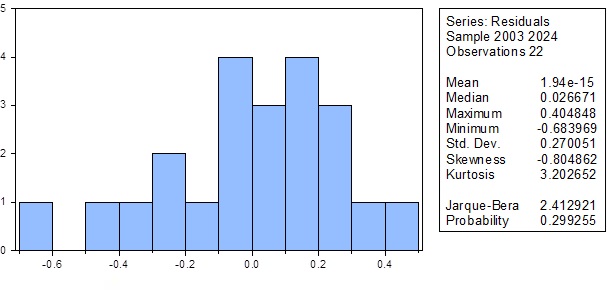
We cannot reject the null hypothesis of normality of the residuals as long as the Jarque-Bera p-value = 0.299255 greater than 0.05, so we conclude that the residuals are normally distributed (Figure 2).
Figure 2. Residuals normality test
Source: Authors’ elaboration using Eviews software
4.5.3. Heteroscedasticity test
The null hypothesis is consistently not rejected by any of the three tests. The variance of the residuals is constant or homoscedastic. Heteroscedasticity is not evident.
Table 9. Residual heteroscedasticity test
| Heteroscedasticity Test: Breusch-Pagan-Godfrey | |||
| F-statistic | 0.307457 | Prob. F(12,9) | 0.9697 |
| Obs*R-squared | 6.396532 | Prob. Chi-Square(12) | 0.8948 |
| Scaled explained SS | 2.095934 | Prob. Chi-Square(12) | 0.9992 |
Source: Authors’ elaboration using Eviews software
4.5.4. Robustness test
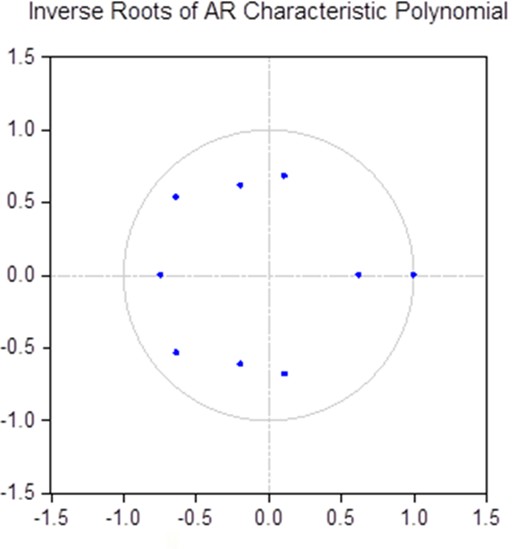
The inverse roots lie within the unit circle, and all the moduli are less than 1, which indicates the absence of the unit root. The estimated VECM(1.1) is therefore stationary, and the model is perfectly stable; thus, the used variables form a stationary dynamic system.
Figure 3. Robustness test
Source: Authors’ elaboration using Eviews software
5. Conclusions
The econometric study shows that tourism entrepreneurship has a positive impact on sustainable development (SDG) in Algeria, suggesting that tourism and entrepreneurship share common goals of socio-economic development at the global and local levels, social inclusion, and protection of cultural and environmental heritage. The premise that tourism entrepreneurship significantly and favorably affects sustainable development and economic growth in Algeria is supported by the model estimation findings. Although currently limited (not exceeding an annual average of 3-4% of GDP) and generating approximately USD 1.6 billion in direct revenue from visitors in 2023, it indicates significant economic activity of tourism businesses in Algeria. The development of this promising sector requires investment in infrastructure and a long-term strategy aimed at promoting tourism. In addition, the obtained results indicate an impact that extends to other variables that are positively correlated with the development of tourism entrepreneurship, including tourism incomes and employment in the tourism sector. The findings of this study also reveal a bitter reality: despite the positive impact of tourism entrepreneurship and the government’s willingness to boost this sector, the various strategies adopted by Algeria to promote the development of tourism have revealed their shortcomings, even their failures. This observation clearly highlights the insignificant position attributed to the tourism sector, particularly after the health crisis of 2019. Indeed, the socialist-inspired development model adopted in Algeria after gaining its independence can explain the low weight of tourism. The aim of this model was to establish an integrated economy capable of meeting the needs of the population, with a crucial role assigned to industrializing industries. The prosperous hydrocarbon situation has led Algeria to neglect international tourism as a source of foreign income at a time when its coffers are full thanks to oil revenues. Available studies and analyses highlight several constraints that still limit the impact of tourism entrepreneurship on economic growth in Algeria:
- limited financing for tourism SMEs,
- lack of adequate infrastructure,
- insufficient vocational training and digitalization of the sector,
- administrative complexity and investment conditions.
These factors are hindering the rapid expansion of tourism entrepreneurship and its direct impact on economic development in Algeria.
References
AAPI (2024). Monthly Archives: décembre 2024. Algerian Investment Promotion Agency. https://aapi.dz/2024/12/
Adamopoulos, A. & Thalassinos, E. I. (2020). Tourism development and economic growth: A comparative study for the G-6 leaders. European Research Studies Journal, 23 (1): 368–380. DOI: 10.35808/ersj/1555
Aslan, A. (2014). Tourism development and economic growth in the Mediterranean countries: Evidence from panel Granger causality tests. Current Issues in Tourism, 17 (4): 363–372. DOI: 10.1080/13683500.2013.768607
Benslimane, A. & Semaoune, K. (2020). Le tourisme durable en Algérie Enjeux et perspectives: Le comportement des Parties Prenantes à l’Égard d’un Engagement dans une Approche Touristique Durable (Cas de la Région de Taghit, Béchar). Al Bachair al Iktisadia Review, 6 (2): 1039–1051. DOI: 10.33704/1748-006-002-066
Bouacha, F. & Lalaoui, A. (2018). Le management du tourisme durable en Algérie: Outils innovants et perspectives. Recherchers Economiques Manageriales, 12 (2): 395–408. DOI: 10.37136/0504-000-022-020
Bramwell, B. & Lane, B. (2011). Critical research on the governance of tourism and sustainability. Journal of Sustainable Tourism, 19 (4–5): 411–421. DOI: 10.1080/09669582.2011.580586
Brida, J. G. & Risso, W. (2010). Tourism as a determinant of long run economic growth. Journal of Policy Research in Tourism, Leisure and Events, 2 (1): 14-28. DOI: 10.1080/19407960903542276
Chouam, B. & Mohammed Belkacem, F. (2016). L’etreprenariat touristique et les mécanismes de son soutien pour le développement du secteur du tourisme. Revue algérienne d’économie et gestion, 9 (3): 52‑65. https://asjp.cerist.dz/en/article/7465/
Fletcher, R. (2019). Ecotourism after nature: Anthropocene tourism as a new capitalist “fix”. Journal of Sustainable Tourism, 27 (4): 522‑535. DOI: 10.1080/09669582.2018.1471084
GEM (2025). GEM 2024/2025 Global Report. Entrepreneurship Reality Check. https://www.gemconsortium.org/file/open?fileId=51621/
González-Rodríguez, M. R., Díaz-Fernández, M. C., & Pino-Mejías, M. Á. (2020). The impact of virtual reality technology on tourists’ experience: A textual data analysis. Soft Computing, 24 (18): 13879‑13892. DOI: 10.1007/s00500-020-04883-y
Heiny, K. (2025). 2025 Sustainibility report. https://www.bookingholdings.com/wp-content/uploads/2026/04/Booking-Holdings_2025-Sustainability-Report.pdf/
Hoang, N. T. (2017). Introductory econometrics: A practical approach (2nd ed.), by Hamid R. Seddighi (Routledge, New York, 2012), pp. 385. The Economic Record, 93 (302): 502‑503.
International tourism highlights (2024). World Tourism Organization. https://www.e-unwto.org/doi/book/10.18111/9789284425808/
Johansen, S. (1988). Statistical analysis of cointegration vectors. Journal of Economic Dynamics and Control, 12 (2‑3): 231‑254.
Johansen, S. & Juselius, K. (1990). Maximum likelihood estimation and inference on cointegration—With applications to the demand for money. Oxford Bulletin of Economics and Statistics, 52 (2): 169‑210.
Komppula, R. (2014). The role of individual entrepreneurs in the development of competitiveness for a rural tourism destination – A case study. Tourism Management, 40 (C), 361‑371. DOI: 10.1016/j.tourman.2013.07.007
Kouri, D. (2015). Le tourisme et le développement économique en Algérie. Economic and Human Growth Review, 6 (2): 383‑410.
Kwiatkowski, D., Phillips, P. C. B., Schmidt, P., & Shin, Y. (1992). Testing the null hypothesis of stationarity against the alternative of a unit root: How sure are we that economic time series have a unit root? Journal of Econometrics, 54 (1‑3): 159‑178.
Livandovschi, R. & Manolica, A. (2017). Tourisme comme facteur de developpement durable. CES Working Papers, 9 (3), 331‑342.
Moleiro, D. F. (2020). O planeamento do turismo urbano com vista à sustentabilidade—Uma revisão de literatura [Urban tourism planning for sustainability – A literature review]. Research, Society and Development, 9 (8): e338985561. DOI: 10.33448/rsd-v9i8.5561
Pablo-Romero, M. del & Molina, J. A. (2013). Tourism and economic growth: A review of empirical literature. Tourism Management Perspectives, 8: 28‑41. DOI: 10.1016/j.tmp.2013.05.006
Phillips, P. C. B. & Perron, P. (1988). Testing for a unit root in time series regression. Biometrika, 75 (2): 335-346. https://users.ssc.wisc.edu/~behansen/718/PhillipsPerron.pdf/
Reinhold, S., Zach, F. J., & Krizaj, D. (2017). Business models in tourism: A review and research agenda. Tourism Review, 72 (4): 462‑482. DOI: 10.1108/TR-05-2017-0094
Roudi, S., Arasli, H., & Akadiri, S. S. (2019). New insights into an old issue – examining the influence of tourism on economic growth: Evidence from selected small island developing states. Current Issues in Tourism, 22 (11): 1280‑1300. DOI: 10.1080/13683500.2018.1431207
Schneider, A. & Treisch, C. (2019). Employees’ evaluative repertoires of tourism and hospitality jobs. International Journal of Contemporary Hospitality Management, 31 (8): 3173‑3191. DOI: 10.1108/IJCHM-08-2018-0675
Tang, C. F. & Tan, E. C. (2015). Does tourism effectively stimulate Malaysia’s economic growth? Tourism Management, 46: 158‑163. DOI: 10.1016/j.tourman.2014.06.020
Tepelus, C. (2008). Reviewing the IYE and WSSD Processes and impacts on the tourism sustainability agenda. Journal of Ecotourism, 7 (1), 77‑86. DOI: 10.2167/joe176.0
UN (2002). World summit on sustainable development, Johannesburg 2002. United Nations. https://docs.un.org/en/A/CONF.199/20/
UNWTO Tourism Highlights (2015).
https://www.e-unwto.org/doi/book/10.18111/9789284416899/
Vellas, P. F. (2011). The indirect impact of tourism: An economic analysis. https://webunwto.s3.amazonaws.com/imported_images/28700/111020-rapport_vellas_en.pdf/
Weaver, D. (2006). Sustainable tourism (1st ed.). Routledge.
World Tourism Organization (2018). UNWTO annual report 2017. World Tourism Organization (UNWTO). https://www.e-unwto.org/doi/book/10.18111/9789284419807/
WTO. (2025). World tourism barometer and statistical annex, May 2025. World Tourism Barometer (English version) 23(2), 1‑40. https://www.e-unwto.org/doi/abs/10.18111/wtobarometereng.2025.23.1.2/
Online sources
Direction Générale des Douanes. https://www.douane.gov.dz/spip.php?rubrique96/ (10. 06. 2025)
Ministere de Tourisme & de L’Artisanat https://www.mta.gov.dz/?lang=fr/ (10. 06. 2025)
Office National des Statistiques. https://www.ons.dz/spip.php?rubrique21/ (20. 07. 2025)
Open Data of Africa. World Data Atlas: Algeria
https://opendataforafrica.org/atlas/Algeria/topics/Tourism/ (12. 06. 2025)
Startup. https://startup.dz/ (13. 06. 2025)
Statista. Contribution share of the travel and tourism industry to the gross domestic product (GDP) in Algeria from 2019 to 2021.
https://www.statista.com/statistics/1329743/tourism-sector-as-a-share-of-gdp-in-algeria/ (23. 06. 2025)
UN Tourism. https://www.untourism.int/ (23. 06. 2025)
World Bank. Data Bank. World Development Indicators.
https://databank.worldbank.org/source/world-development-indicators/ (12. 06. 2025)