

INDIGENOUS PARTICIPATION IN LOCAL TOURISM DEVELOPMENT: A SYSTEMATIC REVIEW
1Zaid Yousra*, 2Lóránt Dávid
1PhD student, John Von Neumann University, Doctoral School of Management and Business Administration, Hungary; zaidyousra2021@gmail.com, ORCID: 0009-0004-3804-2780
2Full professor, John von Neumann University, Faculty of Economics and Business, Department of Tourism and Hospitality Management, Hungary; david.lorant.denes@nje.hu,
ORCID: 0000-0001-7880-9860
Download >
Abstract
The involvement of Indigenous peoples is a vital aspect of sustainable tourism, reflecting the growing recognition of local communities as key actors in developing culturally relevant tourism approaches. This study explores the benefits and limitations of Indigenous participation in local tourism, identifying the processes, outcomes, and barriers that affect its success. Using the PRISMA method, 32 peer-reviewed articles from 2010–2025 were systematically analyzed from four databases to ensure comprehensive coverage and methodological rigor. The results show that participation manifests in economic, social, cultural, and decision-making forms, with explicit focus on social sustainability as a core dimension encompassing equity, inclusion, and community well-being. Weak institutional support, unequal power relations, financial exclusion, and environmental pressures often limit its impact. Critical appraisal reveals a significant geographical concentration in Asia, highlighting the need for broader global coverage and Indigenous-led research in future studies.
Keywords: community-based tourism, decision-making, empowerment, Indigenous participation, social sustainability, sustainable tourism
Received: 16 November 2025
Accepted: 12 March 2026
Published: 15 April 2026
Őshonos részvétel a helyi turizmusfejlesztésben: rendszerszintű áttekintés
1Zaid Yousra*, 2Dávid Lóránt
1PhD-hallgató, Neumann János Egyetem, Gazdálkodás- és Szervezéstudományok Doktori Iskola; zaidyousra2021@gmail.com, ORCID: 0009-0004-3804-2780
2Egyetemi tanár, Neumann János Egyetem, Gazdaságtudományi Kar, Turizmus-Vendéglátás Tanszék; david.lorant.denes@nje.hu, ORCID: 0000-0001-7880-9860
Absztrakt
Az őslakosok bevonása a fenntartható turizmus egyik létfontosságú aspektusa, amely tükrözi a helyi közösségek, mint kulcsszereplők egyre növekvő elismerését a kulturálisan releváns turisztikai megközelítések kidolgozásában. Ez a tanulmány az őslakosok helyi turizmusban való részvételének előnyeit és korlátait vizsgálja, azonosítva a sikerét befolyásoló folyamatokat, eredményeket és akadályokat. A PRISMA-módszerrel 32, 2010 és 2025 közötti, lektorált cikket elemeztünk szisztematikusan négy adatbázisból az átfogó lefedettség és a módszertani szigorúság biztosítása érdekében. Az eredmények azt mutatják, hogy a részvétel gazdasági, társadalmi, kulturális és döntéshozatali formákban nyilvánul meg, kifejezetten a társadalmi fenntarthatóságra, mint az egyenlőséget, a befogadást és a közösségi jólétet magában foglaló központi dimenzióra összpontosítva. A gyenge intézményi támogatás, az egyenlőtlen hatalmi viszonyok, a pénzügyi kirekesztés és a környezeti nyomás gyakran korlátozza a hatását. A kritikai értékelés jelentős földrajzi koncentrációt tár fel Ázsiában, kiemelve a szélesebb körű globális lefedettség és az őslakosok által vezetett kutatások szükségességét a jövőbeli tanulmányokban.
Kulcsszavak: közösségi alapú turizmus, döntéshozatal, felhatalmazás, őshonos részvétel, társadalmi fenntarthatóság, fenntartható turizmus
Benyújtva: 2025. november 16.
Befogadva: 2026. március 12.
Publikálva: 2026. április 15.
1. Introduction
Over the past few years, the role of Indigenous communities in local tourism development has increasingly been acknowledged as a critical dimension of sustainable tourism (Notzke, 1999). Indigenous participation refers not only to the inclusion of local communities in tourism activities but also to their involvement in decision-making, ownership, and benefit-sharing processes that shape the trajectory of tourism development (Butler & Hinch, 2007). Unlike conventional top-down tourism models, Indigenous participation emphasizes community empowerment, cultural preservation, and equitable distribution of benefits, thereby distinguishing it from other approaches to tourism planning and management (Scheyvens, 1999). Previous research has highlighted that the active engagement of Indigenous groups in local tourism projects contributes to poverty reduction, enhancement of cultural identity, and strengthening of community resilience (Scheyvens et al., 2021). However, Indigenous communities often face significant challenges, including marginalization, limited representation in governance structures, and unequal power relations with external stakeholders, which may undermine their ability to fully benefit from tourism initiatives (Nursey-Bray & Rist, 2009). Despite the growing scholarly interest in community-based and participatory tourism, there remains a relative paucity of systematic inquiry into the specific dynamics, outcomes, and constraints of Indigenous participation in local tourism development.
Despite the marginalized position that Indigenous communities often occupy within tourism systems (Tosun, 2000), several scholars have argued that the long-term success of sustainable tourism development largely depends on the extent and quality of Indigenous participation in the process (Scheyvens et al., 2021; Wani et al., 2023). Active involvement of Indigenous groups in planning and decision-making not only enhances their sense of ownership but also strengthens the legitimacy and sustainability of tourism projects (Jamal & Getz, 1995; Scheyvens, 1999). Compared with conventional top-down approaches, Indigenous participation provides a more comprehensive reflection of community values, cultural priorities, and socio-demographic attributes, ensuring that tourism development aligns with local needs and aspirations (Jackson, 2025; Wani et al., 2023). Underpinned by frameworks such as community-based tourism and participatory development theory, scholars have examined Indigenous engagement in terms of degrees of involvement, ranging from mere consultation to full ownership and control of tourism enterprises (Li 2006; Zapata et al., 2011). While existing studies highlight both the benefits of Indigenous participation such as empowerment, cultural preservation, and improved livelihoods and the challenges such as power imbalances, limited capacity, and external dependency research remains fragmented and context-specific (Manyara & Jones, 2007; Salazar, 2012). Consequently, there is a pressing need to systematically analyze how Indigenous participation influences local tourism development, as well as to identify the conditions under which participation contributes to genuine empowerment rather than symbolic inclusion.
Over the past decades, the discourse on Indigenous participation in tourism has evolved from marginal recognition to a central concern in sustainable development debates (Notzke,1999). In earlier tourism models, planning and management were predominantly top-down, often controlled by governments or external investors with limited consultation of local communities (Tosun, 2000). However, a gradual paradigm shift has emerged, particularly since the 1990s, with increasing emphasis on participatory development and community-based tourism as frameworks to foster inclusion, empowerment, and cultural preservation (Woko Suparwoko, 2012). Within this context, Indigenous participation has been reframed from a tool for poverty alleviation into a strategic mechanism to ensure self-determination, equitable benefit-sharing, and sustainable resource management (Butler & Hinch, 2007). This historical shift underscores the recognition that Indigenous communities are not passive beneficiaries but active agents capable of shaping tourism development trajectories according to their cultural values and aspirations.
Considering the divergent outcomes of Indigenous participation reported across different tourism contexts, it is essential to investigate the key mechanisms shaping the extent and effectiveness of Indigenous involvement in local tourism development. These mechanisms can be broadly clustered into extrinsic factors, such as government policies, institutional support, market orientation, and the stage of tourism development (Bramwell & Sharman, 1999; Tosun, 2000), and intrinsic factors, such as community capacity, traditional knowledge, cultural values, and local leadership (Reed, 1997). In addition, socio-demographic attributes, community cohesion, and the degree of dependence on tourism have been shown to significantly influence the level of participation (Scheyvens, 1999). Recognizing that meaningful participation fosters empowerment, cultural preservation, and equitable benefit-sharing, a growing body of literature has explored both the opportunities and limitations of Indigenous engagement in tourism projects, highlighting outcomes such as improved livelihoods, enhanced community resilience, and greater sustainability of tourist destinations (Carr et al., 2016). Nevertheless, despite these scholarly contributions, research on Indigenous participation remains fragmented, with limited integrative frameworks that examine both the determinants and consequences of Indigenous involvement in tourism development. In particular, there is a lack of systematic understanding of how various contextual factors interact to shape participation processes and outcomes across different indigenous communities worldwide.
Therefore, this review paper seeks to critically examine the existing body of knowledge on Indigenous participation in local tourism development in order to provide a more comprehensive understanding of the mechanisms, outcomes, and challenges associated with Indigenous involvement in tourism processes. By synthesizing insights from diverse contexts, this study seeks to identify the antecedents and consequences of Indigenous participation, highlight patterns of effective engagement, and expose persistent gaps that limit meaningful inclusion of Indigenous communities in tourism development. In doing so, the paper aspires to contribute to the formulation of a more integrative conceptual framework that captures the dynamics of Indigenous participation, while offering practical implications and recommendations for policymakers, practitioners, and scholars. In recognition that the Preferred Reporting Items for Systematic Reviews and Meta-Analysis (PRISMA) protocol ensures scientific rigor, transparency, and reliability (Pahlevan-Sharif et al., 2019), this study adopts the PRISMA approach to systematically review the extant literature concerning Indigenous participation in local tourism development.
2. Methodology
2.1. The PRISMA
Considering the increasing reliance on systematic reviews to consolidate fragmented knowledge and generate new insights in underexplored areas, the PRISMA protocol (Page et al., 2021a) was selected as the most appropriate methodological approach for this study. Initially developed in medical research, PRISMA has gained wide recognition across disciplines due to its ability to ensure rigor, transparency, and reliability in synthesizing evidence-based findings (Page et al., 2021b). In the field of tourism studies, PRISMA has recently been applied to interdisciplinary topics, offering a structured framework to identify, screen, and analyze relevant literature (Pahlevan-Sharif et al., 2019). Given that this paper seeks to systematically evaluate Indigenous participation in local tourism development, the PRISMA protocol provides a robust foundation to organize and synthesize existing research while minimizing potential bias in the selection and review processes.
2.2. The PRISMA protocol
As a core framework for conducting systematic reviews, the PRISMA protocol establishes clear procedures for defining research objectives and methods in advance, thereby minimizing potential subjective bias during data selection, synthesis, and reporting (Moher et al., 2009). In accordance with the aims of this review and to address feedback requesting broader literature coverage, four electronic databases were systematically searched: Scopus, Web of Science, Google Scholar, and ScienceDirect. This multi-database approach was adopted to ensure comprehensive retrieval of relevant studies across diverse geographical and disciplinary contexts, rather than relying on a single source (Page et al., 2021a).
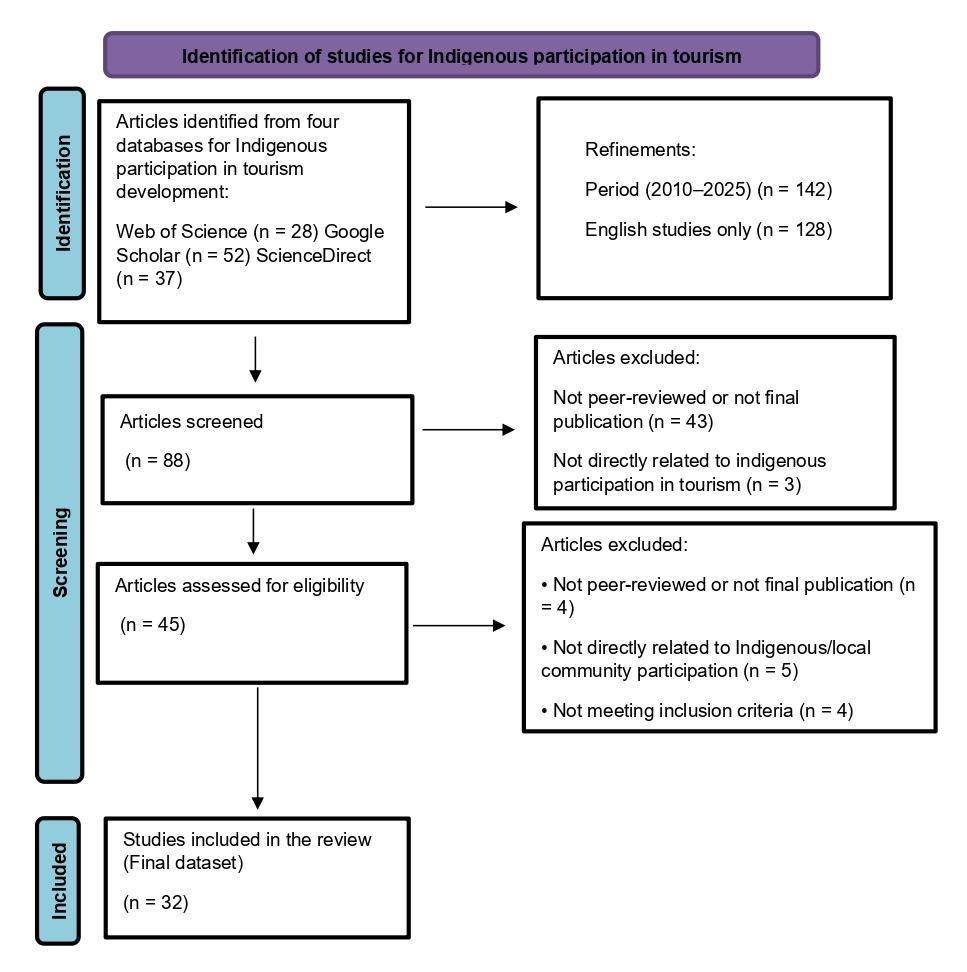
The search strategy employed an expanded set of keywords to capture a wider range of relevant literature. The final search string combined terms such as („Indigenous” or „Aboriginal” or „Native” or „First Nations” or „local people” or „local communities”) and („participation” or „engagement” or „involvement”) and („tourism” or „tourism development” or „ecotourism” or „community-based tourism” or „sustainable tourism”). This broader keyword strategy, particularly the inclusion of „local people” and related terms, was implemented to avoid excluding pertinent studies that address community participation without explicitly using „Indigenous” terminology, thereby reducing potential selection bias. The initial search across all four databases yielded 156 records (Scopus: 39, Web of Science: 28, Google Scholar: 52, ScienceDirect: 37). After removing 68 duplicate records, 88 unique records remained for title and abstract screening. Studies that did not focus on Indigenous or local community participation in tourism development were excluded, resulting in 45 articles for full-text review. The application of inclusion criteria publication between 2010–2025 to focus on recent studies reflecting contemporary developments, then selecting only English-language articles to maintain consistency and clarity in interpretation (Estevão & Costa, 2020), followed by peer-reviewed journal articles and accessibility further refined the selection. Notably, the restriction to open-access papers was relaxed when identifying seminal contributions, ensuring comprehensive coverage while maintaining quality standards. This process resulted in a final dataset of 32 eligible studies, a substantial expansion compared to single-database searches, thereby enhancing the robustness and generalizability of this review.
These 32 studies form the empirical foundation of this systematic review. Each article was examined in detail following the PRISMA protocol (Pahlevan-Sharif et al., 2019). The analysis focused on identifying key themes, methodological approaches, theoretical frameworks, and major findings concerning Indigenous participation in local tourism development. A critical appraisal of the reviewed evidence was additionally conducted to assess methodological rigor, geographical representation, and theoretical contributions. The complete screening and selection process is summarized in Figure 1 (PRISMA Flow Diagram).
3. Results and discussions
3.1. Descriptive and critical synthesis of reviewed studies
The systematic review of 32 studies reveals significant patterns in methodological approaches, geographical distribution, and thematic focus, while also exposing critical gaps that limit the field’s scholarly contribution.
The majority of the reviewed studies employed qualitative or participatory methodologies (n = 20, 62.5%), including case studies, grounded theory, focus group discussions, and community-based participatory research. This predominance reflects the exploratory and context-driven nature of Indigenous participation research (Dam et al., 2025). However, this heavy reliance on qualitative designs, particularly single-case studies without longitudinal follow-up, restricts the ability to assess long-term impacts and generalize findings across diverse Indigenous contexts. Only six studies (18.8%) adopted mixed-methods approaches, integrating surveys with interviews or participatory assessments, while quantitative designs remained underrepresented (n = 2, 6.3%), limiting empirical validation of participation outcomes. Notably, longitudinal studies were scarce (n = 3, 9.4%), impeding understanding of how participation evolves over time.
Figure 1. Flowchart illustrating the systematic selection and screening of studies on Indigenous participation in tourism development
Source : Edited by the authors
On the other hand, the geographical distribution reveals a pronounced concentration in Asia (n = 22, 68.8%), particularly in China (n = 7), Indonesia (n = 4), Vietnam (n = 3), Thailand (n = 3), India (n = 2), and Iran (n = 2). Outside Asia, studies cover Latin America (n = 4, 12.5%): Mexico, Peru, Bolivia, Ecuador; North America (n = 3, 9.4%): Canada and the United States; Africa (n = 2, 6.3%): Egypt and South Africa, and Oceania (n = 1, 3.1%): Australia. Remarkably, studies from New Zealand and the Pacific Islands did not meet inclusion criteria, despite significant Indigenous tourism initiatives there. This skewed distribution indicates that Indigenous participation is most often studied where cultural heritage (Vandermale & Mason, 2024) and community-based tourism intersect closely (Whitford & Ruhanen, 2016), but raises questions about the transferability of findings to underrepresented regions such as Sub-Saharan Africa, Scandinavia, and the Arctic.
Overall, these descriptive findings reveal an expanding and geographically diverse body of literature that emphasizes the active role of Indigenous communities in shaping sustainable and culturally grounded tourism development (Nguyen et al., 2025) .
While most studies relied on community-based tourism or participatory development frameworks, few explicitly integrated Indigenous epistemologies or decolonial perspectives. Only four studies (12.5%) were led by Indigenous researchers or employed methodologies ensuring community co-authorship, raising concerns about whose voices dominate academic discourse. Furthermore, critical examinations of power asymmetries between Indigenous communities and external stakeholders remained superficial in nearly half the sample (n = 14, 43.8%), often treating participation as an unproblematic good rather than investigating its potential for co-option or symbolic inclusion.
The review period (2010–2025) captures evolving scholarly interest, with 54% of publications appearing between 2020 and 2025, suggesting accelerating attention to Indigenous participation. However, open-access restrictions excluded approximately 15 high-quality studies, potentially introducing bias toward well-funded research from institutions with subscription privileges.
Publications were dispersed across sustainability-oriented platforms, indicating a diverse and interdisciplinary research scope. Notably, the Journal of Sustainable Tourism accounted for the largest share of publications, followed by Sustainability (MDPI), Frontiers in Sustainable Tourism, and International Journal of Environmental Research and Public Health (IJERPH). This distribution demonstrates growing integration of Indigenous participation within global sustainability agendas (Carr et al., 2016), yet limited presence in core development studies or Indigenous studies journals suggests interdisciplinary fragmentation (Table 1).
Table 1. Geographical distribution of the reviewed studies
| Continents | Countries / Case study sites | Percentage (%) | Number of studies (n) |
| Asia | China (Yunnan, Yuanjia, Suzhou), Indonesia (Jambi, Desa Adat), Vietnam, Thailand, India, Iran | 62.5% | 20 |
| North America | USA, Canada (Ontario) | 9.4% | 3 |
| Latin America | Mexico, Peru, Bolivia | 12.5% | 4 |
| Africa | Egypt, South Africa | 6.3% | 2 |
| Europe | Russia, Norway | 6.3% | 2 |
| Oceania | Australia | 3.0% | 1 |
| Total | 100% | 32 |
Source: Edited by the authors based on reviewed studies
As shown in Table 1, the majority of research on Indigenous participation in local tourism development has been conducted in Asian contexts (68.8%), particularly in China and Southeast Asia. This reflects the strong link between tourism development and indigenous cultural landscapes in these regions. The limited representation of studies from Latin America (9.4%), Africa (6.3%), Oceania (3.1%), and Europe (6.3%) highlights the need for broader geographical coverage in future research.
In terms of research design, qualitative approaches dominate the sample (n = 20, 62.5%), reflecting the context-specific and participatory nature of Indigenous participation research (Dam et al., 2025), while a smaller subset employed mixed-methods (n = 6, 18.8%) and quantitative strategies (n = 2, 6.3%). Specifically, qualitative studies include participatory/design-led approaches, grounded theory, focus group discussions, qualitative case studies, community-based participatory research (CBPR), longitudinal case studies, and discourse analysis. Mixed-methods typically combine surveys with interviews or framework applications, whereas quantitative designs include questionnaires with logistic regression and geoheritage assessment. Regarding data collection, interviews remain the most frequent method, followed by surveys/questionnaires, participant observation, and secondary data. Notably, longitudinal studies were scarce (n = 3, 9.4%), limiting understanding of how participation evolves over time.
3.2. Key enablers and barriers to Indigenous participation in tourism development
This section explicitly addresses the dimension of social sustainability, recognizing that Indigenous participation is fundamentally a societal process involving equity, inclusion, community well-being, and the preservation of cultural identity (Absolon, 2016). Unlike economic or environmental sustainability, social sustainability focuses on the quality of social relationships (Dempsey et al., 2011), the distribution of power and resources, and the capacity of communities to maintain their cultural integrity and collective identity over time (Carr et al., 2016).
In the context of Indigenous tourism, social sustainability manifests through meaningful participation in decision-making, fair benefit-sharing, gender equality (Saunders et al., 2020), intergenerational knowledge transfer, and the strengthening of community cohesion.
The reviewed literature reveals that the degree of Indigenous participation in tourism development largely depends on the interaction of multiple enhancing and constraining factors. These factors determine whether participation leads to genuine empowerment and sustainable development or remains limited and symbolic. The analysis of the 32 reviewed studies highlights several recurring patterns that explain both the opportunities and challenges faced by Indigenous communities in their efforts to participate in tourism initiatives.
3.2.1. Critical examination of the drivers and barriers to Indigenous participation in tourism development
Modern studies indicate that the participation of Indigenous peoples in tourism development is not an automatic process but rather the result of a complex interaction between enabling and constraining factors. Research has shown that Indigenous communities tend to support tourism when they perceive its social, economic, and cultural benefits provided that projects are designed in ways that respect their values, identity, and ensure their active involvement in decision-making (Wani et al., 2023). For them, tourism is not only a source of income or a means of improving living standards but also a tool for revitalizing language and culture and strengthening their sense of belonging to the land (Carr et al., 2016). In this context, the literature emphasizes that achieving genuine and sustainable participation of Indigenous peoples in the tourism sector requires moving beyond mere involvement in decisions toward empowering them to build their capacities and develop their skills. The process of local capacity building and community empowerment is among the most significant factors contributing to increased Indigenous participation in tourism development. Multiple studies have shown that communities with knowledge and skills in project management, marketing, and heritage conservation are more capable of active participation in decision-making and managing their own tourism resources (Koster et al., 2012; Raja et al., 2022). Zhang et al. (2022) found in China that continuous training and education enable local residents to manage their projects independently rather than relying on external companies, thereby increasing their confidence and negotiation power with government bodies and investors. Correspondingly, Nguyen et al. (2025) noted that tourism education programs and training in traditional handicraft skills help empower women and youth to engage in tourism activities.
Furthermore, empirical evidence from South Asia and Latin America reinforces the significance of targeted capacity-building initiatives. In India, training programs focused on digital literacy and online marketing have enabled Indigenous artisans to bypass intermediaries and reach global markets directly, thereby enhancing their economic autonomy and reducing exploitative trade practices (Vignesh et al., 2025). Similarly, community-based tourism enterprises in Peru demonstrate that when Indigenous youth receive comprehensive training in sustainable hospitality management and cultural interpretation, they are better positioned to assume leadership roles in their communities and advocate for equitable benefit-sharing arrangements (Barbieri et al., 2020). These cases illustrate that capacity building extends beyond technical skills to encompass critical competencies in negotiation, market access, and digital engagement, which are essential for meaningful Indigenous participation in contemporary tourism development.
Alongside local capacity building and individual empowerment, fostering trust and cooperation between local communities and relevant stakeholders is a key element in ensuring the success and sustainability of Indigenous participation in tourism development. As noted by Espeso-Molinero et al. (2016), long-term collaborative relationships based on mutual respect and transparency lead to more sustainable projects and reduce conflicts. Carr et al. (2016) also showed that cooperation among different parties helps balance economic goals with the cultural considerations of Indigenous communities. According to Wani et al. (2023), involving Indigenous peoples in the planning and implementation stages of projects strengthens their sense of ownership and responsibility, making them more willing to support and actively engage in tourism initiatives.
In settler colonial contexts such as Canada, the United States, and Australia, formalized partnerships between Indigenous communities and federal governments have emerged as critical mechanisms for ensuring Indigenous voice in tourism governance. In Canada, co-management agreements for national parks and heritage sites have enabled First Nations to participate directly in decision-making processes, transforming historically exclusionary governance structures into platforms for Indigenous self-determination (Salafsky et al., 2022). In the same way, Native American tribes in the United States have leveraged federal recognition and treaty rights to establish tribal tourism authorities that control access to sacred sites and cultural resources, ensuring that economic benefits flow directly to community members rather than external operators (Pubill Ambros & Buzinde, 2021). In Australia, Native Title agreements and Indigenous Land Use Arrangements have provided Aboriginal communities with legal frameworks to negotiate tourism development on their traditional lands, although the effectiveness of these mechanisms varies considerably depending on the strength of local organizational capacity and the willingness of state governments to honor commitments (Connors & Ruhanen, 2026). These cases demonstrate that while legal recognition and policy frameworks are necessary preconditions for meaningful participation, their translation into genuine empowerment depends on sustained political will, adequate resourcing, and the active involvement of Indigenous communities in designing and monitoring partnership arrangements.
Supportive government policies that protect the rights of Indigenous peoples and ensure their voice in land and tourism-related decisions are a crucial factor in enhancing their participation (Eladway et al., 2020; Moayedfar, 2021). Ma et al. (2023) found that the presence of strong local institutions capable of negotiating with investors and authorities enhances Indigenous peoples’ ability to protect their interests and guide tourism development according to their priorities. Some studies have also stressed that formal recognition of Indigenous rights to land and traditional knowledge enables them to control their tourism resources and ensure fair benefit distribution (Carr et al., 2016). Comparative evidence from post-apartheid South Africa and the Nordic countries illustrates how historical contexts shape contemporary policy frameworks for Indigenous participation. In South Africa, the restitution of land rights and the establishment of community property associations have enabled previously dispossessed communities to develop tourism enterprises on restored lands, although persistent inequalities in access to capital and markets continue to constrain their full participation (Andrea et al., 2014). Likewise, the Sámi people in Norway and Sweden have secured significant legal recognition of their rights to traditional lands and resources, including veto power over development projects that threaten reindeer herding and cultural practices (Kløcker Larsen et al., 2024). However, despite these advanced legal protections, Sámi communities continue to face challenges in ensuring that tourism development respects their cultural protocols and generates equitable benefits, particularly when confronted with large-scale nature-based tourism promoted by national governments. These cases underscore that formal policy recognition, while essential, must be accompanied by meaningful mechanisms for implementation monitoring, dispute resolution, and benefit redistribution to translate legal rights into genuine participatory outcomes.
In addition to legal and institutional support, cultural identity plays a central role in Indigenous participation in tourism. Communities that view tourism as a means to preserve their culture and transmit their heritage to future generations are more willing to engage positively (Elviandri et al., 2024; Nguyen et al., 2025). Carr et al. (2016) noted that tourism can serve as a powerful tool for reviving languages, rituals, and traditional arts when locally managed. Similarly, Suyadnya et al. (2025) found that tourism based on language and cultural identity fosters pride and belonging, increasing motivation to participate.
Equitable economic benefits are also a fundamental driver of active participation. Zhang et al. (2022) and Scheyvens (1999) argue that Indigenous participation increases when communities perceive tangible improvements in living standards and job opportunities. Successful examples include community-based projects in Southeast Asia, where Indigenous peoples established small and medium enterprises in accommodation and cultural services, enhancing economic independence and local well-being (Raja, et al., 2022).
In a related context, the literature confirms that local leadership and self-initiated efforts are crucial in transforming institutional and cultural support into effective participation. The presence of leaders within communities who possess vision and communication skills with external partners helps steer tourism development toward serving Indigenous interests (Koster et al., 2012; Zhang et al., 2022). Pereiro (2016) also noted that communities that organize tourism activities and manage natural and cultural resources on their own achieve better outcomes in empowerment and social inclusion.
3.2.2. Barriers and challenges
Despite the importance of these factors in promoting Indigenous participation in tourism development, evidence shows that such participation often faces a range of challenges and obstacles that limit its effectiveness and sustainability.
Several studies have found that participation often remains formal and limited due to the lack of fairness in power distribution between Indigenous communities and government authorities (Carr et al., 2016). Tosun (2000) and Li (2006) indicate that tourism policies in many developing countries continue to rely on a top-down approach, where decisions are made without genuine consultation with local populations. In more recent studies (e.g., Ma et al., 2023), it has been documented that the absence of transparency and weak representation lead to a loss of trust and a feeling among Indigenous peoples that they are merely implementers of plans they did not help to design.
The lack of financial and institutional support is considered one of the main challenges hindering Indigenous participation. Many communities lack the necessary resources to establish tourism projects or develop the infrastructure needed to host visitors (Raja et al., 2022). Weak local organizational structures make it difficult to obtain grants, loans, or licenses, reducing competitiveness against large companies (Eladway et al., 2020). Cross-regional evidence from Latin America and sub-Saharan Africa highlights how structural barriers in financial systems perpetuate Indigenous economic marginalization in tourism. In Mexico and Ecuador, Indigenous entrepreneurs face systematic exclusion from formal banking services due to lack of collateral, limited credit histories, and geographic isolation, forcing them to rely on informal lending with prohibitive interest rates or forego expansion opportunities entirely (Fernández-Bedoya et al., 2025).
Ma et al. (2023) argue that the absence of financing policies directed toward local communities forces them to rely on donors or external investors, which undermines their autonomy in setting priorities. Moreover, the lack of administrative and institutional training limits their ability to manage projects efficiently, leaving them vulnerable to failure or exploitation.
In addition to financial and institutional challenges, another crucial factor is the weakness of education and tourism training, which is one of the fundamental barriers to active participation. Nguyen et al. (2025) and Okazaki (2008) explained that the lack of knowledge about sustainable tourism and modern management practices makes Indigenous people less capable of adapting to market demands or communicating effectively with official bodies. Other studies (Elviandri et al., 2024; Wani et al., 2023) indicate that traditional education, which does not integrate tourism or economic dimensions, keeps young people away from employment opportunities in this sector, leading them to depend on seasonal jobs or migrate to cities.
Weak local governance represents a major obstacle to genuine participation. The lack of clarity in the roles between local authorities and higher government agencies leads to policy conflicts and marginalization of Indigenous communities (Koster et al., 2012; Moayedfar, 2021). Eladway et al. (2020) also note that the absence of effective mechanisms for accountability and transparency results in unequal distribution of benefits, where local elites or intermediaries gain more than other members of the community. This governance imbalance weakens trust between Indigenous people and official institutions.
Another prominent barrier is the set of cultural and social challenges, especially when traditional values collide with the logic of the modern tourism market. According to Nitsch & Vogels (2022), excessive commodification of cultural heritage distorts its original meanings and transforms spiritual or religious practices into tourist shows, creating tension within the community itself. In some cases (Nguyen et al., 2025; Suyadnya et al., 2025), Indigenous peoples struggle to balance working in tourism with preserving agricultural or spiritual traditions, leading to generational divisions over whether tourism represents a threat or an opportunity. Traditional gender roles may also limit women’s participation, even though many studies have shown that women’s empowerment is a key factor in expanding community participation.
From an environmental perspective, some studies confirm that environmental pressures resulting from mass tourism and weak enforcement of environmental laws represent an additional challenge for Indigenous populations (Ma et al., 2023; Miłosz et al., 2022). The expansion of tourism projects leads to the degradation of agricultural lands and sacred areas. Carr et al. (2016) point out that the absence of clear plans for sustainable natural resource management threatens the spiritual connection that binds Indigenous people to their land, reducing their willingness to engage in projects that affect their environment without their consent. Ecological vulnerabilities in the Amazon basin and Australia illustrate how environmental degradation intersects with Indigenous tourism participation in distinct yet interconnected ways (Bowman et al., 2021). In the Brazilian and Peruvian Amazon, rapid deforestation driven by illegal logging and agricultural expansion has simultaneously destroyed biodiversity attractions essential for ecotourism and displaced Indigenous communities from their ancestral territories, forcing them into precarious engagement with tourism as a survival strategy rather than a sustainable livelihood (Gazoni & Brasileiro, 2018). In Australia, climate change-induced phenomena including intensified bushfires, coral bleaching, and altered seasonal patterns have disrupted access to sacred sites and undermined the ecological integrity of landscapes central to Aboriginal cultural tourism, compounding existing challenges of environmental management authority (Birch, 2016). These cases demonstrate that environmental pressures on Indigenous tourism are not merely local concerns but manifestations of global systemic crises that require Indigenous-led conservation strategies and climate adaptation frameworks to ensure both ecological sustainability and cultural continuity. Overall, the challenges facing Indigenous participation in tourism development do not stem solely from a lack of resources or technical expertise but rather from deeper structural imbalances in governance systems and the limited recognition of cultural and intellectual rights. When decision-making power remains concentrated in external institutions and Indigenous communities are excluded from defining their own priorities, participation becomes a symbolic exercise rather than a process of genuine empowerment. Therefore, overcoming these challenges requires the adoption of a holistic and participatory approach based on transparency, local capacity building, and respect for Indigenous cultural values as essential components of sustainable tourism development.
4. Conclusion
This systematic review has critically examined the key enabling and constraining factors that affect the participation of Indigenous peoples in tourism development. By synthesizing evidence from 32 studies across six continents, this analysis offers a more comprehensive understanding of Indigenous participation dynamics than previous reviews. The findings reveal that effective Indigenous participation is a cornerstone for achieving sustainable and inclusive tourism. Explicit attention to social sustainability encompassing equity, inclusion, and community well-being demonstrates that Indigenous participation is fundamentally a societal process. Genuine participation, which goes beyond mere symbolic consultation, enhances empowerment, preserves cultural identity, and promotes equitable distribution of benefits. However, participation remains limited due to weak institutional support, dependence on external actors, financial exclusion, educational gaps, environmental pressures, and climate change impacts, alongside the persistent imbalance of power between Indigenous communities and external stakeholders. The pronounced geographical concentration of research in Asia (68.8%), combined with limited Indigenous-led studies (12.5%), underscores the need for more globally representative and community-driven research.
To overcome these obstacles, several strategic actions are recommended. First, governments should establish clear legal frameworks that formally recognize Indigenous rights and ensure their active participation in tourism planning, decision-making, and management, with robust implementation monitoring and dispute resolution mechanisms. In parallel, continuous training and capacity-building programs in tourism management, entrepreneurship, digital literacy, and sustainable hospitality are essential to strengthen Indigenous leadership and self-reliance, extending beyond technical skills to negotiation and market access competencies.
Furthermore, adopting co-management models and partnerships between Indigenous communities, government institutions, and the private sector can enhance mutual trust and ensure long-term sustainability. However, such partnerships require sustained political will, adequate resourcing, and active Indigenous involvement in design and monitoring. It is also essential to integrate Indigenous knowledge, cultural values, and environmental stewardship practices into tourism planning to ensure authenticity and ecological balance.
The review highlights the importance of addressing structural financial barriers, supporting Indigenous-led research, and promoting participatory governance systems that integrate Indigenous voices at all levels from planning to implementation. Fair distribution of tourism revenues and their reinvestment in education, community development, and local infrastructure can enhance well-being and strengthen long-term participation.
In conclusion, sustainable tourism development cannot be achieved without fully integrating Indigenous communities as active partners and rights-holders. When Indigenous knowledge, leadership, and decision-making are respected within frameworks prioritizing social sustainability, tourism becomes not merely an economic activity but a pathway toward cultural revival, environmental protection, climate resilience, and equitable local development.
References
Absolon, K. E. (2016). Wholistic and ethical: Social inclusion with Indigenous peoples. Social Inclusion, 4 (1): 44–56. DOI: 10.17645/si.v4i1.444
Andrea, G., Saayman, M., & Jugmohan, S. (2014). Developing commun ity-based tourism in South Africa: Addressing the missing link. African Journal for Physical, Health Education, Recreation and Dance (AJPHERD), 20 (3:2): 1139–1161 https://repository.nwu.ac.za/server/api/core/bitstreams/85c50684-56e9-407d-bbac-d17cbdce88eb/content
Barbieri, C., Sotomayor, S., & Gil Arroyo, C. (2020). Sustainable tourism practices in Indigenous communities: The Case of the Peruvian Andes. Tourism Planning & Development, 17 (2): 207–224. DOI: 10.1080/21568316.2019.1597760
Birch, T. (2016). Climate change, mining and rraditional Indigenous knowledge in Australia. Social Inclusion, 4 (1): 92–101. DOI: 10.17645/si.v4i1.442
Bowman, K. W., Dale, S. A., Dhanani, S., Nehru, J., & Rabishaw, B. T. (2021). Environmental degradation of indigenous protected areas of the Amazon as a slow onset event. Current Opinion in Environmental Sustainability, 50: 260–271. DOI: 10.1016/j.cosust.2021.04.012
Bramwell, B. & Sharman, A. (1999). Collaboration in local tourism policymaking. Annals of Tourism Research, 26 (2): 392–415. DOI: 10.1016/S0160-7383(98)00105-4
Butler, R. & Hinch, T. D. (2007). Tourism and indigenous peoples: Issues and implications (1st ed). Oxford, Burlington: Butterworth-Heinemann.
Carr, A., Ruhanen, L., & Whitford, M. (2016). Indigenous peoples and tourism: The challenges and opportunities for sustainable tourism. Journal of Sustainable Tourism, 24 (8–9): 1067–1079. DOI: 10.1080/09669582.2016.1206112
Connors, A. & Ruhanen, L. (2026). Beyond mining: Transitioning indigenous communities to sustainable tourism in Australia’s Northern Territory. Journal of Sustainable Tourism, 34 (2): 455–478. DOI: 10.1080/09669582.2025.2494046
Dam, X. M., Tan, K.-L., & Eijdenberg, E. L. (2025). Navigating innovations and Indigenous tourism: Insights from a systematic literature review in a four-decade journey of exploration. Tourism Management Perspectives, 58: 101368. DOI: 10.1016/j.tmp.2025.101368
Dempsey, N., Bramley, G., Power, S., & Brown, C. (2011). The social dimension of sustainable development: Defining urban social sustainability. Sustainable Development, 19 (5): 289–300. DOI: 10.1002/sd.417
Eladway, S. M., Azzam, Y. A., & Al-Hagla, K. S. (2020). Role of public participation in heritage tourism development in Egypt: a Case study of Fuwah City. In: Syngellakis, S. & Hernández, S. (eds.) Sustainable Development and Planning XI. Ashurst, Southampton: WIT Press, pp. 27–43. DOI: 10.2495/SDP200031
Elviandri, Y., Yunia, O. A., & Hamzah, S. W. (2024). Indigenous environmental perceptions on the use of cultural keystone species for tourism development. IOP Conference Series: Earth and Environmental Science, 1366: 012046. DOI: 10.1088/1755-1315/1366/1/012046
Espeso-Molinero, P., Carlisle, S., & Pastor-Alfonso, M. J. (2016). Knowledge dialogue through Indigenous tourism product design: A collaborative research process with the Lacandon of Chiapas, Mexico. Journal of Sustainable Tourism, 24 (8–9): 1331–1349. DOI: 10.1080/09669582.2016.1193188
Estevão, C. & Costa, C. (2020). Natural disaster management in tourist destinations: A systematic literature review. European Journal of Tourism Research, 25: 2502. DOI: 10.54055/ejtr.v25i.417
Fernández-Bedoya, V. H., Ruiz-Palacios, M. A., Meneses-La-Riva, M. E., & Suyo-Vega, J. A. (2025). Tourism entrepreneurship in Latin America: A systematic review of challenges, strategies, and post-COVID-19 perspectives. Sustainability, 17 (3): 989. DOI: 10.3390/su17030989
Gazoni, J. L., & Brasileiro, I. L. G. (2018). O turismo como um instrumento de proteção florestal na Amazônia: Uma análise multivariada [Tourism as an instrument of forest protection in the Amazon: a multivariate analysis]. Revista Brasileira de Pesquisa Em Turismo, 12 (3): 23–46. DOI: 10.7784/rbtur.v12i3.1416
Jackson, L. A. (2025). Community-based tourism: A catalyst for achieving the United Nations Sustainable Development Goals One and Eight. Tourism and Hospitality, 6 (1): 29. DOI: 10.3390/tourhosp6010029
Jamal, T. B. & Getz, D. (1995). Collaboration theory and community tourism planning. Annals of Tourism Research, 22 (1): 186–204. DOI: 10.1016/0160-7383(94)00067-3
Kløcker Larsen, R., Staffansson, J., Omma, I.-A., & O’Faircheallaigh, C. (2024). Negotiated agreements and Sámi reindeer herding in Sweden: Evaluating outcomes. Society & Natural Resources, 37 (7): 981–999. DOI: 10.1080/08941920.2024.2321874
Koster, R., Baccar, K., & Lemelin, R. H. (2012). Moving from research ON, to research WITH and FOR Indigenous communities: A critical reflection on community‐based participatory research. Canadian Geographies / Géographies Canadiennes, 56 (2): 195–210. DOI: 10.1111/j.1541-0064.2012.00428.x
Li, W. (2006). Community decisionmaking participation in development. Annals of Tourism Research, 33 (1): 132–143. DOI: 10.1016/j.annals.2005.07.003
Ma, T., Jia, L., Zhong, L., Gong, X., & Wei, Y. (2023). Governance of China’s Potatso National Park influenced by local community participation. International Journal of Environmental Research and Public Health, 20 (1): 807. DOI: 10.3390/ijerph20010807
Manyara, G. & Jones, E. (2007). Best practice model for community capacity-building: A case study of community-based tourism enterprises in Kenya. Tourism, 55: 403–415.
Miłosz, H., Galina, Z., Mariya, M., Ramziya, G., & Olga, I. (2022). Geoheritage of the Kandalaksha region (Kola Peninsula, White Sea, Arctic Russia), Evaluation, and geotourism opportunities. Geoheritage, 14 (4): 112. DOI: 10.1007/s12371-022-00726-4
Moayedfar, S. (2021). Sustainable tourism development in historic cities of arid regions with the revival of QANAT (Yazd City). GeoJournal of Tourism and Geosites, 35 (2): 428–436. DOI: 10.30892/gtg.35222-669
Moher, D., Liberati, A., Tetzlaff, J., Altman, D. G., & for the PRISMA Group (2009). Preferred reporting items for systematic reviews and meta-analyses: The PRISMA statement. BMJ, 339 (jul21 1): b2535–b2535. DOI: 10.1136/bmj.b2535
Nguyen, T.-S. T., Phan, D.-H. T., Doan, D.-H. L., Chau, M.-N. T., & Doan, T.-T. T. (Jessica). (2025). Cultural revitalization for tourism development from an Indigenous perspective: The case of Ta Oi people, A Luoi District, Thua Thien Hue province, Vietnam. Frontiers in Sustainable Tourism, 4: 1510934. DOI: 10.3389/frsut.2025.1510934
Nitsch, B. & Vogels, C. (2022). Gender equality boost for regenerative tourism: The case of Karenni village Huay Pu Keng (Mae Hong Son, Thailand). Journal of Tourism Futures, 8 (3): 375–379. DOI: 10.1108/JTF-01-2022-0032
Notzke, C. (1999). Indigenous tourism development in the arctic. Annals of Tourism Research, 26 (1): 55–76. DOI: 10.1016/S0160-7383(98)00047-4
Nursey-Bray, M. & Rist, P. (2009). Co-management and protected area management: Achieving effective management of a contested site, lessons from the Great Barrier Reef World Heritage Area (GBRWHA). Marine Policy, 33 (1): 118–127. DOI: 10.1016/j.marpol.2008.05.002
Okazaki, E. (2008). A community-based tourism model: Its conception and use. Journal of Sustainable Tourism, 16 (5): 511–529. DOI: 10.1080/09669580802159594
Page, M. J., McKenzie, J. E., Bossuyt, P. M., Boutron, I., Hoffmann, T. C., Mulrow, C. D., Shamseer, L., Tetzlaff, J. M., Akl, E. A., Brennan, S. E., Chou, R., Glanville, J., Grimshaw, J. M., Hróbjartsson, A., Lalu, M. M., Li, T., Loder, E. W., Mayo-Wilson, E., McDonald, S., … Moher, D. (2021a). The PRISMA 2020 statement: An updated guideline for reporting systematic reviews. BMJ, n71. DOI: 10.1136/bmj.n71
Page, M. J., Moher, D., Bossuyt, P. M., Boutron, I., Hoffmann, T. C., Mulrow, C. D., Shamseer, L., Tetzlaff, J. M., Akl, E. A., Brennan, S. E., Chou, R., Glanville, J., Grimshaw, J. M., Hróbjartsson, A., Lalu, M. M., Li, T., Loder, E. W., Mayo-Wilson, E., McDonald, S., … McKenzie, J. E. (2021b). PRISMA 2020 explanation and elaboration: Updated guidance and exemplars for reporting systematic reviews. BMJ, n160. DOI: 10.1136/bmj.n160
Pahlevan-Sharif, S., Mura, P., & Wijesinghe, S. N. R. (2019). A systematic review of systematic reviews in tourism. Journal of Hospitality and Tourism Management, 39: 158–165. DOI: 10.1016/j.jhtm.2019.04.001
Pereiro, X. (2016). A review of Indigenous tourism in Latin America: Reflections on an anthropological study of Guna tourism (Panama). Journal of Sustainable Tourism, 24 (8–9): 1121–1138. DOI: 10.1080/09669582.2016.1189924
Pubill Ambros, A. & Buzinde, C. N. (2021). Indigenous self-representations in the touristic sphere. Annals of Tourism Research, 86: 103099. DOI: 10.1016/j.annals.2020.103099
Raja, P., Raghu, A., Kannan, R., Sivakami, V., & Paraste, D. K. (2022). Management of Indigenous resources for promotion of Indigenous tourism: A study of selected tribal districts of Madhya Pradesh. GeoJournal of Tourism and Geosites, 44 (4): 1509–1525. DOI: 10.30892/gtg.44439-971
Reed, M. G. (1997). Power relations and community-based tourism planning. Annals of Tourism Research, 24 (3): 566–591. DOI: 10.1016/S0160-7383(97)00023-6
Salafsky, N., Irvine, R., Boshoven, J., Lucas, J., Prior, K., Bisaillon, J., Graham, B., Harper, P., Laurin, A. Y., Lavers, A., Neufeld, L., & Margoluis, R. (2022). A practical approach to assessing existing evidence for specific conservation strategies. Conservation Science and Practice, 4 (4): e12654. DOI: 10.1111/csp2.12654
Salazar, N. B. (2012). Community-based cultural tourism: Issues, threats and opportunities. Journal of Sustainable Tourism, 20 (1): 9–22. DOI: 10.1080/09669582.2011.596279
Saunders, F., Gilek, M., Ikauniece, A., Tafon, R. V., Gee, K., & Zaucha, J. (2020). Theorizing social sustainability and justice in marine spatial planning: Democracy, diversity, and equity. Sustainability, 12 (6): 2560. DOI: 10.3390/su12062560
Scheyvens, R. (1999). Ecotourism and the empowerment of local communities. Tourism Management, 20 (2): 245–249. DOI: 10.1016/S0261-5177(98)00069-7
Scheyvens, R., Carr, A., Movono, A., Hughes, E., Higgins-Desbiolles, F., & Mika, J. P. (2021). Indigenous tourism and the sustainable development goals. Annals of Tourism Research, 90: 103260. DOI: 10.1016/j.annals.2021.103260
Suparwoko, Woko (2012). Community-based approach in analysing tourism. Unpublished. DOI: 10.13140/2.1.2530.3842
Suyadnya, I. W., Prianti, D. D., Kanto, S., & Putra, I. N. D. (2025). The local dynamics of global ecotourism trend in the old Balinese village, Indonesia. Cogent Arts & Humanities, 12 (1): 2451516. DOI: 10.1080/23311983.2025.2451516
Tosun, C. (2000). Limits to community participation in the tourism development process in developing countries. Tourism Management, 21 (6): 613–633. DOI: 10.1016/S0261-5177(00)00009-1
Vandermale, E. A. & Mason, C. W. (2024). Sustainable tourism development and Indigenous protected and conserved areas in sub-arctic Canada. Frontiers in Sustainable Tourism, 3: 1397589. DOI: 10.3389/frsut.2024.1397589
Vignesh, V., Bhatta, U., P, S., & Murthy, S. (2025). Native aura: Digital empowerment of Karnataka’s tribal communities through e-commerce and cultural preservation. International Journal of Innovative Science and Research Technology, 10 (7): 2263–2269. DOI: 10.38124/ijisrt/25jul1154
Wani, M. S., Bhat, M. S., Alam, A., & Mir, S. A. (2023). Assessing indigenous community’s perspectives and attitudes toward tourism development impacts in the northwestern Himalayas, India. Socio-Ecological Practice Research, 5 (1): 63–78. DOI: 10.1007/s42532-022-00134-6
Whitford, M. & Ruhanen, L. (2016). Indigenous tourism research, past and present: Where to from here? Journal of Sustainable Tourism, 24 (8–9): 1080–1099. DOI: 10.1080/09669582.2016.1189925
Zapata, M. J., Hall, C. M., Lindo, P., & Vanderschaeghe, M. (2011). Can community-based tourism contribute to development and poverty alleviation? Lessons from Nicaragua. Current Issues in Tourism, 14 (8): 725–749. DOI: 10.1080/13683500.2011.559200
Zhang, Y., Xu, H., Jia, R., Yang, H., & Wang, C. (2022). Realizing common prosperity: The action logic of social entrepreneurship community mobilization in rural tourism. Elementa: Science of the Anthropocene, 10 (1): 00006. DOI: 10.1525/elementa.2022.00006