


Corporate social responsibility, customer satisfaction, trust, and revisit intention among Turkish restaurants in Antalya, Türkiye
1Mohammadsadegh Omidvar, 2Elham Shahmiri, 3Anisah Deen*
1Researcher, Kharazmi University, Faculty of Management, Department of Business Administration, Tehran, Iran; m.sadeghomidvar@gmail.com, ORCID: 0000-0003-3304-2656.
2Researcher, Ferdowsi Mashhad University, Faculty of Administrative and Economic Sciences, Mashhad, Iran; elham.shahmiri@yahoo.com, ORCID: 0000-0001-5015-660X
3Senior lecturer, University of South Africa, College of Agriculture and Environmental Sciences, Department of Life and Consumer Sciences, Pretoria, South Africa; dpathea@unisa.ac.za,
ORCID: 0000-0002-3276-2240
Download >
Abstract
Corporate social responsibility (CSR) has emerged as a significant determinant of customer satisfaction, trust, and loyalty. Although prior work has concentrated on CSR and customer happiness within the restaurant sector, the effects of other CSR components on satisfaction, loyalty, and revisit intention remain inadequately explored. This research investigates the correlations between each facet of CSR and customer satisfaction, loyalty, and revisit intention within the restaurant sector in the city centre of Antalya. A significant relationship was identified between all facets of CSR and customer satisfaction while a favorable correlation existed between consumer satisfaction and customer loyalty in the examined establishments. Findings further demonstrate a significant relationship between consumer loyalty and revisit intention. The study offers theoretical contributions to the domains of consumer behavior, hotel management, and corporate social responsibility in the context of emerging economies like Türkiye while further providing a nuanced understanding of how distinct CSR dimensions differentially affect satisfaction.
Keywords: corporate social responsibility, customer loyalty, customer satisfaction, restaurant industry, revisit intention
Received: 3 January 2026
Accepted: 23 March 2026
Published: 15 April 2026
VÁLLALATI TÁRSADALMI FELELŐSSÉGVÁLLALÁS, ÜGYFÉL-ELÉGEDETTSÉG, BIZALOM ÉS ÚJRALÁTOGATÁSI SZÁNDÉK A TÖRÖKORSZÁGI ANTALYA TÖRÖK ÉTTERMEIBEN
1Mohammadsadegh Omidvar, 2Elham Shahmiri, 3Anisah Deen*
1Kutató, Kharazmi Egyetem, Vezetéstudományi Kar, Gazdálkodástudományi Tanszék, Teherán, Irán; m.sadeghomidvar@gmail.com, ORCID: 0000-0003-3304-2656.
2Kutató, Ferdowsi Mashhad Egyetem, Közigazgatás- és Gazdaságtudományi Kar, Meshed, Irán; elham.shahmiri@yahoo.com, ORCID: 0000-0001-5015-660X
3Adjunktus, Dél-afrikai Egyetem, Agrár- és Környezettudományi Kar, Élet- és Fogyasztástudományi Tanszék, Pretoria, Dél-afrikai Köztársaság; dpathea@unisa.ac.za, ORCID: 0000-0002-3276-2240
Absztrakt
A vállalati társadalmi felelősségvállalás (CSR) a vevői elégedettség, a bizalom és a lojalitás jelentős meghatározójává vált. A korábbi publikációk főként a CSR-re és a vevői elégedettségre összpontosítottak az éttermi szektorban, a többi CSR-összetevőnek az elégedettségre, a lojalitásra és az újralátogatási szándékra gyakorolt hatását azonban még mindig nem vizsgálták kellőképpen. Ez a kutatás a CSR egyes aspektusai és a vevői elégedettség, a lojalitás és az újralátogatási szándék közötti összefüggéseket vizsgálja Antalya belvárosának éttermi szektorában. Jelentős kapcsolatot sikerült azonosítani a CSR minden egyes aspektusa és a vevői elégedettség között, míg a vizsgált létesítményekben erős korreláció volt megfigyelhető a fogyasztói elégedettség és a vevői lojalitás között. Az eredmények továbbá a fogyasztói lojalitás és az újralátogatási szándék közötti jelentős kapcsolatot is mutatják. A tanulmány elméleti hozzájárulást kínál a fogyasztói magatartás, a szállodaipar és a vállalati társadalmi felelősségvállalás területéhez olyan feltörekvő gazdaságok kontextusában, mint Törökország, miközben árnyaltabb képet nyújt arról, hogy az egyes CSR-dimenziók hogyan befolyásolják az elégedettséget.
Kulcsszavak: vállalati társadalmi felelősségvállalás, vásárlói lojalitás, vásárlói elégedettség, szállodaipar, újralátogatási szándék
Benyújtva: 2026. január 3.
Befogadva: 2026. március 23.
Publikálva: 2026. április 15.
1. Introduction
The Turkish restaurant industry is constantly developing because of tourism, geographical location, and diverse cuisine. Customers are the main beneficiaries in the food service industry and may have the power to influence the operation, resources, and reputation of the business (Aguinis & Glavas, 2012). Additionally, building relationships with customers is essential to remain sustainable in the competitive business climate. This further allows and promotes customer loyalty and fulfilment for both customers and restaurants. Hotels, restaurants, and other types of organizations produce social and ecological issues to satisfy customer demands for example trash, contaminants in the air and noise, which may cause the increased decline in biodiversity (Latif et al., 2020). Organizations should be implementing appropriate competitive methods that minimize the adverse effects of operations on the natural, social, and ecological environment (Lee et al., 2020) as organizational social and ethical practices lead to a positive customer response (Bakeshlo et al., 2024).
Corporate social responsibility (CSR) has emerged as a crucial component of an organization’s approach, particularly in sectors like restaurants and hotels, which interact directly with customers (Kaur et al., 2022; Deen et al., 2025). CSR has been described as a voluntary measure that requires economic, social, and ecological issues and takes businesses in ways that go beyond what is legally necessary. Since the food industry plays a key role in treating global issues such as nutritional security, environmental compatibility, and public health, customers are more conscious of food’s origins, production methods and its environmental effects. We can therefore say that customers set higher values through ethical and sustainable practices (Omidvar & Palazzo, 2023). As a result, businesses are under pressure to include CSR into their key processes for the purpose of promoting customer loyalty (Martínez & Del Bosque, 2013).
It is evident that restaurants focus on introducing and counseling to many CSR practices, including philanthropic, legal, ethical, and financial efforts (Han et al., 2020). Since the restaurant industry is becoming more competitive, CSR initiatives have become a competitive tool that aims to get favorable consumer reactions (Kim & Kim, 2016). These reactions include customer satisfaction, corporate reputation, customer loyalty, and favorable opinions about the company’s brands (Omidvar & Deen, 2023). With an emphasis on customer loyalty, satisfaction, and intention to return, this study attempts to demonstrate the benefits of CSR for consumers. As such, the following question is put forward: How does CSR affect customer satisfaction, loyalty, and desire to return in the Turkish restaurant industry?
2. Literature review
2.1. Corporate social responsibility (CSR)
In recent years, management studies have included the concept of CSR and discussions surrounding CSR began with companies and their leaders hold responsibilities to society above the supply of goods and services and their benefits (Bakeshlo et al., 2025; Omidvar et al., 2025). The fundamental idea behind CSR is that companies should manage their impact on the environment and society in a manner that is both beneficial and morally responsible. This idea encompasses a wide range of efforts, including support for regional communities, ethical work practices, and environmentally friendly initiatives.
While there are several definitions of CSR, Carroll was the first to classify it into four dimensions: economic, legal, social, and environmental (Carroll, 1979). All these dimensions should be addressed by organizations; however, prior studies have often examined CSR as a singular entity (Hwang et al., 2016). Carroll (1979) states that legal and economic responsibilities are socially essential and may even evolve over time. Our research model is based on five dimensions of CSR, four of which (philanthropic, ethical, legal and economic responsibilities) are derived from Carroll (1991), as well as the environmental dimension, which Carroll’s framework overlooked, even though research on this dimension, the environmental aspect, is recognized as one of the most significant problems that businesses face.
2.2. Economic dimension
Corporations were established as financial institutions that supply the community with services and products whose main goal was to make money through entrepreneurship (Carroll, 1979). A company must meet its economic responsibilities, which include providing returns to investors and ensuring fair compensation for employees and reasonable pricing for customers (Martin et al., 2009). Carroll (1979) claims economic CSR is a crucial aspect as the community anticipates that individuals will be able to earn money by providing products and services created by businesses. More recently, some researchers demonstrated that economic CSR significantly influences customer satisfaction and loyalty (Hsu, 2018). Other research has identified a positive correlation between economic CSR and trust levels, which contributes to customer satisfaction and loyalty (Lee et al., 2012). Thus, we put forward the following hypothesis:
- Economic CSR has direct effects on customer satisfaction.
2.3. Legal dimension
The legal dimension of CSR evaluates how lawful an organization’s actions are (Schwartz & Carroll, 2003). Businesses have been recognized as economic entities in societies and is expected to operate based on basic rules within societies. The legal side of CSR focuses on the responsibility of businesses to ensure their operations are valid and abide by the laws set by the government (Carroll & Shabana, 2010). Customer retention and satisfaction are positively connected with adherence to privacy and consumer protection laws as customers tend to have greater faith in businesses that follow the law (Onlaor & Rotchanakitumnuai, 2010). This aspect has been examined in the context of CSR activities, revealing a significant positive influence of legal CSR on client retention and satisfaction (Galbreath, 2010). Given the above, the following hypothesis is put forward:
- Legal CSR has direct effect on customer satisfaction.
2.4. Ethical dimension
Determining the parameters of ethical business is essential when businesses are allowed to make profitable investments without regard for ethics. Ethical CSR refers to actions and practices that are accepted or disapproved of by the community, society, and members of the firm, even if they are not legally defined. The ethical aspects of CSR are assessed according to social norms and ethical standards, the ability of organizations to adapt to evolving moral expectations and their willingness to exceed legal and regulatory requirements to uphold their integrity (Carroll, 1991). Multiple studies have discovered that an organization’s ethical practices increase customer satisfaction and retention (Lee et al., 2012). Furthermore, integrity, justice and honesty are closely related to the ethical CSR (Galbreath, 2010). Similarly, employee ethics also affect the intentions and satisfaction of customers. Consequently, we put forward the stated hypothesis:
- Ethical CSR has direct effect on customer satisfaction.
2.5. Philanthropic dimension
Philanthropic responsibility is the fourth level in Carroll’s pyramid, and companies go the extra mile as part of their CSR efforts to help society in a positive way (Chen et al., 2019). Research demonstrates that philanthropy in CSR has a good and meaningful effect on how satisfied customers are and how loyal they remain (Nareeman & Hassan, 2013). Corporate philanthropy can directly impact customer needs through high levels of customer satisfaction and retention (Davidson et al., 2018). Therefore, the following hypothesis is put forward:
- Philanthropic CSR has direct effect on customer satisfaction.
2.6. Environmental dimension
According to Stojanović et al. (2016), the environmental component of CSR has become increasingly important since the 1970s and is acknowledged as one of the biggest issues facing the business sector. The lack of environmental CSR within Carroll’s framework sparks an important conversation about the evolving nature of corporate responsibilities. By incorporating environmental considerations, the framework becomes more relevant to current societal expectations, real-world business scenarios, and the urgent need to tackle environmental challenges. Corporations are under increasing pressure to address environmental damage due to industrial activities, depletion of natural resources, and effects on the environment as well as customer satisfaction (Chung et al., 2015). Moreover, customers are likely to form favorable views of businesses that emphasize sustainable practices because of a shared responsibility towards environmental protection (Cristobal-Cipriano et al., 2022). In addition, some researchers considered customer satisfaction and trust as essential factors that contribute to a restaurant’s competitive advantage, which their environmental and social initiatives can help them achieve (Lee et al., 2020). Accordingly, the following hypothesis is suggested:
- Environmental CSR has direct effect on customer satisfaction.
2.7. Customer satisfaction and customer loyalty
In the world of marketing, customer satisfaction (CS) is crucial because it is an outcome of promotional efforts and the process that stimulates people to purchase products (Churchill & Surprenant, 1982). As stated by Bettman (1979), CS act as a mediator for learning from prior experiences and indicate significant post-purchase behaviors like complaints, word-of-mouth, and product utilization. Furthermore, satisfied customers foster repeat purchasing (Bendapudi & Berry, 1997). Research posits that CL to a product is viewed as equivalent to service loyalty, since customers who have received service that honors their preferences are less likely to switch products (Blut et al., 2014). Earlier studies argue that CL more essential to a company’s success than CS (Smith & Wright, 2004). Based on this it is evident that satisfaction and loyalty are positively related. The connection between CS and CL is frequently highlighted by theoretical models that illustrate how content customers are more inclined to stay loyal, thus contributing to sustained business success (Leninkumar, 2017). Furthermore, CS serves as an essential indicator of consumer loyalty (Kim et al., 2020). This results in the subsequent hypothesis:
- CS has direct effect on CL.
2.8. Customer loyalty (CL) and revisit intention
Revisit intention is regarded as a critical behavioral inclination in the field of tourism studies and is defined as actions relating to repurchasing and the willingness to recommend a business (Pervaiz et al., 2024). Researchers have frequently employed the concept of revisit intention in hospitality studies to explore and understand customer expectations (Huang et al., 2016). Previous studies have revealed that several aspects are associated with revisit intention; for example, feeling satisfied (Choo et al., 2016), perceptions of the place (Huang et al., 2016), perceived value (El-Adly, 2019) and previous travel experiences (Sangpikul, 2018) are some of the primary background factors of revisit intention. A study among hotels in China emphasizes how CL impacts the intention to return is also influenced by service quality (Huang et al., 2016). According to Oliver (1999) a loyalty framework grows in phases and ends with a strong commitment that motivates repeated business or the desire to return. Thus, it is hypothesized that:
- CL has direct effect on revisit intention.
3. Conceptual model
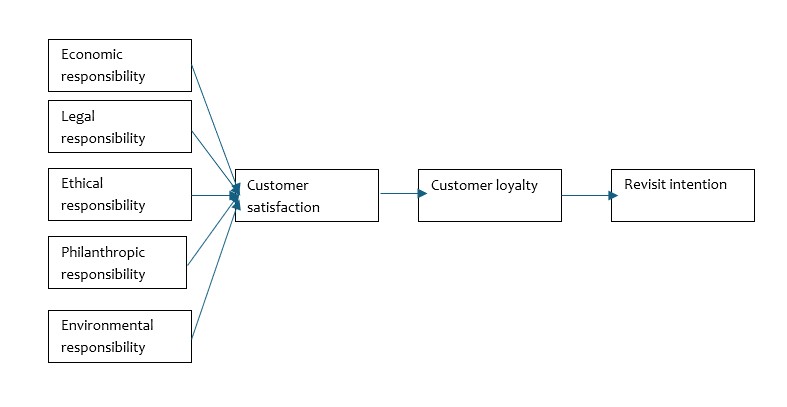
With the aim of achieve the objective of the study, a conceptual model was created. The framework comprises five components: customer satisfaction, customer loyalty, economic, legal, ethical, philanthropic, and environmental CSR, as well as the intention to revisit.
Figure 1. Suggested conceptual model
Source: Own editing
Seven hypotheses were developed to assess the conceptual model stipulated in the literature (Figure 1).
4. Methodology
4.1. Design and sampling
To fulfil the objective of the study, a quantitative design was employed. The choice of the quantitative approach is recommended by the need for precise measurement, rigorous testing of hypotheses, and the ability to generalize findings to a larger population (Almusaed et al., 2025).
The study targeted a group of Turkish restaurant customers in the city center, Antalya. Considering the respondents’ ease of access and ability to provide information, convenience sampling was preferred. Restaurants were contacted by telephone and the aim, rationale and the survey was explained. Based on their willingness, 23 restaurant businesses agreed to participate in the study. Therefore, 50 survey forms were delivered to each of these restaurant businesses between 15 and 20 June 2023. Restaurant employees asked customers to voluntarily fill out the surveys after they had finished their meals. The survey forms filled out by customers were then collected between 3 and 8 August 2023. Forty-one of the 464 questionnaires that were collected were excluded from the study as their responses were either incomplete or insufficient. Accordingly, data from 423 valid surveys were evaluated for the analysis phase.
4.2. Data collection tool
A newly designed survey was utilised to obtain data for this study. It was created after a thorough analysis of extant literature and the surrounding environment to guarantee that it would be applicable to Antalya’s restaurant industry. The first section of the survey obtained demographic information such as the participants’ gender, age, educational status, and marital status. The second section contained statements forming the basis of the research, evaluated using a total of 24 questions using a five-point Likert scale. The scales were translated into Turkish using the back-translation method proposed by Brislin (1970). All scales were originally in English, and the translation process was carried out by four expert linguists. Following the translation, a pilot study was conducted to ensure the linguistic validity of the scales and to test the feasibility of the survey. In this pilot study, the questionnaire was administered to 49 randomly selected customers at two restaurants in Antalya, and the results indicated that the scales were free from errors, omissions, or ambiguities.
Likert scale items borrowed from Han et al. (2020) were used to measure CSR dimensions. The measurement scale has five dimensions and consists of 15 items in total. Going forward into the unidimensional scale, three statements were used to measure each variable of customer satisfaction (Hennig-Thurau, 2004; Leninkumar, 2017; Servera-Francés & Piqueras-Tomás, 2019), customer loyalty (Marin et al., 2009; Leninkumar, 2017) and revisit intention (Hennig-Thurau, 2004; Kim et al., 2017; Lee et al., 2020).
4.3. Data analysis
The demographic information of the participants was analyzed and summarized using SPSS. The hypotheses developed in this study were examined using the partial least squares structural equation modeling (PLS-SEM) approach. As a variance-based SEM technique, PLS-SEM is particularly appropriate for studies aimed at theory building and prediction. In contrast to covariance-based SEM (CB-SEM), which primarily emphasizes overall model fit and theory confirmation, PLS-SEM focuses on maximizing the explained variance of endogenous constructs. Consequently, it is well suited for investigating and predicting complex relationships among latent variables (Hair et al., 2017).
4.4. Common method variance (CMV) check
Common method variance (CMV) was assessed using Harman’s single-factor test, which examines whether a single factor accounts for the majority of variance when data are collected from the same source (Podsakoff et al., 2003). The first factor explained well below the 50% threshold, indicating that CMV is unlikely to bias the results. To further check for potential collinearity and method bias, variance inflation factor (VIF) values were calculated for all constructs and found to be below 3.3 (Kock, 2015). These complementary tests collectively suggest that CMV and multi-collinearity do not pose a significant threat to the validity of the findings.
5. Results
Table 1 demonstrates the demographic traits of the respondents that participated in the research.
Table 1. Demographic characteristics of respondents
| Frequency | Percentage | ||
| Gender | Male | 242 | 57.2 |
| Female | 181 | 42.8 | |
| Age | 18-25 | 114 | 27.0 |
| 26-35 | 147 | 34.8 | |
| 36-45 | 111 | 26.2 | |
| 46 + | 51 | 12.0 | |
| Education | High School | 97 | 22.9 |
| Undergraduate | 287 | 67.9 | |
| Master’s Degree | 28 | 6.6 | |
| Doctorate | 11 | 2.6 | |
| Total | 423 | 100 | |
Source: Own editing based on results
The sample consists of 423 individuals, with 57.1% male and 42.8% female respondents. Regarding age distribution, most participants are in the 26–35 age range (34.8%). This is followed by those aged 18–25 (27.0%) and 36–45 (26.2%), while participants aged 46 and older constitute the smallest group (12.1%). In terms of education level, most respondents have an undergraduate degree (67.8%), with the second largest group being those with a high school education (22.9%). Respondents with a master’s degree and doctorate make up smaller proportions, representing 6.6% and 2.6% of the sample, respectively.
5.1. The measurement model
Table 2 presents the measurement model’s validity and reliability data. The findings showed that all constructs had factor loadings that were statistically significant and higher above the suggested cutoff of 0.70 (Hair et al., 2011).
The achievement of adequate convergent validity was further confirmed by the Composite Reliability (CR) values exceeding the 0.70 benchmark and the Average Variance Extracted (AVE) values for each construct beyond the permitted limit of 0.50 (Hair et al., 2011; Fornell & Larcker, 1981). With CR scores ranging from 0.886 to 0.924, AVE scores ranging from 0.721 to 0.802, and Cronbach’s Alpha values ranging from 0.808 to 0.876, the scale demonstrates strong reliability.
Thereafter, the heterotrait-monotrait ratio (HTMT) and the Fornell-Larcker criterion were employed to assess discriminant validity in the study (Table 3 and Table 4). If HTMT scores stay below the 0.90 criterion, discriminant validity is considered adequate (Henseler et al., 2015). The findings of this analysis demonstrate that discriminant validity has been established according to the specified criterion. Furthermore, as stated by Fornell and Larcker (1981) the findings show that each construct’s square root of the AVE is higher than its correlations with other constructs, demonstrating sufficient discriminant validity.
Table 2. Construct reliability and validity
| Constructs and Items | Loadings | CR | Cronbach Alfa | AVE |
| Economic CSR | 0.876 | 0.789 | 0.701 | |
| It is important for this restaurant to be committed to being as profitable as possible. | 0.837 | |||
| It is important for this restaurant to maintain a strong competitive position. | 0.862 | |||
| It is important for this restaurant to be defined as one that is consistently profitable. | 0.813 | |||
| Legal CSR | 0.881 | 0.799 | 0.713 | |
| It is important for this restaurant to perform in a manner consistent with the expectations of government and law. | 0.890 | |||
| It is important for this restaurant to be defined as one that fulfils its legal obligations. | 0.855 | |||
| It is important for this restaurant to provide goods and services that at least meet minimal legal requirements. | 0.784 | |||
| Ethical CSR | 0.885 | 0.808 | 0.720 | |
| It is important for this restaurant to perform in a manner consistent with expectations of societal mores and ethical. | 0.915 | |||
| It is important for this restaurant to prevent ethical norms from being compromised in order to achieve corporate goals. | 0.770 | |||
| It is important for this restaurant to be defined as good corporate citizenship and known as who does what is expected morally or ethically. | 0.855 | |||
| Philanthropic CSR | 0.855 | 0.747 | 0.663 | |
| It is important for this restaurant to perform in a manner consistent with the philanthropic and charitable expectations of society. | 0.838 | |||
| It is important for this restaurant to allocate some of its resources to philanthropic activities (e.g. fine/performing arts and sports). | 0.791 | |||
| It is important for this restaurant to assist voluntarily with those projects that enhance a community’s “quality of life.” | 0.814 | |||
| Environmental CSR | 0.910 | 0.852 | 0.772 | |
| It is important for this restaurant to perform in a manner consistent with protecting the environment. | 0.875 | |||
| It is important for this restaurant to offer environmentally friendly products/services. | 0.864 | |||
| It is important for this restaurant to make every effort to protect and preserve the environment. | 0.896 | |||
| Customer Satisfaction | 0.836 | 0.706 | 0.630 | |
| My choice to buy from this restaurant was a wise one. | 0.774 | |||
| Based on my experience with this restaurant, I am very satisfied with this company. | 0.813 | |||
| This restaurant has never disappointed me so far. | 0.794 | |||
| Customer Loyalty | 0.860 | 0.755 | 0.672 | |
| What is the probability that you will buy from this restaurant? | 0.817 | |||
| I say positive things about this restaurant to other people. | 0.796 | |||
| I consider this restaurant as the first choice to buy. | 0.845 | |||
| Revisit Intention | 0.861 | 0.762 | 0.674 | |
| This place will be my first choice when it comes to choosing a restaurant. | 0.778 | |||
| I am planning to eat at this restaurant in the future. | 0.873 | |||
| I am a loyal customer of this restaurant. | 0.810 |
Source: Own editing based on results
Table 3. Heterotrait-Monotrait ratio (HTMT)
| CL | CS | EC_CSR | EN_CSR | ET_CSR | L_CSR | P_CSR | RI | |
| CL | ||||||||
| CS | 0.754 | |||||||
| EC_CSR | 0.488 | 0.643 | ||||||
| EN_CSR | 0.407 | 0.826 | 0.495 | |||||
| ET_CSR | 0.430 | 0.714 | 0.266 | 0.438 | ||||
| L_CSR | 0.417 | 0.632 | 0.339 | 0.439 | 0.362 | |||
| P_CSR | 0.321 | 0.638 | 0.412 | 0.400 | 0.326 | 0.382 | ||
| RI | 0.523 | 0.490 | 0.322 | 0.542 | 0.375 | 0.282 | 0.221 |
Note. EC_CSR: Economic CSR, L_CSR: Legal CSR, ET_CSR: Ethical CSR, P_CSR: Philanthropic
CSR, EN_CSR: Environmental CSR, CS: Customer Satisfaction, CL: Customer Loyalty, RI: Revisit Intention.
Source: Own editing based on results
Table 4. Fornell-Larcker criteria
| CL | CS | EC_CSR | EN_CSR | ET_CSR | L_CSR | P_CSR | RI | |
| CL | 0.820 | |||||||
| CS | 0.552 | 0.794 | ||||||
| EC_CSR | 0.384 | 0.485 | 0.838 | |||||
| EN_CSR | 0.328 | 0.641 | 0.410 | 0.879 | ||||
| ET_CSR | 0.341 | 0.556 | 0.222 | 0.376 | 0.849 | |||
| L_CSR | 0.327 | 0.482 | 0.272 | 0.362 | 0.295 | 0.844 | ||
| P_CSR | 0.244 | 0.465 | 0.316 | 0.318 | 0.250 | 0.301 | 0.814 | |
| RI | 0.409 | 0.360 | 0.247 | 0.442 | 0.293 | 0.218 | 0.173 | 0.821 |
Note. EC_CSR: Economic CSR, L_CSR: Legal CSR, ET_CSR: Ethical CSR, P_CSR: Philanthropic CSR,
EN_CSR: Environmental CSR, CS: Customer Satisfaction, CL: Customer Loyalty, RI: Revisit Intention.
Source: Own editing based on results
5.2. The structural model
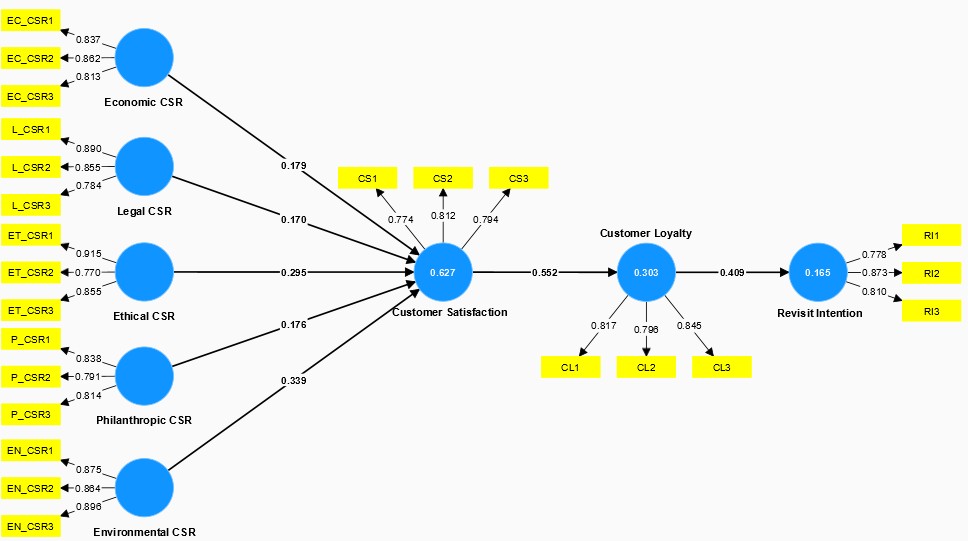
The model’s explanatory power and predictive relevance were evaluated using the R² and Q² values, respectively. According to Falk and Miller’s (1992) recommended criterion of 0.10, all of the R2 values were determined to be over it. In particular, CS’s (0.627), CL’s (0.303) and RI’s (0.165) R2 scores show a significant amount of explained variance.
Figure 2. Findings from the path analysis
Source: Own editing based on results
Furthermore, when considering the Q² values obtained for the internal constructs from Stone-Geisser’s criterion, CS yielded a score of 0.390, CL 0.202, and RI 0.107. These findings support Hair et al.’s (2011) assertion that the model is predictively valid. The results of the study’s path analysis are demonstrated in Figure 2.
Table 5. Structural model results
| Hypothesis | Path | Effect | t Value | f2 | p | Remarks |
| Hypothesis 1 | EC_CSR → CS | 0.179 | 4.145 | 0.068 | 0.000 | Supported |
| Hypothesis 2 | L_CSR→ CS | 0.170 | 4.770 | 0.063 | 0.000 | Supported |
| Hypothesis 3 | ET_CSR→ CS | 0.295 | 7.164 | 0.193 | 0.000 | Supported |
| Hypothesis 4 | P_CSR→ CS | 0.176 | 4.978 | 0.069 | 0.000 | Supported |
| Hypothesis 5 | EN_CSR→ CS | 0.339 | 7.605 | 0.218 | 0.000 | Supported |
| Hypothesis 6 | CS → CL | 0.552 | 13.108 | 0.437 | 0.000 | Supported |
| Hypothesis 7 | CL → RI | 0.409 | 9.213 | 0.201 | 0.000 | Supported |
Note. EC_CSR: Economic CSR, L_CSR: Legal CSR, ET_CSR: Ethical CSR, P_CSR: Philanthropic
CSR, EN_CSR: Environmental CSR, CS: Customer Satisfaction, CL: Customer Loyalty,
RI: Revisit Intention.
Source: Own editing based on results
Table 5 summarizes the structural model findings, demonstrating that all proposed hypotheses are statistically supported. Economic CSR has a significant positive influence on customer satisfaction (H1: β = 0.179, p = 0.000), followed by legal CSR (H2: β = 0.170, p = 0.000), ethical CSR (H3: β = 0.295, p = 0.000), philanthropic CSR (H4: β = 0.176, p = 0.000), and environmental CSR (H5: β = 0.339, p = 0.000), indicating that all dimensions of CSR significantly enhance customer satisfaction. Furthermore, customer satisfaction positively influences customer loyalty (H6: β = 0.552, p = 0.000), and consumer loyalty has a strong positive influence on revisit intention (H7: β = 0.409, p = 0.000).
6. Discussion
This study adds to the current body of research on the strategic importance of CSR in the hospitality field, specifically in relation to Turkish restaurants in Antalya. Results demonstrate support for Hypothesis 1, that economic CSR does positively and significantly influence customer satisfaction in the Turkish restaurant context. This means that consumers are valuing restaurants that offer a competitive advantage. The finding aligns with Hsu (2018) that highlight economic responsibility was a notable predictor of CS and suggests that customers do care about a restaurant’s commitment to providing quality service and products; for a fair price, while making a profit; and sustaining economic viability, which ultimately improves perceived satisfaction. In emerging markets, economic CSR signifies that businesses have resilient characteristics which are similar to trustworthy and competent customers. For example, Turkish customers may consider restaurants that support local producers or keep their employees working during a challenging economy as engaging in economic CSR, which implicitly improves customers’ emotional and rational satisfaction.
Findings indicate that legal CSR has a direct and statistically notable influence on customer satisfaction in Turkish restaurants. This implies that considering a restaurant’s adherence to norms and regulations in a market affects customer perceptions and satisfaction. Results demonstrate that customers are concerned about restaurants following the regulations by society and align with previous study by Saeidi et al. (2015). In the restaurant industry, where issues like food safety, transparency in labelling, and fair labor practices are particularly sensitive, compliance with legal responsibilities is not only expected but also seen as a minimum threshold for earning consumer trust.
The outcomes of this research provide strong support to Hypothesis 3 and demonstrate that ethical CSR has a substantial and significant influence on customer satisfaction in the Turkish restaurant industry. Ethical responsibility was one of the most important CSR dimensions that shaped customers’ attitudes and experiences. This shows that customers consider it important for restaurants to respect social norms, because they expect restaurants to conform to and behave ethically. This finding is in line with Bello et al. (2021), in which CSR engagement was shown to lead to an increase in CS. In the hospitality and foodservice setting, where trust, hygiene, and human interactions are paramount to service delivery (Khuluse & Deen, 2020; Deen et al., 2025), ethical conduct is distinctly important. If restaurants behave ethically, customers could experience moral satisfaction that transcends a transactor mind-set. The moral satisfaction can foster an emotional connection that strengthens the bond between the customer and the business resulting in increased satisfaction and loyalty.
Results reveal that philanthropic CSR has a notable and positive influence on customer satisfaction in the Turkish restaurant sector, similarly to the study by Park & Kim (2019). This is important as customers increasingly recognize and appreciate businesses that take social responsibility actions in addition to the business rationale for profitability. When customers perceive such responsibility, they interpret this as a signal of moral character, contributing to affective trust (an important antecedent of satisfaction in service settings). For example, a restaurant that donates leftover food to shelters or supports local children’s education programs may be considered as behaving responsibly and being a compassionate organization of society. This translates to customer satisfaction that includes both rational and emotional aspects.
Findings also indicate that environmental CSR has a positive and statistically substantial influence on customer satisfaction in the Turkish restaurant sector. These findings support the growing body of literature that emphasizes the strategic value of environmental responsibility in shaping positive customer perceptions and experiences, especially in the hospitality and foodservice industries. It is evident that customers have a strong expectation for restaurants to behave in a way that minimizes environmental harm. These results are consistent with Al-Ghamdi and Badawi (2019) that indicated that CSR activities have a strong and positive influence on CS.
In an era of heightened environmental awareness, customers increasingly expect businesses – particularly those in resource-intensive industries like restaurants – to demonstrate clear and consistent commitment to sustainability. The significant positive relationship found in this study suggests that Turkish restaurant customers are becoming more environmentally conscious and reward restaurants that align with their values. This aligns with recent research by Omidvar et al., (2024) who reported that customers are more satisfied with companies they perceive as environmentally responsible. Environmental initiatives serve not only to differentiate a brand but also to signal broader moral and social responsibility, which enhances customer trust and emotional satisfaction (Omidvar & Deen, 2024a). Customers may perceive environmentally responsible restaurants as more ethical, modern, and customer-oriented, reinforcing their satisfaction with the overall dining experience. For instance, they may derive greater satisfaction from dining at establishments that reduce plastic use, recycle waste, or support sustainable agriculture, as these actions allow them to feel that their consumption choices contribute to a greater good. Environmental CSR may be particularly influential in emerging markets like Türkiye, where environmental issues such as pollution, resource scarcity, and climate change have gained increased public attention in recent years (Demir et al., 2024). As a result, restaurants that adopt proactive environmental strategies may enhance their reputation and appeal to the evolving preferences of a more conscious and values-driven customer base.
Results also provide strong support for Hypothesis 6, showing that customer satisfaction has a positive and meaningful influence on consumer loyalty in the Turkish restaurant context. The literature on service marketing has established satisfaction as a significant precursor to customer loyalty (Fraering & Minor, 2013; Suchánek & Králová, 2019; Ghaderi et al., 2025; Omidvar & Deen, 2024b). The aim and construct of customer satisfaction in hospitality and food service is multifaceted as it is a measure of customer evaluations of restaurants and their overall experience including quality of food, level of service, atmosphere, price of food, and relation to brand (Han & Ryu, 2009). Customers will develop positive attitudes, trust in the brand, and remain loyal and committed to the brand when perceived satisfaction is met or exceed expectations (Han & Ryu, 2009). The substantial impact of satisfaction on loyalty demonstrates the abstract emotional and relational aspect of dining experiences. In a highly experiential industry such as restaurants, especially within culturally rich settings like Türkiye, customers’ loyalty may be shaped by the functional aspects of the service and by how the experience makes them feel such as comfort, delight or a sense of belonging.
In the Turkish market, where dining out is often a social and emotional activity, creating satisfaction through quality service, CSR engagement, and emotional value can significantly influence long-term loyalty. This is also aligned with cultural expectations in Türkiye, where hospitality, warmth, and trust are integral to customer relationships. Moreover, the mediating role of satisfaction in this research model reinforces the idea that CSR initiatives, while valuable, must be channelled into creating real and perceived value for customers. CSR alone may not generate loyalty unless it results in satisfying experiences. This supports the findings of Omidvar and Deen (2024b), who argued that CSR builds loyalty primarily through its influence on satisfaction and trust.
Findings provide robust empirical evidence that supports Hypothesis 7: customer loyalty has a positive and substantial relationship with revisit intention in the context of Turkish restaurants. These finding affirm the concept in marketing, which states that loyal customers are likely to repeat patronage with a brand and maintain a long-term relationship with it (Oliver, 1999). A customer’s loyalty to a restaurant brand represents a favorable attitude, emotional and behavioural ties and reflects mostly cumulative satisfactory experiences, trust, perceived value, and emotional attachment to a restaurant brand. Revisit intention, in turn, refers to a customer’s desire to return to the same establishment, an essential driver of restaurant performance and profitability (Yan et al., 2015). These results affirm with previous studies indicating that loyalty is a strong predictor of future behavior, including visit frequency, recommendation to others, and resistance to switching, even when alternatives are available (Kim et al., 2018).
In the restaurant sector, where the potential to switch between brands are typically high and customer choices are vast, loyalty is essential for retaining a competitive advantage (Bowden, 2009). In the specific cultural context of Türkiye, where dining is considered social and emotional, loyalty is even more significant. Turkish customers may base their loyalty on their perception of warmth, familiarity, and cultural resonance with the restaurant experience, and this emotional bond will increase the chances of them revisiting that same restaurant again when trust and consistency are established. As a point of reference from the current study, we know that customer loyalty is an important outcome from CSR-based satisfaction and is also an important link between customer satisfaction and post-consumption behaviour intentions. This finding lends credence to how important it is to build loyalty based on not only operational excellence but also on ethical due diligence and duty socially.
7. Theoretical contribution
In the context of emerging economies like Türkiye, this research offers several significant theoretical contributions to the domains of consumer behavior, hotel management, and corporate social responsibility. First, the study extends Carroll (1991), a four-dimensional CSR framework by integrating the environmental dimension as a distinct and influential component. While Carroll originally conceptualized CSR in terms of economic, legal, ethical, and philanthropic responsibilities, this study supports the growing academic consensus that environmental responsibility should be treated as a separate, fifth dimension, particularly relevant to service sectors such as restaurants, where sustainability issues are increasingly salient (Omidvar et al., 2024). By empirically validating the unique contribution of environmental CSR to customer satisfaction, this research reinforces the importance of revisiting and expanding traditional CSR models in line with contemporary ecological challenges.
Second, this study contributes to the CSR customer satisfaction literature by providing a nuanced understanding of how distinct CSR dimensions differentially affect satisfaction. Unlike many prior studies that treat CSR as a unidimensional construct, this research demonstrates that ethical and environmental responsibilities exert stronger impacts on satisfaction compared to economic or legal responsibilities. This highlights the need for scholars to move beyond aggregated CSR indices and examine the specific pathways through which individual CSR domains influence consumer evaluations (Al-Ghamdi & Badawi, 2019). In doing so, the study advances stakeholder and signalling theories by showing that customers interpret and value different CSR signals in varying ways based on perceived authenticity, emotional relevance, and social value.
Third, the study contributes to the service marketing and hospitality literature by confirming the sequential relationship from CSR to customer satisfaction, customer loyalty and revisit intention. This model aligns with and extends the expectancy-disconfirmation theory (Oliver, 1999) and relationship marketing theory (Hunt & Morgan, 1994), by empirically validating that CSR induced satisfaction acts as a key antecedent of consumer loyalty, which in turn leads to repeat behavioural intentions. This layered approach provides a more comprehensive explanation of how CSR not only shapes customer attitudes but also influences actual consumer behaviour in high-contact service settings.
Fourth, the research contributes to the literature on CSR in emerging markets by providing evidence from the under-researched context of Turkish restaurants. Much of the existing CSR research is concentrated in Western and developed economies. By focusing on Türkiye, a country with rich cultural traditions, evolving consumer expectations, and increasing environmental concerns, this study provides context-specific insights and supports the argument that CSR perceptions and impacts are culturally contingent. It also highlights the growing moral and ecological sensitivity among consumers in non-Western markets, where CSR is increasingly viewed as both an ethical obligation and a strategic differentiator.
Finally, by incorporating customer revisit intention as a terminal behavioural outcome, this research advances prior work that often stops at attitudinal loyalty. The inclusion of revisit intention responds to recent calls in hospitality and tourism literature for a better understanding of actual customer behaviour, which is critical for business sustainability and competitive advantage (Omidvar & Palazzo, 2023).
8. Managerial implications
The outcomes of this research provide several actionable insights for restaurant managers, CSR strategists and hospitality practitioners in Türkiye and similar emerging markets or developing countries. By empirically confirming that various dimensions of CSR significantly influence customer satisfaction – driving loyalty and revisit intentions – this study offers clear managerial guidance on how CSR can be effectively leveraged as a strategic asset in the competitive restaurant industry. Managers need to transition from viewing CSR as merely peripheral or charitable to incorporating it into their core business and marketing plans. The observed significance of ethical, philanthropic, and environmental CSR about customer satisfaction suggests that customers notice restaurant actions that show social responsibility, environmental responsibility, and ethical responsibility. Therefore, restaurants that proactively communicate their responsible practices such as ethical sourcing, waste reduction, community donations, and fair employee treatment are more likely to foster positive customer experiences and emotional connections with the brand.
From all the CSR dimensions we investigated, environmental and ethical CSR had the most decisive influence on customer satisfaction. These results indicate that Turkish restaurant customers are increasingly concerned with sustainability, transparency, and ethical behaviour; therefore, managers need to pay attention to environmental issues (i.e., use of plastic, composting, sourcing locally), transparency (i.e., sourcing edible items, food preparation) and training employees on ethical behaviour and making an acknowledgment of customers from historically excluded groups. Additionally, managers may want to consider promoting these efforts on their menus, websites, and social media to increase customer awareness and attentiveness.
Philanthropic CSR also had a strong impact on customer satisfaction. Restaurants participating in local charities, offering meal services for the disadvantaged, and supporting local events and artisans could have impactful customer brand loyalty and goodwill with the community. Managers should consider collaborating with NGOs or local community groups, cause-related campaigns, and customer donation promotions with option for customers to volunteer their time.
The validated link between customer satisfaction and loyalty confirms that satisfaction remains the primary basis for long-term customer retention. As such, it is important to invest in service quality, ambiance, menu variety, hygiene, and employee professionalism. However, this study also demonstrates that CSR activities can elevate customer satisfaction beyond operational service performance factors, providing a differentiated and emotional experience that fosters commitment to the brand. Results indicated that customer loyalty significantly informs revisit intention and is thus an important key performance indicator for long-term commercial success. As such, managers should foster customer loyalty by implementing individualized and personalized loyalty programs, offering value-based rewards for repeat visits, and creating emotional bonds through storytelling and authenticity. Restaurants can encourage the intentions to maintain quality and ensure that every experience confirms the values circulated through CSR.
It is not sufficient to apply CSR; it is equally important to communicate CSR initiative effectively for customers to know and believe about the authenticity of these efforts. Therefore, managers should use in-store displays, websites and digital platforms to share CSR-related stories metrics and achievements. Given the cultural and social context of Türkiye, the CSR initiative that reflects local traditions, religious values and community priorities is more likely to be resonant with customers. For example, supporting local farmers, engaging in charitable acts during religious holidays, or preserving the culinary heritage can increase emotional appeal and cultural alignment.
9. Limitations and future research
There are various restrictions on this research. First, the outcomes are specific to the restaurant and tourism sectors, so caution is needed when generalizing them to other industries. Future studies could explore different sectors, especially in developing countries. Second, because the study was carried out in Türkiye, its findings might not be applicable if replicated in other nations. Since Türkiye is a developing economy, comparative research in developed countries could be insightful. Additionally, future work could investigate these dimensions across various aspects of customer behaviour. Most participants were aged between 20 and 40, with fewer responses from younger and older groups. Furthermore, the findings might not be generally applicable because the study was restricted to a single foreign place. While the measuring items were informed by quantitative methodologies and insights from different settings, some notions may have been influenced by the unique characteristics of Turkish eateries. The inclusion of many nations in future studies is necessary to evaluate external validity. The study’s design also presents limitations as it utilized surveys to explore experiences, understanding and introduced new measurement items, but the quantitative approach may limit their generalizability. Overall, this is one of the first studies to fully analyse CSR elements in this setting, and to improve the measurement scales’ validity, more research is required. Using quantitative data, it refined novel scales based on literature in a groundbreaking endeavor. During the survey’s design and analysis, extensive testing was done with an emphasis on validity and reliability. It was restricted to a single sector and a single sample, though, because of time limits and the study’s breadth. It should be the goal of future research to improve and broaden these measurement scales with further robust methodologies for scale development.
References
Aguinis, H. & Glavas, A. (2012). What we know and don’t know about corporate social responsibility: A review and research agenda. Journal of Management, 38 (4): 932–968. DOI: 10.1177/0149206311436079
Al-Ghamdi, S. A. A. & Badawi, N. S. (2019). Do corporate social responsibility activities enhance customer satisfaction and customer loyalty? Evidence from the Saudi banking sector. Cogent Business & Management, 6 (1): 1662932. DOI: 10.1080/23311975.2019.1662932
Almusaed, A., Almssad, A., & Yitmen, I. (2025). Practice of research methodology in civil engineering and architecture: A comprehensive guide. Cham: Springer Nature. DOI: 10.1007/978-3-031-97393-2
Bakeshlo, Z. A., Omidvar, M., & Gigauri, I. (2024). Sustainable path and green leadership: Navigating the challenges of environmental sustainability in Iran. In: I. Gigauri & A. J. Khan (Eds.), Navigating corporate social responsibility through leadership & sustainable entrepreneurship. IGI Global Scientific Publishing, pp. 257–278.
Bakeshlo, Z. A., Omidvar, M., & Palazzo, M. (2025). Unethical pro-organizational behavior in Iranian organizations: A qualitative exploration of consequences. In: I. Gigauri & A. J. Khan (Eds.), Navigating corporate social responsibility through leadership and sustainable entrepreneurship. IGI Global Scientific Publishing, pp. 83–106.
Bello, K. B., Jusoh, A., & Md Nor, K. (2021). Relationships and impacts of perceived CSR, service quality, customer satisfaction and consumer rights awareness. Social Responsibility Journal, 17 (8): 1116–1130. DOI: 10.1108/SRJ-01-2020-0010
Bendapudi, N. & Berry, L. L. (1997). Customers’ motivations for maintaining relationships with service providers. Journal of Retailing, 73 (1): 15–37. DOI: 10.1016/S0022-4359(97)90013-0
Bettman, J. R. (1979). Memory factors in consumer choice: A review. Journal of Marketing, 43 (2): 37–53. DOI: 10.1177/002224297904300205
Blut, M., Beatty, S. E., Evanschitzky, H., & Brock, C. (2014). The impact of service characteristics on the switching costs–customer loyalty link. Journal of Retailing, 90 (2): 275–290. DOI: 10.1016/j.jretai.2014.04.003
Bowden, J. (2009). Customer engagement: A framework for assessing customer-brand relationships: The case of the restaurant industry. Journal of Hospitality Marketing & Management, 18 (6): 574–596. DOI: 10.1080/19368620903024983
Brislin, R. W. (1970). Back-translation for cross-cultural research. Journal of Cross-Cultural Psychology, 1 (3): 185–216. DOI: 10.1177/135910457000100301
Carroll, A. B. (1979). A three-dimensional conceptual model of corporate performance. Academy of management review, 4 (4): 497–505. DOI: 10.5465/amr.1979.4498296
Carroll, A. B. (1991). The pyramid of corporate social responsibility: Toward the moral management of organizational stakeholders. Business Horizons, 34 (4): 39–48.
Carroll, A. B. & Shabana, K. M. (2010). The business case for corporate social responsibility: A review of concepts, research and practice. International Journal of Management Reviews, 12 (1): 85–105. DOI: 10.1111/j.1468-2370.2009.00275.x
Chen, W. T., Zhou, G.S., & Zhu, X.K. (2019). CEO tenure and corporate social responsibility performance. Journal of Business Research, 95: 292–302. DOI: 10.1016/j.jbusres.2018.08.018
Choo, H., Ahn, K., & F. Petrick, J. (2016). An integrated model of festival revisit intentions: Theory of planned behavior and festival quality/satisfaction. International Journal of Contemporary Hospitality Management, 28 (4): 818–838. DOI: 10.1108/IJCHM-09-2014-0448
Chung, K. H., Yu, J. E., Choi, M. G., & Shin, J. I. (2015). The effects of CSR on customer satisfaction and loyalty in China: the moderating role of corporate image. Journal of Economics, Business & Management, 3 (5): 542–547.
Churchill Jr, G. A. & Surprenant, C. (1982). An investigation into the determinants of customer satisfaction. Journal of Marketing Research, 19 (4): 491–504. DOI: 10.1177/002224378201900410
Cristobal-Cipriano, C. M., Arroyo, J., & Romualdo, A. (2022). Corporate social responsibility (CSR) programs in Sarangani Province: Promotion of the triple bottom line framework of sustainability. Journal of Environmental Science & Economics, 1 (2): 67–77.
Davidson, D. K., Tanimoto, K., Jun, L. G., Taneja, S., Taneja, P. K., & Yin, J. (2018). Corporate social responsibility across Asia: a review of four countries. Corporate Social Responsibility, 2: 73–132. DOI: 10.1108/S2514-175920180000002003
Deen, A., Kuhudzai, A. G., & Geyser, I. (2025). Customer behaviour in restaurant establishments in South Africa during the COVID-19 pandemic. Journal of Applied Sciences in Travel & Hospitality, 8 (1): 51–62. DOI: 10.31940/jasth.v8i1.51-62
Demir, R., Yalazı, R. Ö., & Dinc, A. (2024). The relationship between women’s climate change awareness and concerns about climate change in Turkiye. Public Health Nursing, 41 (2): 215–220. DOI: 10.1111/phn.13269
El-Adly, M. I. (2019). Modelling the relationship between hotel perceived value, customer satisfaction, and customer loyalty. Journal of Retailing and Consumer Services, 50: 322–332. DOI: 10.1016/j.jretconser.2018.07.007
Falk, R. F. & Miller, N. B. (1992). A primer for soft modeling. University of Akron Press.
Fornell, C. & Larcker, D. F. (1981). Evaluating structural equation models with unobservable variables and measurement error. Journal of Marketing Research, 18 (1): 39–50. DOI: 10.1177/002224378101800104
Fraering, M. & S. Minor, M. (2013). Beyond loyalty: customer satisfaction, loyalty, and fortitude. Journal of Services Marketing, 27 (4): 334–344. DOI: 10.1108/08876041311330807
Galbreath, J. (2010). How does corporate social responsibility benefit firms? Evidence from Australia. European Business Review, 22 (4): 411–431. DOI: 10.1108/09555341011056186
Ghaderi, Z., Omidvar, M. S., Hosseini, S., & Hall, C. M. (2025). Corporate social responsibility, customer satisfaction, and trust in the restaurant industry. Journal of Foodservice Business Research, 28 (6): 1215–1246. DOI: 10.1080/15378020.2024.2318523
Hair, J. F., Ringle, C. M., & Sarstedt, M. (2011). PLS-SEM: Indeed a silver bullet. Journal of Marketing Theory and Practice, 19 (2): 139–152. DOI: 10.2753/MTP1069-6679190202
Hair, J. F., Matthews, L. M., Matthews, R. L., & Sarstedt, M. (2017). PLS-SEM or CB-SEM: updated guidelines on which method to use. International Journal of Multivariate Data Analysis, 1 (2): 107–123. DOI: doi.org/10.1504/IJMDA.2017.087624
Han, H. & Ryu, K. (2009). The roles of the physical environment, price perception, and customer satisfaction in determining customer loyalty in the restaurant industry. Journal of Hospitality & Tourism Research, 33 (4): 487–510. DOI: doi.org/10.1177/1096348009344212
Han, H., Yu, J., Lee, K. S., & Baek, H. (2020). Impact of corporate social responsibilities on customer responses and brand choices. Journal of Travel & Tourism Marketing, 37 (3): 302–316. DOI: 10.1080/10548408.2020.1746731
Hennig‐Thurau, T. (2004). Customer orientation of service employees: Its impact on customer satisfaction, commitment, and retention. International Journal of Service Industry Management, 15 (5): 460–478. DOI: 10.1108/09564230410564939
Henseler, J., Ringle, C. M., & Sarstedt, M. (2015). A new criterion for assessing discriminant validity in variance-based structural equation modeling. Journal of the Academy of Marketing Science, 43 (1): 115–135. DOI: 10.1007/s11747-014-0403-8
Hsu, S. L. (2018). The effects of corporate social responsibility on corporate image, customer satisfaction and customer loyalty: An empirical study on the telecommunication industry. The International Journal of Social Sciences & Humanities Invention, 5 (5): 4693–4703.
Huang, J., Li, W., Qiu, C., Yim, F. H. K., & Wan, J. (2016). The impact of CEO servant leadership on firm performance in the hospitality industry. International Journal of Contemporary Hospitality Management, 28 (5): 945–968. DOI: 10.1108/IJCHM-08-2014-0388
Hunt, S. D. & Morgan, R. M. (1994). Relationship marketing in the era of network competition. Marketing Management, 3 (1): 18.
Hwang, D. R., Lee, S. H., & Do, H. O. (2016). Convergence generation the corporate research activities on the impact of CSR on purchase: Focusing on the mediating effect of the image and reputation. Journal of Digital Convergence, 14 (3): 127–134.
Kaur, P., Talwar, S., Madanaguli, A., Srivastava, S., & Dhir, A. (2022). Corporate social responsibility (CSR) and hospitality sector: Charting new frontiers for restaurant businesses. Journal of Business Research, 144: 1234–1248. DOI: 10.1016/j.jbusres.2022.01.067
Khuluse, D. S. & Deen, A. (2020). Hygiene and safety practices of food vendors. African Journal of Hospitality, Tourism & Leisure, 9 (4): 597–611. DOI: 10.46222/ajhtl.19770720-39
Kim, J. S., Song, H., Lee, C. K., & Lee, J. Y. (2017). The impact of four CSR dimensions on a gaming company’s image and customers’ revisit intentions. International Journal of Hospitality Management, 61: 73–81. DOI: 10.1016/j.ijhm.2016.11.005
Kim, M. G., Yang, H., & Mattila, A. S. (2018). The impact of customer loyalty and restaurant sanitation grades on revisit intention and the importance of narrative information: the case of New York restaurant sanitation grading system. Cornell Hospitality Quarterly, 59 (3): 275–284. DOI: 10.1177/1938965517744075
Kim, M., Yin, X., & Lee, G. (2020). The effect of CSR on corporate image, customer citizenship behaviors, and customers’ long-term relationship orientation. International Journal of Hospitality Management, 88: 102520.
Kim, S. B. & Kim, D. Y. (2016). The impacts of corporate social responsibility, service quality, and transparency on relationship quality and customer loyalty in the hotel industry. Asian Journal of Sustainability & Social Responsibility, 1 (1): 39–55. DOI: 10.1016/j.ijhm.2020.102520
Kock, N. (2015). Common method bias in PLS-SEM: A full collinearity assessment approach. International Journal of e-Collaboration (ijec), 11 (4): 1–10.
Latif, K. F., Pérez, A., & Sahibzada, U. F. (2020). Corporate social responsibility (CSR) and customer loyalty in the hotel industry: A cross-country study. International Journal of Hospitality Management, 89: 102565. DOI: 10.1016/j.ijhm.2020.102565
Lee, Y. K., Lee, K. H., & Li, D. X. (2012). The impact of CSR on relationship quality and relationship outcomes: A perspective of service employees. International Journal of Hospitality Management, 31 (3): 745–756. DOI: doi.org/10.1016/j.ijhm.2011.09.011
Lee, S., Han, H., Radic, A., & Tariq, B. (2020). Corporate social responsibility (CSR) as a customer satisfaction and retention strategy in the chain restaurant sector. Journal of Hospitality & Tourism Management, 45: 348–358. DOI: 10.1016/j.jhtm.2020.09.002
Leninkumar, V. (2017). The relationship between customer satisfaction and customer trust on customer loyalty. International Journal of Academic Research in Business & Social Sciences, 7 (4): 450–465. DOI: 10.6007/IJARBSS/v7-i4/2821
Marin, L., Ruiz, S., & Rubio, A. (2009). The role of identity salience in the effects of corporate social responsibility on consumer behavior. Journal of Business Ethics, 84 (1): 65–78. DOI: 10.1007/s10551-008-9673-8
Martin, J., Petty, W., & Wallace, J. (2009). Shareholder value maximization – is there a role for corporate social responsibility? Journal of Applied Corporate Finance, 21 (2): 110–118. DOI: 10.1111/j.1745-6622.2009.00232.x
Martínez, P. & Del Bosque, I. R. (2013). CSR and customer loyalty: The roles of trust, customer identification with the company and satisfaction. International Journal of Hospitality Management, 35: 89–99. DOI: 10.1016/j.ijhm.2013.05.009
Nareeman, A. & Hassan, Z. (2013). Customer perceived practice of CSR on improving customer satisfaction and loyalty. International Journal of Accounting & Business Management, 1 (1): 30–49.
Oliver, R. L. (1999). Whence consumer loyalty? Journal of Marketing, 63 (4_suppl1): 33–44. DOI: 10.1177/00222429990634s105
Omidvar, M. & Palazzo, M. (2023). The influence of corporate social responsibility aspects on business model innovation, competitive advantage, and company performance: a study on small-and medium-sized enterprises in Iran. Sustainability, 15 (22): 15867. DOI: 10.3390/su152215867
Omidvar, M. & Deen, A. (2023). The effect of CSR on restaurants’ brand image and customers’ brand attitudes as evidenced by their purchase intentions. Studia Periegetica, 44 (4): 113–138. DOI: 10.58683/sp.576
Omidvar, M. & Deen, A. (2024a). Can restaurants achieve customer retention through CSR? Journal of Applied Sciences in Travel and Hospitality, 7 (1): 1–16. DOI: 10.31940/jasth.v7i1.1-16
Omidvar, M. & Deen, A. (2024b). The mediating role of customer satisfaction between dimensions of CSR and customer loyalty. Studia Periegetica, 46 (2): 59–80. DOI: 10.58683/sp.1990
Omidvar, M., Ghasemi, V., & Frau, M. (2024). Exploring the impact of environmental dimension in corporate social responsibility on restaurants’ customer retention. British Food Journal, 126 (12): 4375–4395. DOI: 10.1108/BFJ-01-2024-0030
Omidvar, M. & Palazzo, M. (2025). Investigating the impact of restaurants’ CSR activities on customer satisfaction: A focus on CSR dimensions. The TQM Journal, 37 (7): 1802–1826. DOI: 10.1108/TQM-01-2024-0028
Omidvar, M., Candar, P., & Deen, A. (2025). The impact of corporate social responsibility dimensions on brand respect: A case study of Cappadocia Hotels. ERBE – European Review of Business Economics, 4 (2): 27–46. DOI: doi.org/10.26619/ERBE-2025.4.2.2
Onlaor, W. & Rotchanakitumnuai, S. (2010). Enhancing customer loyalty towards corporate social responsibility of Thai mobile service providers. World Academy of Science, Engineering & Technology, 40 (6): 41–52.
Park, E. & Kim, K. J. (2019). What drives “customer loyalty”? The role of corporate social responsibility. Sustainable Development, 27 (3): 304–311. DOI: 10.1002/sd.1901
Pervaiz, S., Javed, U., Rajput, A., Shafique, S., & Tasneem, R. (2024). Examining how and why service quality fosters patients’ revisit intentions: evidence from Pakistan. International Journal of Pharmaceutical and Healthcare Marketing, 18 (3): 455–477. DOI: 10.1108/IJPHM-11-2021-0110
Podsakoff, P. M., MacKenzie, S. B., Lee, J. Y., & Podsakoff, N. P. (2003). Common method biases in behavioral research: a critical review of the literature and recommended remedies. Journal of Applied Psychology, 88 (5): 879.
Saeidi, S.P., Sofian, S., Saeidi, P., Saeidi, S. P., & Saaeidi, S. A. (2015). How does corporate social responsibility contribute to firm financial performance? The mediating role of competitive advantage, reputation, and customer satisfaction. Journal of Business Research, 68 (2): 341–350. DOI: 10.1016/j.jbusres.2014.06.024
Sangpikul, A. (2018). The effects of travel experience dimensions on tourist satisfaction and destination loyalty: the case of an island destination. International Journal of Culture, Tourism and Hospitality Research, 12 (1): 106–123. DOI: 10.1108/IJCTHR-06-2017-0067
Servera-Francés, D. & Piqueras-Tomás, L. (2019). The effects of corporate social responsibility on consumer loyalty through consumer perceived value. Economic research-Ekonomska istraživanja, 32 (1): 66–84. DOI: 10.1080/1331677X.2018.1547202
Schwartz, M. S. & Carroll, A. B. (2003). Corporate social responsibility: A three-domain approach. Business Ethics Quarterly, 13 (4): 503–530.
Smith, R. E. & Wright, W. F. (2004). Determinants of customer loyalty and financial performance. Journal of Management Accounting Research, 16 (1): 183–205. DOI: 10.2308/jmar.2004.16.1.183
Stojanović, A., Mihajlović, I., & Schulte, P. (2016). Corporate social responsibility: Environmental aspects. In: Visegrad Project: 11540386. International May Conference on Strategic Management. Bor, 28–30 May 2016. Serbia: University of Belgrade, pp. 1–16.
Suchánek, P. & Králová, M. (2019). Customer satisfaction, loyalty, knowledge and competitiveness in the food industry. Economic research-Ekonomska istraživanja, 32 (1): 1237–1255. DOI: 10.1080/1331677X.2019.1627893
Yan, X., Wang, J., & Chau, M. (2015). Customer revisit intention to restaurants: Evidence from online reviews. Information Systems Frontiers, 17 (3): 645–657. DOI: 10.1007/s10796-013-9446-5