

PREDICTING BEHAVIOURAL INTENTIONS OF FUNERAL TRAVELLERS TO CONSUME TOURISM-RELATED PRODUCTS AND SERVICES
1Munei Nengovhela*, 2Tondani Nethengwe, 3Gift Dafuleya
1Lecturer, University of Venda, Department of Tourism and Hospitality Management, South Africa; munei.nengovhela@univen.ac.za, ORCID: 0000-0001-7664-3043
2Senior lecturer, University of Venda, Department of Tourism and Hospitality Management,
South Africa; tondani.nethengwe@univen.ac.za ORCID: 0000-0003-2610-7327
3Professor, University of Venda, Department of Economics, South Africa; gift.dafuleya@univen.ac.za, ORCID: 0000-0002-4343-7945
ABSTRACT
Funeral tourism has emerged as a culturally significant yet underexplored form of domestic travel in South Africa. This study empirically investigated the behavioural intentions of funeral travellers to consume tourism-related products and services, focusing on accommodation, transport, and food and beverage. A quantitative approach was employed using a structured questionnaire administered to 509 respondents across Limpopo, Mpumalanga, and Gauteng provinces. Structural equation modelling (SEM) was applied to test hypothesised relationships. Results demonstrated that all three predictors significantly influenced behavioural intention, explaining 51% of the variance. Accommodation consumption had the strongest positive effect, followed by food and beverage, and transport. These findings highlight that funeral travellers engage not only in cultural practices but also in economic consumption that supports the broader tourism value chain. The study contributes to the theoretical framing of funeral tourism within the discourse of dark and cultural tourism while offering practical insights for tourism planners and service providers to design culturally sensitive, affordable, and accessible services. Future research should expand the geographic scope and adopt mixed-method approaches to deepen understanding of funeral tourism’s socio-economic impact.
Keywords: cultural tourism, emerging tourism, funeral tourism, rural tourism, tourist behaviour
Received: 11 September 2025
Accepted: 1 December 2025
Published: 16 December 2025
A TEMETKEZÉSI UTAZÓK VISELKEDÉSI SZÁNDÉKAINAK ELŐREJELZÉSE A TURISZTIKAI TERMÉKEK ÉS SZOLGÁLTATÁSOK FOGYASZTÁSÁRA VONATKOZÓAN
1Munei Nengovhela*, 2Tondani Nethengwe, 3Gift Dafuleya
1Lecturer, University of Venda, Department of Tourism and Hospitality Management, South Africa; munei.nengovhela@univen.ac.za, ORCID: 0000-0001-7664-3043
2Senior lecturer, University of Venda, Department of Tourism and Hospitality Management,
South Africa; tondani.nethengwe@univen.ac.za ORCID: 0000-0003-2610-7327
3Professor, University of Venda, Department of Economics, South Africa; gift.dafuleya@univen.ac.za, ORCID: 0000-0002-4343-7945
ABSZTRAT
A temetkezési turizmus kulturálisan jelentős, mégis kevéssé feltárt belföldi utazási formává vált Dél-Afrikában. Ez a tanulmány empirikusan vizsgálta a temetkezési utazók viselkedési szándékait a turisztikai termékek és szolgáltatások fogyasztására vonatkozóan, különös tekintettel a szállásra, a közlekedésre, valamint az ételekre és italokra. A szerzők vantitatív megközelítést alkalmaztak egy strukturált kérdőív segítségével, amelyet 509 válaszadónak adtak ki Limpopo, Mpumalanga és Gauteng tartományokban. Strukturális egyenletmodellezést (SEM) alkalmaztak a hipotézisek közötti kapcsolatok tesztelésére. Az eredmények azt mutatták, hogy mindhárom prediktor szignifikánsan befolyásolta a viselkedési szándékot, a variancia 51%-át magyarázva. A legerősebb pozitív hatást a szállásfogyasztás fejtette ki, ezt követte az étel és ital, valamint a közlekedés. Ezek az eredmények rávilágítanak arra, hogy a temetkezési utazók nemcsak kulturális tevékenységekben, hanem a fogyasztásban is részt vesznek, ami támogatja a tágabb turisztikai értékláncot. A tanulmány hozzájárul a temetkezési turizmus elméleti keretezéséhez a sötét és kulturális turizmus diskurzusán belül, miközben gyakorlati betekintést nyújt a turisztikai tervezők és szolgáltatók számára a kulturálisan érzékeny, megfizethető és hozzáférhető szolgáltatások megtervezéséhez. A jövőbeli kutatásoknak ki kell terjeszteniük a földrajzi hatókört, és vegyes módszerű megközelítéseket kell alkalmazniuk a temetkezési turizmus társadalmi-gazdasági hatásának mélyebb megértése érdekében.
Kulcsszavak: kulturális turizmus, feltörekvő turizmus, temetkezési turizmus, falusi turizmus, turisztikai magatartás
Benyújtva: 2025. szeptember 11.
Befogadva: 2025. december 1.
Publikálva: 2025. december 16
1. Introduction
Travel and tourism (T & T) is one of the fastest growing economic centres, representing approximately 10% of the global GDP and accounting for more than 330 million jobs across the world (World Economic Forum, 2025). Prior to the COVID-19 pandemic, the sector accounted for 8.6% to South Africa’s GDP and accounted for 1.5 million jobs (South African Tourism, 2025), it is further estimated that T & T will continue to recover with domestic tourism playing a critical role. In 2023, it was reported that a total of 32.2 million day-trips and 25.8 million overnight trips were undertaken, surpassing the estimated targets (Statistics South Africa, 2024).
Of interest to this research study are funeral travellers. According to Statistics South Africa (2024), travelling for funeral purposes was the third most cited reason for domestic travel across South African provinces in 2023, accounting for over 12% of such travels. Whilst studies have argued for the consideration of funeral tourism as a distinct niche sector (Nengovhela et al., 2024), this study aims to empirically evaluate the propensity and intention of funeral travellers to consume tourism-related products and and services such as transport, accommodation, and food and beverage (catering). Such an empirical enquiry is important as it paves the way for further research, such as profiling and segmentation of funeral tourists.
With the advent of emigration and urban migration, travelling for funeral purposes has become a common activity for many people. In the context of Africa and specifically South Africa, funeral attendance holds a cultural significance, with many viewing attendance of funeral ceremonies as significant activities (Khosa-Nkathini, 2023). It was further illustrated that funerals in the African culture includes important ceremonies that require people to travel over 500 kms in order to attend and participate in the ceremonies. A study that attempted to qualitatively establish a relationship between funeral traveling and consumption of tourism-related products found that funeral travellers interact with tourism products such as accommodation, transport, and catering (Nengovhela et al., 2024). However, a limitation of the study was that it did not empirically evaluate such interactions.
With the primary objective of empirically evaluating the intentions of funeral travellers to consume tourism products, the current study presents a conceptual model and employs structural equation modelling to create hypothetical relationships and quantitatively analyse them.
2. Literature review
2.1. Funeral travelling in South Africa
From January to December 2023, Statistics South Africa (2024), reported that domestic travellers undertook approximately 16,282,000 overnight trips in the country. A substantial proportion of these trips (over 7 million) were undertaken for the purpose of visiting friends and relatives, making it the most common travel motive for domestic overnight travellers during the reporting period. Leisure travel was the second most common travel motive, accounting for over 4 million travellers. Notably, more than 2 million overnight trips were undertaken specifically for the purpose of attending funerals, which reflects the cultural and social importance of funeral travel in South Africa (Statistics South Africa, 2024).
The significant contribution of funeral travelling to the overall domestic travel propensity can be attributed to the importance of funeral attendance for most African cultures. According to Bhuda et al. (2023), funerals in African cultures are not merely private family events but are deeply embedded in social structures, community identity, and traditional political systems. Funeral attendance and active participation in related rites are perceived as inherently social obligations, with only a few African people opting to be excused from the ceremonies. Such an obligation is further reinforced by a shared cultural belief that funeral participation strengthens communal bonds, reaffirms kinship ties, and maintains cultural and communal identity (Khosa-Nkathini, 2023). Thus, funeral travel is a significant travel motivation that warrants critical investigation and exploration.
Internal migration has been identified as one of the factors that influence propensity of funeral travelling. According to Nengovhela et al. (2024), urban migration has resulted in majority of rural dwellers relocating to urban areas but still holding deep ties with their rural communities, of which in the event of funerals, those who have migrated to urban areas travel to their originating areas to participate in funeral ceremonies. In the context of Northern South Africa, according to Statistics South Africa (2023), a total of 468,149 migrants moved out of the province, with 75% moving to Gauteng, 7.1% to the Northwest, and 10.4% to Mpumalanga. It can therefore be posited that urban migration and internal migration are among the main factors influencing the significance of funeral travel. Moreover, various studies have shown that a correlative relationship between migration and different forms of tourism exists (Dwyer et al., 2014).
2.2. Funeral tourism and dark tourism
Death, suffering, visitation, and traveling have been related concepts for centuries. However, dark tourism as a phenomenon and research discourse was first proposed by Lennon and Foley in 1996, which they later defined as the attraction of death and disaster (Lennon & Foley, 2000). Mortal beings are subject to death and have always held a fascination with death, be it their own or others. As posited by Stone (2006), death and tragedy are critical motivators in the discourse of funeral tourism or Thanatourism. Whilst death or tragedy is the primary motivator in dark tourism, the literature has tended to ignore funeral tourism as a distinct form of dark tourism, which positions funeral attendance and participation in funeral ceremonies as a distinct demand and supply of dark tourism (Stone, 2006). The majority of the literature has focused on prominent specialised dark tourism sites such as battlefields, Holocaust and other tragic areas as main supply-side factors of dark tourism.
The current study takes a slightly divergent train of thought, arguing that funeral tourism is a sub-set of dark tourism, a significant contributor to the overall travel propensity within the tourism sector in Northern South Africa. During the financial year 2022/23, funeral travellers spent a total of 73 million rands ($4.1 million) on overnight and day trips, with an average trip length of 3.5 days (Statistics South Africa, 2024). It is therefore clear that funeral tourism is a significant part of the South African tourism sector and should be explored and investigated. Whilst the study holds the premise that funeral tourism is a distinct form of dark tourism, it is this study’s primary objective to empirically investigate the intention of funeral travellers to consume tourism-related products and services.
2.3. Funeral travellers and tourism products
Tourism products under consideration of this study include accommodation, transport, and catering. According to Nengovhela et al. (2024), a consumption relationship exists across the three tourism products and funeral travellers. The authors further argued that such as relationship could be conceptualised as is shown in Figure 1.
Figure 1. Interactions between funeral travellers and tourism products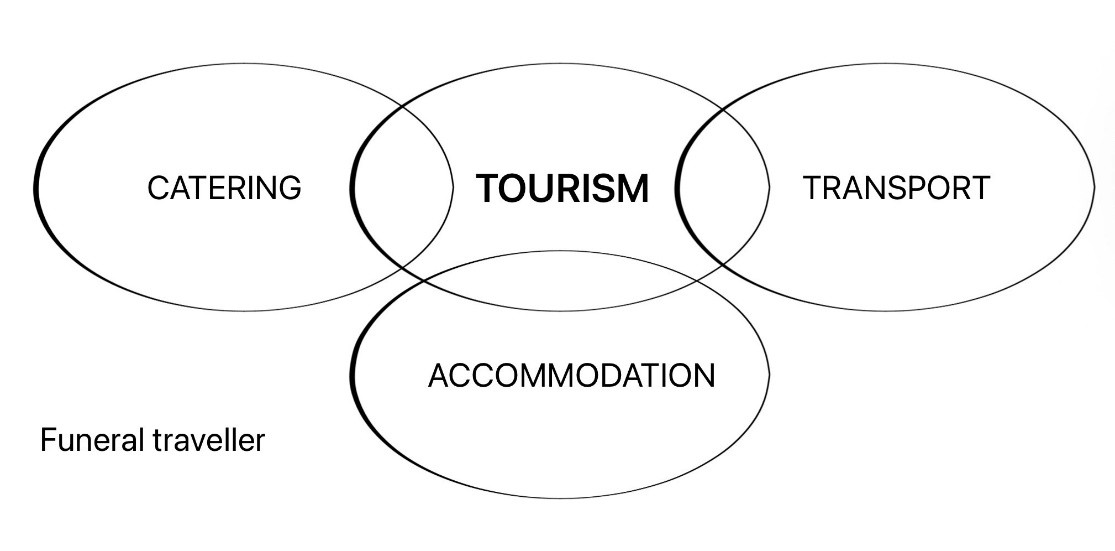
Source: Own editing.
A similar study was conducted in Ashanti Region of Ghana, which concluded that the local funeral tourism market has considerable economic benefits for the local community, including generation of revenue, improvement of standard of living, job opportunities, and market growth (Yeboah et al., 2017).
2.3.1. Funeral travel and accommodation
Funeral travellers have been reported to make use of accommodation and lodging establishments. Nengovhela et al. (2024) found that a smaller proportion of funeral travellers make use of commercial lodging establishments, many opting to stay in the home of mourners, staying with friends and relatives, and some not requiring overnight accommodation. In the case study of Ashanti, Ghana, it was found that most accommodation providers reach the peak of demand during funerals, funeral rites, and funeral celebrations (Yeboah et al., 2017). In light of this, the following hypothesis is conceptualised:
- H1: The use of paid accommodation positively influences funeral travellers’ intention to purchase other tourism products and services.
2.3.2. Funeral travelling and transportation
Funeral tourists travel for over 100 kms in order to participate in funeral ceremonies, activities, and rites. Nengovhela et al. (2024) and Yeboah et al. (2017) found that funeral travellers make use of public transport, rented and privately owned vehicles when engaging in funeral related travelling. Earlier studies in the field of tourist behaviour have found that mobility is a critical predictor of touristic intention or a catalyst of tourism product consumption. Thus, the following research hypothesis has been formulated:
- H2: The use of paid transport positively influences funeral travellers’ intention to purchase other tourism products and services.
2.3.3. Funeral travelling and catering (food and beverage)
Nengovhela et al. (2024) and Yeboah et al. (2017) found that funeral travellers make use of catering services and products while enroute, at the destination, and when returning home. An earlier concession was made by Stone (2006) that dark tourists exhibit consumption behaviours of other tourists and potentially make use of tourism-related amenities. A critical distinction was proposed by Nengovhela et al. (2024), who found that some funeral tourists would prefer not to spend on food and beverage, hoping to be catered for at the mourners’ home. Considering the above, the following hypothesis has been formulated:
- H3: Paid food and beverage consumption positively influences funeral travellers’ intention to purchase other tourism products and services.
2.3.4. Conceptual model
Based on the literature review and the need to depict hypothesised relationships and corresponding assumptions, the study has developed a conceptual model as indicated in Figure 2. The model assumes that consumption of transport, accommodation, and food and beverage services positively influences the intention of funeral tourism to consume tourism-related products. The primary argument is that like any other types of tourists, funeral tourists exhibit behavioural intentions related to general tourism product intention.
Figure 2. Proposed conceptual model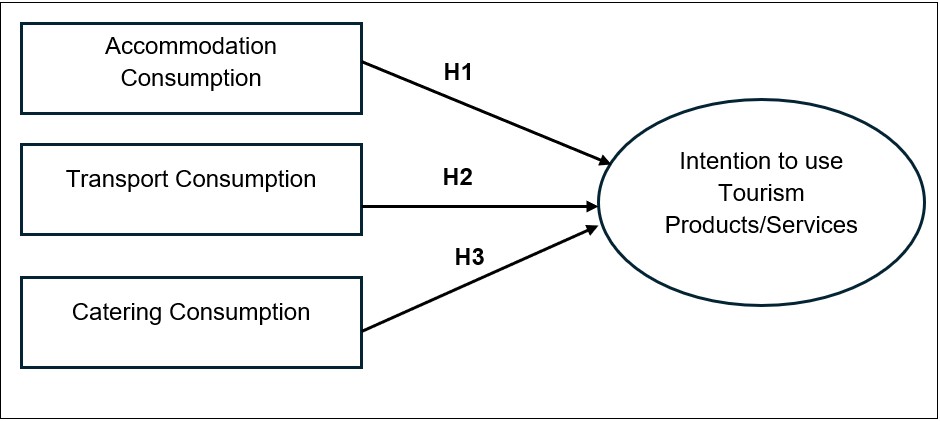 Source: Own editing.
3. Methodology
3.1. Study area
The study was conducted in the northern regions of South Africa, specifically, the provinces of Limpopo, Gauteng and Mpumalanga. These areas were selected due to their strong cultural traditions and high rates of urban migration, which has been reported to increase travel for funeral attendance. Limpopo province is characterised by deeply rooted cultural practices and tribal affiliations such as Venda, Pedi, and Tsonga, where funeral attendance remains a strong communal obligation. Mpumalanga, with its mix of rural and peri-urban settlements, also records high frequencies of funeral travel as residents maintain ties with extended families and ancestral homes. Gauteng, the economic hub of South Africa, attracts large numbers of migrants from rural provinces; however, many continue to return to their places of origin to attend funeral ceremonies, making it a critical node for outbound funeral travel. Together, these provinces provided a representative sample of funeral travellers across different socio-economic and cultural contexts. The selection of cemeteries and funeral sites as data collection points further ensured that participants were actively engaged in funeral travel, thus aligning with the study’s focus.
3.2. Research design, data collection and analysis
The study adopted a quantitative research approach, with the construct depicted in the conceptual model measure using a questionnaire, with multiple Likert item scales. The five-point items (1 = strongly agree, and 5 = strongly disagree) were developed in line with existing literature (Nengovhela et al., 2024; Yeboah et al., 2017). The study employed convenient purposive sampling, with data collected using self-administered questionnaires at cemeteries where there were funeral processions, mainly in provinces of Limpopo, Mpumalanga, and northern Gauteng. A travelling distance of 100 kms was used as a qualifying criterion. A sample size of 600 was determined in view of Reisinger & Mavondo (2006), who indicated that a sample size of 200+ should be sufficient for Structural Equation Modelling (SEM). Roscoe (1975) indicated that a sample size of more than 30 and up to 500 is sufficient for behavioural research (Reisinger & Mavondo, 2006). For the study, a total of 600 questionnaires were distributed and 509 were successfully completed, representing a response rate of 85%. Data was analysed using the statistical software SPSS version 24.0 and AMOS version 23.0.
4. Results
4.1. Descriptive statistics
Descriptive statistics revealed that 56.6% of respondents were females and 43.4% males. A total of 59.5% of respondents were employed; with 19.3% students and 15.7% unemployed. Table 1 shows the demographic profile of respondents.
Table 1. Descriptive Statistics
| Variable | Frequency | Percentage (%) |
| Gender Male Female | 221 288 | 43.4 56.6 |
| Employment status Employed Student Unemployed Self-Employed Retired | 303 98 80 22 06 | 59.5 19.3 15.7 4.3 1.2 |
| Monthly Income R0 – R2500 R2501 – R5000 R5001 – R7500 R7501 – R10000 R10001 – R12500 R12501 – R15000 R15000+ | 159 40 55 94 66 43 52 | 31.2 7.9 10.8 18.5 13.0 8.4 10.2 |
| Province of residence Limpopo Gauteng Mpumalanga Others | 321 109 43 36 | 63.1 21.4 8.4 7.1 |
| Tribal Association Venda Pedi Tsonga Others | 222 104 134 49 | 43.6 20.4 26.3 9.7 |
Source: Own editing.
4.2. Measurement model
Confirmatory Factor Analysis (CFA) was conducted to identify factor distributions and corresponding factor loadings, means, and standard deviations (Table 2).
Table 2. CFA Descriptive Results
| Construct and Items | SL | M | SD |
| Accommodation Staying with family or friends is my preferred accommodation option. I would use funeral-specific accommodation if it were available. My family influences my decision to use paid accommodation when traveling for a funeral. Affordability is the most important factor when choosing paid accommodation. Comfort and amenities are important when choosing paid accommodation. The availability of family or group lodging is important when choosing paid accommodation. Flexible check-in and check-out times are important when choosing paid accommodation. I usually book accommodation in advance when attending a funeral. Proximity to the funeral venue is important when choosing accommodation. I expect accommodation to be culturally and religiously sensitive to funeral travellers. | 0.796 0.763 0.793 0.712 0.705 0.746 0.770 0.710 0.714 0.756 | 1.97 2.04 2.12 1.96 2.12 2.08 2.01 2.09 1.97 2.16 | 1.26 1.28 1.33 1.25 1.29 1.28 1.25 1.30 1.27 1.31 |
| Transport I prefer to use my own vehicle for funeral travel. I would use a funeral shuttle service if it were available. Organised group transport is my preferred option for funeral travel. I prefer funeral transport that offers flexible departure and return times. I would use ride-sharing or carpooling for funeral travel. Cost is a major factor in my choice of funeral transport. | 0.754 0.645 0.653 0.670 0.683 0.617 | 2.05 2.01 2.00 2.07 2.14 1.98 | 1.34 1.23 1.25 1.30 1.27 1.24 |
| Food and Beverage I am willing to pay for my own food and beverages at a funeral. I prefer catering that accommodates different dietary needs. The availability of refreshments during funeral proceedings is important to me. I prefer having breakfast provided during funeral proceedings. I am willing to pay extra for premium food and beverage options at a funeral. | 0.763 0.743 0.716 0.877 0.720 | 3.29 2.32 2.12 2.39 3.19 | 1.48 1.37 1.32 1.46 1.43 |
| Tourism Product consumption Intention I intend to use paid accommodation when attending a funeral. I intend to use my own transport when attending a funeral. I intend to use paid transport services when attending a funeral. I intend to use paid catering services when attending a funeral. | 0.755 0.743 0.671 0.712 | 3.20 2.13 2.52 2.51 | 1.59 1.32 1.39 1.37 |
Source: Own editing.
Anderson and Gerbing (1988) recommended a two-step approach towards conducting SEM. In line with the recommendation, we first conducted an evaluation of model fit, reliability, and validity through CFA, and then we used SEM to investigate structural relationships between the study constructs. Prior to CFA, reliability and dimensionality assessment was carried out, using Cronbach’s alpha and McDonald’s omega. The results revealed alphas that were >0.8 and omegas that were >0.85. An exploratory factor analysis on each scale confirmed that all items loaded onto a single factor per construct, and no item exhibited low communalities (< 0.40). Therefore, all selected items were retained for CFA.
A four‑factor CFA was estimated, specifying accommodation, transport, F & B, and behavioural intention as correlated latent variables. The model was fitted with a robust estimator (WLSMV for ordinal indicators). Fit statistics demonstrated excellent measurement quality (Table 3).
Table 3. Fit Indices
| Fit index | Value | Recommended threshold | Interpretation |
| χ²(df) | 220.3 (df = 146), p = 0.001 | Non‑significant desired but sensitive to sample size | Acceptable given other indices |
| CFI | 0.957 | ≥ 0.90 (≥ 0.95 preferred) | Very good fit |
| TLI | 0.944 | ≥ 0.90 | Good fit |
| RMSEA | 0.051 | ≤ 0.08 (≤ 0.06 ideal) | Close fit (90 % CI 0.041–0.060) |
| SRMR | 0.038 | ≤ 0.08 | Good fit |
Source: Own editing.
Standardised factor loadings ranged from 0.66 to 0.88 for accommodation, 0.63–0.85 for transport, 0.69–0.86 for F & B, and 0.71–0.90 for behavioural intention. All loadings were significant (p < 0.001), and no cross‑loadings were allowed. For each construct, composite reliability (CR) and average variance extracted (AVE) were calculated. CR values ranged between 0.85–0.92, exceeding the 0.70 threshold; AVE values ranged between 0.59–0.71, above the 0.50 criterion. Discriminant validity was assessed using the Fornell–Larcker criterion; the square root of AVE for each construct was greater than the inter‑construct correlations, indicating adequate discriminant validity. Thus, the measurement model was deemed reliable and valid.
SEM added three regression paths from the exogenous latent variables (accommodation, transport, F & B) to behavioural intention. The model fit remained strong (χ² = 228.7 (df = 149), CFI = 0.954, TLI = 0.942, RMSEA = 0.052, SRMR = 0.041). Standardised regression coefficients (β) and hypothesis decisions are summarised below (Table 4).
Table 4. Hypothesis Results
| Hypothesis | Path | Std. β (SE) | z | p | 95 % CI | Decision |
| H1 | Accommodation → Behavioural Intention | 0.42 (0.07) | 6.00 | < 0.001 | 0.28 – 0.56 | Supported (positive, significant) |
| H2 | Transport → Behavioural Intention | 0.30 (0.06) | 5.00 | < 0.001 | 0.18 – 0.42 | Supported |
| H3 | F&B → Behavioural Intention | 0.36 (0.08) | 4.50 | < 0.001 | 0.20 – 0.52 | Supported |
Source: Own editing.
All three predictors exhibited positive and statistically significant effects on behavioural intention. Accommodation had the largest effect (β = 0.42), followed by F&B (β = 0.36) and Transport (β = 0.30). Together, the three variables explained 51% of the variance in Behavioural Intention (R² = 0.51). The results support the conceptual argument that funeral travellers’ engagement with typical tourism services predicts their intention to purchase additional tourism‑related products. Among the predictors, accommodation had strong positive path, suggesting that travellers who stay at paid lodging are more likely to extend their trip and purchase other tourism products. Accommodation may provide comfort, convenience, and exposure to surrounding attractions, encouraging broader tourism consumption. Paid transport also had a significant, albeit weaker, positive effect. Organised transport likely increases mobility and flexibility, making it easier for travellers to explore and patronise tourism services beyond funeral activities. Consumption of paid meals and refreshments was positively associated with broader buying intentions. Experiencing local cuisine or convenience catering can enhance satisfaction and stimulate interest in related tourism experiences.
5. Discussion and conclusion
This study has demonstrated that funeral travellers in Northern South Africa do not only travel to fulfil cultural obligations but also engage meaningfully with tourism products and services. The findings from SEM revealed that accommodation, transport, and food and beverage consumption all significantly predict behavioural intentions, jointly explaining 51% of the variance. This shows that funeral tourism is both a cultural practice and an economic contributor to the broader tourism value chain.
Accommodation emerged as the most influential predictor of behavioural intention, suggesting that when travellers use paid lodging, they are more likely to extend their stay and participate in additional tourism activities. Food and beverage consumption also played a significant role, showing how convenience, cultural sensitivity, and culinary experiences enhance satisfaction and encourage broader spending. Transport, while less influential, remains a key enabler of mobility, facilitating access to accommodation and catering services and making it easier for travellers to engage with nearby attractions.
These results highlight funeral tourism as a niche form of cultural and rural tourism that intersects with dark tourism discourse. By consuming tourism products, funeral travellers indirectly stimulate local economies, particularly in rural communities where funerals are hosted. The study therefore advances theoretical understanding of funeral tourism while providing practical implications: tourism planners and service providers should recognise this market segment and invest in culturally appropriate accommodation, flexible transport solutions, and affordable catering options.
Although the research was limited to selected provinces and relied on convenience sampling, its findings underline the importance of further inquiry into funeral tourism across South Africa. Future studies could explore expenditure patterns, motivations, and long-term socio-economic impacts using broader and mixed-method approaches. Overall, funeral tourism should be acknowledged as both a cultural necessity and an economic opportunity, capable of diversifying domestic tourism markets and fostering rural development.
References
Anderson, J. C. & Gerbing, D. W. (1988). Structural Equation Modeling in Practice: A Review and Recommended Two-step approach. Psychological Bulletin, 103 (3): 411–423. DOI: 10.1037/0033-2909.103.3.411
Bhuda, M. T., Motswaledi, T., & Marumo, P. (2023). A place for traditional and customary practices in funerals during and post COVID-19: Insights from South Africa. Pharos Journal of Theology, 104 (3): 2414–3324. DOI: 10.46222/pharosjot.104.316
Bauer, I. L. (2021). Death as attraction: the role of travel medicine and psychological travel health care in ‘dark tourism’. Trop Dis Travel Med Vaccines, 7: 24. DOI: 10.1186/s40794-021-00149-z
Dwyer, L., Seetaram, N., Forsyth, P., & King, B. (2014). Is the migration-tourism relationship only about VFR? Annals of Tourism Research, 130-143.
Hundzukani, P., & Khosa-Nkathini. (2023). Ubuntu and mourning practices in the tsong culture: Rite of passage. Verbum et Ecclesia, 44 (1): 2682. DOI: 10.4102/ve.v44i1.2682
Lennon, J. & Foley, M. (2000). Dark Tourism – The Attraction of Death and Disaster (Second Edition). London: Continuum.
Nengovhela, M., Nethengwe, T., & Dafuleya, G. (2024). Funeral Tourism in Northern Parts of South Africa. Turisztikai és Vidékfejlesztési Tanulmányok, 9 (4): 140–153. DOI: 10.15170/TVT.2024.09.04.07
Reisinger, Y. & Mavondo, F. (2006). Structural Equation Modeling: Critical Issues and New Developments. Journal of Travel & Tourism Marketing, 21 (4): 41-71. DOI: 10.1300/J073v21n04_05
Roscoe, J. T. (1975). Fundamental Research Statistics for the Behavioral Sciences. Holt, Rinehart and Winston.
South African Tourism (2025). Annual Perfomance Plan. Pretoria: South African Tourism.
Statistics South Africa (2023). Migration Profile Report for South Africa: A country Profile. Pretoria: Statistics South Africa.
Statistics South Africa (2024). Domestic Tourism Survey, 2023. Pretoria: Stats SA.
Stone, P. (2006). A dark tourism spectrum: Towards a typology of death and macabre related tourist sites, attractions and exhibitions. Tourism: An Interdisciplinary International Journal, 54 (2): 145–160. https://hrcak.srce.hr/file/237990/
World Economic Forum (2025). Travel and Tourism at a Turning Point: Principles for Transformative Growth.
https://reports.weforum.org/docs/WEF_Travel_and_Tourism_at_a_Turning_Point_2025.pdf/
Yeboah, T., Kulega, A., Saaka, C. A., & Baidoo, A. (2017). Examining funeral tourism development at Abono in the Ashanti Region, Ghana. African Journal of Hospitality, Tourism and Leisure, 6 (2): 1–13.
https://www.ajhtl.com/uploads/7/1/6/3/7163688/article_35_vol_6__2_.pdf/