

RESEARCH PARADIGMS FOR RESTAURANT MANAGEMENT IN COVID19
SYSTEMATIC REVIEW OF THEORETICAL FRAMEWORKS AND A RECOMMENDED RESEARCH DESIGN
1 Debreceni János – 2 Fekete-Frojimovics Zsófia
1 tanársegéd, Budapesti Gazdasági Egyetem, Kereskedelmi, Vendéglátóipari és Idegenforgalmi Kar; debreceni.janos@uni-bge.hu
2 docens, Budapesti Gazdasági Egyetem,Kereskedelmi, Vendéglátóipari és Idegenforgalmi Kar; fekete-frojimovics.zsofia@uni-bge.hu
DOI: 10.15170/TVT.2021.06.04.08
Abstract
The coronavirus epidemic has posed an unexpected challenge to tourism and hospitality operators worldwide. Local and global restrictions separated the guests and the hosts from each other. Coping with the crisis led to the transformation of the business model of enterprises and the forced adaptation of guests and diners. Since the spring of 2020, a number of studies have been published in the international scientific literature on the phenomena of tourism hospitality. Most of the studies can be grouped around the paradigms of corporate theory, marketing, consumer behaviour, and organizational behaviour. Among different scientific approaches, resilience shows a significant theoretical and managerial potential. Resilience means the ability to adapt to and recover from adverse events and to develop the ability to cope in the future. There is no doubt that tourism businesses should only be rebuilt from the damage they have suffered during the coronavirus epidemic, together with the development of their resilience. Therefore, the aim of recent study is to present a conceptual framework for commercial hospitality SMEs, including variables such as planned and adaptive resilience, financial performance, sustainable tourism development and satisfaction with state aid. The study proposes the composition of the corporate sample needed to examine resilience, and interprets the applicable research scale and methodology.
Keywords: hospitality, resilience, restaurant, sustainability
Absztrakt
A koronavírus járvány világszerte váratlan kihívások elé állította a turizmus és a vendéglátás szereplőit. A helyi és globális korlátozások elválasztották egymástól a vendégeket és a vendéglátókat. A válsággal való megbirkózás a vállalkozások üzleti modelljének átalakításához, valamint a vendégek és a vendéglátók kényszerű alkalmazkodásához vezetett. 2020 tavasza óta számos tanulmány jelent meg a nemzetközi szakirodalomban a turisztikai vendéglátás jelenségeiről. A tanulmányok többsége a vállalatelmélet, a marketing, a fogyasztói magatartás és a szervezeti magatartás paradigmái köré csoportosítható. A különböző tudományos megközelítések közül a rugalmasság jelentős elméleti és menedzseri potenciált mutat. A reziliencia a kedvezőtlen eseményekhez való alkalmazkodás és a kedvezőtlen eseményekből való felépülés képességét jelenti, valamint a jövőbeni megbirkózás képességének fejlesztését. Kétségtelen, hogy a turisztikai vállalkozásokat csak a rugalmasságuk fejlesztésével együtt lehet újjáépíteni a koronavírus járvány során elszenvedett károkból. Ezért a közelmúltbeli tanulmány célja, hogy bemutasson egy fogalmi keretet a kereskedelmi vendéglátóipari kkv-k számára, amely olyan változókat tartalmaz, mint a tervezett és adaptív ellenálló képesség, a pénzügyi teljesítmény, a fenntartható turizmusfejlesztés és az állami támogatással való elégedettség. A tanulmány javaslatot tesz az ellenálló képesség vizsgálatához szükséges vállalati minta összetételére, valamint értelmezi az alkalmazandó kutatási skálát és módszertant.
Kulcsszavak: vendéglátás, reziliencia, étterem, fenntarthatóság
1. Introduction
The worldwide emergence of the COVID-19 (Covid) in spring 2020 followed by the epidemiological precautions greatly influenced all areas of the economy. Decisions restricting individuals’ free movement and personal contacts has radically affected tourism and hospitality. Although the epidemic has not yet passed, near future scientific researches will demonstrate how radically it has transformed business practices and consumer behaviour.
The aim of present study is twofold: on the one hand (O1) to explore the scientific paradigms from which it is worth examining the transformation of business practices and consumer perceptions in hospitality die to crises; on the other hand (O2) based on the previous results, the presentation of a conceptual framework applicable to the examination of the resilience of food and beverage enterprises in Hungary. Achieving the objectives can stimulate empirical research and create theoretical value in the field of post-Covid tourism and hospitality. The study does not include primary data collection and analysis. Paradigms have been identified through a systematic literature review; and the conceptual framework is based on conclusions derived from the literature and industry statistics.
2. The effect of Covid on hospitality
By 2019, world tourism had grown bigger than ever before. According to STATISTA (2020a), the direct contribution of tourism to the world economy was $ 2.9 trillion and the indirect was $ 9.25. The number of tourist arrivals increased to $ 1.46 billion. In 2019, leisure tourists spent $ 4.69 trillion (STATISTA 2020b), while business travellers $ 1.29 trillion (STATISTA 2020c).
The first Covid-related illnesses were reported in late 2019 in Wuhan, China. The infection spread rapidly, enforcing most of the countries to apply entry bans in March 2020, while restricting citizens’ movement within the country, decreasing social contacts and services requiring personal contacts (hospitality, education, leisure activities). The sector affected the most by precautions was tourism. Tourism indicators zeroed in a few weeks and fell by half in annual comparison: leisure-spending fell by 50% (STATISTA 2020b) while business spending dropped by more than 60% (STATISTA 2020c).
Catering, especially restaurant and hotel catering are integral parts of tourism. According to tourism satellite accounts in 2017, the share of restaurant consumption in hospitality was 26% (HINEK 2020). The precautions against Covid have been extended to hospitality in different ways around the world. In Hungary, the restaurant service has been subject to several restrictions and easing. First, restaurants and cafes had to close at 3 pm. (March 16 2020) and then could only sell food and drink for takeaway and home delivery (March 28 2020). The first reopening on May 18 2020 was followed by a significant recovery, but it lasted only until the border closure on 1 September and further restrictions. From 11 November, the restaurants could only sell for takeaway and home delivery again until spring 2021. On 24 April, restaurants could serve guests in open-air gardens and terraces, and from 29 April, guests with a vaccination record card could have a meal in the restaurants’ indoor dining rooms.
The negative effects of the closures are evident. According to the CENTRAL STATISTICAL OFFICE, the commercial hospitality sector shrank by 30% to HUF 950 billion compared to 2019. According to the database of the NEMZETI CÉGTÁR (2021), in Q2 2021 there were 2.5% fewer restaurant and mobile hospitality enterprises, and 22.4% fewer employees in the restaurant industry than a year earlier. The damage is well illustrated by the fact that the indicators of the sector show a 5 years ago performance. The way to achieve the sectoral output of 2019 is likely to take years. During this time, market participants must adapt to market uncertainty, variable operating conditions and transforming guest needs. The O1 of recent study can provide an answer to what relevant research questions and scientific theory approaches might be adapted in academic research in Hungary.
3. Articles and their content analysis in the systematic literature review
The literature review was based on scientific journal articles found by Google Scholar and ScienceDirect search pages. The articles were filtered between 25 and 31 January 2021 using the keywords: Covid, restaurant, hospitality, and guest. After revising about a thousand titles and hundreds of abstracts, 24 scientific journal articles met the content requirements of O1: dealing especially or partially with the relationship between Covid and restaurants. The publications appeared in qualified (Q1-Q2) journals, except for one published in an unrated journal (Journal of Hospitality, US). The journals with their impact factor and Scimago ranking are summarized in Table 1.
Table 1: List of journals used as a source
| Journal | Number of publications | Impact factor 2019 | Scimago ranking 2019 |
| International Journal of Hospitality Management | 18 | 6.701 | Q1 |
| Cornell Hospitality Quarterly | 1 | 2.800 | Q1 |
| Current Issues in Tourism | 1 | 4.147 | Q1 |
| Food Research International | 1 | 4.972 | Q1 |
| International Journal of Environmental Research and Public Health | 1 | 2.849 | Q2 |
| Journal of Hospitality and Tourism Management | 1 | 3.415 | Q1 |
| Sustainability | 1 | 2.576 | Q2 |
Source: own edition
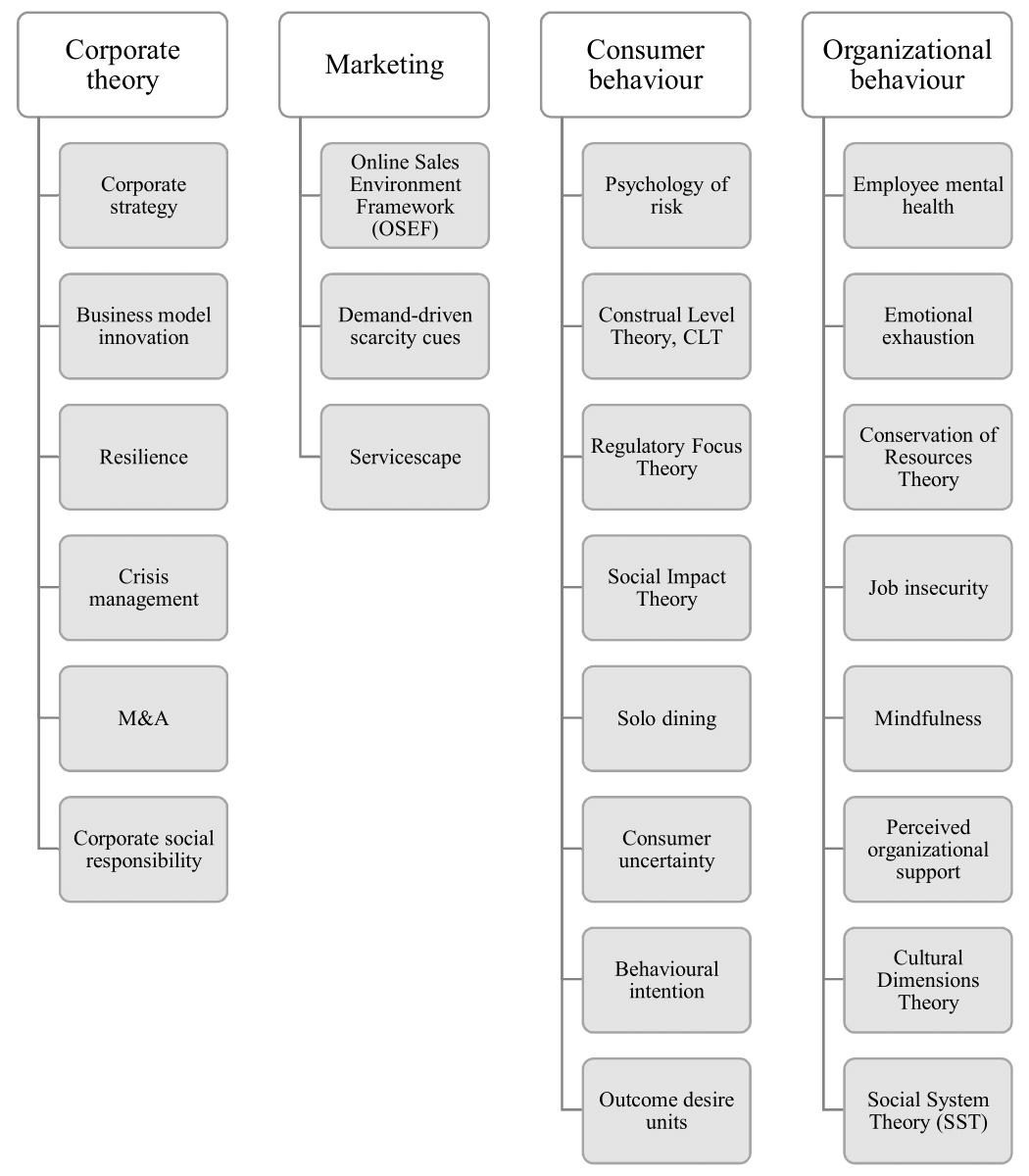
The result of 21 articles were based on their own empirical dataset. Twelve studies were conducted in the United States, Europe was represented by Austrian, Portuguese, English, and Turkish samples, and three studies were conducted in Taipei, Macao, and Egypt. Among non-empirical studies nationwide description (Brazil), meta-analysis and text analysis can be found. Most of the studies included in the systematic review rely on different scientific paradigms or theoretical frameworks, which are summarized in Figure 1.
Figure 1: Hierarchy of paradigms and theoretical approaches
Source: own edition
Among the representatives of company theory, SONG et al. (2021) examined what corporate strategies in the United States proved to be more effective in the Covid crisis. It turned out that the epidemic had a weaker impact on stock returns if the restaurant companies had been larger, leveraged and had more liquid funds. The internationalization of restaurant firms and the higher return on assets (ROA) also mitigated the impact of Covid shock on capital market, but franchising had no significant effect. MUN et al. (2021) also examined restaurant companies in the United States in terms of merger and acquisition strategies (M&A). The relevance of acquisition strategies as a framework is confirmed by the expected wave of acquisitions that are likely to follow the pandemic. The pre-M&A profitability of the acquiring restaurant company has a greater impact on its post-M&A profitability than its pre-merger sales growth. OU et al. (2021) argued for possible co-evolutionary processes in restaurants during Covid crisis management. They pointed out that while restaurant strategies focused primarily on service delivery, guest satisfaction, and revenue generation, there were also CSR considerations, for example, maintaining good physical and mental health of employees. There is a definite shift in the food service sector towards charity, philanthropy, for instance, offering and ordering food to health workers, or bringing together local communities to help those in need. Large restaurant companies are introducing initiatives, scholarships, and trainings to strengthen the next generation of experts (back to farmers) and to make the food industry more sustainable. A study by MADEIRA et al. (2020) fits into the theoretical framework of crisis management. They discovered how restaurant owners and managers see the survival potential of hospitality in Portugal. Market participants were grouped as pessimistic, resilient, uncertain, and opportunistic, while their key expectations were the financing of fixed operating costs, job retention programs, zero-interest business loans, cutting bureaucracy and taxes.
BREWER and SEBBY (2021) demonstrated that visual aesthetics of food, food information, convenient food ordering, and Covid risk perceived by customers reinforce the desire to order. This topic fits into the theoretical framework of the online sales environment (OSEF). OSEF is one of the extended stimulus-organ-response (S-O-R) models. During online sales, the quality of the shopping surface is a stimulus for consumers, influencing their decisions. In the spring of 2020, panic-like accumulation of household FMCGs was experienced in all countries, in-store and online shops as well. The phenomenon is explained by the theory of demand-driven scarcity cues, which was studied in hospitality by LI et al. (2021). Demand-driven scarcity cues is when the buyer perceives that the demand for a given product or service has increased dramatically. Scarcity cues can increase or decrease customers’ willingness to buy. LI et al. (2021) demonstrated during Covid constraints that the perception of scarcity cues due to increased demand reduces the intention and preference to buy the service, which can be explained by a lower sense of security. The negative effect is attenuated if the place of consumption is less crowded or if more information is available on the conditions of consumption. TAYLOR (2020) demonstrated that restaurant diners are more willing to separate tables with a screen instead of placing mannequins on chairs to keep distance. Over the age of 40 people are strictly demanding distance when eating out. Precautions to reduce health risk are also reflected in guests’ outcome desire units.
CHOI and co-authors (2020) investigated the phenomena of solo dining, which closely relates to service image and restaurant attributes. In authentic Chinese restaurants, dining alone is paired with positive emotions. According to their results, consumers’ freedom of choice and satisfying hunger are the strongest motivations, while the venues of solo dining are usually fast food restaurants. Solo dining habit is significantly influenced by lifestyle, occupation, and age. Perceived health risk can heavily affect consumer behaviour. Based on large-sample research BYRD et al. (2021) found that there is a moderate fear of food packaging. Respondents consider food to be the primary risk factor for restaurant consumption and consider food delivery by a third party to be risky. KIM and LEE (2021) examined the influence of other guest presence and demonstrated that perceived coronavirus risk increases the intention to avoid other guests and that private dining room and private tables may be a solution to reduce perceived risk. Risk can fit into Constructive Level Theory (CLT), which means that individuals think differently about a particular action if they are personally involved in it, or just observers. CAI and LEUNG (2020) examined the relationship between constructive thinking and risk perception in the context of online food ordering. They showed that self-efficacy mediates between constructive thinking and willingness to order food. If the buyer considers buying is a risky action, it has a significant moderating effect on food ordering. KIM et al. (2021) examined the operation of restaurants under Covid constraints within the scope of customer uncertainty. Customer uncertainty means that in decision-making situation the consumer gathers as much specific information as possible in order to reduce uncertainty and predict the outcome of the decision. It has been proofed that quality signs, symbols or even a brand can significantly reduce uncertainty and may even be more important to customers than price discounts. This is because when choosing food, customers are looking for the benefit attenuating their safety concerns.
According to WORLD HEALTH ORGANIZATION (2004), mental health refers to the individuals’ state of well-being in which an individual can realize himself or herself to be able to cope with general stressful situations in life and contribute productively and effectively to community performance. BUFQUIN et al. (2021) examined the correlations of variables such as the nature of employment, psychological well-being, distress, alcohol and drug use and the career turnover intention. Their results show that distress increases alcohol and drug use as well as career turnover intention. There is a significant difference between working and long-term leave employees regarding anxiety and substance use. The employees working under Covid restrictions showed greater anxiety and increased substance use compared to those on long-term leave. The difference can be explained by the fact that the research was conducted in the United States, where significant compensation was given to those who lost their job or were on long-term leave, while workers were exposed to increased work-related stress due to health risks. CHEN and EYOUN (2021) found that the fear of Covid in case of frontline restaurant employees is positively related to emotional exhaustion and feelings of job insecurity in the United States. Job insecurity – the fear of losing a job – mediates between fear of the Covid and emotional exhaustion. Positive organizational support (POS) moderates the positive relationship between job insecurity and restaurant frontline employees’ emotional exhaustion. The relationship weakens for employees who perceive higher level of POS than employees who perceive lower levels of POS. SHAPOVAL et al. (2021) examined the impact of Covid on hospitality by interviewing managers and owners within the framework of social systems theory (SST). According to the SST, the subgroups at individual and community levels interact with each other, and every subgroup influences another and vice versa. Answers of respondents reflected compassion and empathy towards colleagues. On the other hand, strong relationships with family and friends; and less material and performance-oriented values prevailed in the answers. However, there is negative impact of pandemic on hospitality as a career model, as it has become questionable whether is it worthwhile to develop and invest in this sector.
4. Theoretical foundations for an own research framework
Based on the systematic literature review we can identify the paradigm through which the effect of coronavirus on hospitality in Hungary can be examined in accordance with the expectations of qualified journals. At first read consumer paradigms seem to be obvious, but there are several concerns. Home delivery and takeaway sales analysis requires robust and expensive Big Data research (see LI et al. 2021), moreover the relevance of this topic lowered due to the re-opening of restaurants. In addition, the relevance of the empirical study of risk and consumer uncertainty has been strongly questioned also, because after the reopening (24 April 2021) diners do not seem to fear infection. It would also be important to examine the impact of Covid on organizational behaviour, but research findings would easily be biased by survival strategies due to constraints, frustration and career turnover intention among workers, moreover the financial support of restaurant industry was one of the lowest in Hungary in international comparison. Therefore, we decided to choose corporate strategies subgroup, especially resilience. The resistance and recovery capability of hospitality businesses are the central elements of our conceptual framework (O2).
4.1. Resilience in hospitality
According to the NATIONAL RESEARCH COUNCIL (2012), resilience is preparing for, and adapting to adverse events, nevertheless the recovery from crisis. There is no doubt that the Covid is an undesirable, unforeseen event. According to DE FREITAS and STEDEFELDT (2020), from the shock of Covid restrictions hospitality companies should recover by developing their resilience through the simultaneous restoration of four domains – physical, informational, cognitive and community (LINKOV ¬ TRUMP 2019). Physical domain includes service infrastructure; informational domain refers to the dataset that helps and influences diners’ decisions; cognitive domain usually consists of perceptions, beliefs of the people affected by the service, understanding established norms and their practical application; community domain means the support and involvement of the community, which in recent pandemic situation also includes the reduction of health risks. They pointed out that resilience development is not possible without reviewing and re-evaluating past activities, and without remembering at all. Learning from the past and the current adverse events would be the basis for effective adaptation to future challenges.
SOBAIH et al. (2021) investigated the resilience of micro, small and medium tourism enterprises (hotels and traditional restaurants) in Egypt. Their conceptual framework was based on the relationship between planned and adaptive resilience, corporate performance and sustainable tourism development. Planned resilience is a pre-crisis strategy developed by the company, while adaptive resilience is the result of a crisis and usually requires good leadership, efficient networking, internal collaboration, staffing, and the ability to learn from experiences (LEE et al. 2013). SOBAIH et al. (2021) proved all of their propositions such as planned resilience of small hotel and restaurant businesses positively affect adaptive resilience, corporate performance, and sustainable tourism development.
PRAYAG et al. (2018) investigated tourism businesses in the Canterbury region of New Zealand (accommodation, passenger transport and operation of an attraction) where the adverse and tragic event was the 2011 earthquake. The impact of planned and adaptive resilience on financial performance was examined instead of corporate performance (SOBAIH et al. 2021) while the size and activity of firms were used as categorical variables. It has been demonstrated that the planned resilience has a positive effect on the development of adaptive resilience, but it has no effect on financial performance. Nevertheless, adaptive resilience has a positive effect on the company’s financial performance. Out of the two categorical variables, only the firm size had a significant influence on finances. As a conclusion, resilience is a strong predictor of a firm’s financial performance in a crisis.
5. Presentation of an own research framework work
Resilience is a promising and applicable approach to investigate hospitality business environment in Hungary. Future research results will be relevant for industry players and contribute to academic literature. Research design below can provide answers to the questions: How do companies evaluate their preparedness for crisis, and have they improved their resistance as a response? Have they learned from past crisis experiences? What domains guided their recovery processes? The subjects of our research framework are the enterprises of the commercial hospitality sector providing restaurant and mobile food service, event catering, and beverage service. Since O2 research framework targets qualified international journals, therefore the research design, the methodology of data collection and the applicable quantitative methods are strongly determined by the requirements of journals. The latter is a bottleneck for international dissemination opportunities. One of the most common data analysis methods for quantitative methodologies is confirmatory factor analysis, more specific various methods such as path analysis or covariance-based structural equation modelling (CB-SEM) and a variance-based (PLS-SEM) method, which basically determines the method of data collection. Confirmatory factor analysis is typically applicable only to a model identified by exploratory factor analysis based on a database recorded with a validated measurement scale. Validated measurement scales are very common in the management literature, but it has not yet been sufficiently exploited in tourism and hospitality research in Hungary. Besides methodological niche, a comparison of “current state” and “desired state” of businesses can also lead to novel results.
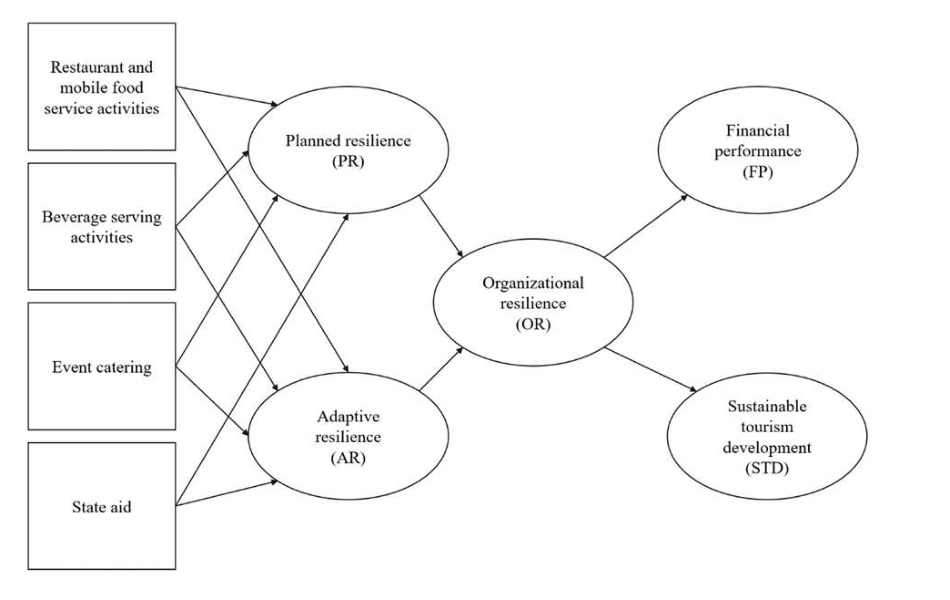
In data collection, we would use four validated scales at least, including planned resilience (PR), adaptive resilience (AR), financial performance (FP), and sustainable tourism development (STD). The relationships among factors, as well as the possible paths to be analysed in confirmatory factor analysis are shown in Figure 2. The figure shows four more variables that are categorical: the activity of catering enterprises and satisfaction with government aid. It is worth to explore whether there is a difference between diverse catering activities regarding financial performance, resistance and enterprises’ satisfaction. We would like to examine the influence of the construct above on sustainable tourism development. Based on the literature review, we consider that recovery from the crisis should be integrated with sustainable approaches. In Figure 2, there is an additional variable: organizational resilience (OR), which is the second-order construct of the model, made of the PR and AR factors.
Figure 2: A possible model for conceptual framework work
Source: own edition based on SOBAIH et al. (2021) and PRAYAG et al. (2018)
Micro and small enterprises from the three subsectors of hospitality are going to be involved in data collection. The number of hospitality SMEs and their performance in 2020 are summarized in Table 2. The number of enterprises and employees decreased in all three sectors, as did the annual net sales. The decrease is indicated by the percentages compared to the previous year. Market indicators demonstrate the crisis of restaurant hospitality.
Table 2: Market indicators for the sectors to be covered
| Business activity | Standard Industrial Classification | Number of enterprises (May 2021) | Number of employees (May 2021) | Yearly net revenue (2020) |
| Restaurant and mobile food service activities | 5610 | 15,240 -2.5% | 73,692 capita -22.4% | 582,240 million HUF -31.3% |
| Event catering | 5621 | 221 -0.9% | 841 capita -26.5% | 6,251 million HUF -50.2% |
| Beverage serving activities | 5630 | 3,445 -5.6% | 6,202 capita -26.5% | 43,007 million HUF -42.1% |
Source: NEMZETI CÉGTÁR
6. Summary and discussion
The study met the objectives O1 and O2. According to O1, the relationship between restaurant industry and Covid is dominated by theoretical approaches such as corporate theory, marketing, consumer, and organizational behaviour. Before doing any research, the researcher needs to make sure that the most appropriate scientific paradigm is selected to investigate a market. If the theoretical approach is given, there are two aspects to consider. One is the perishability of the topic: in a crisis, most of the phenomena can easily disappear or lose their relevance. The other is the methodology of the research, which is a strict quality constraint in international publication environment. Qualified journals are typically open to multistage multivariate data analysis methods or alternative, nonconventional research methods. Conducting validated measurement scales, an empirical research based on O2 framework would result in adequate findings for qualified journals and for managerial consequences. A resilience study would provide answers to practical questions: will hospitality be prepared for future crises; have industry players integrated Covid experiences in their recovery; and does sustainability play any role in future development?
References
BREWER, P. – SEBBY, A. G. (2021): The effect of online restaurant menus on consumers’ purchase intentions during the COVID-19 pandemic. International Journal of Hospitality Management. 94 (April)
BUFQUIN, D. – PARK, J. Y. – BACK, R. M. – DE SOUZA MEIRA, J. V. – HIGHT, S. K. (2021): Employee work status, mental health, substance use, and career turnover intentions: An examination of restaurant employees during COVID-19. International Journal of Hospitality Management. 93 (February)
BYRD, K. – HER, E. S. – FAN, A. – ALMANZA, B. – LIU, Y. – LEITCH, S. (2021): Restaurants and COVID-19: What are consumers’ risk perceptions about restaurant food and its packaging during the pandemic? International Journal of Hospitality Management. 94 (April)
CAI, R. – LEUNG, X. Y. (2020): Mindset matters in purchasing online food deliveries during the pandemic: The application of construal level and regulatory focus theories. International Journal of Hospitality Management. 91 (October)
CHEN, H. – EYOUN, K. (2021): Do mindfulness and perceived organizational support work? Fear of COVID-19 on restaurant frontline employees’ job insecurity and emotional exhaustion. International Journal of Hospitality Management. 94 (April)
CHOI, S. – YANG, E. C. L. – TABARI, S. (2020): Solo dining in Chinese restaurants: A mixed-method study in Macao. International Journal of Hospitality Management. 90 (September)
DE FREITAS, R. S. G. – STEDEFELDT, E. (2020): COVID-19 pandemic underlines the need to build resilience in commercial restaurants’ food safety. Food Research International. 136. (October)
HINEK, M. (2020): A turizmus közvetlen hozzájárulása a magyar gazdaság teljesítményéhez: a Turizmus Szatellit Számlák fejlesztésének alternatívái. Turizmus Bulletin. 20. pp. 45-52.
KIM, J. – KIM, J. – WANG, Y. (2021): Uncertainty risks and strategic reaction of restaurant firms amid COVID-19: Evidence from China. International Journal of Hospitality Management. 92 (January)
KIM, J. – LEE, J. C. (2020): Effects of COVID-19 on preferences for private dining facilities in restaurants. Journal of Hospitality and Tourism Management. 45 (December) pp. 67–70.
KÖZPONTI STATISZTIKAI HIVATAL (2021): A vendéglátóhelyek forgalma és volumene. https://www.ksh.hu/docs/hun/xstadat/xstadat_evkozi/e_oga016.html (accessed 19 May 2021)
LEE, A. V. – VARGO, J. – SEVILLE, E. (2013): Developing a tool to measure and compare organizations’ resilience. Natural Hazards Review. 14 (1) pp. 29–41.
LI, Y. – YAO, J. – CHEN, J. (2021): The negative effect of scarcity cues on consumer purchase decisions in the hospitality industry during the COVID-19 pandemic. International Journal of Hospitality Management. 94. (April)
LINKOV, I. – TRUMP, B. D. (2019): The science and practice of resilience. Springer. pp. 9-34.
MADEIRA, A. – PALRÃO, T. – MENDES, A. S. (2021): The impact of pandemic crisis on the restaurant business. Sustainability. 13 (1) pp. 1–13.
MUN, S. G. – KOH, Y. – JANG, S. C. (2021): Which Type of M&A Makes an Acquiring Restaurant Firm a Star? Profit-Driven Versus Growth-Driven M&A. Cornell Hospitality Quarterly.
NATIONAL RESEARCH COUNCIL (2012): Disaster Resilience: A National Imperative. The National Academies Press, Washington, DC. https://www.nap.edu/catalog/13457/disaster-resilience-a-national-imperative (accessed 19 May 2021)
NEMZETI CÉGTÁR: Interaktív grafikon https://nemzeticegtar.hu/interaktiv-grafikon (accessed 19 May 2021)
OU, J. – WONG, I. K. A. – HUANG, G. Q. I. (2021): The coevolutionary process of restaurant CSR in the time of mega disruption. International Journal of Hospitality Management. 92 (January)
PRAYAG, G. – CHOWDHURY, M. – SPECTOR, S. – ORCHISTON, C. (2018): Organizational resilience and financial performance. Annals of Tourism Research. 73. pp. 193–196.
SHAPOVAL, V. – HÄGGLUND, P. – PIZAM, A. – ABRAHAM, V. – CARLBÄCK, M. –SOBAIH, A. E. E. – ELSHAER, I. – HASANEIN, A. M. – ABDELAZIZ, A. S. (2021): Responses to COVID-19: The role of performance in the relationship between small hospitality enterprises’ resilience and sustainable tourism development. International Journal of Hospitality Management. 94 (April)
SONG, H. J. – YEON, J. – LEE, S. (2021): Impact of the COVID-19 pandemic: Evidence from the U.S. restaurant industry. International Journal of Hospitality Management. 92 (January)
STATISTA (2020a): Global tourism industry – statistics & facts https://www.statista.com/topics/962/global-tourism/#dossierSummary (accessed 19 May 2021)
STATISTA (2020b): Leisure tourism spending worldwide from 2000 to 2020. https://www.statista.com/statistics/1093335/leisure-travel-spending-worldwide/ (accessed 19 May 2021)
STATISTA (2020c): Business tourism spending worldwide from 2000 to 2020. https://www.statista.com/statistics/1093295/business-travel-spending-worldwide/ (accessed 19 May 2021)
TAYLOR, S. (2020). The socially distant servicescape: An investigation of consumer preference’s during the re-opening phase. International Journal of Hospitality Management. 91 (October)
WORLD HEALTH ORGANIZATION (2004): Promoting Mental Health https://www.who.int/mental_health/evidence/en/promoting_mhh.pdf (accessed 19 May 2021)
Kiemelt kép forrása: <a href=”https://www.freepik.com/photos/food”>Food photo created by master1305 – www.freepik.com</a>